Tag Archive for Jigsaw Jones

Fan Mail Wednesday #99 (Friday Edition)

Wow, I am so busy I can’t believe it. I am still revising my new YA, going on school visits, brainstorming-slash-scribbling a first draft for a new MG novel (so excited about this one!), planning Skype visits, and, yes, reading and trying to answer fan mail. Very, very time-consuming.

I’ve also been slogging along with my new blog project, Fathers Read. I’ve been getting some fabulous, wonderful, incredible photos and now have a pretty impressive array. While I’m eager to get this new blog up and running, some minor technical difficulties have slowed me down. I’m shooting for early December.

In the meantime, check out this spectacular letter from a third-grader named Kate:

Dear James Preller,

I am a big fan of your Jigsaw Jones books. I even asked my friend if she wanted to be detectives in the color code at first she did not know what a color code was but then I told her what it is. My favorite Jigsaw Jones book is The Case of the Class Clown! I have probably read more than ten jigsaw jones books. Because the jigsaw jones books are so cool and when I read them it feels like I am in the book just watching it all. And because the words that you use are so clear that they paint very clear and very nice pictures in my head. I have a question where do you get all you ideas from? Did you ever want to be a detective when you were little or did someone else in your family want to? Please write back.

Your fan,

Kate

I replied:

Thanks for that beautiful note. I began to melt when you described how the words “paint very clear and very nice pictures” in your head. You have a gift for words, Kate. Keep on writing.

I think all good writers dream of achieving something like that, where the reader can see the story, like a movie playing inside your head. And we do that, I think, by writing clearly and directly and by using specific details. When we “show, don’t tell.” It’s something I work at very hard, though I don’t pretend to be some amazing, fantastic writer. I learn something new every day and try my best, always.

Hey, did you know that Class Clown is now a touring musical? With songs and everything! How crazy is that?! I don’t know where you live, but if you go here you can find out the current tour schedule.

My ideas come from a run-down, ramshackle store in Rutherford, New Jersey. Twice a year I travel by emu to . . .

No, not really.

Much of my writing springs from my life and my family experiences. I grew up the youngest of seven children, and now I have three children of my own. You know, it’s funny. I once imagined that writers had these amazing lives, full of adventure and exotic places. But I’ve learned that the real adventure is what goes on inside your head, and in the rumblings of your heart, and that we can write about the most ordinary details and somehow connect with thousands and thousands of readers.

And, okay, sure — sometimes I just MAKE THINGS UP!

I’m glad you liked the color code. What’s great about that code is that it’s so easy to invent new codes based on the same idea. Here’s a “clothes code” (just invented on the spot):

lazy frog socks your scarf email

photo pages silly underwear message black

pants made bag pizza puzzle troop

bird hat me underwater elbow mittens

super slim burp shirt happy bling!

I was never a detective like Jigsaw, though I spied on my brothers quite often and became very good at snooping around for presents during the holidays.

By the time Christmas came, I had usually discovered each of my presents — hidden in closets and under beds — and that always make the actual Christmas Day a little bit of a disappointment. I already knew what I was going to get!

My best,

JP

P.S. Kate, you might be curious to see a video I made, where I answered a different piece of fan mail. Nice sweater, don’t you think?

Fan Mail Wednesday #98 (The Video Edition!)

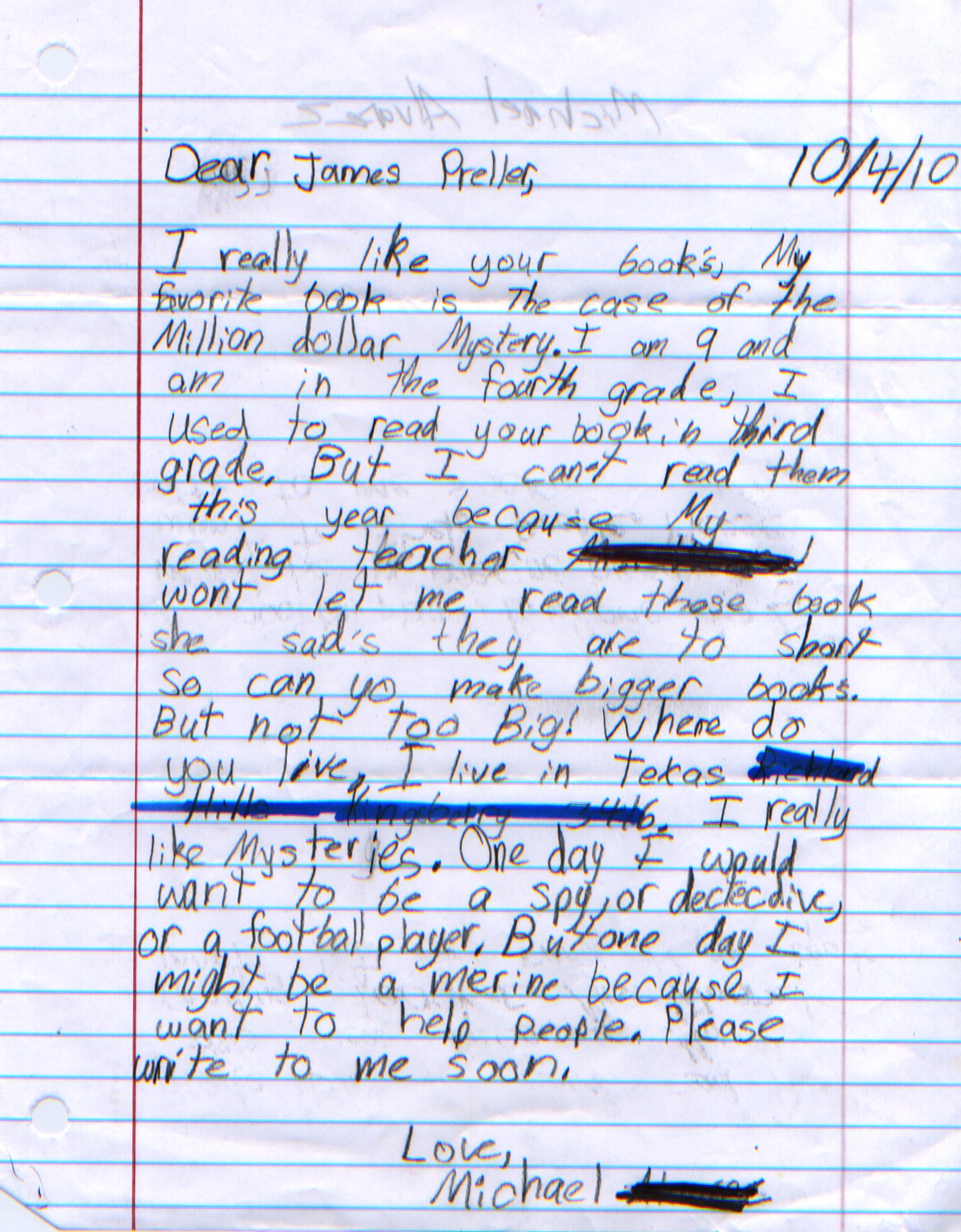
Here at Jamespreller.com, we’re all about the latest in breakthrough technology. Actually, it was first suggested at least a year ago by my friend Paul, and I replied, “I’ll get right on it!” So I overcame my fears and, with the help of my 11-year-old son, posted my first Youtube video in response to the letter below.

What do you think? Are you purists aghast? Or merely agog? Is this something I should try again . . . or perhaps nevermore?

Please click on the video below to see my awkward, stumbling response. Experts in the business sometimes say that the camera loves certain celebrities.

Personally, I’m not feeling it.

Anyway, I don’t mean for the medium to overwhelm the content of Michael’s letter. I wasn’t sure how to reply to news of a reading teacher who prevented a boy from reading the books he clearly seems to enjoy. It’s not about me. But I do feel that when a young student expresses enthusiasm for a certain book or series of books, when he shows interest and motivation, that’s not something you want to suppress. Have at it, I say. At the same time, I’ve only heard one side of the story.

You need to a flashplayer enabled browser to view this YouTube video

Building Character

There are a million ways to create a well-rounded character, and all of them crystallize with concrete details. Today I’d like to share one small example.

I was reading an interview with a young actress, Elisabeth Moss, and a couple of times she described things as “super-[fill in the blank]!”

You know: “I was super, super, super-happy” and “she’s still super-young.”

That appealed to me as a writer, for a number of reasons. It’s a youthful, energetic, and distinctive way of speaking. I immediately imagined a female character who uses that phrasing in her dialogue. Since I’m currently revising a book, I’ll look at giving that vocabulary to a character (and only one character). I may discover that it works,  or find that it’s unnecessary or even excessive. We never wish to gild the lily. In which case I’ll file it away — read: hope to remember it — for another day.

The point is, I do seek out particular phrases or speech patterns for different characters. Charlie Brown says, “Good grief.” Jigsaw Jones says, “Oh brother,” “Go figure,” and “Yeesh.” Another character might say “like” a lot or utter something like, “Am I right or am I wrong?” As a writer, you try to find those singular ways of speaking, anything to help individualize a character. Then you look at clothes, or mannerisms — the way Mila Yeh pulls on her long black hair, or another character scratches behind his knees — and those specific details build character.

So thank you, Elisabeth Moss. You were super-helpful!

Absent Parents in Children’s Literature

A friend of mine, author David Klein — whose debut novel, Stash, is due out later this month — alerted me to a recent interweb discussion about absentee parents in children’s literature.

Literary agent Nathan Bransford summarized the debate here, while making some solid, sensible points. Here’s one quick snip:

Another major factor in YA and MG literature is allowing the characters to fight their own battles. It’s a very common theme in YA for parents to be absent, abusive, oblivious, or otherwise useless. There’s actually a reason for this, other than the obvious ready-made angst factor. You see, for a story to truly be centered around an underage MC, they have to do everything themselves. Parents, guardians, and other adults can’t do it for them.

Of course, this is an old narrative device, wildly popularized (and trivially conventionalized) by the folks at Disney (Bambi, Simba, I’m looking at you). Seriously, the list of dead or missing parents in Disney films is long and almost comical in its predictability.

Note: This screen shot was filed under the caption,

“Awesome Moms,” so of course she had to go.

The role of parents is often a thorny issue in children’s books, for some of the reasons explained above. But as a devoted parent, I have mixed feelings. I understand the narrative expediency of eliminating parents, or making them appear incompetent, but at the same time I kind of hate it in books when every adult is a complete, useless waste of oxygen. I guess I’m much more offended by one-dimensional characters than the idea of absentee parents.

Personally, I tend to write sympathetically about parents in my books. The trick is to keep the story child-centered. Because, likewise, I also loathe it when a perfect adult prances into the story and solves the problem for the child.

In Bystander, my recent book about middle school bullying, I created an absent father and it served as an important fact in my main character’s life. A source of vulnerability, the limp in his walk. At the same time, Eric’s mother is outstanding. She does a lot of things right as a parent of a child who is bullied. For example, even though her role in the book is limited, Ms. Hayes has thoughtful family policies about computer and cell phone use, she advocates aggressively for her child with the school once she perceives a problem, she makes an effort to spent alone time with him and, basically, she tunes in. I like her and wanted to model how a good, caring mother might act under those circumstances, since I think that’s the most likely scenario. The adults in the school are also shown in a positive light.

Even so, the conflict and the drama remain with the boy, Eric Hayes, in his own world (mostly) away from home. Mom isn’t the answer, but she does provide a foundation of support.

In Six Innings, I’m pretty sure all the adults portrayed are sympathetic and realistic, though Mike Tyree’s parents are distracted by his sister’s athletic success. They don’t quite give Mike the attention he needs. When I started the book, a few people asked me, essentially, “Are you going to write about how the Little League parents and coaches are so awful and over-the-top?”

My answer, “No, not this time.”

In my experience, the coaches — while flawed and sometimes too focused on their own child — are good, decent parents who volunteer an incredible amount of time and energy to the benefit of many children in the community. These aren’t horrible people. And overwhelmingly, the parents in the stands are good folks, too. Hopelessly biased, a little irrational at times, emotionally invested, caring. What I respect most is they are . . . there. They show up, and if you ask me, that’s 95% of parenting: showing up, day after day.

Quantity time, not quality time.

Art: rough cover sketch by R.W. Alley,

where Jigsaw literally finds a skeleton

in the closet.

Lastly, since I’m on this topic, I’ve written almost 40 Jigsaw Jones mystery books. His parents are amazing, loving, funny, intelligent, present in every way. It’s a great family. Mila Yeh has a stepmother — and guess what? She loves Mila just as much as a birth mother. Part of that was inspired as a reaction against the negative cliches that are prevalent about stepmothers, but also by my own wife, Lisa, who is an incredible mother and stepmother.

Still: The stories are about Jigsaw, his adventures and struggles in his boyhood world, and that’s where the conflict takes place. So from my point of view, I think you can represent strong, capable, caring parents in children’s literature and still keep the story kid-centered and child-resolved.

An April Fools Classic: Writing the Memory

I’m not a prankster, merry or otherwise, so April Fools Day isn’t a big day here at Chez Preller. But as a kid, we had one surefire trick that worked every time. It was fast, easy, and painless (illustrations by Jamie Smith).

I wrote about it in the “currently unavailable” Jigsaw Jones #22: The Case of the Perfect Prank. (Yes, it kills me to type that.)

To set the scene, Jigsaw wakes up to screams. He finds his mother at the kitchen sink, soaking wet. We’ll let Jigsaw take it from here:

The trick was an oldie but a goodie. At our house, we have one of those sinks with a spray nozzle. You squeeze it, and water comes out of the nozzle instead of the faucet. The trick is to tie a rubber band around the nozzle. Then you aim the nozzle outward. Daniel and Nick must have done it last night, when they were giggling in the kitchen. Come morning, my mom went into the kitchen to make her “necessary” pot of coffee. She turned on the water and . . . splash, the spray hit her!

It works every time.

Kids ask me all the time, “Where do you get your ideas?”

Sometimes it’s as easy as recording a memory . . . and giving it to someone else, a shift from memoir to fiction that makes all the difference. And of course, Jigsaw’s perspective was my life perspective as the youngest in a family of seven children. Sometimes you’re in the middle of the action. Other times, you’re the forgotten observer, witness to all the goings-on. They didn’t realize I’d write about it 30 years later. Neither did I.

I think the trick for teachers — and this is so hard — is to get kids to value the everyday life that surrounds them. All that “slice of life” stuff. Ideas aren’t some magical golden drops from the gods. And if writing has given me anything (and it has), it’s been reflection, looking back, holding on to something valuable amidst the blur and whoosh and accelerated push of life. Maybe I’m just old. But those memories mean more and more as each year passes.

Now if you’ll excuse me, I have to go find a rubber band.