Tag Archive for best books on bullying

Fan Mail Wednesday #125 (further thoughts on bullying)

As part of a late summer assignment, I received a terrific letter from Zander in Brooklyn, including his answer to the question, “What will happen to the characters in Bystander after the story?

Here’s an excerpt from that letter . . .

Thanks so much for answering my questions. I really loved your book! I did a little writing about what I thought might happen to some of the characters in the future. I was wondering if you have ever thought about this? Do you think Griffin will continue to be a bully? What about the other characters? I also have to ask the obvious question — were you a bully or where you bullied in school? If not, why did you want to write this book? I’m really looking forward to your answers.

Zander

What I think will happen to the characters after the story:

I think Griffin will still be the bully, but he will be a lone bully with no clique by his side. About twenty pages before the book ended, Griffin’s gang separated from him; they were fed up with Griffin and his ways and felt bad for the people they hurt and picked on. Griffin may form a new clique, but I think the same thing will happen that happened to the original click, they will get fed up with Griffin’s ways. Eventually, Griffin will probably find out that this whole bully thing isn’t working out for him and turn over a new leaf, but I’m not so sure about that either; it’s not exactly Griffin’s way. The other problem is the relationship between Griffin and Griffin’s father. If the way Griffin’s father acts changes, Griffin will change with him. You see, Griffin mimics his father’s actions, and if those actions change, I have a good feeling that a new Griffin will be born. If they would go into therapy, this could be achieved. But since that didn’t happen in the story, it’s unlikely that it will happen now. Thus having Griffin stay the same.

I also think that Mary and Eric will still hang out a lot, they might be considered boyfriend and girlfriend, but I’m not sure. I also think that Griffin’s original clique will turn into Eric’s clique, or Griffin’s original clique will accept Eric as a member; either way, Mary will no longer be Eric’s only friend. Before I finished the story, I thought to myself that it would not be a “…and they all lived happily ever after” ending, and I was right. If the story continued on, I still think this would be true, but it would be a cheerier ending than it is now.
Part of my reply . . .

Hey Zander,

Thanks for reading my book. I like the angle you took on it, thinking about what might happen to the characters after the story is finished and the final pages read.

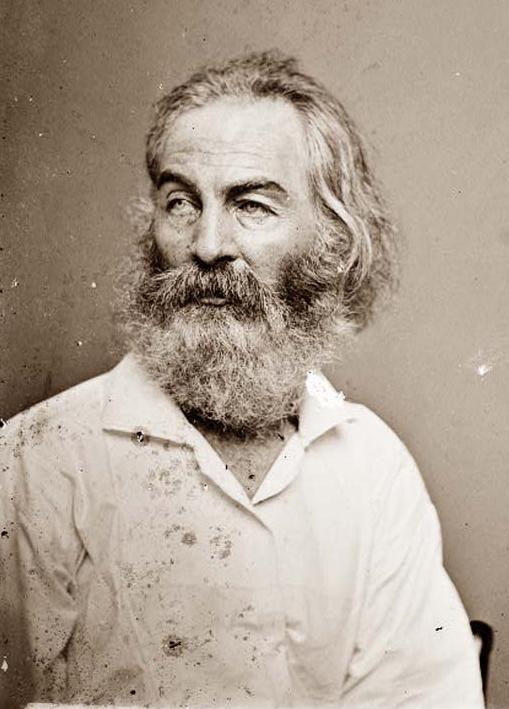
No, I was not a “bully” in school. But to be honest, that’s a big label and not something I like to stick on anybody. It’s not often accurate to tag people with easy labels. I believe there are bully behaviors, there are times when some of us might act in unkind ways, but that’s rarely ever the sum of the whole person. A so-called bully might also be a loyal friend, a good teammate, a loving pet owner, an adventurer, a son, a comic, a student, an athlete, and, yes, even victim. Research shows there’s often a duality. Someone engaged in bullying might be a victim of it in another part of his life (Griffin), while a target of bullying will frequently turn around to bully someone else (David). It’s a common dynamic. The bully part is just one aspect of character, something he sometimes does, not the whole person. And in that way, I think we all have a bit of a bully, and victim, inside us. Walt Whitman wrote, “I am large; I contain multitudes.”

I’m not saying that bullying isn’t real. That there isn’t genuine hurt and, sometimes, devastating loss. We’ve all heard those tragic stories and I don’t diminish that pain for a second. But I think with that label we tend to turn every “bully” into a monster, and I suspect it’s subtler than that. Often the bully — or more accurately, the person engaged in bully behavior — is misguided, unknowing, doesn’t empathize fully, doesn’t really understand the effects of his behavior. I’m not ready to throw all bullies into the dungeon and throw away the key. I think most of us are good, decent people capable of making mistakes, poor decisions.

My primary reason for writing Bystander is that I wanted to tell a good story. I write realistic fiction, and I try very hard to be true to that word, “realistic.” I want my characters and situations to feel authentic, relatable. I want readers to identify with the story, to maybe see themselves, or someone they might know. Robert McKee, in his book Story, makes a strong case for the importance of “story” in our lives. We are surrounded by stories, and seem to hunger for them: movies, television, talk on park benches, at dinner tables, around fires, on stages and in books. McKee calls stories our “equipment for living,” and makes the bold claim: “A culture cannot evolve without honest, powerful storytelling.”

Wow. What do you think of that, Zander? Story is the fiction writer’s craft, a finer tool than a how-to book, or a nonfiction guide to a problem. Story doesn’t provide answers so much as it, hopefully, clarifies some of the questions. Not facts, but truths. And always the most important question is this: How to walk this earth? What kind of person are you going to be?

Well-told stories, as Harper Lee so beautifully demonstrated in To Kill A Mockingbird, allow us to walk in someone else’s shoes. If you haven’t seen the movie, I urge you to check it out. There’s a beautiful scene at the end of the book (and movie), when Scout walks Boo Radley home, climbs up the steps to his porch, and for a moment turns and looks at the world from his perspective.

That’s story.

It’s also called empathy, understanding, compassion. McKee’s “equipment for living.”

I first landed on the theme of bullying through conversations with my editor. I did research, read books, talked to experts, visited middle schools, and I gradually began to formulate the character of Griffin Connelly. The story grew out of that, until I became convinced that the focus had to be on the bystander, the silent observer.

From the beginning, I felt that Griffin was a boy on the wrong path. Obviously there are issues at home with his father. The mother is gone somewhere, his sisters have moved away, too. We know that Griffin has been stealing, and we know that the police suspect his involvement. Unless there’s some kind of dramatic change, I don’t see things ending well for Griffin Connelly.

I thought your analysis of the characters was insightful. I agreed with all of it. No, I did not write a happily-ever-after ending. But I’ve never been a guy who needs those kinds of endings in movies or books. I bristle when everything is all tied up in a tidy bow at the end.

To me, that’s not life. That’s not realistic. Real life is messier than that, and not so simple, and I wanted my book to reflect that.

Thank you for your thoughtful response to my book.

JP
Fan Mail Wednesday #122 (Bystander Sequel)

Bryan writes:

Can you please make a second book for "Bystander"? I loved the book and wanted
to see more about eric and mary, griffin etc. It would probably sell. Thanks for
considering. 
I replied:
Bryan,
Thanks for your note. It’s funny, I get asked that question a lot. I recently learned that in 2011, there were more movie sequels than at any point in history. It’s just expected that if you liked a movie, they’d soon churn out another with the number “2” after it. It’s natural for young people today to expect a sequel.
It was different for my generation when sequels were the rare exception (I’m fifty, btw, but I feel forty-seven). The idealist in me tends to view sequels as these very cynical, marketing-based decisions. A crass bunch of fat cats sit around a big table, crunch the numbers, and proclaim, “Hey, we made a ton of money on this first movie. Let’s make another!” Same thing with books.
It simply doesn’t strike me as a pure artistic effort. Most of the time, anyway.
When I wrote Bystander, I buried myself in research about bullying. I came away convinced that I could write 100 different books on the topic, all from different perspectives. The ground was so fertile, there was so much to explore. But at the same time, I felt satisfied with my work. Bystander didn’t feel unfinished, and I didn’t have anything else that I was aching to say about these particular characters.
Moreover, today I also feel strongly that — wait — did you say, “It would probably sell“?
Ca-Ching!
Let me call my agent.
JP
P.S. Seriously, though I never intended to write a sequel, I take your request to heart. When I think about it, there are two characters I could imagine exploring in more detail. Mary, since she was only a minor character in the book, and her experiences with cyberbullying seem particularly relevant today; and Griffin, because even I am curious about what happens to him. It might be fun to write a book that centers on the bully. The bad guy who might have some unexpected depths of his own. Hmmm.

Fan Mail Wednesday #121 (re: Teaching “Bystander,” and Some Thoughts on Bullying)

I’ve been in summer mode, the quiet season for teachers and librarians, and taking a break from my weekly Fan Mail Wednesday posts. But here’s a happy letter that might be useful to some of you out there, edited ever-so-slightly for privacy . . .

Hello, Mr. Preller.  I am a Library Media Specialist in Virginia.  Your book is on the Virginia Reader’s Choice Awards list and is a Battle of the Books selection. Because of that, I read it last spring.  I loved it so much I convinced my principal to buy 1200 copies for a One School, One Book unit.  She just authorized the purchase of books and has put me in charge of writing a unit for the whole school.  As a former English teacher I have written many novel study units, but this time it is for the WHOLE school.  To say I am overwhelmed is an understatement.  Any suggestions from you will be greatly appreciated.
Again, thanks for writing this wonderful novel which accurately portrays middle schoolers and the seriousness of bullying.
P.

I replied . . .

Dear P,

I am always floored when I hear something like this, it’s such an honor. I appreciate your support for the book and, I’m sure, your commitment to the greater causes of bullying and social responsibility in your school community.

I confess that while it is great news to learn that my book will find its way into the hands of readers, there’s a nagging part of me that worries about assigned reading. I know, I know. Even if you believe in the importance of self-selected reading, as I do, there’s no getting around the value of assigned books and shared reading experiences. Still, it’s disconcerting to see that I’ve become what I once hated most — homework.

That said, let me see if I can help you a little bit. Be warned, I’m not a teacher and I don’t play one on television.

One of the most important ideas embedded in this book — an idea I learned along the way, and came to understand better only upon reflection — also happens to be nearly-impossible to convey to middle school students. It might even be advisable to not even try. But it’s worth saying to you, here. Research shows that bullying peaks at middle school. Why is that?

Well, for starters, let’s agree that one of the most difficult achievements in life is to become, simply, yourself. It seems easy, but it is not. To be content in your own skin. To not look at others for all your cues. To accept and trust who you are, following your own inner compass. And at no time in life is this tougher than in middle school, when peers begin to replace parents as prime influencers. How to dress, what to talk about, what to listen to or watch on television, how to act, where to sit, who to speak with, who to avoid. This is how we forge an identity, an awareness of self — and all of these details are determined, to varying degrees, by the pack.

These kids care so much about what their peers think, and yet part of becoming a true individual is casting off those concerns. It’s a challenge for ANYBODY to stand up against the crowd. For a middle schooler, it’s nearly impossible. On a deep level, in terms of self-identity, they are the crowd. Generally speaking, the individual is almost indistinct from the amorphous mob, as if swallowed by a great whale. They are only gradually becoming aware of, at ages 12-14, who they are. The group, the social context, provides the first hints toward that great journey to self-discovery. You see where you fit, where you don’t. You watch others to learn about yourself. And at a time when they define themselves only as part of the larger group, we ask these children to not worry about what anybody else thinks. “Who cares what anybody thinks!”

Well, they care. A lot.

So in my heart of hearts, I think the lasting answer to bullying is to become a genuine, authentic, free-thinking, responsible individual. People are good, I believe that, and the closer people are to their true selves, the better and more moral they become (see, for reference: The Bystander Effect). Be yourself, and in doing so you are far more likely to give others the freedom to be themselves. Responsibility is the ability to respond, to act according to the courage of your convictions.

I realize that none of this helps in your task. It’s all background.

There are many pieces of me in this book, and I’ve often blogged about “inside” aspects of Bystander on this site. Here’s a few that might be useful . . .

* The story of one boy who helped inspire this book, “When I Stood By and Did Nothing.

* Here’s a note about the inspiration for the ketchup in Chapter One. I’ve found that kids today don’t generally know about Columbine,  but for me it was an event — and an awareness — that changed everything. The stakes were raised forever.

* The Bystander Effect — this strikes me as such a crucial idea, really the key to overcoming the bystander, do-nothing mentality. There’s a bunch of videos on the web about this, touching upon “the diffusion of responsibility.”

You need to a flashplayer enabled browser to view this YouTube video

* Martin Luther King, Jr and bullying. One quote in particular had to make it into the book.

* Dr. Milgram’s experiments and how they connect to bullying and the larger, more profound issues of individuality in the face of seeming consensus, the “authority” of the clan.

* Eric’s father, who struggled with schizophrenia, was modeled after my late brother, John.

* Creating the character of Griffin Connelly, the bad guy with a killer smile.

* How my hometown, Wantagh, Long Island, informed the book — and made it necessary to include Nixon’s dog.

* A rare interview with the author!

* A few possible talking points about Bystander.

* How one teacher’s offhand comment made it into the book.

Okay, well, sigh, I’m afraid that I didn’t help you very much. Too much philosophy, not enough practical info. But that’s your department. If you have any specific questions, please let me know and I’ll answer them. If you want to include a brief Q & A with the author in the Teaching Guide, let’s do it!

In the end, I’m an author and this is a story, a work of fiction. And as an author, I strive to “show, don’t tell.” I want to take readers on a journey, open up their minds, and hopefully inspire them to think about things for themselves. I don’t have the answers. I’m more like the Great Oz behind the curtain, a phony, a faker, but with enough wisdom to say to any reader, “There’s nothing I can give you. The answers are already inside you. They’ve been inside you all along.”

Thank you, again, for your kind note. I’ve felt from the beginning that this book, in the hands of a good parent or educator, could serve as a starting point for conversations. A talking book. I think the success of what you do will depend upon the interaction of students, their feedback and personal observations. As educators, it’s not what we pour into these kids, as if they were empty vessels, but how we help each child make connections to the outside world and draw that information out of themselves.

Good luck!

JP

Notes to Myself: Writing BYSTANDER

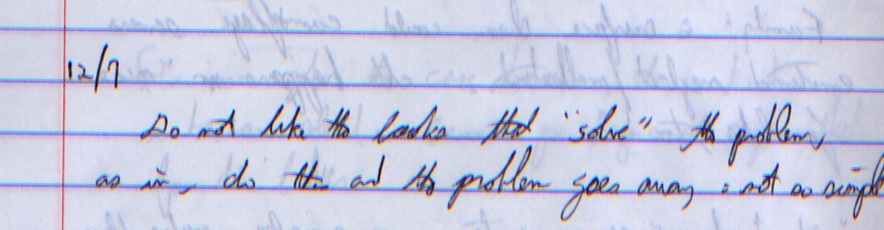
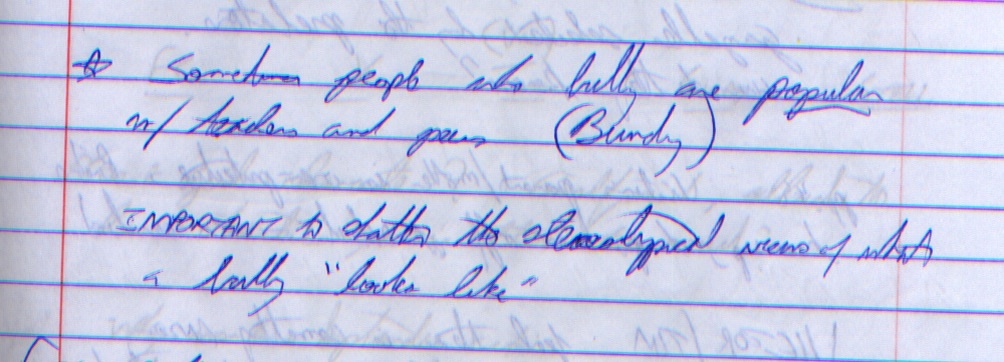
I’d guess that all writers do it, but I can only speak for myself. During the course of brainstorming for a book, which for me usually involves a composition notebook and random observations, snatches of dialogue, character traits, ideas for scenes, etc., I’ll often write brief notes to myself. These notes that I’m referring to are general guidelines for the book I’m writing — about tone, intention, theme. They serve as signposts, clarifying my intent for that specific book. I’m not talking about notes to address specific scenes in the story, but more global thoughts about the book I’m hoping to write, what I’m trying to achieve.

Below, here’s a few notes taken from a larger notebook that I filled during the research phase for my middle grade novel, Bystander. This might come across as naval gazing, I suppose, but I hope the notes shed light on my writing process and in doing so help readers and writers with their own creative work.

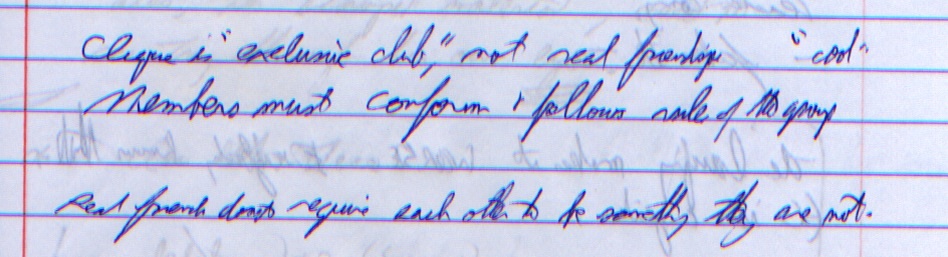
Don’t worry, I’ll translate these into English for those unfamiliar with the dialect of Southpaw Scrawl: “Do not like the books that ‘solve’ the problem, as in, do this and the problem goes away: not so simple.”

“Sometimes people who bully are popular w/ teachers and peers (Bundy)

Important to shatter the stereotypical views of what a bully ‘looks like.'”

“It becomes important to realize/understand what real friendship means.”

“Clique is ‘exclusive club’ not real friendship. ‘Cool’ members must conform & follow rules of group.

Real friends don’t require each other to be something they are not.”

“Children go to great lengths to hide the fact that they are victims of a bully.”

“Bully/victim is more dangerous, because acts out of anger, revenge.”

BYSTANDER in Paperback: New Cover, Old Hype

Good news for schools interested in using Bystander as part of a “One Book, One School” program, or on Required Summer Reading lists, or as part of an anti-bullying initiative: The book will be available this May in paperback.

Read: Cheap, cheap, cheap!

Or, at least, cheaper.

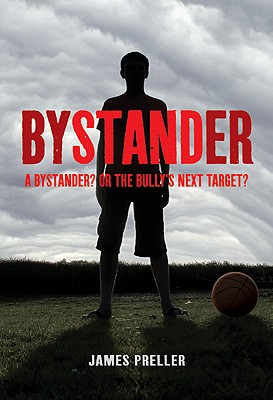
Take a look at the new cover . . .

Preller has perfectly nailed the middle school milieu, and his characters are well developed with authentic voices. The novel has a parablelike quality, steeped in a moral lesson, yet not ploddingly didactic. The action moves quickly, keeping readers engaged. The ending is realistic: there’s no strong resolution, no punishment or forgiveness. Focusing on the large majority of young people who stand by mutely and therefore complicitly, this must-read book is a great discussion starter that pairs well with a Holocaust unit.” —School Library Journal, Starred Review.

“Plenty of kids will see themselves in these pages, making for painful, if important, reading.”Publishers Weekly.

“Expertly written and rich on multiple levels, “Bystander” weaves a realistic tale of the bully, the bully’s targets and the physical and emotional pain that the victims suffer. It explores what might happen when someone decides to no longer be a bystander and to do something about the bully’s behavior.”Kendal Rautzhan, Nationally Syndicated Columnist

Should be required reading for students in middle school or just getting ready to enter middle school.” Literate Lives.