Archive for Interviews & Appreciations

Rudine Sims Bishop — Windows, Mirrors, Sliding Glass Doors — and Mike Curato’s “Flamer”

–

A librarian friend recently passed on a link to a landmark article by Rudine Sims Bishop. The article, “Mirrors, Windows, and Sliding Glass Doors,” was first published in 1990. While I was well aware of the ideas in the article, I had never read the original source. 

–

–

Bishop is credited with being the first to discuss children’s literature within the context of windows and doors. Most of the concepts are now familiar to anyone who has been paying attention. To quote the opening paragraph:

Books are sometimes windows, offering views of worlds that may be real or imagined, familiar or strange. These windows are also sliding glass doors, and readers have only to walk through in imagination to become part of whatever world has been created or recreated by the author. When lighting conditions are just right, however, a window can also be a mirror. Literature transforms human experience and reflects it back to us, and in that reflection we can see our own lives and experiences as part of the larger human experience. Reading, then, becomes a means of self-affirmation, and readers often seek their mirrors in books.

Skipping down, she later writes:

When children cannot find themselves reflected in the books they read, or when the images they see are distorted, negative, or laughable, they learn a powerful lesson about how they are devalued in the society of which they are a part. Our classrooms need to be places where all the children from all the cultures that make up the salad bowl of American society can find their mirrors.

Those are profound and important points, widely recognized in the children’s literature community (finally), after decades of neglect. We are now witnessing a sometimes awkward but wholly necessary Diversity Movement in children’s literature.

There’s another concept from Bishop’s article that has been somewhat slower to be absorbed. Maybe it’s less obvious. Sure, many of us can easily accept the importance for nonwhites to see themselves reflected in books. But in the absence of those diverse books — an absence that has long haunted American culture — the damage is also felt by the dominant social groups who have always found their mirrors in books.

Writes Bishop:

They, too, have suffered from the lack of availability of books about others. They need the books as windows onto reality, not just on imaginary worlds. They need books that will help them understand the multicultural nature of the world they live in, and their place as a member of just one group, as well as their connections to all other humans. In this country, where racism is still one of the major unresolved social problems, books may be one of the few places where children who are socially isolated and insulated from the larger world may meet people unlike themselves. If they see only reflections of themselves, they will grow up with an exaggerated sense of their own importance and value in the world — a dangerous ethnocentrism.

Go ahead, read that last sentence again.

Here, I’ll help you out:

–

If they see only reflections of themselves, they will grow up with an exaggerated sense of their own importance and value in the world — a dangerous ethnocentrism.

–

I believe that we experience a perilous echo of that limited ethnocentrism in the “Great Replacement” theory espoused by Tucker Carlson on FOX News and the white supremacist movement. These fearful, narrow people probably didn’t read enough diverse books when they children.

Along these lines, I now teach an online class for Gotham Writers, “Writing Children’s Books: Level 1.” I began our last session by sharing Bishop’s article and discussing it. The truth is, if I hope to assist less-experienced writers, it can’t only be about encouragement and the development of writing skills. They need to know this information, too. 


—

Yesterday I sat down to read Flamer, a 2020 graphic novel by Mike Curato. Not strictly a memoir, the book is based on Curato’s experiences as a young gay male struggling with his own confusing feelings, an uncertain sense of identity and place in the world. The book is unflinching in its honesty and directness, including the portrayal of bullies and personal anguish, to the point of suicidal ideation.

Curato’s book is an act of courage and compassion. A triumph in every respect. He writes in the book’s afterward:

Although living is scary when we continue to suffer, I would do it all over again to be able to write this book for you. To hope. To dream. To want love. These are dangerous acts. Fear and hope are bound up together inside of us, alongside our flaws and our divinity. In this darkness, we can find an inner light to guide us. And there is light in you, even if you can’t see it.

Of course, in our often dark world, some folks will rouse themselves to challenge and ban such a book. We can’t have that in our schools. It is currently happening all around us. An act of erasure. The book-banners final solution? To make people like Mike Curato disappear from our bookshelves and our lives.

Returning to Rudine Sims Bishop, she rounds off her essay by recognizing the limits of literature. It cannot feed the hungry or wipe out the scourge of drugs. But, she concludes:

It could, however, help us to understand each other better by helping to change our attitudes towards difference. When there are enough books available that can act as both mirrors and windows for all our children, they will see that we can celebrate both our differences and our similarities, because together they are what make us all human.

Here’s to that better world.

Here’s to books, and diversity, and mirrors and doors, and to librarians who fight the good fight, and the bright light that burns within each and every one of us.

Shine on, my good people. Shine on. Our world desperately needs your light.


–

–

“The Most Beautiful Work of All”: Patti Smith & Robert Mapplethorpe

–

–

I’ve seen a lot of concerts over the years, but somehow one of my heroes, Patti Smith, always eluded me. But I recently saw her down in Knoxville at the Big Ears Music Festival. Twice, in fact. One show was a standard rock concert with a full band in the Tennessee Theater. The other show, titled “Words & Music,” took place in a slightly more intimate setting, the Mill & Mine. No drums, no bass. Patti on stage with only her son Jackson Smith on guitar and Tony Shanahan on keyboards and various other instruments. A cozier, chattier, more relaxed vibe. Patti performed songs, including covers of Bob Dylan (“One Too Many Mornings”) and Stevie Wonder (“Blame It On the Sun”); she gave brief readings and allowed herself the time to introduce songs at length. It was, as they say, a special night.

One of the things Patti read — maybe at the Tennessee Theater? — was the letter she wrote in 1989 to artist Robert Mapplethorpe who was in the hospital at the end of a long illness. Another bright soul taken by AIDS. Patti explained that she returned home after a hospital visit and composed a short letter to her friend, a relationship lovingly chronicled in her award-winning memoir, Just Kids.

He died the next day without ever having read it.

But you can. We can.

–


Dear Robert,

Often as I lie awake I wonder if you are also lying awake. Are you in pain, or feeling alone? You drew me from the darkest period of my young life, sharing with me the sacred mystery of what it is to be an artist. I learned to see through you and never compose a line or draw a curve that does not come from the knowledge I derived in our precious time together. Your work, coming from a fluid source, can be traced to the naked song of your youth. You spoke then of holding hands with God. Remember, through everything, you have always held that hand. Grip it hard, Robert, and don’t let it go.

The other afternoon, when you fell asleep on my shoulder, I drifted off, too. But before I did, it occurred to me looking around at all of your things and your work and going through years of your work in my mind, that of all your work, you are still your most beautiful. The most beautiful work of all.

Patti

–

A Conversation with Michael Arndt, Graphic Designer and Author/Illustrator of “Snails & Monkey Tales: A Visual Guide to Punctuation & Symbols”

–

“I feel creators are vessels.
We fill up with input, ideas, and inspiration
until it spills over
and we empty it out into our work
so that we may fill up again.
An endless delightful cycle.”

— Michael Arndt

–

–

Every once in a while, a talent comes along who is just . . . different. A fresh perspective, offering a new way of looking at things. As you’ll see, Michael Arndt comes to books from a design background. His work conveys wit, intelligence, curiosity, joyfulness. I didn’t know him at all — and I suspect that you might not either — so I invited Michael over for a chat. As luck would have it, March 22nd, 2022, is the publication day of Michael’s singular new book, Snails & Monkey Tales:  A Visual Guide to Punctuation & Symbols. Congratulations, Michael! I imagine that any lover of language would delight in your handsome new book. Let’s do this interview thing!


–

You first caught my attention when you started posting minimalistic portraits of celebrities on Facebook. It’s remarkable to me how you can capture the essence of these people in spare yet eloquent details. It’s all about the reduction — seeking out the signal from the noise.

Hi, James. Thank you for the kind words and interviewing me here. Yes, you put that as succinctly as I have ever heard it put. “Reduction—seeking out the signal from the noise” is the essence of graphic design.

I think it’s also the essence of picture book writing — something I have not at all mastered!

It is indeed the essence. Many people think designers make things look pretty and that the beauty comes from adding to the material in the same way an interior decorator might add pillows and flower arrangements to a room or the way an artist might add paint to a canvas. Instead, any beauty we contribute comes from providing clarity, much like polishing a rough stone — and that comes from reduction, not addition.

–
–

For Black History Month . . .

–

–

Less is more.

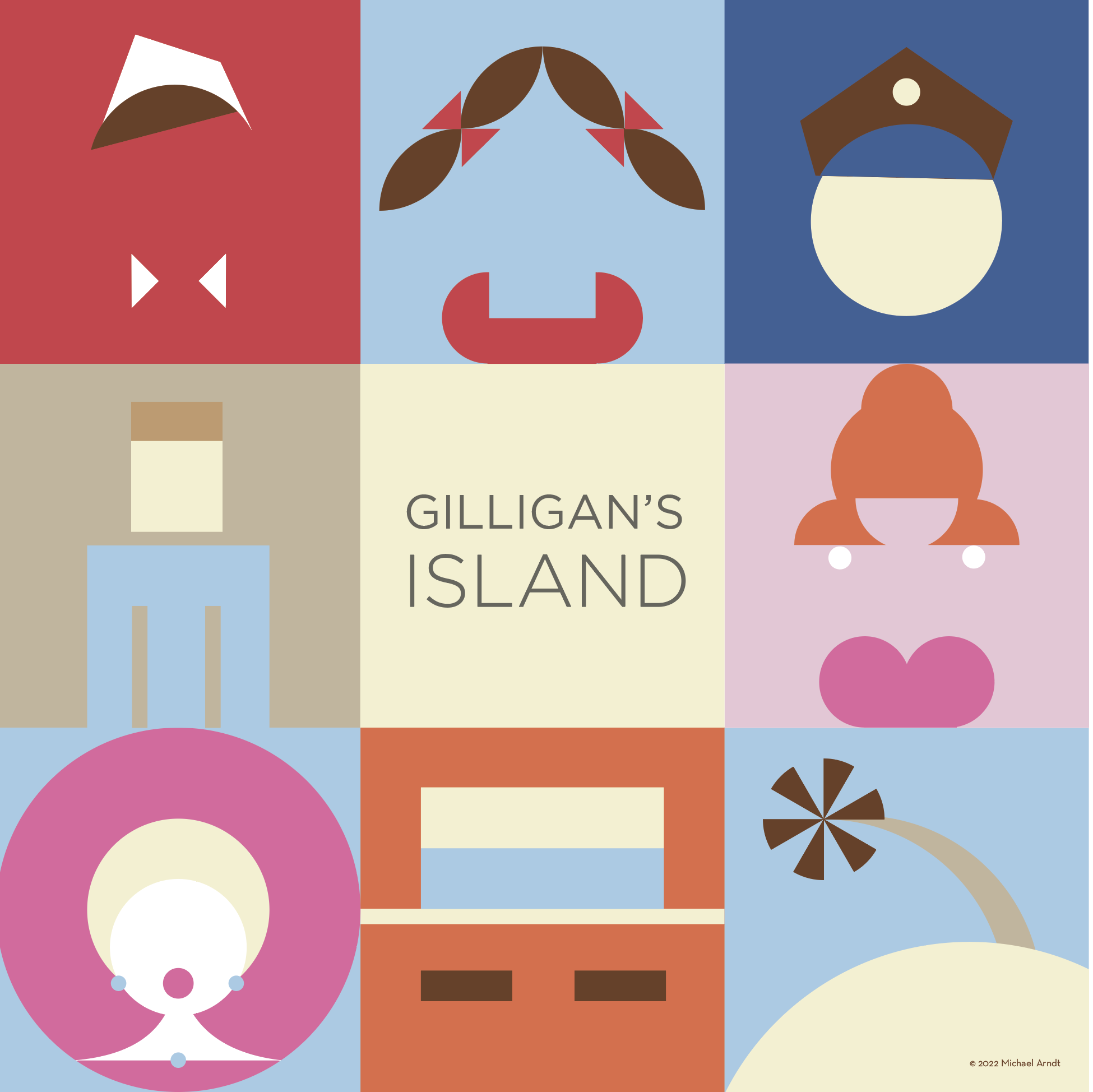
Yes, more or less. [Insert wink.] Designers are akin to sculptors who chisel away the excess stone to reveal the form inside. My focus with those minimal portraits was on the negative shapes. I often would draw those shapes first (e.g. the faces are usually the same color as the background and therefore rely upon the surrounding shapes to define them). When you work with as few elements as possible, each element has to work impeccably and do double duty, so you have to put the negative shapes to work. For those images, I applied what I learned in my design career about scale, proportion, color, shapes, and composition to help convey the physicality, personality, genre, and historical time frame. In some cases, the color reinforced the name as in the cases of Ruby Bridges and Rosa Parks whose portraits I rendered in hues of reds and pinks…a sort of visual pun.

I appreciate the wit of your work. The humor. I love your Sonny & Cher. 

–

–

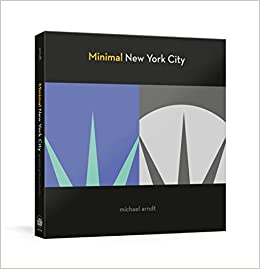
Thank you. It is funny (no pun intended), but I don’t usually set out to incorporate humor in my books. My last gift book—Minimal New York City: graphic, gritty, and witty (Clarkson Potter, 2020)—did not start out with that subtitle. While the book is catalogued under humor, I was merely trying to juxtapose iconic New York phenomena, visually and sometimes verbally. I read that humor relies upon the element of surprise, the unexpected, so perhaps that is what you and others are picking up on.
Can you give us a little biographical background? Where did you grow up? What brought you to children’s books?

Sure. My own childhood was spent in Kinderhook in New York’s picturesque Hudson Valley. It is an idyllic pastoral historic setting. Our house was built in an apple orchard. I played with my dog, rode my bike, and drew…basically how I spend my days in New York City now! There really wasn’t much else to do. Like many, I wasn’t familiar with graphic design. Instead, I wanted to be an illustrator. At one point, following my year of wanting to be a dentist (much like Hermey in Rudolph the Red-Nosed Reindeer), I was convinced that I wanted to do medical illustration. When college application time came around, I applied to various schools. Each had a different program…fine arts, illustration, editorial design, graphic design. In the end the only affordable option was the University of Cincinnati and they only offered Graphic Design…

“I guess I will be a Graphic Designer then.”

Ha, yes. Our grand plans turn like a dime on accident and chance. We’re in boats, we think we know where we’re going, and suddenly a wind fills the sails.

Agreed. At first, I didn’t “get” design. Hated it. Fought it. Wanted to transfer out of it. I applied elsewhere for sophomore year and got in. A professor pulled me aside and convinced me to stay arguing that graphic design was the most solid foundation for anything else I might want to do in the visual field, so I stayed. She was right. About a year later it all clicked and I fell in love with the quiet power of design and the way a few simple shapes or letters could convey entire worlds. It appealed to my yearning for simplicity and minimalism. But I never lost my love and respect for illustration and illustrators.

I hope you send that professor a copy of your new book.

I would like to but haven’t managed to locate her. In the meantime, I have sent copies of my books to my other professors.

Sorry, I interrupted your story.

No worries. I tend to ramble on otherwise. So, to fast forward, I spent twenty years after college designing branding and packaging, and art directing for the beauty and fragrance industry. A midlife crisis arrived right on schedule —

You bought a little red sports car?

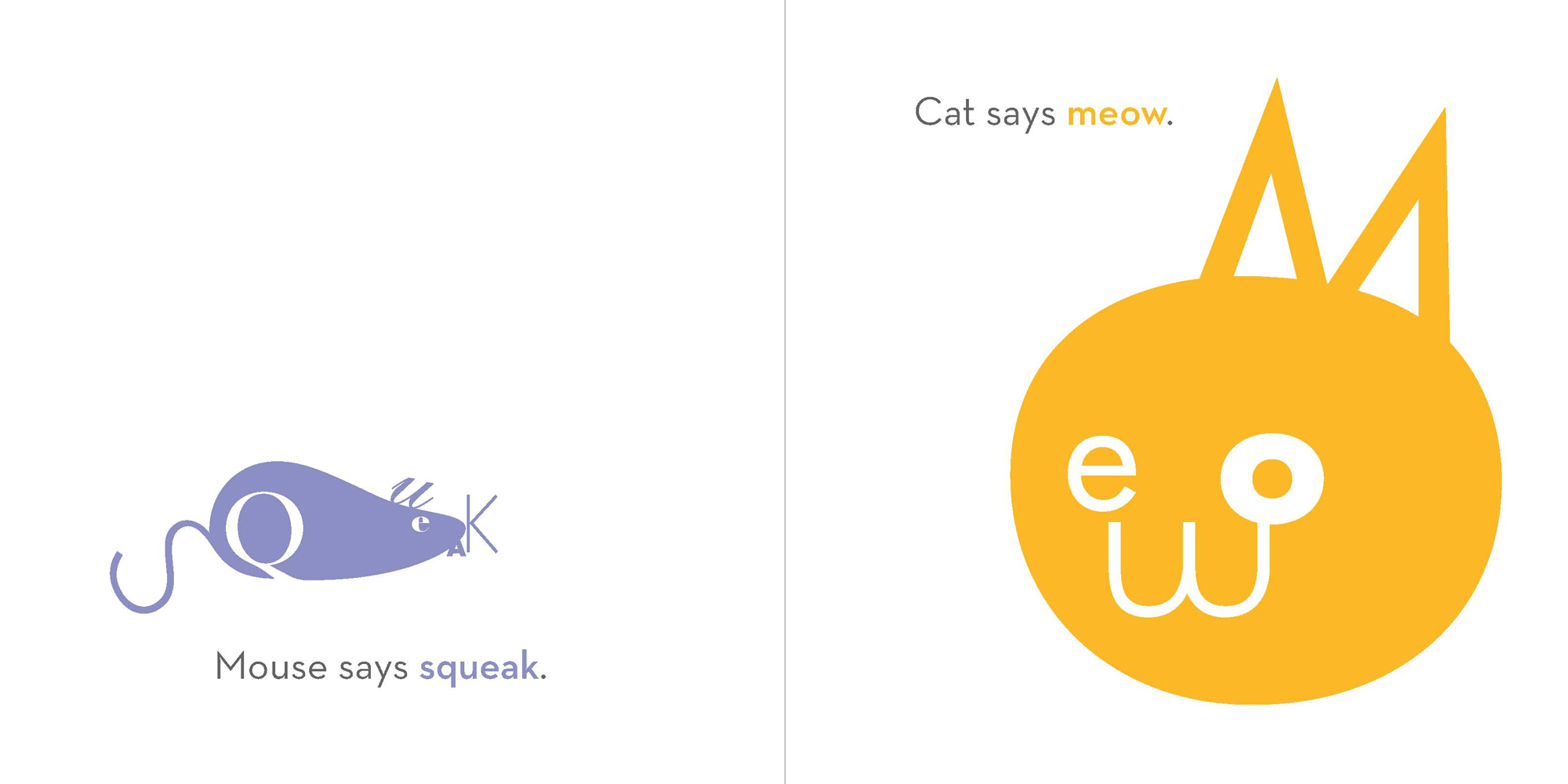
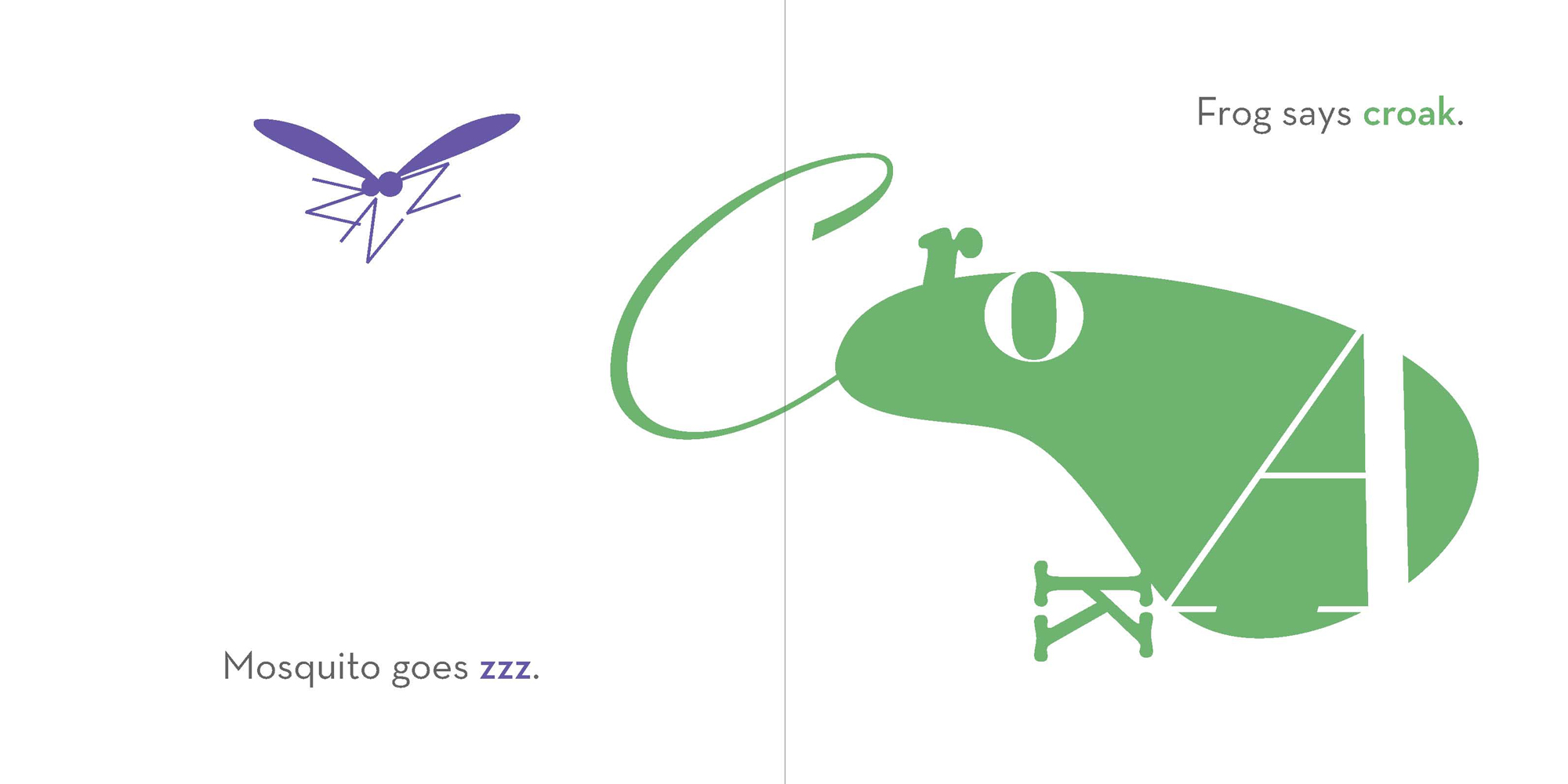
I wish!…and yet I don’t, because I would not be speaking to you about books today if I had. You see, I was looking for something that had more personal meaning that would allow me more flexibility to work from home and spend time with my pets, even into my golden years some day. I came up with a series of animal designs that used the letters in the sounds each makes and called them by my own portmanteau “animalopoeia.” They were intended to be my own line of letterpress greeting cards. When I had 24 though, I thought, this is a basis of a children’s book. I put together a prototype and sent it un-agented to Chronicle Books—and to them only—as I thought they were the right publisher for it. To my delight they agreed and they published CAT SAYS MEOW: and other animalopoeia in 2014. That started my book career.

–
–

And another spread . . .

–
–

I love that book. It’s so clever and original. And obviously that’s because you come to it from a different perspective—you bring that graphic design intelligence to the work.

Oh, thank you, James; that is always nice to hear. I have to say, it will always have a special place in my heart as it was my first book and first time being called an author and illustrator. The field of picture books has a significant number of graphic designers who illustrate…and even write. This is not as strange as it may first appear. Picture books, for those who may not know, are rarely more than the standard 32 pages and the text is increasingly less than it was in books when you and I grew up. Designers are trained to pair images and words in a cohesive way that is visually enticing and communicates a lot in a little space. Often, as in my case, the style tends to be more graphic and typographic, but not always. That all said, designers and illustrators are not the same profession. We are more like siblings or cousins than twins. Illustrators draw, and draw well, very well. They illustrate an idea or story. Graphic designers solve visual communication problems and seek to clarify, inform, and/or motivate. Many wonderful graphic designers cannot draw at all. It is more about thinking critically about a design problem and using the most effective visual tools to solve it. Saul Bass defined design as “thinking made visual.”
–

I like that. For me, so much of the early stage of writing is about thinking. Which to an outside observer (my wife, for example) looks a lot like doing nothing!

And sometimes, in my case, it is literally doing nothing. My walks in the park with my dog Clooney are times when I ruminate the best. Those, and truly sitting in my apartment and literally doing nothing. They are my ways of clearing my body’s internal hard drive of its clutter and visual noise. Just as music or design or architecture or even nature in the form of Winter needs rest and so-called negative or white space, so do we as thinking, creating beings. Not to get too Zen, but I feel creators are vessels. We fill up with input, ideas, and inspiration until it spills over and we empty it out into our work so that we may fill up again. An endless delightful cycle.

Time out! I’m just going to roll here with a few sample spreads from Snails for my Nation of Readers to enjoy.

–

–

–

–

–

–

–

–

Stunning, right?

Michael, are you familiar with the books of Donald Crews? He came at children’s books from a similar perspective, the emphasis on graphic design (in particular, Freight Train, Truck, 10, Flying). I think his graphic vision helped us see those familiar topics in new ways.

I am familiar with his books! Michael Bierut, a partner at the international design firm Pentagram and president emeritus of the AIGA, wrote the forward in my upcoming book. In a personal note to me beforehand, he wrote, “Your books…as good as anything by Don Crews or Mr. [Paul] Rand.” Seeing familiar topics in new ways is a mission of mine—to impart the tenets of visual literacy to people of all ages, starting, but certainly not ending, with the youngest amongst us. A good number of my books are early concept board books for babies and toddlers.

That’s the essence to all art, isn’t it. To help us see or feel the familiar—or the neglected, the unseen—in a new and startling way.

It is, and that is the exciting part for me. It brings out the philosopher and rebel sides of me, but also the visionary and optimist sides. I want to encourage people to see things, their environment, world, and lives, first for what they are and then for what they can be. The first day of design school, our professor said, “the purpose of this class is to sensitize you to your visual environment,” i.e., to teach us how to see. This obviously has its pros and cons, but decidedly more pros. My signature line of early concept books—M books, published by Andrews McMeel—aims to do precisely that. Teach kids, hopefully in engaging ways, the “fun”damentals of visual literacy. We live in an Information Age and today’s generation will need to be visually fluent.

–

–

–

–
–

–

Could you tell us about your new book?

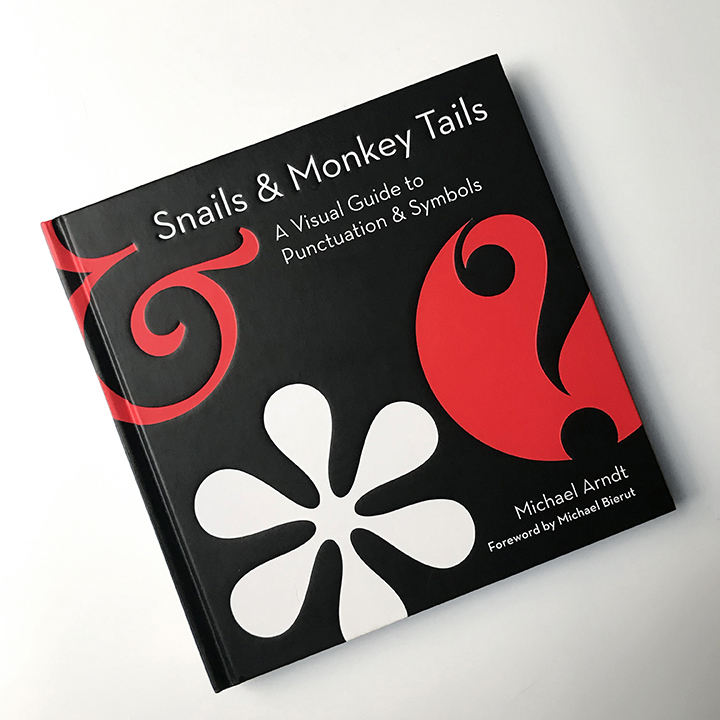
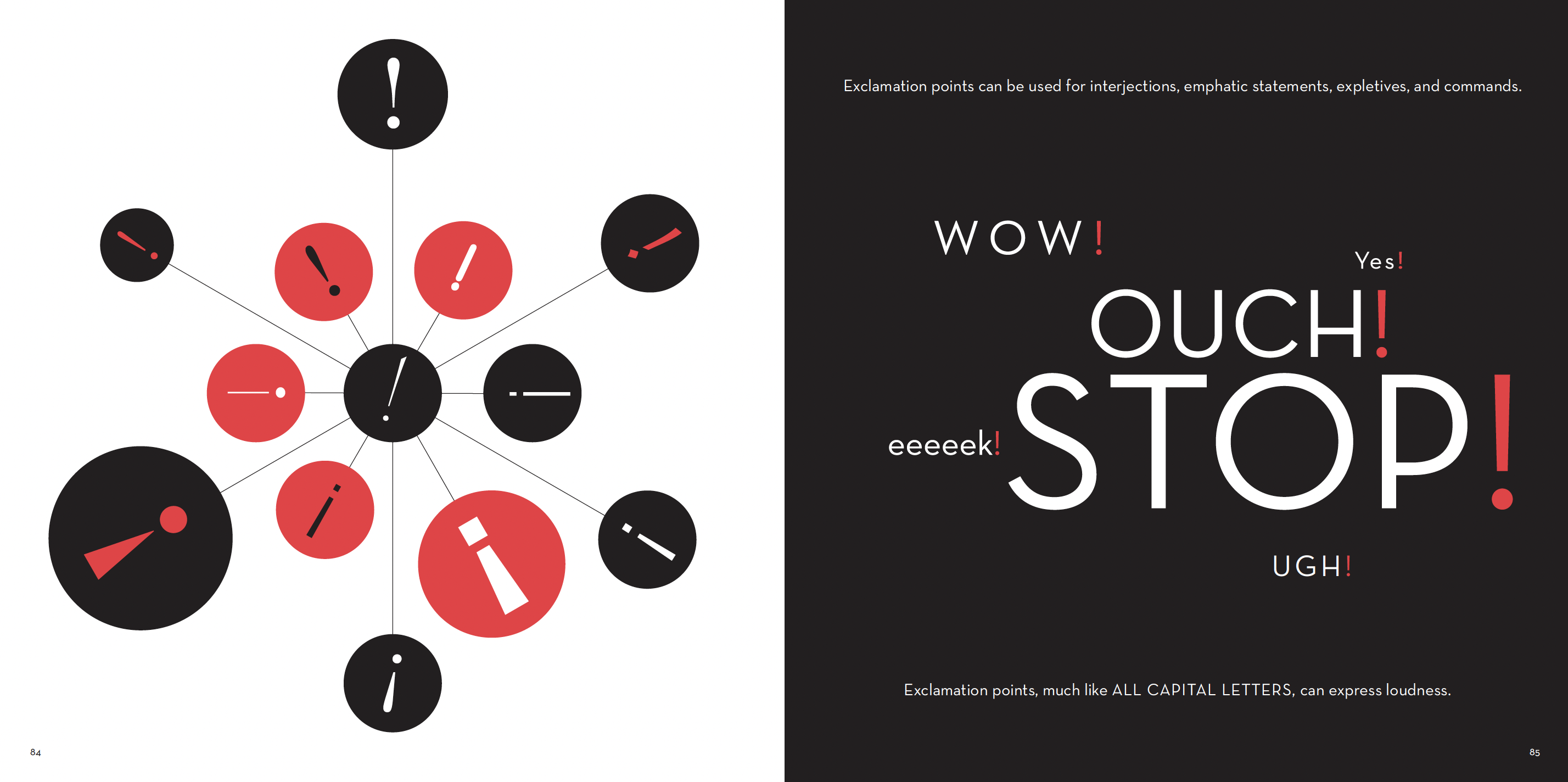
I thought you would never ask! It is called Snails and Monkey Tails: A Visual Guide to Punctuation & Symbols. “Visual” and “Guide” are perhaps the two most important parts of that title for it is decidedly from a graphic design and typography point of view. As such, it will appeal to designers, typophiles, anyone who delights in being visually stimulated or learning visually. That said, it is equally for the word people who live among us. Students, learners of English as a foreign language, teachers, editors, grammarians…. It is simultaneously a primer that covers the basics and what I hope an intriguing journey down the rabbit hole into the origins of the names, shapes, styles, and uses of punctuation and symbols. In this era of short attention spans and “tl;dr” (too long; didn’t read), I wanted to minimize the verbal explanations and maximize the visual elements. I hope I have a created something that is as stylish as it is informative. Did you know that the word “glamour” is an alteration of the word “grammar?” I wanted to bring punctuation back by making it sexy.

–

–

While the book certainly coheres as a whole, each spread works independently as a sort of infographic.

Thanks. That is just one of the ways I wanted to make the book approachable and accessible. It is definitely not a stuffy or tedious grammar-type book. Conceptually, I wanted to flip the scale in an Alice in Wonderland sort of way. I blew up the usually tiny marks to gargantuan proportions while the body text is discreet and understated. The entire book is in classic, yet modern, black and red for dynamic spreads and the entire package is designed to be a joy to hold and read. Coated paper, matte varnish, and debossed hardcover that feels like holding a Zen river stone.

It’s a book that defies category, at least for me. I’m not sure how or where it fits, exactly, but I know I want it,

That is what in the beauty world we called “creating desire” or the “must-have” factor. In the book world it falls into the gift book category: compact, interesting, affordable books that have enhanced production value and therefore make attractive gifts.

Michael’s dog, Clooney, hanging on the Upper West Side of NYC.

Well, Michael, thank you for your time. I saw your work, we became friends on Facebook, and I just kept wondering, “Who is this guy?” Turns out you grew up not too far from where I live (Delmar, NY) and, maybe best of all, you are a dog lover. I am so impressed with your talent. If I were a children’s book art director, I’d be seeking out nonfiction books for you to “illustrate.” A trip to the zoo, a day at the airport, the first day of school — the possibilities are wide open. I’m excited to see what comes next.

Thank you, James. From your mouth to the ears of art directors, editors, and publishers. I love animals and I love knowledge, so projects like those sound wonderful. This has been fun. Thanks for the chat.

–

–

For readers who’d like to learn more about Michael, there’s this thing called Google . . .

As for me, James Preller: You might know my Jigsaw Jones mystery series. My most recent book is titled Upstander, a stand-alone novel that also serves as sequel/prequel to Bystander. It follows Mary’s experiences, enters her home life, and includes a strong Substance Use Disorder (SUD) storyline. I’m proud that both books were named Junior Library Guild Selections — ten years apart. 

Thanks, as always, for stopping by.

–

–

A Conversation with Sylvie Kantorovitz: Author/Illustrator of the Dazzling New Graphic Novel Memoir, “SYLVIE”

–

“My picture book background did help me
a lot with pacing
and the importance of visual variety,
and I will also credit years of reading
graphic novels and comics!”

— Sylvie Kantorovitz

=

Sylvie Kantorovitz is a true artist from the top of her head down to the soles of her shoes. She’s just one of those rare people where creating art in some form seems as natural as breathing. Sylvie’s latest book, a memoir in graphic novel form, is a triumph in every way. It’s a book that could have been titled, “Portrait of the Artist as a Young Child and Woman.” You can’t help but be charmed by Sylvie’s story — her uncanny recollections of childhood — the warmth of her illustrations — and the path of her self-discovery. After I finished admiring the book, I invited Sylvie over to the swanky corporate offices here at the 14th floor of James Preller Dot Com. Let’s meet her!

–


I can’t wait to talk about this terrific book, so let’s get started. As I understand it, this book was something of a happy accident. You didn’t set out to write a memoir? 

I knew I wanted to write a graphic novel. I knew I wanted to base it on my memories of growing up in France. But I was worried about not remembering enough. At first I called the main character Lisette, and labeled my work “a fictional memoir”. Then I found out I remembered plenty! And one day my agent asked this very simple question: Is it fiction or is it a memoir? And the answer jumped at me: of course it is a memoir!

There’s a minor moment early in the book, four illustrations across two pages. You are circling a favorite tree, stepping on the roots with your brother Alibert, careful not to fall off. And to me, that was absolute perfection. You captured something that felt so right, childlike and authentic. I remember that exact feeling, careful not to fall into the shark-infested waters. 

Thank you! I really love how universal these early childhood games seem to be. Pretending the floor is lava. Or the bed is in the middle of an ocean teaming with pirates and sharks. How thrilling imaginary danger is! 

I want to get at this by avoiding a couple of standard pat answers. We often hear: 1) I’m still a 7-year-old in my heart; or 2) I still have a direct line to my childhood. And while those two things might be true for you, I want to ask: Why do you think those moments still resonate for us, still linger so powerfully in our memories? 

Haha! I am definitely not a 7-year-old at heart any more, nor do I have a direct line to my childhood! For me, as I get older, I want to define who I am, what is important to me. I want to embrace that fully and also decide how I want to use the time I have left. It’s hard work, and my memories are one of the tools that help me in figuring all that out.      

It’s interesting how this creative act opened up a flood of memories for you — forgotten memories, if there’s such a thing.

I was happy to find out that memories have a way of triggering each other. In fact, more are still coming! What became a challenge was what to keep. I chose anecdotes that I thought showed an emotional moment in the story, or allowed me to expand on who a character was. Like showing what happened when my sister fell through a roof, or when my father took me to Paris, or when I messed up on an important school test.

There’s a lot of playing in your book, which I found so relatable. An experience that is at the core of us all, I’d think. Did that come back to you easily?   

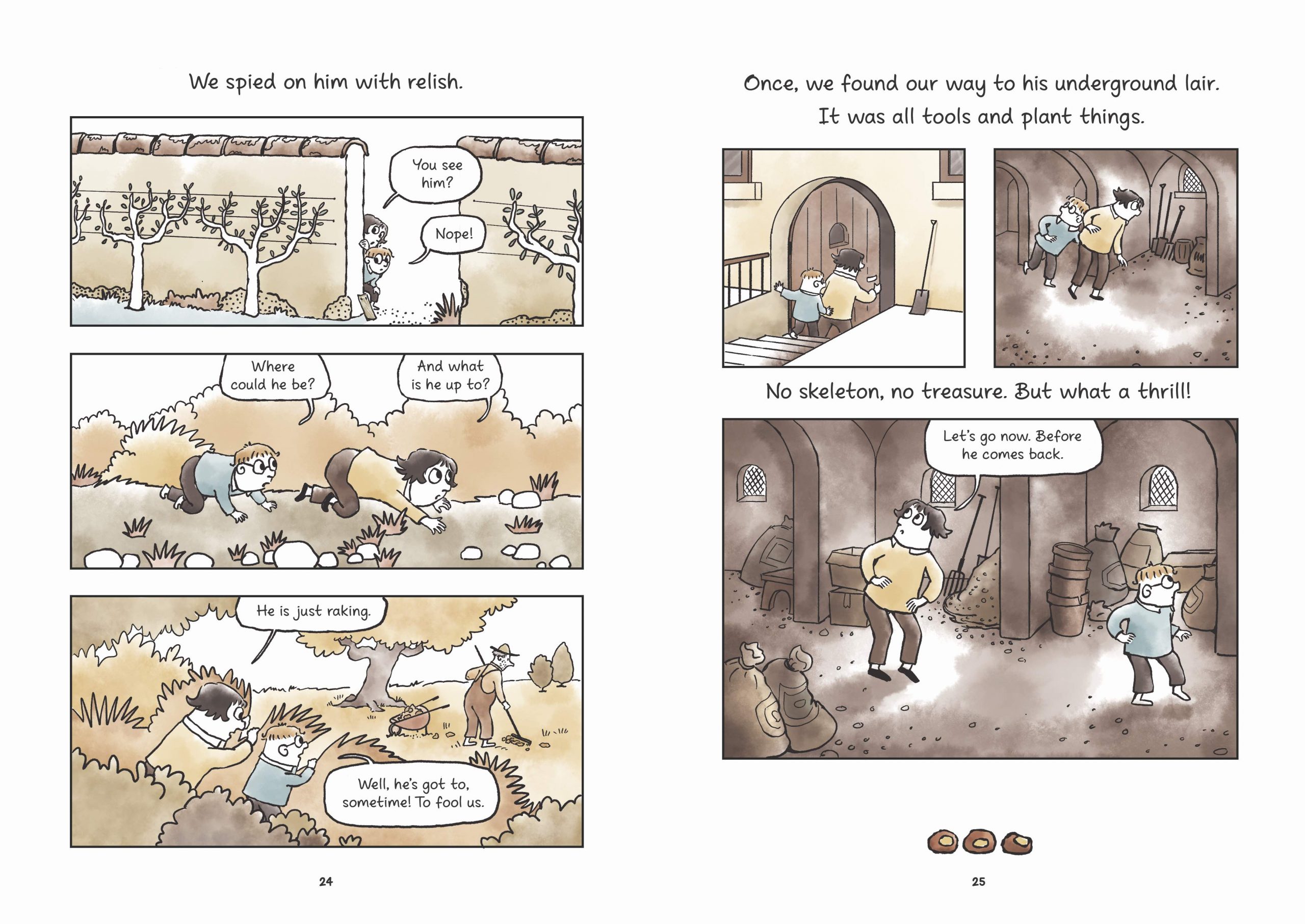
Actually yes. The school where my family lived was like a giant playground! We played in the classrooms, spied on the gardener, once had a sleepover in the infirmary. I also wanted to show how similar playtime is for children in another country, including games like hopscotch or marbles.

I could personally identify with the magical visits to your father’s office, where he had a ready supply of paper clips, markers, pens, tape, paper. Heaven for a young artist. As a boy, I used to go to my father’s insurance office. He had something that trumped all that: tracing paper!  

I can’t help wondering: tracing paper in an insurance office? But how about the thrill of using a manual typewriter?  That also was such fun!  

–

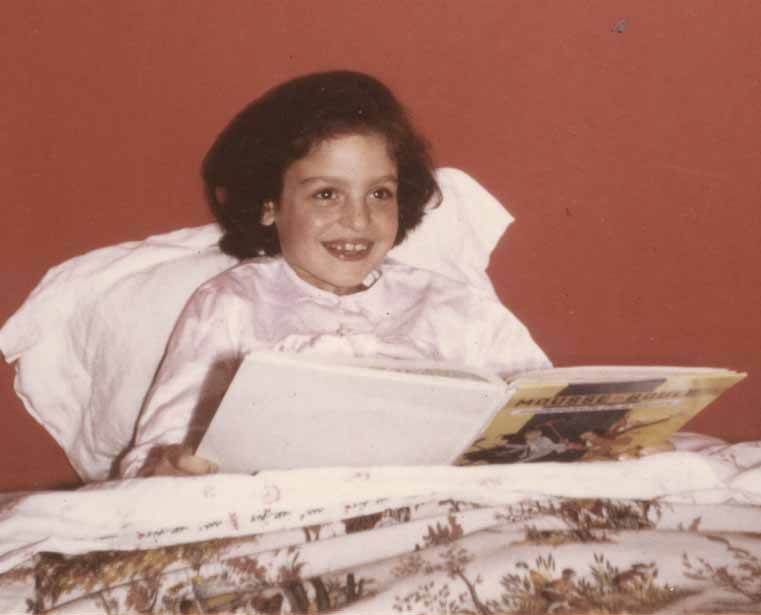
A snapshot of Sylvie in real life, reading in bed in 1968.

—

Yes, it sure was, though I was dazzled with the first electric typewriter. Wowza! I especially appreciate the variety of images and artwork, the pacing. It’s as if each chapter is its own complete, self-contained picture book, where the artwork flows in different shapes and sizes. Each spread contains a new surprise. You make it look easy. 

My picture book background did help me a lot with pacing and the importance of visual variety, and I will also credit years of reading graphic novels and comics! Growing up in France when I did, I was immersed in a great comics culture which I am so glad has arrived here too.  The variety available now for kids is amazing!

Your mother was tough. She said some harsh things, too. How was it looking back on that now, so many years later? 

Haha! I didn’t wait to write a memoir in order to examine the effect of my parent’s influence on my adult mind. So pondering over my mother’s style was nothing new to me. In the book, I tried to show a balanced view of my mother, such as her also being caring and affectionate. And how confusing those mixed messages are for a child to navigate.

Are your parents still alive? And if so, how did they react to the book? 

My father died many years ago but I think he would have been pleased. He loved all forms of expression, from the classics to popular genres to comics. My mother died during the pandemic, a few months before publication. But I think she would have been oddly proud to figure so prominently in a book by her “American” daughter.  

–

–

There’s a lot of cleaning in this book! Are you as neat today? 

Haha! I really am! I love cleanliness and order. It really started with getting that skeleton key to my own little attic room.  I still sigh with pleasure when I think of the orderly little domain I created as a girl.   

Could we see a photo of your workspace (but no cheating — I don’t want you cleaning beforehand!)? 

My two tables:

–

–


That’s so cool, thanks for giving us that glimpse. Sylvie follows your life from childhood to college. A journey of self-discovery. What age reader is this book intended for? 

It is listed as a book for children 8 to 12. But I have had a lot of feedback from adults who have loved it, which is great.

I love that very last image of you sitting on a train, a zoomy blur, catapulting into the future. You are on your way! When did you know that would be the final image? 

That scene actually moved from the very beginning — Sylvie thinking back on her youth — to the very end — Sylvie on her way to her future. I think it worked out well, as the theme of the train kept cropping up: waving at trains, taking a train for the first time without parents, loving a song about a train whistling in the night. For me the train is a metaphor for the longing I felt to go places. A longing that eventually brought me to the United States.  

I’d be remiss if I didn’t ask about your partner, the lovely and talented Barbara Lehman. How is she? 

Barbara is well, thank you. Her latest book came out very recently: Little Red and the Cat who Loved Cake. The Horn Book called it “Another triumph from a master of wordless picture books.” I agree!  It is also very funny.


You are also a fine painter. Is your work available for sale? 

Thank you. At this time, I do not actively try to sell my artwork. At my art table, I can do whatever I want. However, I am always happy if someone wants to own a piece. People often contact me privately and I have sold much art that way through the years.

Last question: you must have learned a lot by reflecting on your life in this way. Stories give it shape and meaning. Did anything surprise you along the way? 

I was delighted to find out my young self was not that different from who I am now. My views on people and life have evolved, of course, but my core values are essentially the same. I also realized how similar I am to my father. And I like that. It is something I hadn’t fully realized before because I didn’t have a reason to reexamine my memories and look at the bigger picture. I am glad I did!

Sylvie, I’m a little abashed by how many questions I asked you. My apologies. I truly loved your book and, of course, I’ve been a fan for many years. Thanks for giving us your life in this format, and your time in this interview.

I enjoyed this conversation, James!  And now, back to the drawing board.

–

To learn more about Sylvie Kantorovitz, you can find her on Twitter, Instagram, Facebook, or her website. She’s published many other picture books, including The Very Tiny Baby, Zig and the Magic Umbrella, and more. 


Gary Paulsen & Me: An Appreciation

–

“I owe everything I am 
and everything I will ever be
to books.”
— Gary Paulsen

–

–

Gary Paulsen passed in October, 2021, and I wanted to hang back and wait a bit before bringing up my very slight connection to the great writer. I didn’t know the man, we’ve never met. And unlike others, I’ve only read a few of his books, all as an adult.

My 2019 novel, Blood Mountain, was compared in three separate reviews to Paulsen’s Hatchet. No reviewer suggested that my book was as good as Hatchet, and certainly not as important (arriving, as it did, 30-plus years later). But they noted that I was working the same vein as Paulsen’s masterwork. Writing in that tradition of wilderness survival and, as is the nature of such an endeavor, within the tradition of wilderness respect and appreciation.

Both books are, in their way, love stories.

The quotes on Blood Mountain:

–

“Fans of Gary Paulsen’s books will likely be hooked from page one.” — Publishers Weekly.

–

“Preller combines brave characters with vivid descriptions of the perilous mountain, grasping readers’ emotions in the same way as Gary Paulsen’s Hatchet series.” — Booklist.

–

“A thrilling purchase for middle grade collections, perfect for fans of adventure novels by Jean Craighead George, Peg Kehret, and Gary Paulsen.” — School Library Journal. 

–

What I admire most about Paulsen is his engagement with the natural world. He was an outdoorsman, comfortable and expertly capable in the wild. I don’t have 1/10th of his skills and knowledge. But in my own way, I try to see things, appreciate and name the trees, the birds, the world around me. That’s what he offered us, more than anything: his own innate sense of wonder and respect.

There’s a deceptively simple line by Roger Tory Peterson, the artist and writer known for the famous Peterson Guides. He said, “The more you look, the more you see.”

I believe Gary Paulsen was telling us the very same thing. And his message became, for me, all the more relevant as we drifted further and further from the real world into cyber-whatever. And as the natural world became more endangered — witness the great species die-off — and as we all became more entangled in our phones and apps and the algorithms of social media, I find myself holding closer to the message of writers like Gary Paulsen, Bill McKibben, Robin Wall Kimmerer, Gary Snyder, Thich Nhat Hanh, Peter Wohlleben, Jane Goodall, Robert Macfarlane, and many more.

Paulsen said to us, in effect: Go outside. Look, see, love every blessed living thing.

I’m honored to enjoy the slightest, most gossamer connection to such a compassionate writer.

Here’s a very short excerpt from Blood Mountain:

–

Grace spends much of that day gathering anything that will soften her bed. She works doggedly, with purpose. Grace saws at the branches of a hemlock, scraping her knuckles, covering her hands with sap and dirt. Hauls the boughs up, which is not easy with her injuries. She spreads the curved branches with the ends stuck in the dirt, so there’s a slight hump in the middle. Then she adds a mattress of moss and soft boughs.

By the end, she is exhausted. Her entire body throbs.

She lies down, breathes in the piney air, satisfied. And for that brief moment, Grace doesn’t feel lost anymore. 

–

Blood Mountain is a Junior Library Guild Selection.

–

–

–

–