Archive for Interviews & Appreciations

A Little Advice for Aspiring Writers

–

Stephanie Affinito — lover of books, writing, teaching, journals, podcasts, and long walks on the beach — asked me five questions after our podcast interview. (For that, just bounce on this link, and the miracle of the interwebs will take you there.)

Stephanie asked: 

Where do you do your best writing?
What are your favorite writing tools? (pens, notebook, software, etc.)
Do you have any special writing routines or rituals?
What inspires your writing?
What advice do you give to others who hope to one day write something of their own?

Here’s how I answered: 


I suppose it’s my disposition to remove any of the preciousness or magic out of the writing process. For me, it’s been called “going to work” since I went freelance in 1990. Let me back up. The important thing, regardless of your physical surroundings, is to get yourself in the proper headspace to write. The right frame of mind (and the time required to produce anything of length). Now, granted, everyone is different and there may well be various rituals or strategies to help you get there, in place, so to write. It might be an office, a chair, a particular pen, a bottle of gin. We can scribble on napkins or jab sentences into the “Notes” feature of our phones. But to write at length requires, simply, a place where you can be free from distractions. Focus is everything. Concentration is king. And at every turn the world conspires against those things. To write well, I think you need to turn the world off and allow yourself the time and space to go deep inside your head. What inspires my writing? Oh, gosh. Everything and anything. But I do seem to need to be inspired — moved to write — — in order to get anything worthwhile done. I’ve never been very good at cranking out 1,000 words on any given afternoon. Whereas for others, that’s exactly the process. They write by writing. And I’ve gone through all the self-loathing that comes with falling short at the job. What I’ve learned — and this translates into my advice for any writer — is to read widely with care & attention and to write often. The obvious stuff. But after a while, you will begin to learn about yourself, the things that work for you. We are all different. For example, I’ve come to accept that I seem to need a lot of time percolating. Ruminating. Dithering might be another word for it. Working things out in my head over time. And it’s as if a certain kind of creative pressure slowly builds and builds until, one day, it’s time. I’m ready to write. As a writer, you might be completely different. You might be analytical, methodical. You might like to write out extended character profiles, elaborate backstories, fill pages and pages in notebooks. But ultimately, the task comes down to just you and a blank page. Nothing gets written until you sit down in front of that blank page. You need to get yourself there on a regular basis, one way or other. What else? Oh, please, forgive yourself. Be patient with yourself. Try your best. Work hard, but also take time off. Exercise. Enjoy walks. Read books. Meet with friends. Fill yourself up. And always return to that blank page. Just you & the silence of your thoughts, your feelings, and the time & space to think & feel them. Good luck.


Addendum: I did not write this in my original answer to Stephanie, but all my references to the “blank page” reminded me of a tip that I actually practice. At the end of the day, around the time you are ready to push away from the desk, leave a little something unwritten. That is, don’t finish the chapter. Don’t end the scene. Leave it off in the middle if possible, maybe with a few clear notes. Then the next day, you can pick right up where you left off — i.e., it’s not a blank page! — rather than having to start all over again at the bottom of the hill. 


                .    .    .   


Etcetera, etcetera . . .

–

PODCAST: I Was the Special Guest on the “Get Lit” Podcast. Come Listen as We Talk About Books & Writing & Other Difficulties

Celebrating Children’s Literature with James Preller


—

Yes, as the headline states, I was the special guest on Stephanie Affinito’s book-centric “Get Lit” podcast. We recorded it last week and had a pretty wide-ranging conversation. If you happen to be interested in far, far too much Jimmy, stomp the link — scroll a tiny bit, and listen to us talk books, and Exit 13, and writing, along with various other topics. Thank you, Stephanie Affinito, for inviting me to celebrate children’s literature with you!

–

–

5 QUESTIONS w/ London Ladd, Illustrator of “Black Gold”

–

Hey, we’re back again with “5 Questions 2.0” — the new & improved interview format that asks some of the best folks in children’s literature five — and this time, only five! — questions.

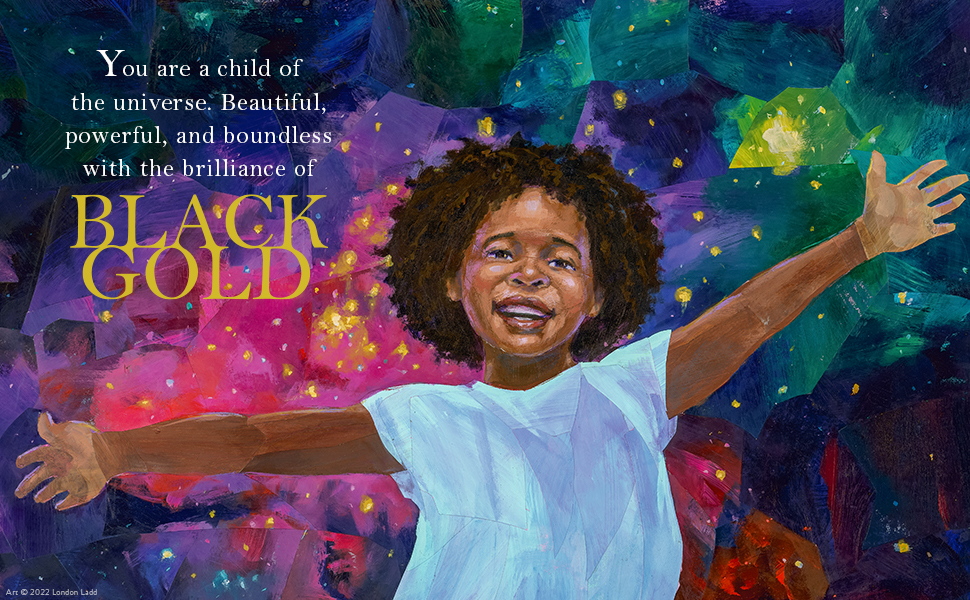
My guest today is London Ladd, a brilliant artist and friend. We’ll be focusing on his brand new book, Black Gold, written by Laura Obuobi. It’s already creating quite a buzz, along with two starred reviews (and counting).

–

–

1. London, I’ve been a fan for a long time, though I believe it was your amazing work on Frederick’s Journey that first really turned my head. That’s when I thought: This guy’s a rising star. And yet this is your first published book in five years. Could you tell us what you’ve been up to?

–

–

Thank you! The five-year gap started in early 2017, and I felt a little burned out and uninspired by my artwork. It was too formulaic, very basic! Don’t get me wrong, I was proud of my artwork then, but I desired something more in-depth, true to my artistic spirit, visual voice, whatever to describe it. I wanted to step away but was fearful that I may never be able to return. After experiencing multiple personal setbacks in late 2017 and early 2019, I abandoned art altogether.

Oh, no!

Still, thankfully a person I deeply respect urged me to enroll in grad school at Syracuse University. The three-year program was intense, a chance to learn and experiment with art in new ways. One of the best decisions I ever made in my life. I decided if I were going to do this grad school thing, I would fully commit myself to embrace art in ways true to my heart without fear. I was able to fall in love with art again. This is reflected in the artwork I produce now and moving forward.

2) Observing you from the outside, mostly via social media, it looks like you’ve been on a deeply personal, artistic journey. You seem to be focused on growth and free experimentation. What did you learn these past few years?

To not be afraid, to take more chances, to see what happens. The stuff I do now is more in line with my sketchbook. Personal time without criticism of others, whether positive or negative, doesn’t matter to anyone but me. I was able to develop my visual voice, my philosophy, and my reasons for what I create. There’s unfiltered freedom in it that’s hard to explain. But I love it!! 

–

–

3) I can feel your enthusiasm — your new boldness — and see it in your work. What was it about this manuscript by Laura Obuobi that made you want to illustrate it?

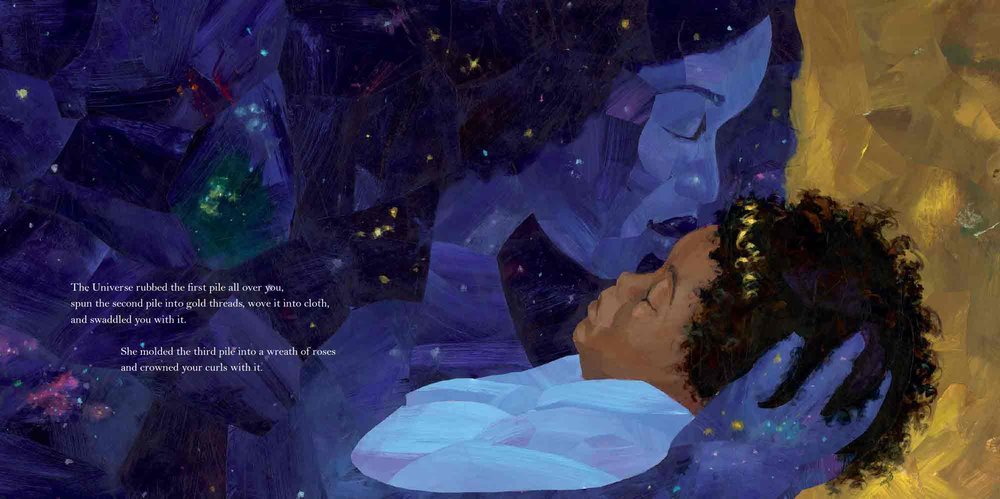
I was and still am amazed by the unconditional love expressed throughout her writing. The level of detail described from page to page, building to a crescendo on the last page — “I am a child of the universe, I am Black Gold.” It spoke deep within my spirit as a parent and creator of art. I doubt I’ll ever experience something like this again with another project because each project can be so different in theme, plot, lyrical tone, and color palette.

–

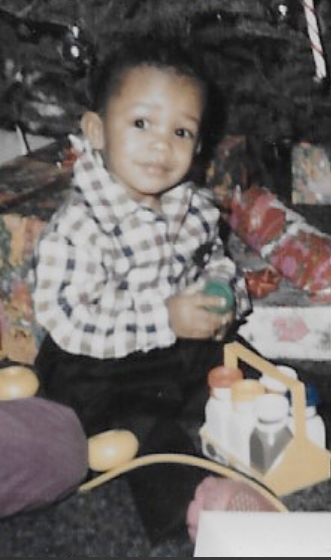
Young London’s first Christmas.

–

4) Here at James Preller Dot Com we love process, and appreciate any glimpses behind the scenes. It strikes me that Black Gold — a highly poetic, original creation myth — was an incredibly liberating book to illustrate because anything was possible. All that freedom. But also extremely difficult, because anything was possible. All that (scary) freedom. 

For example, here’s the text from six pages of the final book:

Then the universe breathed in and breathed out. Her power hovered around you.

You breathed in.
Her power flowed into you. You breathed out.

Alive!

How did you even begin tackling it?

Black Gold was such an experience for me. I drew from my journey to this moment as an illustrator and person, using symbolism and surrealism to convey Laura’s words in a spiritual way that is both honest and complementary to her beautiful words. Those pages spoke of rebirth, so what better way than to symbolize it than butterflies?

–

Lots of sketchbook work and research — thinking, looking at things that inspire me, journaling, drawing quick thumbnail studies, all of it builds my emotive visual library that pours onto the page.

–

–

–

–

After submitting a refined tighter sketch to the art director, I apply their ideas to another tighter sketch to share with them for any final feedback. Afterward, I put the final on the illustration board to start layering my mixed media elements — cut and ripped paper, tissue paper, acrylic paints, or whatever creates interesting textures. It’s my technique that is uniquely me and radiates throughout the spread.

–

5) Wow, what a stunning journey. Thank for you sharing your process so openly and honestly. Are we going to have to wait another five years for the next book?

Nope lol. This January, I have TWO books being released!! You So Black (Denene Millner Book/Simon & Schuster) is based on the titled poem of the amazing spoken word artist Theresa Tha S.O.N.G.B.I.R.D. And My Red, White and Blue, written by Alana Tyson (Philomel Books). Two vastly different books with powerful messages where Black children of all walks of life can find themselves and those around them.

–

–

Also, I’m currently working on three more picture books in various stages, along with my first authored book, so you’ll be seeing a lot more of me over the next five-plus years.

What good news — and what a happy interview with a true artist! I can’t wait to see what comes next. 

–

–

JAMES PRELLER is the author of many books for young readers, including Bystander, Upstander, Blood Mountain, Six Innings, All Welcome Here, and the popular Jigsaw Jones mystery series, along with the Scary Tales series. Look for his strange & mysterious middle-grade series, EXIT 13, on Scholastic Book Fairs and Book Clubs. It will be available in stores in February, 2023. 
–

5 QUESTIONS w/ Kyra Teis, author/illustrator of “Klezmer!”

–

My Nation of Readers will be thrilled to learn, one might hope, that I have decided to bring back my famous “5 Questions” interview format — but with a key difference.

This time I’m going to limit it to 5 actual questions.

Shocking, I know. 

In the past, I’d get too excited and ask too many questions and come away with a 2,000 word interview. Fun, but time-consuming for all concerned. And maybe a little bit daft.

Today I’m kicking off 5 Questions 2.0 with the preternaturally creative Kyra Teis. We’ll be focusing on her recent book, Klezmer! 

–
1) Kyra, you grew up in a household of creative people. I wonder if you can talk about that.
–

It’s true. Both my parents were artists — my father a painter, and my mother in textiles. Both had home studios and they gave my siblings and I full access to their materials and spaces. That said, because they were so knowledgable they were quite demanding — there was no, “That’s wonderful, dear! Let’s put this on the fridge.” It was more like, “That arm’s too long,” and “You need more contrast.” But overall, art was a way of life. Not something extra we added in. This picture is of me in 1976, I was six. At that time my mom was a weaver. She made us 1776 costumes and we went all around to craft fairs. She would make yarn on her spinning wheel while I sat at her feet carding wool.

–
–
2) I love your recent book, Klezmer! How did this particular book begin for you? A visual image? A phrase? A song?
–
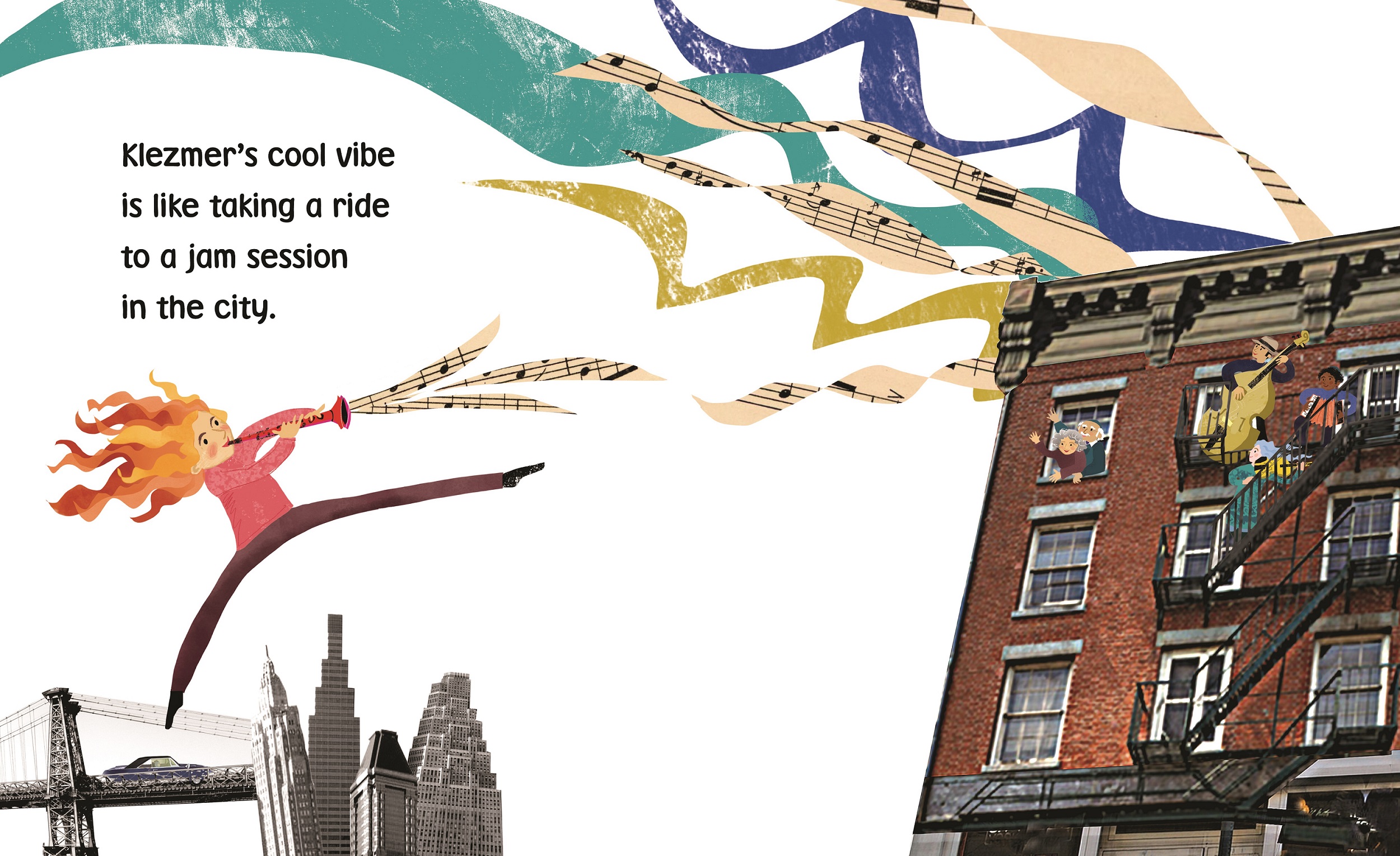
Thanks! This is the book I can point to and say: “This is everything I am!” When I first heard Klezmer music, I was like: What the heck is this crazy music? It’s sad, it’s happy. It’s fun, it’s serious. When I dug into the subject, I was struck how much the music itself echoes the Jewish religion/culture it was born out of: Global, but connected to its roots. Keeping a finger on happiness, even in the midst of tragedy. I played with drafts over about ten years trying to figure out how to represent those ideas.
–
–
3) You do an amazing job capturing the joyful vibrancy of klezmer music — both in the artwork and the text. Playful and buoyant. “Klezmer’s oldish, and newish, Like jazz, but it’s Jewish.”
–
What I love about klezmer as a music genre is its variety. Every musician gives it a unique twist — bringing in all different instruments, rhythms, sounds. I love to be surprised.
–
–
–
4) Your artwork seems to have evolved. The characters have a loose, rhythmic vibe — yet you incorporate collage techniques and even historical photos. It just feels to me like you were inspired and sort of let it all hang out with this book. 
–
I agree that my art has evolved. Some of that I owe to switching from traditional paper collage to digital. I had used paper collage for years in book illustration, but it became too heavy and static a medium for me. I wasn’t able to incorporate the energy of the hand-drawn line because I didn’t like the way lines would break over the edges of paper. To go digital, I scanned hundreds of my textural painted and blotted papers, I learned Photoshop (a year-long process!) and created about 20 portfolios worth of new artwork. After a while a new voice emerged. I like it: it still has the bright colors and deep texture of my earlier art, but it is much more gestural and layered.
–
–
5) When we first met more than 20 years ago, you had already experienced some success in children’s books. You had a passion for it and a knowledge of it. However, as it is for so many of us, the road has not always been smooth. Yet you’ve persevered. What has that experience been like? Any takeaways?
–
I’d rephrase that to say, the road hasn’t been a straight line. I’m at my best when I alternate time in my studio with epic projects involving lots of people and moving parts  — planning conferences for SCBWI; designing Nutcracker costumes for my daughter’s ballet school; helping friends’ political campaigns; starting a handmade clothing line — it’s all good, you know? I think the overall goal is to have a full and creative life. 
–
–
I love that answer. A full and creative life. Thank you, Kyra. I wish you success in all of your rich & varied artistic endeavors. Now I think I’ll go listen to some klezmer music . . . 
–
–
–
JAMES PRELLER is the author of many books for young readers, including Bystander, Upstander, Blood Mountain, Six Innings, All Welcome Here, and the popular Jigsaw Jones mystery series. Look for his strange & mysterious middle-grade series, EXIT 13, on Scholastic Book Fairs and Book Clubs. It will be available in stores in February, 2023. 
–

A Conversation with Debut Novelist E.L. Shen, Author of “The Comeback” — On the Writing Process, Ice Skating & Confronting Racism


“Maxine’s goal
was to go to the Olympics
where she would proudly represent
the United States.
But what do you do when people
don’t even think you belong in America?
How do you contend with that?“

–

–

There’s a long line of things I love — great poems, birds at my feeder, live music, sitting around a fire, a really good chicken salad sandwich, debut novelists, and on and on. But maybe most especially debut novelists (or illustrators, or anyone putting out their very first book into the world). What a moment in a life. It is joyful and thrilling and oddly anti-climactic. Everything and nothing changes. I met E.L. Shen at a benefit for Ronald McDonald House at The Book House in Stuyvesant Plaza, Albany, NY. I came away wanting to know more. And I wanted to point my little beam of light in her direction.

–

–

Thanks for stopping by, Elizabeth. I know that you grew up not far from where I live now, in upstate New York. Give us a little background? Did you want to be a writer from a young age? 

Thank you so much for having me! Yes, I grew up in the suburbs of Albany, not too far from Lake Placid, where my debut novel takes place. I think from the moment I was born, I knew I wanted to be a writer. In first grade, I created these little stories that I persuaded (read: forced) my teacher to put in the reading bins. That feeling of creating a story from nothing –- and of seeing other people read and enjoy it –- was addicting.

You got your BA at Barnard/Columbia with a concentration in creative writing. What did you learn there? Confession: I didn’t go to school for writing and I sometimes wonder what I missed. 

Gosh, I learned so much. In my classes, we dissected and deconstructed stories and novels -– not just on a “this flower is a symbol of her love” level, but on a “what was the author trying to do when invoking second person? Why is this paragraph where it is? What can we say about the pacing of the story?” level. We also often imitated authors as well to get a sense of what we liked about their styles and what we didn’t like. Imitation is a great way to fight writers’ block, and a useful tool in figuring out how you like to write, and how your style might stand out from others’. 

And after school, you went into children’s publishing. 

Yes! My turn for a confession: I quickly learned that being a full-time writer does not necessarily offer a lot of job security! I also really loved reading other people’s work and offering feedback –- this led me to deciding I wanted to become an editor. I specifically chose children’s books because I gravitated toward middle-grade and young adult stories in my free time. I love being an editor and an author; it’s a real privilege to see behind both sides of the curtain and to help other writers’ dreams comes true.

–

–

How did you come to settle on figure skating for your debut novel? 

So this is a funny story! I was an intern at Farrar Straus Giroux Books for Young Readers (FSG), an imprint of Macmillan Children’s Publishing Group, during my spring semester at Barnard. This internship happened to coincide with the 2018 Olympics. I would not stop talking about the Olympics, and specifically about figure skating, to anyone who would listen. I had figure skated from the age of 9 to 15 after watching the very iconic Disney movie, Ice Princess, and loved, loved, loved watching figure skating as an adult. An editor at FSG, Wes Adams, overheard me chattering endlessly about my skating background and my general love for the sport. One day, he came up to my desk (which was literally in the middle of the kitchen –- intern life!) and said he had always wanted a figure skating middle-grade story –- especially one that combats stereotypes about catty skaters. He asked me if I’d be interested in writing a book like this. At first, I thought he was joking. When I realized he was serious, I told him I’d think about it, but really needed to find a job first (after all, I was a graduating senior). Wes was very patient, and several months later, when I was finally ready to write this story, he was all ears.

Tell us about your process for developing the character of Maxine. Are you using index cards and elaborate notes? Sketching out character traits in a notebook? I imagine she’s a curious blend of you & not you. 

Maxine is indeed a blended me and not me. When I came up with this story, I knew that I wanted her to be Chinese American, like me. I also knew that I wanted her to be feisty and passionate –- traits that would help her a lot on the ice, and keep her competitive and ambitious. Like Maxine, I too, grew up in a mostly white suburb where I was bullied for my ethnicity. I knew that whatever Maxine experienced had to be the antithesis of who she was and strip of her power. On the ice, she felt strong, confident, sassy. But at school, a racist bully took all the wind out of her sails, leaving her a shell of who she was. That dichotomy was essential for me to explore –- especially since Maxine’s goal was to go to the Olympics where she would proudly represent the United States. But what do you do when people don’t even think you belong in America? How do you contend with that?

In terms of process, I am a big outliner. I first bullet-pointed plot ideas and notes in my Notes App on my computer because that seemed less scary/permanent than writing in Word (it’s purely a psychological tactic). Once I felt I had a clear idea, I outlined chapter-by-chapter to get a sense of pacing and characterization.  This step was very important in crafting Maxine’s rivalry and (spoiler!) eventual friendship with Hollie, a new girl at her rink. It forced me to me visualize the ebbs and flows of their relationship, and how they would both grow and change over the course of the book. 

Maxine seems to believe she’ll make it to the Olympics. In the book’s first paragraph, 12-year-old Maxine promises that she’ll skate in the Olympics. I read that as delusional. Not the dream but the extreme confidence. Was that your sense of it? 

Honestly, choosing to become a competitive figure skater is kind of delusional. You have to wake up at 5 AM to skate before school, you pay a ton of money on coaches, equipment, costumes, etc., and you give up a significant chunk of your social life to be on the ice. But if you really love it, if you feel like this is the thing that is pulling on your bones every time you wake up, you do it. And for a lot of skaters –- that sacrifice is worth it because they see the dream: the Olympics. For Maxine, she had to really believe in herself and feel extremely confident in that dream to feel like it was all worth it. 

At one point, Maxine blushes and senses that no one can see it through her tan skin. She thinks, “This is basically the only instance where I’m grateful to be Asian.” Was that true for you? Do you think that is true, or was true, for many Asian Americans? 

As a child, I harbored a lot of self-hatred, specifically around being Asian. Growing up, I was not surrounded by people who looked like me –- not in my town, not in media, and not even in books at the time. Unfortunately, I know this feeling of self-doubt is true for a lot of BIPOC kids today –- some have told me this in-person or emailed me about it. But I hope that as our worldviews progress, all marginalized children will become confident in their heritages and their identities. 

Maxine buys Magic Methods Eyelid Tape. I didn’t know that was a thing. Could you tell us about it? 

Eyelid tape is made up of tiny adhesive slivers you can dig into your eyelids to make them “wider” or “bigger.” Asian eyes tend to be more almond, while western European eyes tend to have more eyelid space. If you feel insecure about your Asian eyes, you can use eyelid tape, though I personally find that it often looks ridiculous, and caters to the idea that Western eyes are the most beautiful. It was something I tried to use as a kid and hilariously failed at executing, and it’s a one-two gut-punch for Maxine as she grapples with her bully’s comments about her eyes and her subsequent inability to change them. 

I admired how the book seamlessly transitioned from a discussion about eye makeup to a much deeper questioning about identity. At one point Maxine thinks, “I am not a nerd, but I am a chink.” Is that a thought you’ve experienced? 

It was important to me to highlight how beautiful Maxine was, and how, with the right guidance and support (another Asian skater who could teach her how to do makeup for Asian eyes, for example), she could finally feel beautiful, and take pride in her body and skin. At first, what Alex, the bully, said to her seeped into who she really thought she was, but over the course of the book, she gained pride in her identity –- much like myself!

This leads to a point when Maxine, with Hollie’s help, begins to practice snappy comebacks to Alex’s teasing. Tell us about that idea. 

The comeback list was derived from something I actually created as a kid. I made up insults and wrote down witty responses (and then memorized them!). I forced my friends to practice with me and needless to say, they were not exactly thrilled about this activity. I thought it was such a hilarious thing that I did so I included it in the book. Readers will have to see how that works out for Maxine! 😉 

Maxine is picked on — in subtle and more obvious ways — because she is different. In this case, Chinese. As you’ve said, some of that comes from your own experiences. How do you feel today about those kids who targeted you? How does an individual overcome those obstacles that get in the way of our sense of self-worth and identity? 

Bullying stems from the perpetrator’s insecurities and worldviews, and/or what they’re taught by their parents. There are always deeper things at play. I hope that my bullies have all grown and learned more about the world, and are thriving now. I think the greatest thing you can do when you’re bullied is tell someone –- a teacher, a friend, a parent. You’re not alone. And remember, you’re freaking amazing. No one is you; no one could ever be you, and I think that’s a pretty cool thing.

What’s next for E.L. Shen?

I have a young adult novel pitched as an Asian American Sisterhood of the Traveling Pants coming out in Summer 2023 from HarperCollins! And more middle-grade on the way –- stay tuned. ☺ 

Well, Elizabeth, I see that we’ve filled up all the available space on the interwebs. It’s been so nice getting to know you. I’ll be watching and rooting for you from the sidelines, sans skates.

Thank you so much for this wonderful chat! 

–

–