I was not exactly confident that we would make it out alive.
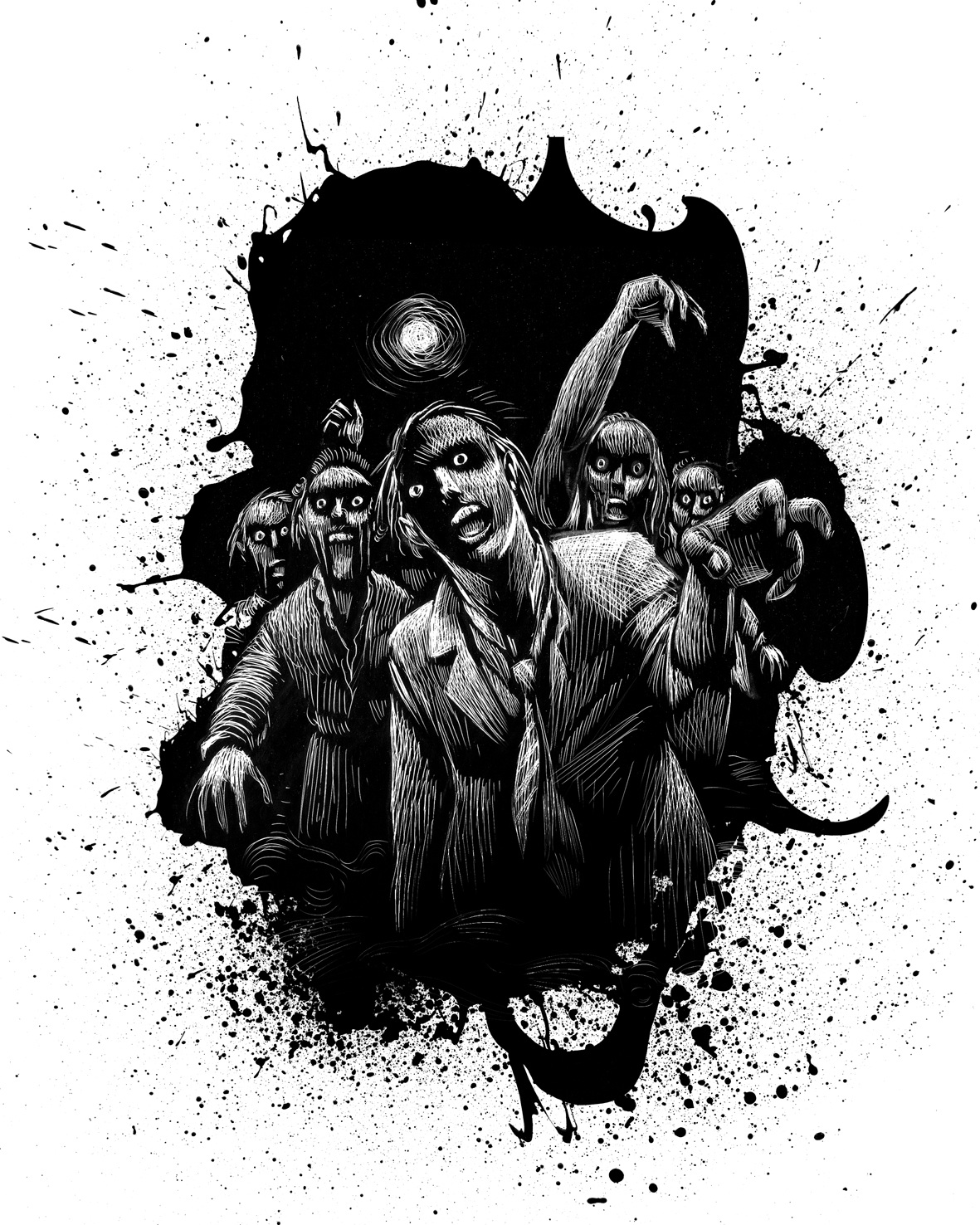
The hordes kept shuffling toward us out of the darkness, closer and closer they crept . . .
Art by Iacopo Bruno, from Good Night Zombie (Scary Tales #3), by James Preller.
Well, okay.
Let’s backtrack a minute.
I was in Austin, Texas, on a Saturday night, scheduled for a reading in the Texas State Cemetery with R.L. Stine. A creepy literature crawl in a graveyard. What mad genius, I wondered, devises such things?
I met Bob in his 15th-floor hotel room — yes, he lets me call him “Bob,” a name that no one under the age of seven actually bears anymore, they’re all named “Brendan” and “Colby” and “Luke.” We sat and chatted for half an hour or so, the old days at Scholastic, our experiences with school visits, this and that and whatnot. Time passed amiably. At seven, we crept to the cemetery, where we quickly learned that Austin was more than good beer, righteous food, and great live music.
It’s a town that loves books.
Forty-five minutes ahead of schedule, hundreds of R.L. Stine fans had already gathered amidst a sea of tombstones. It was an incredible vision. Many sat under the high flood lights, but others sat on the edges, and waited patiently in the graveyard’s deeper, darker, gloomier pastures.
My task was to serve as the opening act, like a lone slice of cucumber on a plate. Bon appetit! Bob was the hearty main course and the reason they came, so ravenous. By 8:00, it was time to get the show started. I spoke, elicited a laugh or two, told them that the scariest thing I ever encountered was kids who didn’t like books (because they grew up and voted, and sometimes even got elected to Congress). I read the “Bloody Mary” section from Home Sweet Horror, the creepiest part of the first book in my SCARY TALES series. I had the sense to keep it brief, with no intention of messing with Texas. Next I had the pleasure, the honor, to introduce the beloved author, R.L. Stine.
Beloved? Revered? Idolized? Worshipped? Words fail me. What I witnessed was that deep connection between reader and book. I saw what it was all about. The power of the word.
The crowd, I mean to say, went a little bananas.
They love him, you see. On a deep and profound level, the books of R.L. Stine had impacted these people — and they were there to see the man, to shake his hand, to thank him, to tell him what those stories meant to their lives.
The first books they ever really, really loved.
Goosebumps. Fear Street. The most trusted name in book-learnin’: R.L. Stine.
After the reading, it was time for us to sign. They don’t really do lines in Texas, unless, I guess, it’s for dancing. Somebody should have brought a fiddle. Fortunately a couple of good-natured cops came by restore order (at the end, after thank you’s, they even asked us both to sign a few books for ’em, which we gratefully did).
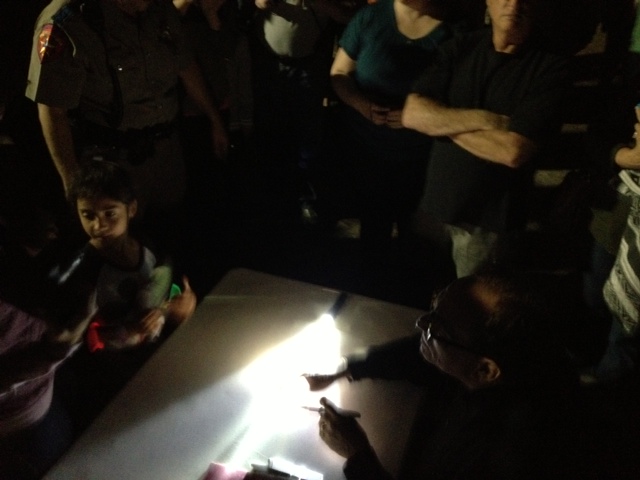
Of course, R.L. was the star attraction. I mostly sat nearby, making sure Bob had water, a Sharpie, a small flashlight to see, and, sure, I even signed a few books of my own, basking in that borrowed light. I took a few lousy snapshots, which you see here.
The entire night was a revelation and a confirmation. The power of story. The impact of books. And how lucky I was to do this job, to be in this place, to share in these moments.
Near 10:00, the last of the line had finally wound down. Time to go.
We headed to the car through the big iron gate, which swung shut behind us with a clang.
Bob smiled. “It was a good night,” he said.
“Yes,” I agreed. “It was.”
And I thanked R.L. Stine — Bob, my friend — for the gift of letting me share a small part of it. And to see again what it can mean to write a book, and for that book to be read, and for it to be loved by someone, by anyone, somewhere, anywhere.
It’s a beautiful thing. Even in a graveyard. Even at night. Especially with R.L. Stine.
NOTE: I’ve been blogging at this site since May, 2008, which is like 120 in Blogger’s Years. My strong suspicion is that a lot of the oldies-but-goodies have not been seen by my current readership, so I decided to give this one a new airing. I still often think of Mr. Newkirk’s great book and insights. This was originally posted on March 6, 2011.
I recently read Thomas Newkirk’s outstanding book, Misreading Masculinity: Boys, Literacy, and Popular Culture. I sent him a complimentary email and, to my great surprise, he agreed to an interview. My reasons were selfish. I simply wanted to learn more from this very smart, insightful man.
Back in college, I had an English teacher who taught me an important question: So what? I mean, okay, boys don’t read as much as girls. They do other things well. What’s the big deal?
I think there are two responses. Reading well is so tied to school success — and to liking school — that it is unethical to write off a big percentage of boys as non-readers.It may have been possible in previous times to drop out or barely finish school and go on to good jobs. But that is not the case now.
I think the bigger argument that reading is a deeply pleasurable and enlightening activity — or can be. I don’t want boys to miss out on it.
Thomas Newkirk.
One of the things I loved about your book was how you wove in small pieces of memoir, little stories from your life, and connected those experiences to the book’s larger themes. You tell a wonderful story about how as a young man you visited the library in Harvard. You saw a dusty old scholar with a suitcase full of index cards and suddenly recognized the absolute weirdness of the literary life. Silent, isolated, inactive –- and how utterly strange it must appear to a non-reader. As book lovers, I don’t think we fully appreciate the perspective of the non-reader, how foreign it must look to a boy who typically chooses action, companionship, and noise.
Reading doesn’t have to be silent and isolated — although it must appear that way to readers who have never been in what Nancie Atwell calls “the reading zone.” When we enter that zone — identifying with characters, visualizing, hearing the voices of the narrator and characters — we are NOT alone. And if reading can be shared in friendship groups, talked about, it becomes even more social. C.S. Lewis once said that we read to learn that we are not alone, and I believe that.
You made a funny comment, when exploring the tension between literacy and the code of the real boy: “What better disguise could there be for Superman than to turn him into a writer!” It’s just not a very masculine endeavor, is it, shutting one’s self away from the active world, isolated and alone, sitting in a chair in silence. How much more un-boy can you get?
But I think technology is changing that. To compose with the resources of the Internet — to make digital stories, to navigate the various social networks, to create animation. We have recently seen how exploiting these social networks can bring down dictators. This is writing that is anything but isolated. Maybe school writing and reading is too isolated, but digital literacy is anything but.
At one point, you note, “Boys often feel than an open show of enthusiasm for schoolwork, particularly in the language arts, can undermine their identity as a ‘real boy.’” It seems like boy culture –- the codes of behavior — can be a major obstacle for boy readers.
Absolutely. I remember the African American journalist comment on the social pressure for African American boys to see trying at school as being “white.” His comment was: “With friends like that who needs enemies?” One reason parents look desperately for charter and private schools is to find places where trying and excelling at academics is part of the school culture.
As an adult, I enjoy reading closely observed, realistic fiction. Life’s little moments. I love Richard Ford and nothing ever happens in his novels. It takes him twelve pages to go to the store to pick up some muffins. And that fits in perfectly with a classroom emphasis on memoir writing. But I can vividly recall that as a boy I wanted things to HAPPEN in my stories. Otherwise, why write about it? So I think when boys are pushed to write about, say, their trip to the beach, about real things, they are bored and disappointed. A bomb didn’t explode? A shark didn’t attack? Why bother writing about eating chicken salad sandwiches with Uncle Max?
There has been a lot of the imposition of adult tastes on students — who may find fantasy and adventure genres more appealing. I don’t think that means that we give up on asking students to read and write realistic genres — but we need to be open to other tastes as well. Fantasy allows us to escape, to be bigger and braver than we are, to suspend the limitations of time and space. I think we all need that freedom as well.
Many years ago, not long after 9/11, I volunteered in my oldest son’s 3rd grade classroom. One boy, typical of many you discuss in Misreading Masculinity, wrote a story that included exploding bombs. I learned from his teacher that the mandated response was for us to forward the story to a school counselor who would contact the boy’s parents: “Billy’s writing about bombs again!”
Yes, unfortunately, many schools have given up on making meaningful distinctions here. I have never understood, for example, why it is OK to read about violence, even the gruesome violence of Beowulf, and that’s ok, even culturally valued. But if a kid writes something like that, it’s off to the guidance counselor. For me the key question is this: does the writing seem threatening to anyone; does it make anyone feel unsafe or targeted. If is does, it fails to meet the basic rules of any school. But if a kid writes a Star Wars take-off and a space ship explodes, does anybody really feel threatened by that?
I guess it’s natural for us, as enlightened adults, to want boys, or any students, to value what we value. We want them to read and appreciate what we consider to be good books. When those values aren’t shared –- when, say, they like low-brow stuff, AKA, “crap” –- the tendency is for us to see it as a deficiency in them. There’s something wrong with boys.
I think we all like some AKA crap. No one is high brow all the time. So it seems to me OK to ask kids to value what we value; but we also have to understand the appeal of what they like. It can’t be all one or the other. We have values and goals for their reading and writing; but we won’t win the cooperation of students if our attitude toward their culture is one of dismissal. Teaching is a cross-generational trade.
As a man who came to reading through my boyhood love of sports, where I’d dive into the morning paper (pre-ESPN, thank goodness) for the stats and scores and stories, I liked that you included a nod to “the literature of sports tables.” I can read a box score and imagine a half-dozen story lines.
Yes, it’s so rich in information — the scores by quarters or innings. Who’s hot and who’s not. It is still my favorite page in the sports section. I am convinced that one advantage boys have in math is their early immersion in sports statistics.
At times you use the term, “school literacy.” How do you distinguish that from ordinary literacy? Is it a matter of “school-approved” literacy?
School literacy is necessarily a limited subset of possible literacies. It traditionally focuses on the verbal over the visual; on high culture over popular culture; on print over oral expression; on realism over fantasy and escapism; on extended formal writing over informal and expressive writing.
It resonated with me when you gave a historical perspective on oral vs. silent reading, linking it to a “cult of efficiency.” We know that speed readers are taught to eliminate sub-vocalization, and instead to scan chunks of language, eliminating meaningless words. Yet as a writer, some of the best advice I can give is to read what you’ve written aloud, to really hear what you’ve written, the sound and rhythm of the words. That is, it’s the total opposite of what most of us do in silent, sustained reading!
I am convinced that even when we read “silently” we are attending to the intonations of language. In other words, “silent” reading is not really silent. That’s why writers will often read their work aloud to revise—even though almost all their readers will not read it aloud. But I would argue that they still register sound in some way, internally. I will expand that idea in my new book, The Case for Slow Reading. Stay tuned.
You argue for television as a legitimate source of writing topics. Why do you see television as an under-valued resource?
I think schools see TV, the Internet, and video games as the enemy. And this makes some sense—studies show that many students spend way too much time with this media, often multitasking. But I believe that TV can teach dialogue, conflict, characterization, narrative, humor. The visual narratives can provide scaffolds, or cultural props, for students to use in their writing — if teachers let them. They can write parodies or alternative versions with their friends co-exiting with fictional characters — Darth Vadar and the kid down the street — all in the same adventure.
I hesitate before opening this can of worms, since much of my livelihood depends upon the approval of gatekeepers (editors, teachers, librarians, bloggers, book purchasers) who are overwhelmingly female. Clearly, the world of children’s books is a woman’s world. Is that, in your opinion, part of the problem when it comes to boys literacy?
One challenge is to look at books from the boy’s point of view. I don’t think gender is an absolute barrier here. What’s needed is an open mind, a sense of curiosity. What makes this boy tick? What are the themes, passions, competencies in his life that I can build on? To teach we all need to get outside ourselves, and into someone else’s skin. I know many female teachers who are wonderful at this. And it seems to me that when a boy senses a female teacher cares about what he cares about, that boy will be open to other things the teacher asks of him.
Finally, can you recommend any other books on this topic?
I’d read Ralph Fletcher’s Boy Writers. I’d also watch the PBS documentary “Raising Cain.”
I loved Fletcher’s book and commented on it before, so I second the nomination. Thanks, Thomas, for taking the time out to answer my questions. You’ve certainly given me a lot to think about. And I’ll be looking forward to your new book, The Case for Slow Reading. I posted on that subject back in September, 2010, and led with a quote by . . . Thomas Newkirk: “Teachers can enhance students’ pleasure and success in reading by showing them how to slow down and savor what they read.”
My best to you. Keep up the great work. And here’s a clip from “Raising Cain.”
Thomas Newkirk is Professor of English at the University of New Hampshire. He has studied literacy learning at a variety of educational levels — from preschool to college. His book,Misreading Masculinity, was cited by Instructor Magazine as one of the most significant books for teachers in the past decade. He is also the author of Holding On to Good Ideas in a Time of Bad Ones: Six Literacy Ideas Worth Fighting For and The Performance of Self in Student Writing.
Just passing along an article by the very kind Sally Lodge, who phoned me a couple of weeks back. We chatted for a while and the result of that conversation was this article that appeared in a special edition of Publishers Weekly for Book Expo America (BEA).
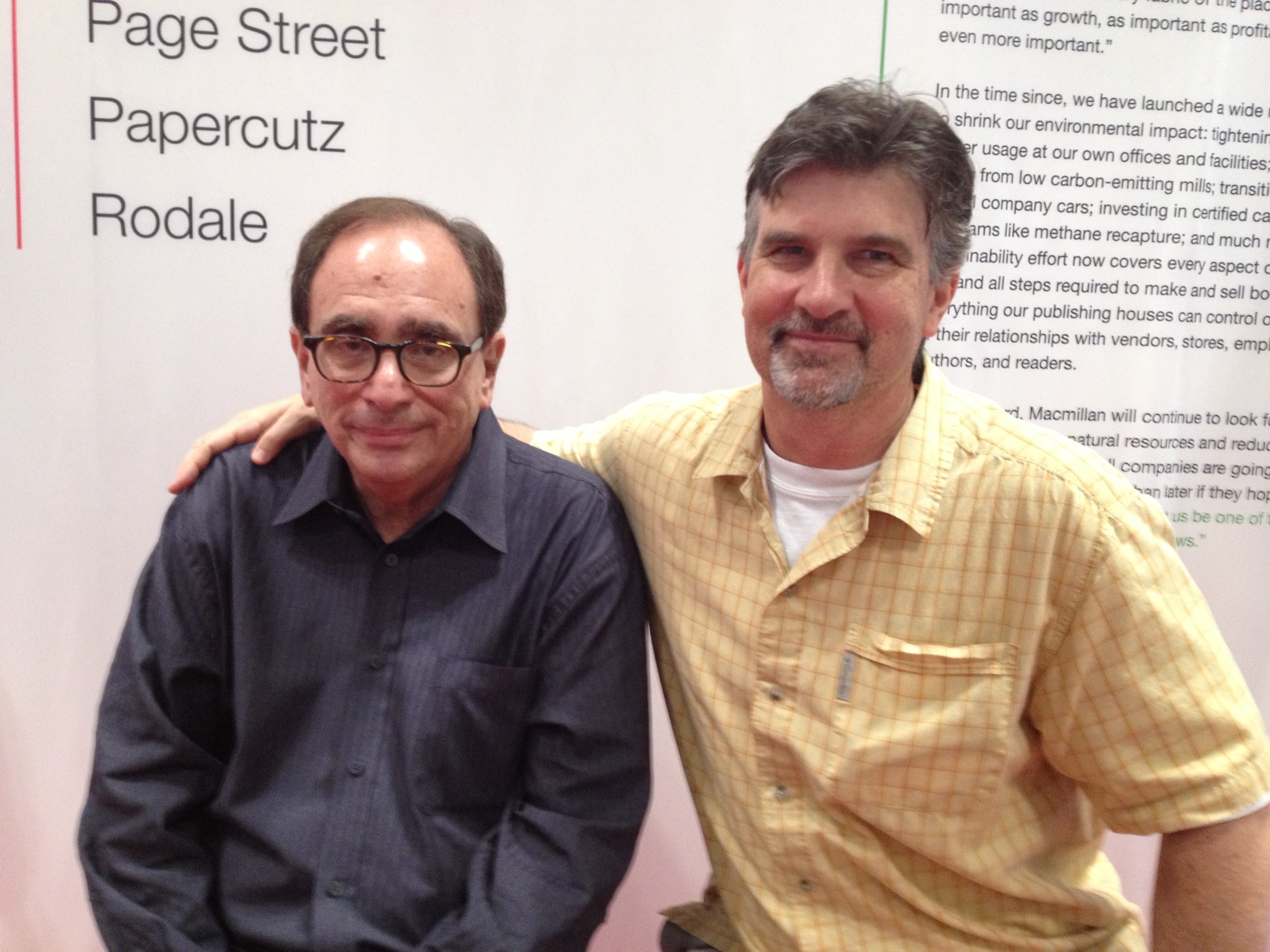
And yes, while I was in NYC, I stood next to R.L. Stine and tried to hug him. Thanks to Kathryn Little for the snap!
He might not have loved it, hard to say. But actually, we spoke amiably in front of a video camera, so maybe a cool clip will come of it at some point down the road. But I digress!
Here’s the article:
The author of the Jigsaw Jones Mysteries ventures onto chilling turf in his latest series, Scary Tales, which premieres in July with Home Sweet Horror. James Preller calls the project, published by Feiwel and Friends, a “massive departure for me. I’ve always really adhered to realistic fiction. If someone had said that I would be writing a novel about zombies outside of a school—that happens in the third book—I would have said, ‘That’s ridiculous!’ But what’s interesting to me is how the other characters, ordinary people, respond to and interact with those zombies. With this series, I’m giving myself new freedom, and I’m really having fun with it.”
Preller’s inspiration for Scary Tales had several sources. His most recent fiction has been geared to older readers, including middle-grade novels Six Innings and Bystander, and Before You Go, his debut YA. “I hadn’t written anything for the second- and third-grade audience for a while, and I wanted to get back to that,” he says. “I hear from teachers and librarians that kids love scary books and that there isn’t much that is fresh and new in that area.”
The author’s fondness for old Twilight Zone episodes also fueled his imagination. “I love that the show spans a number of genres, from science fiction to gangster stories,” he says. “I want to do something similar with Scary Tales. I see these books existing on a broader canvas than just being scary. The series is not going to be just one ghost story after another. Each will be different, though all will have an intellectual twist at the end that will blow readers’ minds a little.”
Preller is hopeful that Scary Tales will provide kids with “a positive, fun reading experience” and will snare reluctant readers. “To attract reluctant readers who might need an easier read, a book can’t look babyish,” he observes. “But if it looks cool, they’ll pick it up. I am hoping the series will reach those readers, especially boys. That is a very important readership for me — reaching them is something I feel passionate about.”
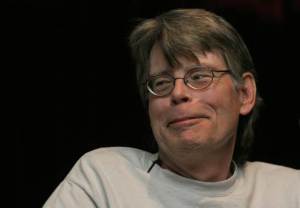
I have an uncomplicated relationship with the books of Stephen King.
For the longest time, I ignored ’em.
The problem was two-fold:
1) for whatever reason, I didn’t get around to them in high school, which was too bad, because of what happened next;
2) next, I went to college and got educated.
College can mess you up. I was a Lit major, trying my hardest to be a good student and a sublime writer, and for the most part that meant dealing with IMPORTANT BOOKS and LITERARY WRITERS and DIFFICULT TEXTS. I don’t regret any of that — it’s where I learned to love books, and I enjoyed many great teachers — but I wish somebody said, “You know, don’t underestimate the value of a good story.”
It sound ridiculous, of course, since “a good story” is only everything.
But it took me a long time to grasp that plain fact. My head was in the clouds; my nose was in the air.
In college, I learned a lot, and later in life I had to unlearn a lot.
So I’ve come to Stephen King late in life. And now that I’m here I am filled with great respect for the man and the writer. I previously wrote about his excellent book on writing, titled — wait for it — On Writing. I’m not an expert on these things, but I found it to be the best, most relatable, no-nonsense book on THE JOB (& CRAFT) of writing as anything I’ve come across before or since.
I’m currently reading 11/22/63, King’s great novel about time travel and a man who seeks to change history by thwarting the Kennedy assassination.
Here’s a few lines from p. 150, which struck me as great advice and, for a writer with my flaws and proclivities, an essential reminder. Maybe it will help you, too?
“In both fiction and nonfiction, there’s only one question and one answer. What happened? the reader asks. This is what happened, the writer responds. This . . . and this . . . and this, too. Keep it simple. It’s the only sure way home.”
I posted this long ago, but thought I’d hurl it into the maw of the internet once more just in case you didn’t catch it the first time around:
Here’s a quick recap of Stephen King’s 12 guidelines:
1. Be talented
2. Be neat
3. Be self-critical
4. Remove every extraneous word
5. Never look at a reference book while doing a first draft
For the paperback publication of my young adult novel, BEFORE YOU GO, I was asked to answer a few interview questions for the back matter.
I didn’t really intend to share this here, but given recent events, and the fact I just stumbled upon it again, well, sometimes you have to trust in coincidence. Here you go:
Losing a peer when you are young is especially difficult. Do you have any advice for someone who has experienced this?
Advice? My first impulse is to give sympathy, to say how sorry I am, and to recognize that I cannot know exactly what they are going through. Life can feel impossibly hard at times. I remember when my oldest son — he’s in college now — was fighting cancer at age two. I was newly divorced, living in a stupid apartment, just a number of things going seriously haywire at the same time. My crazy “whirled.” There were days when I didn’t want to hang out or do much of anything. But here’s the thing: you do what you must do. The bare essentials. So I washed the dishes in the sink. Folded the laundry. Put on some music, flipped through a magazine, checked the scores in a baseball game, noticed how the leaves turned color outside my window. Life itself is this tremendous vital force. It leaks into everything. And if you allow it, life will pull you through. Before you know it, almost by accident, you are living again, swimming in that great river. You learn that the heavy weight you carry becomes lighter, more buoyant, and at times you temporarily forget. At the same time, the remembering is so important. Life shapes us, makes us who we are –- we endure the good and the devastating. The important thing, I think, is to keep your heart open, even though it hurts, and try to appreciate that you are loved. And, well, you put one foot in front of the other. Day by day. After a while you realize you’ve traveled a great distance. Your back has grown strong. And you are living again.







)

