Archive for Interviews & Appreciations

One Novel with a Perfect Ending

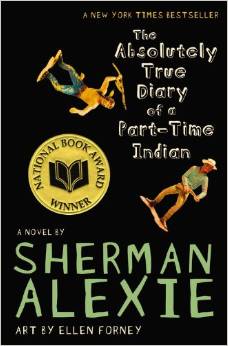
UnknownI finally got around to reading Sherman Alexie’s bestseller, The Absolutely True Diary of a Part-Time Indian. There’s just times in your life when you’ve got to rectify old wrongs, and this was one of them. I had to read that book.

I’d heard that it was a great book from many sources, including some trusted friends. (A curious phrase, by the way, “trusted friends.” As opposed to all those other friends we have, with crappy taste, the friends we can’t possibly trust.)

So I took Alexie’s book out of the library and read it. Now I am a member of the club and say without hesitation: Stop wasting your life and read it already! Today I’m not looking to review a book that’s already been reviewed hundreds of times. My focus is on the book’s final two paragraphs. To me, those six sentences felt exactly right, forming a poignant, understated conclusion.

I don’t think that reproducing it here involves any spoilers, or anything that could diminish your enjoyment of the book, so here goes:

Rowdy and I played one-on-one for hours. We played until dark. We played until the streetlights lit up the court. We played until the bats swooped down at our heads. We played until the moon was huge and golden and perfect in the dark sky.

We didn’t keep score.

I love the repetition of “we played,” repeated four times, the rhythmic, accumulative power of that device, the simplicity of the word choice, the interplay between light and dark, and that great, four-word conclusion. We didn’t keep score. Perfection.

Back four years ago, I wrote a decent post titled “Best Last Lines from Books,” and I think you might enjoy it. So click away, folks. It’s absolutely free.

A Children’s Book That Left a Lasting Impression

I was recently contacted by a journalist for a national newspaper who wanted me to name a book I read as a child that left a lasting impression.

That’s a tough question for me, because I sense that my answer is never exactly what the questioner is seeking. I don’t have a poignant story about Charlotte’s Web or Harriet the Spy, that glorious day when I suddenly knew that reading was for me, and forever. I can’t describe in loving detail the book I encountered as a fresh-faced welp. (Though I do recall loving Splish, Splash, and Splush.)

Nonetheless I did somehow grow up to become an author, and therefore my answer is, I guess, legitimate. It’s the only story I’ve got.

Here’s how I replied, limited to 150 words:

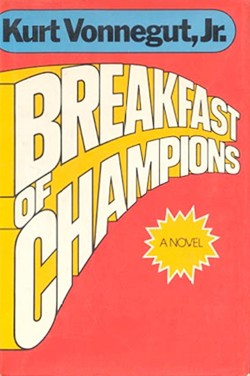
Born in 1961, I have no memory of my parents reading to me. That’s not a complaint, by the way. I grew up surrounded by six older siblings and they were (mostly) all readers. I guess I got the message by sheer proximity. As a baseball-mad boy in a world without ESPN, I devoured the sports pages in the daily newspaper. Those were the first writers I desperately needed. By age 13, I encountered Kurt Vonnegut’s “Breakfast of Champions.” It was funny and easy to read. There was no YA back then, my generation naturally graduated to Steinbeck, Bradbury, Brautigan, Vonnegut, Plath, whomever. “Breakfast” blew me away. Here was something as devilish as the kid in the back row, irreverent, rebellious, hilarious, wild. In a word, subversive. In those pages I first recognized the possibility that a book could be supremely cool. Thanks, Kurt.

A Perfect Passage from THE ROUND HOUSE by Louise Erdrich

No offense to any librarians out there, but I prefer to own books, not borrow them. I realize there’s a financial downside to my predilection, but what can I say? It feels good to support the industry, the book stores, the publishers, the authors themselves. If I can manage it, I don’t mind spending the money on books.

For starters, I like having them around, living in my rooms. Books make great furniture and, in a way, furnaces: they warm homes.

Secondly, I usually read with a pen in my hand. I underline passages, write comments, exclamation points, stars, notes and complaints. It is the dying art of marginalia, a direct reader-response. I can’t do that with library books, and Post-It Notes simply do not satisfy.

I’ve been on nice reading streak lately — have picked out some good ones. I just finished THE MARTIAN by Andy Weir. Fabulously entertaining, and a celebration of science and the intelligence of man. A geek-hero who survives through his attitude, his determination, and his brilliant mind.

Before that, I read THE ROUND HOUSE by Louise Erdrich. I loved it, every word. What a great writer. Seamless sentences, never a crack showing, and such human insight. A writer with soul. But I’ve got a problem and you can probably guess it: I borrowed the book from my local library and it’s past due.

I’ve been reluctant to return it, to drop it into the slot and hear the dull thunk as it hits the bin. Gone, gone, gone. My book no more.

One first-world problem is that I’ve been rereading, almost daily, the book’s perfect last paragraph. Over and over I return to it, stunned and speechless. That penultimate sentence, especially. What a beautiful evocation of lost innocence, the crossing over into something harder, more brutal and cold, adulthood and loss, “when we all realized we were old.”

I really didn’t want to let the book go, and maybe I’ll buy a copy for myself one day. In the meantime, I’ll type out that last paragraph here, so I’ll have it safely tucked away in the white, high-ceilinged halls of cyberspace. I don’t think there’s any spoilers revealed, it’s not that kind of book. A 13-year-old boy and his parents return home after a long drive.

Quick aside: I don’t play a musical instrument, but I love music. One of the things I’ve always envied about musicians is that they can play all these great songs, have those enduring melodies and fat riffs run through the fingers as they channel greatness.

That’s how I feel typing this passage from Louise Erdrich. Like I’m playing the guitar part from “And Your Bird Can Sing.”

How I wish that I could write as simply, as beautifully.

– – – – –

IN ALL THOSE miles, in all those hours, in all that air rushing by and sky coming at us, blending into the next horizon, then the one after that, in all that time there was nothing to be said. I cannot remember speaking and I cannot remember my mother or my father speaking. I knew that they knew everything. The sentence was to endure. Nobody shed tears and there was no anger. My mother or my father drove, gripping the wheel with neutral concentration. I don’t remember that they even looked at me or I at them after the shock of that first moment when we all realized we were old. I do remember, though, the familiar side of the roadside cafe just before we would cross the reservation line. On every one of my childhood trips that place was always a stop for ice cream, coffee and a newspaper, pie. It was always what my father called the last leg of the journey. But we did not stop this time. We passed over in a sweep of sorrow that would persist into our small forever. We just kept going.

My Interview at “Author Turf”

I was recently invited for an interview by Brittney Breakey over at AUTHOR TURF. Brittney has really accomplished a lot with her site. It’s worth checking out. She’s recently interviewed Holly Goldberg Sloan, Sally Nicholls, Gennifer Choldenko, Jo Knowles, Kathryn Erskine . . . and my great pal, Lewis Buzbee.

For me, that’s a double-edged sword. I’ll be honest, I’ve always hoped to be the kind of person who somebody wanted to interview. It’s an incredible compliment. And a true honor.

In my career, some of the first work I ever did was interviews of authors for promotional brochures. I think Ann McGovern was my first interview, back when I worked as a junior copywriter for Scholastic. Or it might have been Johanna Hurwitz. I don’t think I saved them. This would have been in 1985, I guess. Life went on and I’ve interviewed some talented authors and illustrators over the years.

You’d think I’d have learned some things along the line, but my basic feeling is usually one of disorientation, a sense that I have no idea what I’m doing, most likely saying the wrong things, awkwardly. Oh well.

I do have lucid moments, times when I think, “Okay, not terrible.” But in general I can’t read things like this without wincing, without twitching and blinking too often. I don’t know, it’s weird. I try to be honest, authentic, and hope for the best.

Below, you’ll find a brief excerpt of a much longer interview. Click here for the whole shebang.

What’s the worst thing you did as a kid?

It’s interesting you ask this, because I recently wrote about it in my journal. A theme that I’m exploring in the book I currently writing (or should be writing), which is a quasi-sequel to BYSTANDER. I have superstitions about talking about books before they are finished, but I’ll say this: In the summer between 7th and 8th grade, a girl in my homeroom died unexpectedly. I didn’t know her well, and wouldn’t call her a friend. When I first heard about Barbara’s death, I was with a bunch of friends –- I can picture it vividly, a bunch of us lounging around — and I said something dumb, snarky, immature. Of course, the death of a peer was completely new to me, a big deal, and I didn’t know how to react. I still feel a sense of shame about it, across these forty years, that one dumb thing I said that no one else even noticed. I’ve been reflecting a lot about identity lately, the idea of self not as a revelation, but as a made thing. Something you earn. Bryan Stevenson gave an incredible presentation for TED Talks -– everyone in America should Youtube it -– and he said, “I’ve come to understand and to believe that each of us is more than the worst thing we’ve ever done.” That’s a huge, complicated, controversial idea –- and it speaks directly to the topic of my next book. [NOTE: I’ve embedded Stevenson’s talk, below.]

Was there ever a time in your writing career where you wanted to seriously give up? If so, how did you find the motivation to continue?

Yes, I’ve wanted to quit. Absolutely. Mostly because it’s hard, and because I’ve felt (and still feel, though less so) insecure about my own ability –- that I was a pretender, a self-deceiver, a fake. Also, it’s a bunny-eat-bunny business that can crush your soul at times. As a husband and father, I’ve worried about my ability to provide for my family, to keep paying the bills. But that’s life, right? You have to keep getting up. You can’t just lie there on the canvas. That said: Every day I feel blessed that I can do this for a living. The hard is what makes the good.

What’s your favorite writing quote?

It’s not a quote, so much as an attitude about doing the work, a sort of blue collar distrust of pretentiousness. In a phrase, shut up, sit down, and write. Or not! But either way, shut up. It’s hard, writers are told that we need to promote ourselves, we need to “have a presence” on the web, we need to “get out there.” And I just keep thinking, we need to write great books. That’s all that matters.

Is there anything you find particularly challenging in writing? What comes easily?

The whole thing is a challenge. One thing about having published a bunch of things over a long period of time is that I’ve come to understand that each book is its own, self-contained thing. You write the story that’s in front of you. Then you write the next one. And the next. You don’t control what happens after that and, on good days, you accept that plain fact.

You need to a flashplayer enabled browser to view this YouTube video

Barbara Park: A Conversation Remembered

“I happen to think that a book is of extraordinary value

if it gives the reader nothing more than a smile or two.

It’s perfectly okay to take a book, read it, have a good time,

giggle and laugh — and turn off the TV. I love that.”

— Barbara Park (1947-2013)

–

I was surprised and saddened to read that Barbara Park passed away on November 15th at the young age of 66. I never met Barbara in person, but I certainly got a strong sense of Barbara through her books. Every reader knows and feels this experience. When we read the best books, when we feel that electric connection, there is a communion that endures beyond time and space and even death.

In my career, I’ve had the opportunity to interview more than a hundred authors and illustrators. One of them was Barbara Park, who was genuine in every way. We spoke sometime in the late ’90s,  and a bunch of those interviews were later compiled in a Scholastic Professional Book called, rather klunkily: The Big Book of Picture-Book Authors & Illustrators.

Good luck finding it. The book is long out of print (big sigh), but there are treasures within. It’s worth seeking out on eBay or wherever. I seriously wish I could write another someday.

I enjoyed memorable, lively conversations with so many great artists. A few of my favorites were Molly Bang, Aliki Brandenberg, Ashley Bryan, Barbara Cooney, Mem Fox, Kevin Henkes, Karla Kuskin, James Marshall, Bill Martin, Patricia Polacco, Jack Prelutsky, Faith Ringgold, Lane Smith, Peter Spier, Bernard Waber, Vera B. Williams, Charlotte Zolotow . . . and, of course, Barbara Park.

Barbara was warm, and kind, and modest, and funny, and absolutely genuine, just as you’d expect.

Here’s what ended up in the book, which was intended to be shared with students:

Best-selling author Barbara Park did not take the usual path to becoming a writer. “As a kid, I didn’t even read much,” Barbara confesses. “I bought books from the school book club because I liked the smell of them. It was nice to have this pile of new books. But I really had no great desire to read them!”

Barbara was a lively, active child with a motormouth and a sharp sense of humor. She had a great many interests, but writing was not one of them. “To me, writing was an assignment, period. I was no particularly imaginative. I didn’t sit around and make up stories to entertain my friends. But I was always the class clown. In high school I was voted ‘Wittiest,’ which, let’s be honest, is just a nice way of saying ‘Goofy!'”

It wasn’t until after college, marriage, and the birth of two children, that Barbara began to think seriously about writing. “I wanted to see if I could put my sense of humor to work. Because, sad to say, it was the only thing for which I’d ever got any recognition. I thought, Maybe I can write funny.”

Working at home while her two boys were in school, Barbara concentrated on books for middle-grade readers. Barbara lists The Kid in the Red Jacket, My Mother Got Married (and Other Disasters), and Mike Harte Was Here as personal favorites. She considers her best work to be Mike Harte Was Here. Many readers agree. In a stunning achievement, Barbara addresses a boy’s tragic, accidental death with writing that is at once deeply heartfelt and — amazingly — joyously funny.

In all of her books, no matter the seriousness of the theme, Barbara’s humor spontaneously bubbles to the surface. In fact, Barbara has made something of a career out of focusing on funny, irreverent, wisecracking kids who, like her, just can’t walk away from a punch line.

Though Barbara’s books are moral in the truest sense of the word, she steers clear of heavy messages and “life lessons.” Says Barbara, “I happen to think that a book is of extraordinary value if it gives the reader nothing more than a smile or two. It’s perfectly okay to take a book, read it, have a good time, giggle and laugh — and turn off the TV. I love that.”

In the early 1990s, Barbara was approached by Random House with the idea of writing a series for younger readers. It scared her half to death. Barbara admits, “There was some question as to whether or not my dry sense of humor would be picked up by younger kids.”

In the end Barbara decided that she’d have to write to please herself, to be true to her own sensibilities. “I can’t change my sense of humor,” Barbara explains. “If I did, it wouldn’t even be me trying to write this book. It would be me trying to write like somebody who didn’t think like me!”

Barbara soon created the irrepressible character Junie B. Jones. This best-selling children’s character, who often said and did all the wrong things, elbowed her way into the spotlight. Barbara didn’t have to look far for inspiration. “Junie B. is me in an exaggerated form,” Barbara admits. “I think the core of most of my characters is me. I mean, where else is it going to come from? It’s got to be from you.”

Though Junie B. is in kindergarten (with a move to first grade coming soon), Barbara has an uncanny knack for inhabiting her world. She says, “I’ve never had a problem becoming five years old in my head. I really think that you basically stay the same person all your life. I fell the essence of me hasn’t changed.”

Junie B. is by no means perfect. She acts out in class, she’s not always respectful, and she tends to massacre the English language whenever she opens her mouth (which is often). An ideal role model? Forget about it. Junie B. is much more than that — with her foibles and mistakes, she is as genuine as her readers. Junie B. is a pretty terrific kid doing her best to get it right — and happily succeeding most of the time.