
In Book #3 of my SCARY STORIES Series — launching this summer, so don’t make any plans — and I mean that, no plans whatsoever — I featured a whole mess of crows in the story. You know, when it comes to foreshadowing and a general air of ominousness, nothing beats a murder of crows.
We have Van Gogh to thank for that, his intimations of mortality in the great painting, “Wheat Field with Crows.”

And, of course, there’s Hitchcock. This is one of my favorite scenes in the history of film, the essence of suspense, the knot slowly tightening, the shots of the crows gathering, cut to Tippi Hedren smoking her cigarette unawares, and back and forth, back and forth, until we get that great shot of Tippi watching one crow in flight across the sky until it lands on the playground. And her eyes grow large. In the background all the while, children sing an American variation of a Scottish folktale, “Risseldy, Rosseldy.” Young, innocent voices. That’s cinematic perfection right there. I’ve watched it a dozen times.
So I stuck some crows into my story, black harbingers of doom!, and even included a small tribute to a scene from “The Birds.” (Kids these days are always clamoring for more allusions to 1960’s films. It’s just the kind of thing that young readers nowadays expect to find in their chapter books.)
Crows are basically gross, for the most part. But useful as nature’s trash collectors. They eat the road kill, smashed squirrels and flattened chipmunks, and I think we can all agree that we’re grateful for that. Thanks, crows!
Quick crow story:
My wife Lisa is the best mother in the world. She’s tied, actually, with a long list of other mothers, but she’s right there at the top, tied for first place. One Easter long ago, when Gavin (13) and Maggie (12) were probably 3 and 1 1/2, Lisa woke early in the morning to set up an Easter egg hunt. We had a nice, woodsy backyard at the time. Plastic eggs? What? Is that what you’re thinking? Oh, please. No, Lisa used actual hard-boiled eggs and hid them around the lawn. Under bushes and often right there in the middle of the lawn, since at the time the kids were young and not exactly the best Scotland Yard had to offer.
Later it was time for the egg hunt. And lo, there were no eggs. Or, at least, very few to be found.
What happened to them? Where’d they go? We didn’t know. So we set out an egg in the middle of the lawn, ducked back inside, and watched by the window. Within two minutes, a big black crow landed, grabbed the egg in its talons, and flew off for a hearty breakfast.
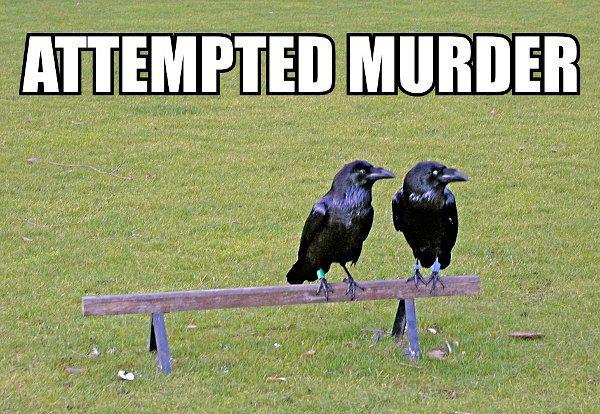
While thinking about crows, and researching them ever-so-slightly, I came across this, which is why I began this post in the first place.
Oh, and here’s the brief excerpt from SCARY TALES, Book #3. In this scene, three students are trapped inside a school, surrounded by zombies, or ghouls, or whatever creepy thing they are out there. It’s not good. For a variety of reasons — the best one being “for dramatic purposes” — Carter decides to go for help. He needs to quietly make his way two blocks through the night fog, avoid the zombies that seems to be aimlessly milling around, find his folks, get help, and save the day.
(I know, it’s sounds kind of dumb, but it’s a lot of fun.)
Here goes . . .
Carter stepped out into the mist with supreme calm. Cool as a lake. It was foggy, but he could still see about 30 feet in any direction. He gave a thumbs-up to the worried faces that stood vigil at the door.
It’s all good.
A crow landed near his foot, cawed noisily. Then another, and another. Carter stepped cautiously, not wishing to disturb the birds. He noticed a dark figure ahead and veered away from it.
CAW-CAW! Carter looked up to see a crow dive-bombing from above, talons out. The black bird hit Carter’s head at full force, wham, and tore into his scalp.
“Ow, shoot,” Carter cursed. He staggered a step, dazed, and waited for the dizziness to pass. Carter tenderly probed the injury with his fingers. His scalp was torn. Under a loose flap of skin, his flesh felt like raw hamburger. It was wet.
He checked his fingers. Blood. Lots of it.
Oooooaaaaannnn, oooooaaaaannnn.
The moans came, louder and louder, from every direction. As if the creatures were calling to each other. Now more shapes appeared in the distance, moving toward him. “It’s the blood,” Carter thought. “They smell it.”




On Lois Lowry and the Perils of The New York Times Comments Section
There was a nice piece on Lois Lowry, written by Dan Kois, in the October 3 edition of The New York Times. It’s worth reading. I’m not a fanboy by nature, but with Lois Lowry I make an exception. I hold her in the highest regard, with great respect and admiration for the integrity of our work — and, even moreso, her commitment to her work. I think of her in the way I thought of Arnold Lobel: the real deal, the genuine magilla.
In the article, Lowry made a comment that made me think. To set the stage, the year was 1978, and Lowry was to give a commencement address to a local middle school:
I love that: I chose the kids. I’ve asked myself if that’s always true of my own work, or even if it’s possible. With the Jigsaw Jones series, for example, I was always aware of the potential parent in the room, the mother reading the story out loud at bedtime. And I was aware of the gatekeepers, the teachers, the librarians. Even before that, my editors and publisher. You have to navigate through a lot of adults before reaching an actual kid. Maybe that was wrong, but I tried to please those adults, too.
I remember coming across Bugs Bunny cartoons as an young adult, and realizing (then) that they often threw in some grown-up humor, with references that few children would understand. I liked how it worked on dual levels. Anyway, that’s NOT the section of the article that got the biggest response. Lowry was asked about The Hunger Games, and she had the temerity to respond carefully, respectfully, and honestly:
Here’s are few highlights and lowlights from the Old Gray Lady’s comments section. In fairness, you should read the entire article, since some of these folks are taking issue with Mr. Kois’ handling of the article, more than anything Lois Lowry specifically said. The YA crowd is a tough (and yet sensitive!) readership, and some of them shoot arrows:
A.J. asks:
Herzliebster writes:
Cynthia Bishop:
Elizabeth Hutchinson writes:
To which Tamora Pierce replies:
Alice comments;
Thom McCan:
And at last, mercifully, there’s Donald:
And most beautifully, Jane Hinrichs: