Tag Archive for James Preller school visits

School Visit: Messages on the Wall

IMG_0227-1

–

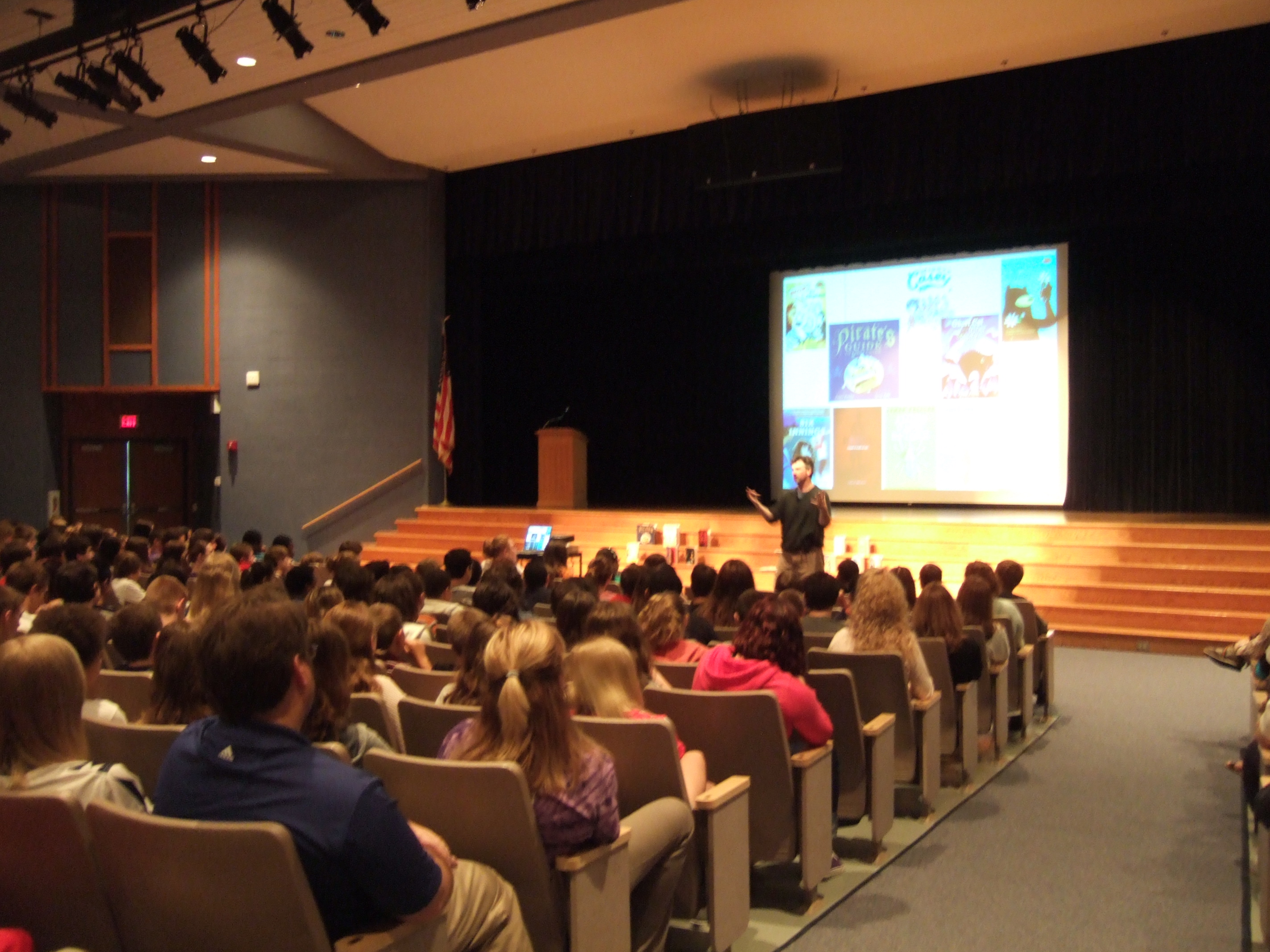
When I visit schools — which is often, and always gratefully — if time allows we’ll arrange for me to enjoy lunch with an intimate group of students. It’s always relaxed and informal, just talking, hanging out together, trading desserts. In some groups the conversation turns to literary concerns, but more often we just sort of chat, talk about ourselves, and try to crack each other up. I like it because, finally, it’s not strictly about me, me, me. My power point, my dumb books. These visits become more about them, and the truth is that I’m probably more comfortable that way. I’m surely more entertained.

Anyway, there was a white board in the room earlier in the week. Toward the end, as the principal was trying to pry the students away, a few of them wandered over to the board to write brief messages. I snapped a photo of these two, just to share with you, My Mighty Nation of Readers!

Sweet, huh?

IMG_0228


Sophie, you are welcome, the pleasure was all mine.

And Elizabeth, I’m not offended at all. There’s so many great books out there, I’m just glad you picked one of mine.


What the Hey?! Some Guy Named “James Preller” Is Featured in an Interview at Kirkus — and It’s Pretty Good!

Tomorrow is Halloween, and author James Preller wants to scare your children—the safe, exhilarating type of scare, that is, which comes from a well-constructed set of spooky stories just for the younger set. He’s been doing this not just on Halloween but all during the year with Scary Tales, his chapter book series of ghost stories, launched last year and illustrated by Iacopo Bruno.Chilling and thrilling and very often spine-tingling, the series offers up serious page-turners for students who enjoy reading frightening tales while on the edge of their seats. It’s a far cry from Preller’s Jigsaw Jones series of chapter books, which debuted in 1998, the beloved fictional detective stories for children that are still circulating in libraries. The latest and fifth book in the Scary Tales series, The One-Eyed Doll, was just released. It brings readers hidden treasures, deserted houses, and a creepy one-eyed doll, who moves and tells stories. Needless to say, it’s a good fit for Halloween—or, really, any time of year.Next year, Preller will also see the release of a middle-grade novel, one that follows 2009’s Bystander, which the Kirkusreview called “eminently discussable as a middle-school read-aloud.” The Fall, as you’ll read below, addresses bullying, but not for the sake of jumping on the bullying bandwagon. That’s to say that as soon as many schools kicked off anti-bullying crusades in recent years, we suddenly saw a flock of books about bullying in the realm of children’s literature. But Preller isn’t one for the “bully” label.Let’s find out why.
–
The Scary Tales series started in 2013, yes? How much fun has it been to scare the pants off of readers?
–
 
OneEyedDoll_cvr_lorezWriting “scary” has been liberating. A blast. In the past, I’ve mostly written realistic fiction. But for these stories I’ve tapped into a different sort of imagination, what I think of as the unpossible. The trick is that once you accept that one impossible element—a zombie or a ghost in the mirror—then the story plays out in a straightforward manner.All storytelling has its backbone in realistic fiction.
–
So many kids, even at a surprisingly young age, are eager to read scary stories. I tried to fill that gap. “Scary” thrills them. It makes their hearts beat faster. Yet I say to students, “I’m sorry, but nobody gets murdered in these books. There are no heads chopped off. No gore.” To me, the great sentence is: The door knob slowly, slowly turned. That delicious moment of anticipation, of danger climbing the stairs. I’ve tried to provide those chills, while still resolving each book in a safe way.
–
You do a lot of school visits, as I understand it. What do you see the very best teachers and librarians doing (best practices, if you will) that really get children fired up about reading? 
–
In its essence, teaching is enthusiasm transferred. The best educators seem to do that naturally—the excitement, the love of discovery. It leaks into everything they do. I think it’s about a teacher’s prevailing attitude, more than any specific activity.
–
Speaking of school visits, I assume you still visit schools to discuss Bystander, especially given the subject matter. How have middle-schoolers responded to that book in school visits? 
–
DOLL_Interiors_07The response to Bystander has been incredible—and humbling. Many middle schools have used it as their “One School, One Book” community reads, which is such an honor.I attempted to write a lively, unsentimental, informed, fast-paced story. I hope that I’ve given readers something to think about, while leaving them to draw their own conclusions. I didn’t write a pamphlet, 10 steps to bully-proof your school. Robert McKee, in his book Story, says that stories are “equipment for living.” I believe in the power of literature to help us experience empathy.
–
What’s next for you? Am I right that there’s a new Scary Tales coming out in 2015, as well as a new novel? Working on anything else you’re allowed to discuss now? 
–
I have an ambitious hardcover coming out next year, titled The Fall (Macmillan, Fall 2015), in which I return to some of the themes first explored in Bystander. We’ve seen “the bully” become this vilified subcreature, and in most cases I don’t think that’s fair or accurate. Bullying is a verb, a behavior, not a label we can stick on people to define them—especially when we are talking about children. Walt Whitman wrote, “I am large, I contain multitudes.”The book is told in a journal format from the perspective of a boy who has participated in bullying—with tragic results—and now he’s got to own it. A good kid, I think, who failed to be his best self. To my surprise, the book ended up as almost a meditation on forgiveness, that most difficult of things. The opening sentence reads:

“Two weeks before Morgan Mallen threw herself off the water tower, I might have sent a message to her social media page that read, ‘Just die! die! die! No one cares about you anyway! (I’m just saying: It could have been me.)”

I was guided throughout my writing by a powerful quote from the great lawyer and activist Bryan Stevenson: “I’ve come to understand and to believe that each of us is more than the worst thing we’ve ever done.”

THE ONE-EYED DOLL. Copyright © 2014 by James Preller. Illustrations copyright © 2014 by Iacopo Bruno and used by permission of the publisher, Feiwel & Friends, New York. 

Julie Danielson (Jules) conducts interviews and features of authors and illustrators at Seven Impossible Things Before Breakfast, a children’s literature blog primarily focused on illustration and picture books.

New Slide for School Visits

Came across this today and thought it would make a good slide for my Middle School presentations. It basically expresses where I come out on all the tips and strategies for so-called “Bully Proofing” a school. It’s why these students don’t need to be preached to. They already know. They just need to be encouraged to listen, and supported when they do.

When my presentation is over — which is decidedly not about bully-proofing a school, it’s about writing books — I like to keep up a final slide while the students filter out. Most of my slides are just images, not words. But at the end, I think that last slide can have words. This one just might make the cut.

Thank you, Shel Silverstein!

School Visits: Small Treasures

I am preparing to hit the road tonight, three nights away from my home and family, and I’ll be honest: a big part of me hates being away. The leaving is the worst part.

No, there are no tearful farewells. My middle schoolers just yawn, shrug; they know they are in good hands with Mom, and understand that I’ll be back. It’s normal. The cats don’t care. The dog, baffled as always.

I’ll be happy when I’m there, mostly, and enjoy the schools, the teachers and students. And I will also now admit, finally and at last, that I know I’m doing something worthwhile. We’re talking about things that matter, about finding what you love, about books and writing, family and kindness. It’s good stuff that I bring in my little bag, glad tidings from the generous heart of children’s literature.

So I was packing, cleaning out old papers, making sure I had the right books. And I found this, amidst a clutter of similar pages:

I’ll tell you how it typically happens. I’m walking down the hall with a teacher, on my way to setup the Power Point or to the library to sign books. Heading to the next thing. Children in the halls sort of stare at me and whisper. Then some sweet someone comes up and hands me a page, we chat a shy moment, I stuff it into my bag, says thanks, move on.

Just another treasure I don’t fully value at the proper moment. I’m rushing to the next place, or blathering about something with an adult. I mean, I’m not rude, I’m not a jerk to these kids. Just that it takes me a month to dig the page out of my bag and look at it again, seeing it maybe for the first time, thinking again again again: how lucky am I?

At least somebody’s excited.

Are Students Sick & Tired of Anti-Bullying Messages? And What About You?

I’ll admit it. Sometimes I have doubts. Not about bullying, exactly — I know it’s a serious issue, a matter of life and death — but I fret about the effectiveness of talking about it.

You could call it an occupational hazard.

Does anyone hear the message anymore?

Anti-bullying rhetoric seems everywhere these days. Trending hot on Twitter. Almost fadish. And I sometimes wonder if kids have tuned it out. In my travels, I’ve talked to many teachers who have expressed that worry.

This year, I’ve visited schools in OH, MA, FLA, MI, NJ, NY, SC, PA, and CN — often because I wrote the book, Bystander. I’ll arrive at a school where all the middle schoolers, grades 6-8, have read and discussed my book. They’ve wrestled with the issues, hopefully identified with characters, felt compassion, empathy, anger. Or, I guess, some of them have just been bored by another book they didn’t get to select themselves. In most cases, my novel is only one small piece of a comprehensive anti-bullying agenda.
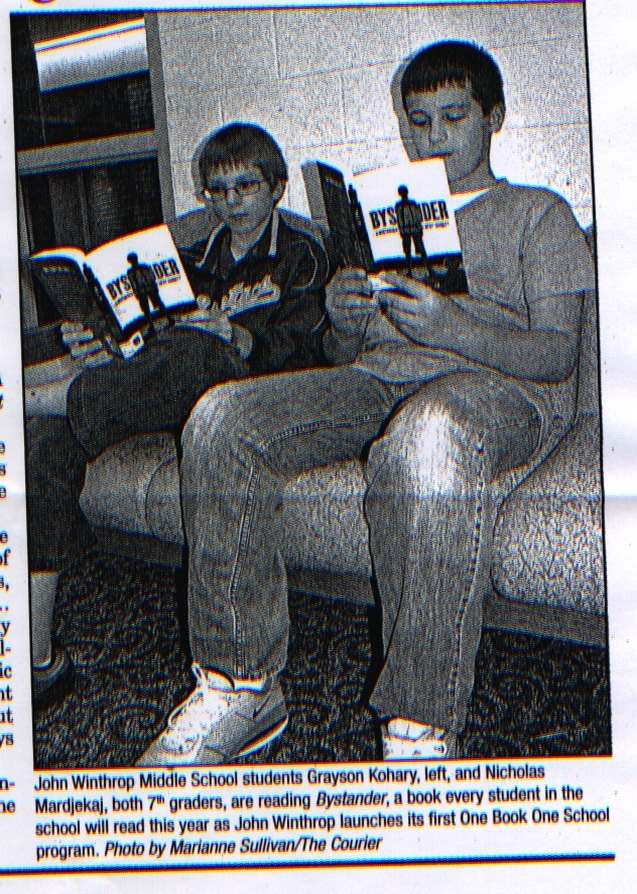
But as I’ve said before, I wrote a book. A story. Not a brochure on how to make your school a “bully-free zone.”

Despite the amazing letters I receive, I still wonder what I can say on a school visit that won’t come off as yet another lecture to this audience. What can I say that might make a difference. And if, perhaps, they simply can’t hear it anymore.

Is it worth beating on that same old drum?

Then I opened up The New York Times and read Nicholas D. Kristof’s op-ed piece from Thursday, May 17. And I’m reminded, yet again, why this matters so very much; and how real people — the children in our village — are powerfully effected every single day; and that anything we can do is far, far better than sad resignation.

As an author and father of three children, ages 11, 12, and 19, I believe that the core of this issue comes back to simple values. Do unto others. The importance of thinking to yourself, “How would that make me feel?” Identifying with others. Caring. Our fundamental humanity.

The issue of bullying is about the importance of compassion, tolerance, kindness, and empathy — at a time in life when empathy does not come easily to many middle schoolers. Stories can help. Like Wonder, by R. J. Palacio, to cite one recent, brilliant work of children’s literature. I read it recently and then pressed it into my 5th-grade daughter’s hands. You must read this, I said. I loved the way, like any great book, Wonder brought us into the hearts and minds of different characters. How we experienced forms of bullying, of painful isolation, from the inside out. I loved Palacio’s message of kindness and compassion.

Anyway, I digress.

Here’s an excerpt from Mr. Kristof’s op-ed piece:

Plenty of adults are skeptical about the fuss over bullying. “How come the thin-skinned kids nowadays can’t handle the bullying that made us better, stronger adults?” one man wrote to me on Twitter.

He should read what Madison Jaronski, 15, of New Hope, Pa., wrote:

“Tears have been flooding down my face; breathing is a task that now seems impossible. I draw my legs closer and closer into my chest as I try to transform the pressure into reassuring comfort. I begin to slowly rock myself, and by now my tears have colored my pillow black. …

“All of my accomplishments and enjoyable moments are overshadowed by the pain and harassment that was thrust upon me. Just looking at my surface, you would see a confident young woman, as sturdy as a rock. You would never think that I was broken, broken into a million pieces like shattered glass, all because of the work of a group of senior boys.”

You want to reach out to these kids and envelop them in a big warm hug and tell them that they are smart, sensitive human beings, a thousand times better than their tormenters.

——

To read the winning essays, go here. Just do it.

You will be blown away.

Here’s a brief sample from one winning essay, written by Lena Rawley, age 17, from Montclair, NJ:

Teenage girls are cruel super-humans from a distant galaxy sent here to destroy us all. They have the self entitlement of a celebrity heiress and the aggression of a Roman Gladiator. Like vampires they feed off the blood of the weak. They’re pubescent monsters. Adolescent boogeymen.

While my observations may be coming from a point of bias, that doesn’t mean they are faulty in accuracy. As a teenage girl myself, I think I know teenage girls quite well. Not only was I a former teenage mean girl, but I was tortured, tormented, isolated and socially maimed by them as well.

—–

Just came across this school that featured a booktalk about Bystander, way back in 2011. I appreciate that this kind of thing has been happening in many schools across the country, and sometimes on a schoolwide scale, but this one is especially sweet since I grew up in Nassau County, too. I just love the idea of parents and kids coming together and talking about this stuff — that this book, my book, offers a safe springboard for those conversations. Wow.

—–

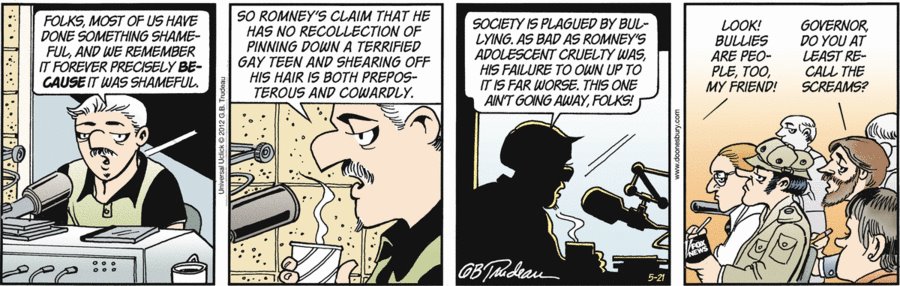
Lastly, here’s a recent Doonesbury . . . still kicking it after all these years.