Archive for Six Innings

Fan Mail Wednesday #102

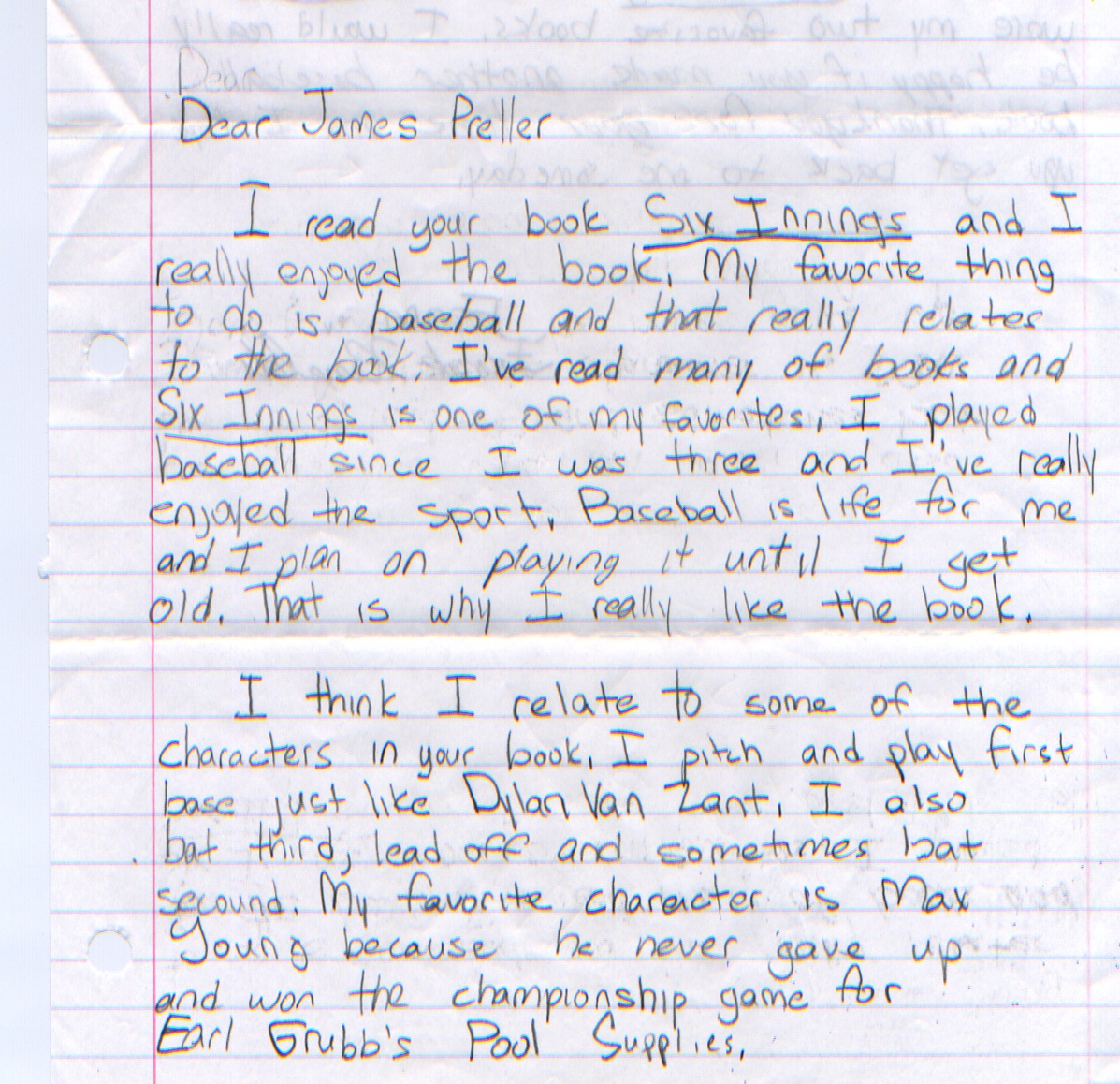
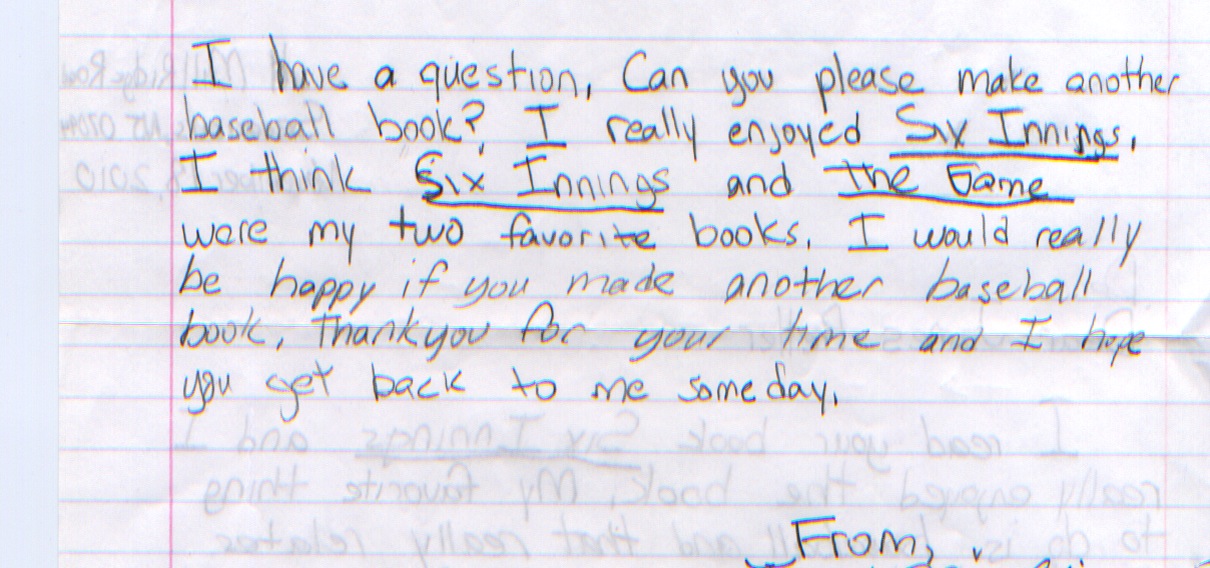
Here’s a letter from Frank in Secaucus, New Jersey!

Hold on while I warm up the scanner . . .

I replied:

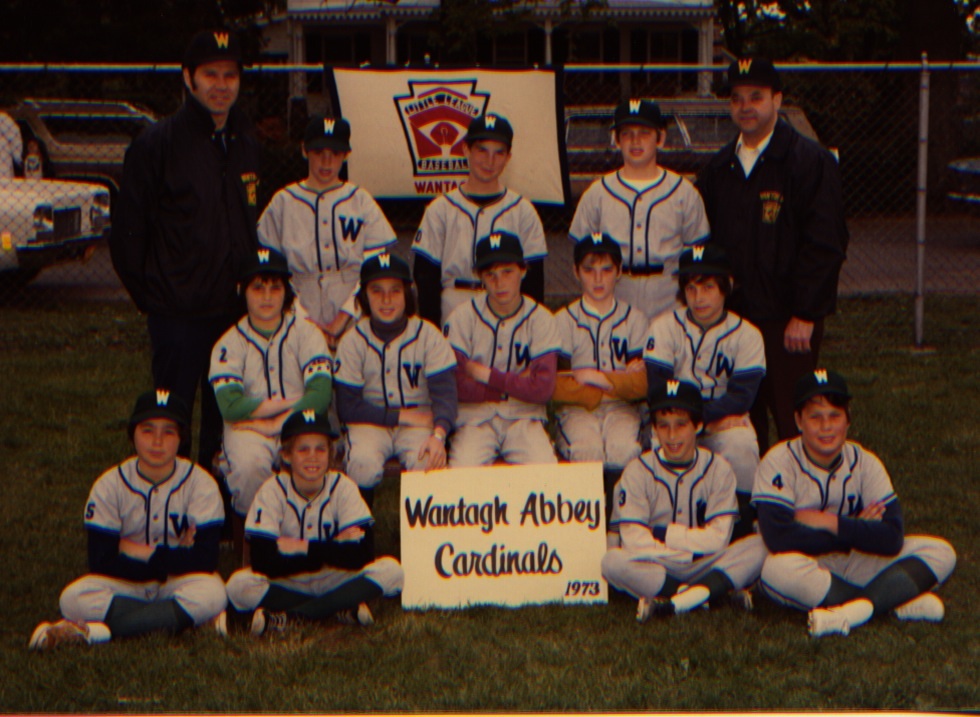
Hi, Frank. Thanks for the letter. It sounds like we’ve got a lot in common, since I’m also a huge baseball fan. Here’s a shot from back in 1973, when I was 12 and played Little League for the Cardinals in Wantagh, Long Island.

That’s me, top row, center.

I loved playing baseball so much that when I turned 38, I joined a Senior Men’s Hardball League. I started my own team, managed a group of men for eight seasons — doctors, engineers, state troopers, teachers, it didn’t matter so long as they could play! I had to stop a couple of years back, when coaching my son in Little League and All-Stars and Travel Baseball just got too overwhelming. I ultimately had to realize, this was his time, not mine. Even so, I hope to get back on the field again someday, because it’s just so much fun to go out there and play, compete to win, dive for a ball, steal a base, rip a double into the gap. My point: You don’t have to give up the game just because you’ve gotten older.

This is me about 30+ years later.

After Six Innings, I was a little bit worried about being typecast as “just” a sports writer. I wanted to write about many different things, so I avoided following up Six Innings with another baseball book. But I do have an idea for one, and I hope to get around to it within the next couple of years.

Thanks for reading my book!

JP

Fan Mail Wednesday #95 (Friday Edition!)

Do you remember that classic scene in the original “Miracle on 34th Street,” when a line of uniformed postal workers comes into the courtroom to dump sacks of letters on the judge’s desk?

That’s the way it is around here every day at Jamespreller.com.

So let’s take a gander at one . . .

Dear James Preller,

My name is Dillon. I am in 7th grade and I go to _______ Middle School. Some things I like to do is ride dirt bikes and four wheelers because I have a lot of woods and fields to ride on. I also like to go hiking and find cool things like stuff in my creek and in my woods or anywhere.

I am reading the book Six Innings. I liked your book because I like baseball and books about baseball even though I’m not that good at it. When I read your book it was good. That’s coming from me and I usually don’t like to read at all.

My favorite character in the book was Dylan Van Zant. He was my favorite character in the book for a couple of reasons. One reason is he has the same first name as me. Another reason that Dylan Van Zant is my favorite character is because he is nice and not a mean kid at all.

Thank you for taking the time to read my letter to you. But before I am done I will ask you some questions and one is why did you pick Dylan Van Zant to be a nice kid and a really good baseball player. Like in real life sometimes people who are really good baseball players are mean. Another question is why did you pick the title Six Innings.

Sincerely, Dillon

I replied:

Dear Dillon:

Thanks for your letter. I liked that you began by telling me a little bit about yourself. Like you, I also enjoy nature, though I’m not really a dirt bike kind of guy. Too noisy. Growing up, I had some friends, Timmy Tighe and Frank Connelly, who built their own motor bikes — basically lawn mower engines attached to regular bicycles — and we loved cruising around on them. Their hands were always filthy, covered in oil and grease. These days, you couldn’t get me on a motorcycle if you paid me. I can only imagine skidding across the cement  . . . ouch, Ouch, OUCH. I guess if you’re a good rider you can’t let those negative thoughts into your head.

When I think of motorcycles, all I can imagine

is a long, sad stay in the hospital.

I’m glad you enjoyed my baseball book. It makes me happy when someone who doesn’t normally like to read writes to say that my book wasn’t as bad as he might have expected. Out of all the characters in that book — besides Sam’s father — I might have identified the most with Dylan Van Zant. As a Little Leaguer, I loved to pitch. I could never throw that hard, but I had great control and I absolutely loved standing on that mound with the ball in my hand, literally the King of the Hill.

It’s true what you said: Sometimes when people are very good at things, they can be obnoxious about it. You know, conceited, superior, like they are the greatest thing since sliced bread. (I can’t stand those types of people.)  I think with Dylan, he knows he’s not a superstar; he just loves playing the game.

I titled the book Six Innings because that was my first idea for the book, to use the structure of one Little League game — across six innings — to tell the story of the players and the plays. It was a sturdy format, because it gave me a beginning, middle, and end.

Mostly though, I have vivid memories of my Little League games, they were important to me, and I know that many kids felt, and still feel, the same way. Thanks for writing. I appreciate it. I hope you continue to seek out other books you might enjoy, even if the pickings look slim. I’m sure there are books in your school library that are just right for someone with your interests and obvious intelligence. Try your school librarians — professional know-it-alls, they love bringing good kids and books together.

My best,

JP

Baseball, Gavin, Six Innings, Championship Games, etc.

I don’t like to brag, but.

Look at this kid, will ya.

That’s Gavin, right around his 11th birthday, back in June/July. We endured a heartbreaking All-Star experience and I had to let time pass before revisiting it.

This year, along with my friend Andy, I coached a team of ten-year-olds in the District 13 All-Star Tournament. We played five games and found ourselves in the Championship Game — a scenario not much different than what I wrote about in the book, Six Innings (now in paperback).

As it turns out, that was the problem. Six innings. Would it were five.

Somewhat unexpectedly, Gavin really shined in this tournament, played the best baseball of his life. Pitched a shutout, fielded great, hit a ton. He was focused and he cared and somehow it all came together for him.

As a parent, you love ’em whether they strike out or hit a double. And let me tell you — it’s easier when they hit the double.

So there he was on the mound to start the Championship Game against our talented arch-rivals. It was a tense game, all the boys felt it, and nerves got the best of many of them. Both sides made errors. By the top of the 6th, we were on top, 10-6. Gavin had pitched with poise and determination, but after throwing five full innings and 75 pitches, the Little League maximum for boys his age, it was time to turn the ball over to someone else.

We had a four run lead. We needed three more outs.

Never happened. Our rivals exploded for 11 runs (!) in the 6th — it was the longest, most brutal inning of my coaching career — and we fell, 17-10, with an ignoble thud. Gavin was seriously bummed. For my part, I slept less than two hours that night. Just tossed and turned and replayed it all in my head, over and over. It was a week before I could walk without a limp.

When you write a book, you can get that last out, the boy can kiss the girl, you can pick any ending you want. Real life, that’s a tougher thing.

So let’s look at that scene from Six Innings one more time . . .

Max takes the sign, nods, understands. He wants me to climb the ladder.

One last time, Max Young is alone in his daydreams, throwing against an imaginary hitter in a game of his own invention. He is the author and the instrument, the pitcher and the ball, the beginning and the end.

Max rocks back into his windup, he drives forward, the ball leaves his fingertips, comes in high and hard and true.

Angel Tatis hits nothing but air. Swing and a miss.

That’s it. Game over.

Max drops to his knees, flings his glove high into the sky. All the boys rush the mound, shouting, screaming, piling on . . . .

Sigh.

Absent Parents in Children’s Literature

A friend of mine, author David Klein — whose debut novel, Stash, is due out later this month — alerted me to a recent interweb discussion about absentee parents in children’s literature.

Literary agent Nathan Bransford summarized the debate here, while making some solid, sensible points. Here’s one quick snip:

Another major factor in YA and MG literature is allowing the characters to fight their own battles. It’s a very common theme in YA for parents to be absent, abusive, oblivious, or otherwise useless. There’s actually a reason for this, other than the obvious ready-made angst factor. You see, for a story to truly be centered around an underage MC, they have to do everything themselves. Parents, guardians, and other adults can’t do it for them.

Of course, this is an old narrative device, wildly popularized (and trivially conventionalized) by the folks at Disney (Bambi, Simba, I’m looking at you). Seriously, the list of dead or missing parents in Disney films is long and almost comical in its predictability.

Note: This screen shot was filed under the caption,

“Awesome Moms,” so of course she had to go.

The role of parents is often a thorny issue in children’s books, for some of the reasons explained above. But as a devoted parent, I have mixed feelings. I understand the narrative expediency of eliminating parents, or making them appear incompetent, but at the same time I kind of hate it in books when every adult is a complete, useless waste of oxygen. I guess I’m much more offended by one-dimensional characters than the idea of absentee parents.

Personally, I tend to write sympathetically about parents in my books. The trick is to keep the story child-centered. Because, likewise, I also loathe it when a perfect adult prances into the story and solves the problem for the child.

In Bystander, my recent book about middle school bullying, I created an absent father and it served as an important fact in my main character’s life. A source of vulnerability, the limp in his walk. At the same time, Eric’s mother is outstanding. She does a lot of things right as a parent of a child who is bullied. For example, even though her role in the book is limited, Ms. Hayes has thoughtful family policies about computer and cell phone use, she advocates aggressively for her child with the school once she perceives a problem, she makes an effort to spent alone time with him and, basically, she tunes in. I like her and wanted to model how a good, caring mother might act under those circumstances, since I think that’s the most likely scenario. The adults in the school are also shown in a positive light.

Even so, the conflict and the drama remain with the boy, Eric Hayes, in his own world (mostly) away from home. Mom isn’t the answer, but she does provide a foundation of support.

In Six Innings, I’m pretty sure all the adults portrayed are sympathetic and realistic, though Mike Tyree’s parents are distracted by his sister’s athletic success. They don’t quite give Mike the attention he needs. When I started the book, a few people asked me, essentially, “Are you going to write about how the Little League parents and coaches are so awful and over-the-top?”

My answer, “No, not this time.”

In my experience, the coaches — while flawed and sometimes too focused on their own child — are good, decent parents who volunteer an incredible amount of time and energy to the benefit of many children in the community. These aren’t horrible people. And overwhelmingly, the parents in the stands are good folks, too. Hopelessly biased, a little irrational at times, emotionally invested, caring. What I respect most is they are . . . there. They show up, and if you ask me, that’s 95% of parenting: showing up, day after day.

Quantity time, not quality time.

Art: rough cover sketch by R.W. Alley,

where Jigsaw literally finds a skeleton

in the closet.

Lastly, since I’m on this topic, I’ve written almost 40 Jigsaw Jones mystery books. His parents are amazing, loving, funny, intelligent, present in every way. It’s a great family. Mila Yeh has a stepmother — and guess what? She loves Mila just as much as a birth mother. Part of that was inspired as a reaction against the negative cliches that are prevalent about stepmothers, but also by my own wife, Lisa, who is an incredible mother and stepmother.

Still: The stories are about Jigsaw, his adventures and struggles in his boyhood world, and that’s where the conflict takes place. So from my point of view, I think you can represent strong, capable, caring parents in children’s literature and still keep the story kid-centered and child-resolved.

Coach Preller . . . and a Deleted Scene from “Six Innings”

Baseball has been central to my life for as long as I can remember. These days, it’s primarily as a coach, since I’ve become too busy to play on my men’s hardball team.

Let me give you a quick update:

* On Saturday, my Little League team, RC Dairy, lost a devastating semi-final playoff game by the score of 9-7. We had ended the season in 1st place, with a 12-4 record, but in baseball anything can happen in a single-elimination format — and anything did.

I was very disappointed; it took me a day and a half to get over it. Seriously. I couldn’t get that loss out of my head. I loved that team and wanted them to play in a Championship Game, to feel that excitement, have that lifetime memory. I also understood that most kids never get that opportunity. Eight years ago I coached my oldest son’s team, Blue Sky Music, to a championship victory. It would have been nice to do it again, on the same field, with a different child. Maybe I’m still not completely over it.

* The next day, Sunday, Father’s Day, my Travel Team played a doubleheader about fifteen minutes north of Saratoga Springs, an hour’s drive. This team plays on Sundays only, and again it was the end of our regular season. We won both, 11-4 and, in extra innings, 12-11. Gavin had a great day, a couple of big hits, a beautiful sacrifice bunt, pitched three solid innings, and scored the winning run in game two. A close play at the plate, safe, game over! Awesome. A great way to spend Father’s Day.

* Meanwhile, today is the first day of practice for our District 13, ten-year-old All-Stars. That will go hot and heavy until July 13th — unless we come out on top, in which case we’ll move on to Regionals. (I can imagine a dozen parents, thinking of camps and vacation plans, crossing their fingers and hoping . . . not.)

As you likely know, I wrote the book Six Innings about the boys who play in a championship Little League game. It was a book I was highly qualified to write. I know the game, and I know those players (an aside: at this level it is extremely rare to see a girl on the field; softball has swallowed them up).

In revising Six Innings, I cut about 10,000 words. Most of it was back story, character sketches, small moments off the field. We decided that my initial format was too confusing for the reader, bouncing back and forth from game action to character pieces tended to undercut the drama of the game itself. So I cut it to the bone. Painful but necessary. I’ve blogged about this before, and previously shared four deleted scenes: here, and here, and here, and here.

Below, here’s a fifth deleted scene, this time with the focus entirely on two fathers. That’s another lesson learned; there’s not a kid in sight, generally a no-no for children’s books. In short, I needed to write the scene, I needed to know it, but it didn’t have to go into the book. That’s the iceberg theory of writing. Nevertheless, don’t get me wrong: I like this scene a lot, there’s truth in it, and it was something I wanted to explore, how the game helped keep a fractured family connected. Here goes:

CASPER LIONNI

Brrriiiiing!

Jeff Reid groaned, hit the mute button. “Hello,” he spoke into the phone.

“Is this Jeff?”

“Speaking.”

“Jeff, hello. This is Casper Lionni,” he paused, “Alex’s father.”

“Yes, Casper,” Jeff replied. “How can I help you?”

“I understand that you’ve got Alex on your Little League team this coming season,” Mr. Lionni said.

“Yes, I do. We’re eager to get started.”

There was a brief pause on the phone. Casper Lionni continued haltingly. “I was wondering if, perhaps, you could use an assistant,” he began. “However, I confess that I don’t know much about baseball.”

“Neither do I!” Jeff joked. “I appreciate the offer, Casper, really. But I’ve been coaching with Andy Van Zant for the past couple of years, so we’re pretty set in that department.”

“I understand.”

Jeff could hear the disappointment in Casper’s voice.

“You see, er,” Casper continued, “as you may know, my wife, Lauren, and I, have recently separated –”

“Yes, I heard that,” Jeff admitted. “Small town.”

“I only see Alex on Wednesday nights and alternate weekends,” Casper said.

Jeff nodded, said nothing. Before giving it more thought, he blurted, “Do you know how to keep a scorebook?”

“A scorebook?” Casper repeated. “I’m sure I don’t even know what that is.”

“You can learn,” Jeff answered. “It’s pretty straightforward. You could come to the games and help out that way. Would that suit you?”

“What? Are you saying that — ?”

“We’d love to have you,” Jeff replied.

“Thank you,” Casper said. “This means a lot to me. You have no idea.”

The two men spoke for a few more minutes. The conversation confirmed three things in Jeff’s mind. Casper Lionni was a good guy, he really didn’t know anything about baseball, and he missed his son, terribly.

Jeff Reid hung up the phone, turned the sound back on for the spring training ballgame. The Red Sox just scored a run, a lefty was warming in the Yankee bullpen. He thought, Oh boy, here comes another season.