Archive for Interviews & Appreciations

5 QUESTIONS with HUDSON TALBOTT, author/illustrator of “FROM WOLF TO WOOF”

—


9780399254048


I’m kicking off a new, recurring series of posts where I interview one author or illustrator, limiting our conversation to 5 questions, with a focus on a specific book. I’ve got a terrific list of talent planned for upcoming visits — they just don’t know it yet.

Today we get to hang out with Hudson Talbott. And come back next week for a visit with Hazel Mitchell and her dog Toby.


Hudson (left) and I got to catch up at the Warwick Children's Book Festival.

Hudson (left) and I got to catch up at the Warwick Children’s Book Festival.


JP: Hudson, I love your new picture book, FROM WOLF TO WOOF: THE STORY OF DOGS. You manage to deliver a lot of information within the context of “story.”

Hudson: Thanks, James. I love research and the process of absorbing as much as I can and then distilling it down to its essence. I come from Kentucky. We’re known for distilling.

 150616134355-moonshine-sutton-still-exlarge-169

–

And God bless Kentucky for that! But let the record show: I haven’t asked a question yet. I feel like one of the poor fisherman bargaining with a magic fish. I still have three wishes left –- or in this case, five questions!

I don’t think that was a question either. But thanks for calling me a magic fish.

Now that you mention it, you do look a little green around the gills. Maybe it’s the light in here. Anyway! I remember long ago reading Desmond Morris’ classic book, The Naked Ape, and in it he speculated about the first dogs. How they might have come to be domesticated. Which is a poor term for it, as I type those words. Because we’re talking about these wild animals that, over time, became intensely, passionately interconnected with human beings. The beginning of a long relationship. I’ve always found that a fascinating subject, so I was immediately drawn to your book. How did that story begin for you?

intimagewolftowoof6-1024x427

The love of animals, the love of dogs, the love of history. Not facts-and-dates history, but the how-did-we-get-here? kind of history. So it was bound to happen. You and I have this privileged platform to address and explore things that we think matter, or at least, things we’re curious about. That look in a dog’s eyes of knowing, of asking and loving, of aligning him/herself with us had to come from someplace. Plenty of theories about where and when — I like to think that the two species found each other useful and could see the advantage of throwing their lots in together to survive. Like two kids finding each other in kindergarten and growing up together in a rough neighborhood. At some point we both stepped across that magic threshold of trust and realized that we have each other’s backs.

Well said. Do you self-identify more as a writer or an artist? Does one always come before the other? Responding to a similar question, Bernard Waber, who also wrote and illustrated his books (Lyle, Lyle Crocodile, and many more), replied that “The writer in me tries to please the illustrator.”

I think of myself primarily as a storyteller. Whatever serves the story best is my priority. That said, I am a visually-oriented person so usually if I come up w/ an idea for a book I first look at what points in the story would be good “photo-ops” or actually illustration ops. While I’m doing sketches for the plot points I’m also getting ideas for the text, the plot, the characters, etc. It’s not uncommon that something I’ll stumble onto while writing some text will lead to changing the picture, or even the whole story line. So it goes back and forth a lot between art and text. Art is much more expendable to me because there’s always more where that came from. But when I have to throw out a paragraph that I’m attached to but no longer serves the story — that’s painful! Picture books actually have more in common with making movies than they do with chapter books.

river_sm

Yes, especially when we consider the storyboarding tradition. After all, movies are simply “moving pictures.” Back to your book, I have to say there’s just a beautiful moment that comes right in the middle. It floored me, because it was such a deep and yet profoundly simple moment to capture. Just masterful storytelling. Before that moment, I was intellectually engaged. But on that double spread, the book stole my heart. I was all in. We’ve been watching the boy slowly gain the trust of this wild creature. They draw closer and closer. Until one day . . . everything changes. Tell me about the thought process that went into that illustration, that pivotal turning point in the book?

 intimagewolftowoof3

Wow, I should’ve read ahead to this question because I think I already answered it a couple of questions ago. It makes me happy to know that you really got the book, and felt what you felt from it. I started this book with a whole other concept, even another title: The Wolf Who Cried Boy. But when my editor, the brilliant Nancy Paulsen, saw the sketches I had at the end of the book showing where dogs evolved to, she immediately said, “More of that! More of that!” So it got re-balanced to a shortened fictional story leading to an extended nonfiction portion. But that was good because it gave me a chance to get in a plug for saving the wolves today, as well as my own theory that dogs played a strategic part in the development of civilization (with their help we could stay in one place with domesticated herds rather than having to constantly roam in search of wild herds).

Wow, Nancy Paulsen: legend! I was wondering, Do you have a wolf at home?

I have two cats. One does his best to be a dog for me because he knows that’s what I would have if I didn’t travel so much. I had dogs growing up and usually spend more time with dogs at friends’ houses than I do with the friends.

You’ve been at this business for a while, and I guess that’s part of the reason why I connect with you. We’ve both been around the block a few times. Let’s just confess to the world that we still have our AOL email accounts. Can you point to any primary inspirations in your work? Do you have heroes in the business? And tagging on to that question (I’m cheating here, oh Magic Fish), how do you keep your work fresh?

maxresdefault

Primary inspirations: my apparently insatiable curiosity keeps me alive. It also drives me crazy sometimes but at least it keeps me from being bored. My first book [We’re Back! A Dinosaur’s Story] was a hit and it would’ve been easy to build a career on it but I wouldn’t have lasted long — I’m too restless, there’s too much other good stuff to fall in love with. A quote from Leonardo da Vinci captures it for me: “For in truth, great love is born from great knowledge of the thing loved.” That’s how I remember it anyway.

Yours in AOL,
Hudson Talbott


Hudson Talbott is the author/illustrator of many outstanding children’s books, including River of Dreams, O’Sullivan Stew, United Tweets of America, and more. He lives in upstate New York, not far from the town Hudson, not from from the Hudson River. It’s pretty much Hudson, 24/7, when it comes to Mr. Talbott. For more info, please visit his website. Readers might also enjoy clicking on this thoughtful review at Librarian’s Quest.


10 Things I Love (March 31st Edition)


–images


Blogs are dead, everybody knows it, the tweet spread the news long ago. Nobody reads blogs anymore. These days it’s all Twitter and Instagram and Facebook and short, short, short.

I get it, I do. We’re all feeling the time squeeze.

But because I’m childishly oppositional, I refuse to give up my blog. And I’m keeping my 8-Tracks, too. I started this blog back in 2008, so we’ve become attached. I like to have readers, but I’m not sure I really need them. It wouldn’t stop me from writing. There’s something about the open-ended blog format that offers room to spread out and say things, however long it takes. Whether anyone listens or not.

My pal, illustrator Matthew Cordell, used to blog with enthusiasm. One of his recurring features was his monthly-ish “Top Ten” lists, where Matt randomly listed some of his recent enthusiasms. It could be a song, a book, a movie, or a type of eraser (Matt was weird about erasers). It was always fun to read.

So I’m stealing it.

Here are ten things I’ve recently loved:


THE ROCK AND ROLL HALL OF FAME AND MUSEUM

rock-and-roll-hall-of-fame-and-muse

I visited Cleveland with my son, Gavin, to check out Case Western Reserve University. The following day, we headed over to the Rock and Roll Hall of Fame, which was spectacular in every way. (Except for: The Red Hot Chili Peppers? Really?) I’m a huge music fan, so it was perfect for me. I found the museum strangely moving in parts, my heart touched. I could see that rock music was big enough, and diverse enough, to offer a home to people from every walk of life.

CARRY ME HOME by Diane McWhorter

51E8e02RafL._SX329_BO1,204,203,200_

Amazing, fascinating, and at times brutal Pulitzer Prize-winning book that’s stayed with me long after the last page. It provides a dense, detailed account of the civil rights struggle centered in Birmingham, Alabama. Martin Luther King, the Klu Klux Klan, Fred Shuttlesworth, George Wallace, J. Edgar Hoover, Bobby Kennedy, Bull Conner, and more. One of those books that helps you understand America.

FAN MAIL . . . WITH ILLUSTRATIONS!

Scan

I’ve been ridiculously fortunate in my career, in that I’ve received a lot of fan mail across the past twenty years. But I have to admit, I especially like it when those letters include a drawing. There’s just something about children’s artwork that slays me, every time. This drawing is by Rida in Brooklyn.

BETWEEN THE WORLD AND ME by Ta-Nehisi Coates

Between-the-World-and-Me-0-290x370

This book has been on my list almost since the day it came out — the buzz was instantaneous, and huge — but on a tip from a friend, I waited for the audiobook to become available through my library. Here, Ta-Nehisi Coates gives a powerful reading. It’s poignant to listen to an author reading his own words, particularly since this book is essentially a letter to his son.

“WINTER RABBIT,” a poem by Madeleine Comora

“Scan     Scan 1

We’re not here to bash Jack Prelutsky. Because, after all, Jack Prelutsky is hilarious. But, but, but. There are times when I worry that too many people think children’s poetry begins and ends with Mr. Prelutsky. That a poem for kids always has to be bouncy and fast and slight and funny, i.e., Prelutsky-ish. Well, here’s a poem I came across while reading Oh, No! Where Are My Pants? and Other Disasters: Poems, unerringly edited by Lee Bennett Hopkins. I admire the heartfelt, beautiful sorrow of Comora’s poem. “I thought of his last night alone/huddled in a wire home./I did not cry. I held him close,/smoothed his fur blown by the wind./For a winter’s moment, I stayed with him.” The illustration is  by Wolf Erlbruch. Click on the poem if your eyes, like mine, need larger type.

EMBRACE OF THE SERPENT

embrace-of-the-serpent-poster

I’m so grateful that I live near a cool, little movie theater that makes room for small foreign films such as this, a mind-blowing look at life on the Amazon, spectacularly filmed in black-and-white. Click here for more details.

THE AMERICANS

americans

My wife Lisa and I don’t watch hours of TV together, but we do like to have a show we can share. We’ve been a loss for a few months, but recently discovered season one of “The Americans” on Amazon Prime. We’re hooked.

DAVID BROMBERG: “SAMMY’S SONG”

You need to a flashplayer enabled browser to view this YouTube video

We have tickets to see Bromberg this coming weekend. He’s an old favorite of mine, first saw him in 1980 on Long Island. I’ve just rediscovered “Sammy’s Song,” which I haven’t heard in decades. What a chilling coming-of-age story, brilliantly performed. Oh, about that harmonica part? That’s Dave’s pal, Bob Dylan, with an uncredited guest turn.

JIGSAW JONES

795.Sch_Jigsaw_jones_0.tif

I just finished writing my first Jigsaw Jones book after a long time away. For many years, Scholastic had allowed the series to die on the vine, with book after book slowly going out of print. It’s been a crushing thing for me to stand by helplessly and watch. But with the help of my agent, I got back the rights, and now Macmillan has plans to relaunch the series. I am thrilled. There are more than 10 million copies of those books out there in world, and it seems like every second-grade classroom in America has a ragged copy or three. Writing the new book, The Case from Outer Space, was such a pleasure. It felt like being home again.

THE DAY THE ARCS ARRIVE

IMG_1593

For an author, it’s a special day, always, always. That book you’ve been toiling over for months, years, finally arrives in book form. Uncorrected, unfinished, but for the first time you can hold it in your hands — a book! — and think, “I did that!” Note: Arc = Advanced Reader’s Copy. The Courage Test, a middle grade novel, will be out for real in September.

BONUS SELECTION . . .

THE BARKLEY MARATHONS

d7a4957ef8cf93c22ada7e7510336211

I love documentaries of almost any nature, but I can’t recommend this one highly enough. A pure joy, with twinkling mischievous wit and surprising heart, too. If you like running at all — or not! — see this movie. About the toughest, wildest, and weirdest race in the world. Catch it on Netflix Instant!

“Teaching Is Believing” — My Short Essay over at THE NERDY BOOK CLUB

–
12418040_10208943236163396_1070494708685066319_n

I’m a big fan of Donalyn Miller.

Do you know her? As a classroom teacher, Donalyn made a splash with her book, The Book Whisperer. I met Donalyn during a trip to a reading conference in Dublin, Ohio, where I had the opportunity to hear her present to a large audience. She was impressive and her message was inspiring.

If you are an educator, you should read this book.

If you are an educator, you should read this book.

Long story short: Donalyn has made a deep impact bringing books and young readers together, and she does it without ego or self-aggrandising motives. There’s nothing phony about Donalyn. She’s simply a positive force in the world of children’s reading. My kind of people.

Several years back she started The Nerdy Book Club with, I believe, Colby Sharp. It’s an active, inspirational resource/blog for teachers and librarians who care about children’s literature. I recommend it. Over the past couple of years, Donalyn has allowed me to contribute a few essays, and I’m always grateful to reach that specific audience, and to participate in that grand conversation.

I’m happy with my recent essay and I invite you please check it out (link below). The idea came as the result of a few things going on in my life, particularly the end of my baseball coaching experiences. I reflected on what I had learned from those times coaching young people, and I connected those lessons to teaching and writing. But don’t go by me. Judge for yourself.

Here’s the opening:

I’m at loose ends.

For the first time in 16 years, I find myself not coaching a baseball team. During those seasons, I’ve coached a men’s hardball team, and all three of my children at various stages of Little League, including All-Stars and competitive Travel teams.

Now it’s over.

All I’m left with are memories, some friendships, and my accumulated wisdom, which can be reduced to a single, short sentence. So I’m passing this along to the readers of the Nerdy Book Club because I think it connects to teaching. And writing. And maybe to everything else under the sun.

When I started coaching, my head was exploding with knowledge. I knew all this great stuff! Boy, was I eager to share it. I had an almost mystical awareness of the game: tips and strategies, insights and helpful hints. Baseball-wise, I knew about the hip turn and burying the shoulder, how to straddle the bag and slap down a tag. The proper way to run the bases, turn a double play, and line up a relay throw. As coach, I simply had to pour this information into my players –- empty vessels all –- and watch them thrive.

But something happened across the years. I found myself talking less and less about how to play. Fewer tips, less advice. It seemed like I mostly confused them. The learning was in the doing.

I became convinced that the most important thing I could do was believe.

< snip >

Please click here to read the whole enchilada.

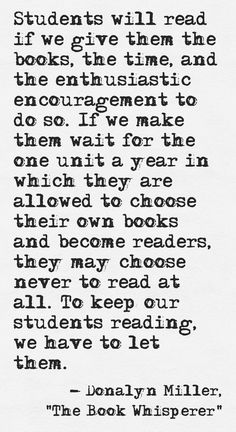
But before you go, here’s a nice quote from Donalyn that I figured I’d share.

Truth!

54ca57e70638ad712813f27288f92057

13 Questions & Answers: On Childhood Memories, Writing Advice, Favorite Fictional Worlds, and More

–

One thing about being a published author is that every blue moon your publisher asks you to do things. For example, I was just called on to answer a series of questions which will be published in the back matter of the paperback edition of The Fall (coming in October, 2016).

This is not usually my favorite thing to do. I enjoy talking about the work, the writing, but I’m not a fan of questions that focus on personality. At the Albany Teen Con this past year, the day’s events got kicked off with questions from the audience addressed to the panel of authors. Almost every question focused on personality. What’s your favorite food, etc. I realized that readers like to know this stuff, and that I have to get over it (to the degree I’m able).

So here you go, Dear Nation of Readers, a sampling of some of the Q & A which will appear in paperback later this year. The complete version is simply more than any single blog reader should be required to endure.


When did you realize you wanted to be a writer?

pen-and-notebookAs a young kid, ages 8-10, I used to invent these elaborate dice games that revolved around baseball. Roll a seven, the batter strikes out; roll a three, he hits a double. I filled entire notebooks with the box scores of these imaginary games. Looking back across the decades I realize that: 1) Dice games? OMG, I’m getting old; and 2) I was experiencing, and passionately seeking out, the core experience of being a writer. I was alone with an empty notebook and a pen in my hand. Later in life, those fictional baseball statistics became words and stories. The clear dream of desiring to become a writer happened in college.

What’s your favorite childhood memory?

There are so many and they come in such a disordered jumble, like the splatters of an action painting by Jackson Pollack. I have snippets and impressions. Overall, the feeling is of being small in a crowded household. Being safe, being loved, being entertained. One story: I shared a room with two older brothers, John and Al, when I was quite young. John had an electric guitar and at night, he would turn off the lights and scare me with it. He’d hit a low note, make creepy noises in a deep voice, and I would hide in the darkness under the bed –- shivering with fear and loving it.

What were your hobbies as a kid? What are your hobbies now?

Do kids have hobbies? It seems like the wrong word for it. I’m sure I was pretty sports obsessed; I was active and athletic. Music has always been a presence in my life. The accumulated family record collection was pretty incredible, and for some reason I really connected to those records at a young age. The thing I wish for every young reader is to have passions, interests, things that get your blood pumping. In general, for me, that’s usually connected to the arts in some way. Books, movies, music, paintings, etc. But I have to admit, thinking about my teenage years, we spent a lot of time hanging out. Getting together with a few friends and doing a lot of nothing much. When I look at the lives of my own children, that’s a part that seems missing in today’s world. There’s just not enough free time. I loved hanging out! Is that a hobby?

What book is on your nightstand now?

James Marshall's fabulous characters, Martha and George.

James Marshall’s fabulous characters, Martha and George.

I mostly read adult books. I just finished with Norwegian Wood by Haruk Murakami, who is a beautiful writer; the book before that was Intruder in the Dust by William Faulkner. Now I’m reading a nonfiction book about the civil rights movement in Birmingham, Alabama, 1963, Carry Me Home, by Diane McWhorter. On the children’s front, I just reread every “George & Martha” book by James Marshall. They are hilarious and perfect.

What sparked your imagination for The Fall?

After I wrote Bystander, I received many requests for a sequel. And I always thought, well, no. I felt satisfied with that book, finished with those characters. But I realized that I was still interested in the subject matter, the social dynamics of young people at that age. I began to feel a degree of sympathy for the so-called bully. I wanted to try to write something from the bully’s point of view, perhaps to show a fuller picture than I was seeing in other books and articles. When I read in the newspaper about a girl who had killed herself because of being “terrorized on social media,” I set down the newspaper and immediately started writing in my notebook. It was that direct. I knew I wanted to tell the story of a boy who wrote some terrible things on her social media page. I kept wondering, “Can we be defined by the worst thing we do?”

What challenges do you face in the writing process, and how do you overcome them?

I’ve published more than eighty books in my life. The gift that comes with that is an awareness that sooner or later, eventually, I do get around to putting words on the page. In the words of a writer friend, “I know I can land the plane.” Even so, part of my “process” is that I go through unproductive periods. I’m lazy, unfocused, distracted, a mess. A period of self-loathing eventually sets in. It happens every year, these creative lulls, and every time I grow to hate myself for it. And yet, every time, I fight my way out of it. I recently learned something from cooking (and I hate to cook). It’s the idea of marinating. The chicken tastes so much more flavorful after we marinate it for a period of time. Now I see those quiet, supposedly “unproductive” times as perfectly necessary and valid; it makes for a better, richer book at the end. Even when it looks like I’m not productive, hey, check it out: I’m marinating!

If you could live in any fictional world, what would it be?

CourageTestFrontCvrI’m not really a “fictional world” kind of guy. The real world is quite enough for me. I am curious about the past, however, so if I could have a magical tardis like Doctor Who, and travel from place to place, and time to time, that would be great. The thing is, I believe that books do that for us. Books are the tardis, the magic portal into other worlds. I just finished a manuscript titled The Courage Test, and in order to write it I had to read in depth about the Lewis and Clark expedition of 1804-06. What an amazing time, when America was new and wide-open and little known. When I want a fictional world, I read a book.


Who is your favorite fictional character?

I don’t make lists of favorites. First place, second place, third place, and so on. I’m just not built that way. Instead, they all sort of co-exist swimmingly in the gumbo of my mind. I love Gandolph and Hermione, Wilbur and Atticus Finch, the character in Hemingway’s Old Man in the Sea (did we ever learn his name?), that fabulous fat-bellied father in Hop on Pop. As a writer, I really enjoy slipping into the fictional world of Jigsaw Jones. He’s always a good time.

I do love writing about these two characters, entering their world.

I do love writing about these two characters, entering their world.


What’s the best advice you have ever received about writing?

Jane Yolen talks about “BIC.” Butt in chair! If you want to write, you have to sit down and do it. Talking about it won’t get the work done. Also, from other sources, write from the heart. And . . . the day you send out a book submission, start a new one. The worst thing you can do is sit around and wait for someone else’s approval. Be true to yourself, that’s another one. Trust that good work will find its way into the world. And lastly, you don’t have to write your book in order! You can bounce around. Write the scene that feels most urgent at that moment. You can always go back and fill in the empty spaces at

The new paperback cover to THE FALL (September 2016). Now available only in hardcover.

The new paperback cover to THE FALL (September 2016). Now available only in hardcover.

a later time. Every book is different, and requires different things from me as a writer. For The Fall, that was a book I very much wrote out of sequence. I think this was because of the journal format. By the end, I had a lot of separate piece I had to weave together, like sewing a patchwork quilt. The challenge was that Sam’s mind -– like any mind -– would bounce freely from the present to the past and back again in an instant. One minute he’s remembering something that happened a year ago, then he’s back in the present moment looking at the rain outside the window. Writing a book that offered up that time-traveling experience was a real challenge, since I didn’t want to confuse the reader in the process. Um, er, what was the question?


What advice do you wish someone had given you when you were younger?

I don’t know, I think life has to teach you through experiences as you go along. I’m not convinced that anyone can tell us the secrets, you know? We have to stumble along and fall and learn and grow. When I look at my own children, I wish for them to be open to new people, new experiences. Not be too judgmental. To greet the world with open arms and an open mind. But I can also see that part of growing up, developing into your own unique self, is to look at aspects of the world and think: “Not me, not me, not me.” In a sense, we need those walls to build a sense of our own home place. So do I have any advice? Be kind, be kind, be kind.

What do you want readers to remember about your books?

Every book is different, so is every reader. Simply to be remembered at all is the goal. To have somehow made a lasting impression, whatever it might be, is a huge accomplishment for any writer. I hope that my books are open enough –- porous, in a way -– that each reader is free to respond in his or her own way. It’s not a case of, “Here, this is the message.” It’s more like, let’s take this trip down the path. Keep your eyes and ears open, keep your heart open. The thoughts you have along the way are entirely your own.

If you were a superhero, what would your superpower be?

Flawless grammar. Yes, I’d be the dullest superhero in the world (not the most dullest).

What would your readers be most surprised to learn about you?

chicken_lgI can juggle a chainsaw, a bowling pin, and a live chicken. Also, I didn’t know that I’d be a writer at an early age. I wasn’t even much of a reader. It came later. In my teens, as I said early, my main focus was on hanging out. I’m pretty good at it, by the way. So that’s what I’d say to you, Dear Reader: Hey, you never know!

SCARY STUFF: Highlights from My Interview at the “Awake At Midnight” Blog

quote-there-is-no-terror-in-the-bang-only-in-the-anticipation-of-it-alfred-hitchcock-13-32-72

I want to direct readers to a recent interview I did over at the Awake at Midnight blog. My gracious interlocutor, Sean, was well prepared, asked great questions, and best of all, genuinely respects and values the craft of scary stories. Honestly, it was one of the better blog interviews I’ve ever done — so thank you, Sean. Great work.

Please start clicking wildly right here to get the whole kaboodle in full glory. In the meantime, here’s a few random sample selections, just because.

James-Preller-Today

Talking about a favorite scary book from childhood:

“At a young age, I endlessly pored over those illustrations. They were frightening and fascinating. I can close my eyes and still picture them. That’s the thing I’ve learned about scary. It jars you. It upsets you. It disturbs your universe. And for that reason, it sticks to you.”


From SWAMP MONSTER.

From Scary Tales: SWAMP MONSTER.

On how to judge if a story is too scary?

“For starters, I decided that children today are quite sophisticated. They’ve all watched Harry Potter. If they picked up a book by their own choosing that’s called “Scary Tales,” the worst reaction would be for them to shrug and say, “That wasn’t scary.” They are seeking a certain quickening of the senses, the heart beating faster. You don’t go on a roller coaster and hope it travels at cautious speeds. For readers at this level, which I’ve seen range from grades 2 all the way up to reluctant readers in grades 6, I decided that no character would get killed. In the end, everyone comes out okay. I would deliver the reader back to a safe world. As for your other question, how do I know? Well, I don’t. I can’t know. But I’ve learned that the best children’s writers have a natural sense of their audience, a way to tap into the age group that is completely outside any sort of calculated analysis. I think we see that in everyday conversations between adults and children. Some folks can make that connection, others simply can’t.”

On how to convey shivers without getting too intense for young readers:

“I always think of Alfred Hitchcock, that close-up of the footsteps slowly climbing the stairs, step by step. I decided that the best sentence for my purposes was: The doorknob slowly, slowly turned. It’s all about tension, the twisting knot in the stomach, anticipation and suspense -– rather than the bloody payoff and cathartic release.”

Scary Tales: ONE-EYED DOLL, illustrated by Iacopo Bruno.

Scary Tales: ONE-EYED DOLL, illustrated by Iacopo Bruno.

On why scary stories are important:

“Many brilliant scholars and artists have spoken eloquently about the value of a good, safe scare: The experience of it, and the experience of moving beyond it. Whew, you know? I survived. I have decided that some of us actively seek the bone-rattling thrill of having our universe disturbed. A feeling of “up-set-ment.” As a parent watching the development of my children, I’ve come to believe that growth follows a simple, reliable pattern. There’s a period of disequilibrium, followed by equilibrium, in an endless pattern, like a set of stairs going up, up, up. You can’t grow without some sort of “dis-ease.” A new school, a new job, a new friend. You grapple with the changes and adjust. A lot of people want to be scared; they like it. There’s value in having our universe disturbed.”


Art by Iacopo Bruno from SCARY TALES: NIGHTMARELAND.

Art by Iacopo Bruno from Scary Tales: NIGHTMARELAND.

Again, I’m not looking to steal content from Awake at Midnight, just hoping to wet your whistle (and whet your appetite). See what I did there with my fancy grammatical flourishes, wet and whet used correctly? There’s lots more over at Sean’s place.

Thanks for stopping by.