Tag Archive for Preller writing process

Writing Process: Using Index Cards, Developing Character, Creating an Outline

On school visits, I’m frequently asked about my writing process. I’m always a little stumped by this, since I’m not usually aware of having one, exactly. Certainly not a consistent one, from book to book, year to year, decade to decade. It changes.

Lately I’ve concluded there are times when I don’t want to write. I’ll start writing and grow bored before I get to the end of the sentence. My mind drifts, I’m not fully present. Which is a problem, since good writing is about focus and concentration. You have to be there.

My latest thinking is to accept this phase of my writing process — the non-writing part — and wait it out as productively I can. I’ve also come to understand that the Pre-Writing phase is deeper, more complicated and mysterious, that I originally imagined. It’s not just Brainstorming, it’s Serious Daydreaming. There’s more focus to it. If Brainstorming is wide, then this phase is narrower, more concentrated.

So my Writing Process, like Story itself, is something I make up as I go along. Only upon reflection can I really go, “Oh, that’s how I got here!”

Which brings me to my recent reliance on index cards. I don’t want to write, but I do need to remember and organize the story points in my head. So I scribble on cards. I can shuffle them later, and they will form a structure, or storyboard, for my story. It’s my way of creating an outline.

Here’s one example:

I had an idea for several students who are trapped in a school while scary things lurked outside. I needed to figure out these characters, who they were, why they were there, and whatnot. On this card, I hit upon a Telling Detail. One girl was the type who, as I wrote, “reminds the teacher when she forgets to give the homework assignment.”

It was like a door opening to character. I understood something essential about this girl immediately. And once you have character, then story ideas open up.

If character is the tree trunk; then story

is the many branches that grow from it.

Here’s a different kind of index card, for the same book:

I wrote: “SCENE: The Face in the Window.”

Because, again, I didn’t feel up for writing it. And that’s the exact word to describe it, “up.” I need a degree of ooomph, zip, energy, drive in order to write well. I need to feel like it, I guess. Or maybe: I need to be ready. Yet when I jotted those words down on the card, I had a concept for a full scene in my mind. It was going to be the first time the kids got a good look at the horror outside of the school. Soon they would see the face in the window.

Here’s a snippet from an unedited draft that grew out of that index card. It’s actually the part the comes right before the face appears in the window:

The wind was still. Not a leaf stirred. High above a full moon appeared like a cloudy eye that stared, unblinking, through the gathering mist.

“There, see ‘em?” Carter put a hand on Esme’s back and pointed.

Dark shapes moved through the grounds. Men and women, drifting aimlessly on shuffling feet, like lost sleepwalkers.

A murder of crows flapped and bickered near the figures, landing on heads and shoulders. None of the dark shapes seemed to mind.

“It’s people,” Miranda said. Her breath smelled like strawberry gum. She cracked it loudly and chewed.

“Yeah, but . . .” Esme hesitated, uncertain. “They don’t seem normal.”

Nooooope,” Arnold agreed.

Could this be real?

Esme saw, or thought she saw, through the fog, a crow peck at the face of one of the figures. Again, and again, the black scavenger plucked at the man’s eyes.

Inspiration: “Feeling Good” by Nina Simone

I’ve long been awed by the song, “Feeling Good,” as sung by Nina Simone. It slays me every time I hear it. The lyrics by Anthony Newley and Leslie Bricusse (I don’t know who to credit, exactly) are so simple, yet convey such depth of feeling.

Birds flying high you know how I feel
Sun in the sky you know how I feel
Breeze driftin’ on by you know how I feel

It’s a new dawn
It’s a new day
It’s a new life
For me
And I’m feeling good

Fish in the sea you know how I feel
River running free you know how I feel
Blossom on the tree you know how I feel

(refrain)

Dragonfly out in the sun you know what I mean, don’t you know
Butterflies all havin’ fun you know what I mean
Sleep in peace when day is done
That’s what I mean

And this old world is a new world
And a bold world
For me

Stars when you shine you know how I feel
Scent of the pine you know how I feel
Oh freedom is mine
And I know how I feel

And when the horns kick in, oh my.

You need to a flashplayer enabled browser to view this YouTube video

Anyway, I’ve been writing and re-writing a scene in a new book. So far, it feels like every decision I make is the wrong one. Every path, the wrong one. I try to squeeze some background information into dialogue, it sounds false. I try it with straight exposition, it drags. I’m wrestling with the problem of “set-up,” an issue I’ve faced dozens of times with Jigsaw Jones, and I’m still searching, slashing, deleting, surrendering.

But I did wake up this morning with that song in my head, and I thought about my main character, Samantha, looking up at the clouds — something I wanted her to do, an aspect of her character — and that’s the feeling in her heart. She sees a bird soaring high and she knows how it feels.

Over coffee, I scribbled on a sheet of paper:

Sam was a cloud watcher and a sky dreamer. She looked up to admire a red-tailed hawk soaring through the clouds, and sent a silent message to that bird: You know how I feel.

Will this solve my problem? No, it won’t. Will it make it through the revision and editing process? No idea. But I’m going back in again, this song in my heart, and I’m going to bring that moment with me.

FUN FACT: Newley and Bricusse also composed the original score and songs for “Willy Wonka and the Chocolate Factory.” Which, weirdly enough, inspired aspects of the story I’m currently writing. There’s a Wonka-esque character in it. When coincidence comes together, I often think, “Somebody’s trying to tell me something.” I figure I’m on the right track. Time to grab a shovel and dig in.

You need to a flashplayer enabled browser to view this YouTube video

Uncorrected Proofs, Living with ARCs: One Author’s Perspective

I’ve never been comfortable when people describe themselves as “perfectionists.” Especially coming from writers. It implies that, somewhere down the line, they actually do get it “perfect.”

We don’t, not ever. But many of us — though not all — try our best. And often, our best takes time.

Part of the hardcover publishing process is for publishers to send out Advance Reader’s Copies, or ARCs. These ARCs typically go out for review months in advance of publication to selected bloggers, review periodicals, and influential librarians. To be clear: In most cases, an ARC is what the reviewer reads, not the finished book.

So ARCs are not final, and not perfect. In fact, in the case of my upcoming novel, BEFORE YOU GO, I had/have two rounds of opportunities to make corrections before the book goes to print. These are mostly small details, corrections, not wholesale revisions (and this is in addition to the copyediting process that goes on in-house). So, sure, the ARC is basically a good representation of the final book.

So long as you aren’t a perfectionist.

On the back cover of every ARC I’ve ever seen, it typically reads something like this: PLEASE NOTE: This is an uncorrected proof. This edition should not be quoted without comparison with the finished book.”

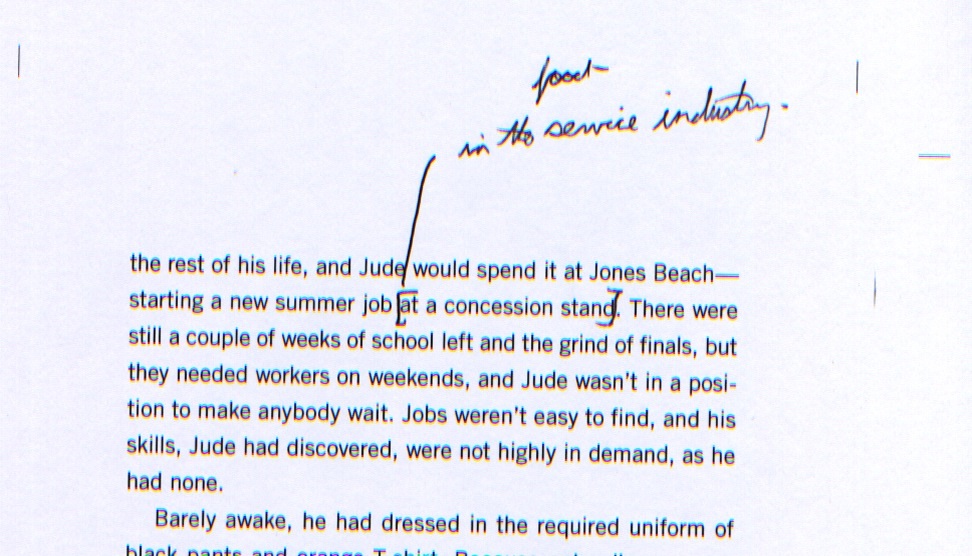
I’ve been living with my ARC for about a month now. For various reasons, it came out eight months before the publication date. The ARC does not reflect what I’d estimate to be several hundred minor changes, revisions, corrections. Maybe that’s a lot, I don’t know; and maybe it was all my fault, probably so. It might be because I’m a perfectionist . . . or that I can’t let go . . . or that I should have caught all that before we got to this point. Maybe I’m an idiot. These revisions range from changing a character’s name, to eliminating a comma, to deleting or inserting a single word, to trying once again to get that sentence exactly right. Here’s some examples:

It seemed funnier, changing it to “in the food-service industry.”

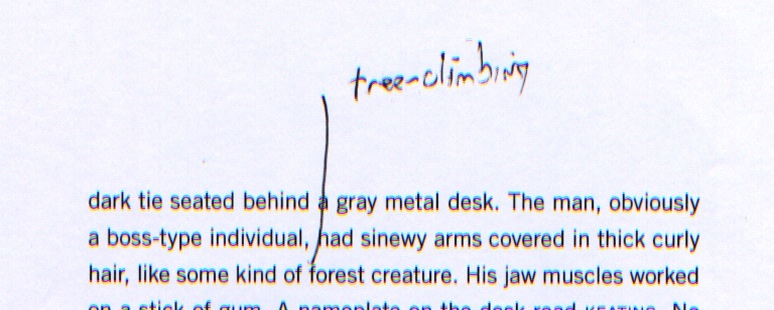
I’m adding a hypenated word here, now it’s “like some kind of tree-climbing forest creature.” This revision — everything I’ll show you here, in fact, we discussed with my editor, Liz Szabla. At the bitter end, we roll up our sleeves and talk it out, comma by comma. And I absolutely love that attention to detail. Liz and I will go months without discussing a work — I like to do my own thing for long stretches — but when we do get a change to get down to it, well, for me, that’s pure joy. I don’t understand writers who don’t like revision. That’s the fun part.

Deleting an unnecessary phrase, for speed.

We talked this over and stayed with “fractures.” There’s a great danger at this point, for someone like me, to gild the lily. To over-think.  Sometimes I’ll suggest a change and Liz will say, not unkindly, “I think it’s fine the way it is.” William Wordsworth, you know, rewrote many of his poems toward the end of his life. And the consensus is that he usually made them worse. There’s a point when you’ve got to put down the pen and back away.

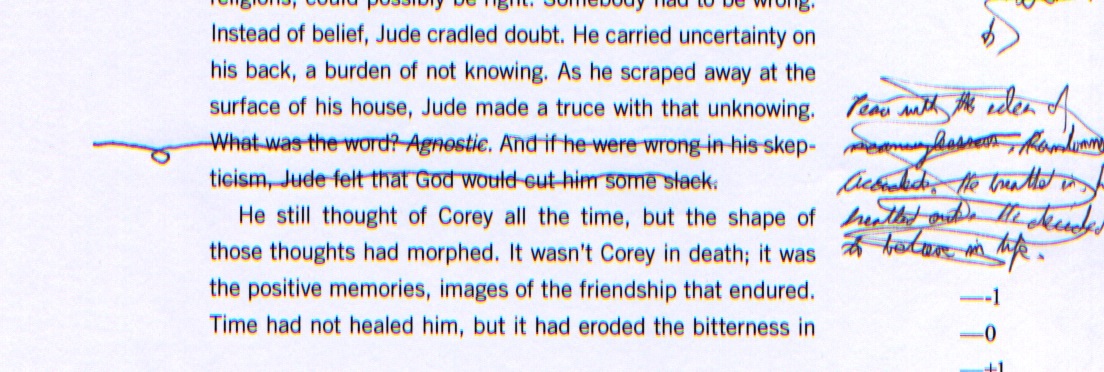
I cut two lines, considered some new text, and cut that, too. Actually, I think I revised and inserted that revision into a different moment in the book. There was an idea that I was trying to get to, which resulted in this sentence: “He decided to believe in life.” But this particular paragraph ends, “Jude made a truce with that unknowing.”

Have you deciphered my lefty scrawl?

He forced himself to retrace his blessings, the people and things he would never wish away, yet the exercise proved small solace. Some secret part of him that he dared not confess longed only for annihilation.

The idea of death.

Just a little faster this way.

He’s a strong runner, an able runner. It was only two miles. Jude didn’t need to catch his breath, he wasn’t panting. He needed to find some pebbles to throw at Becka’s window. For dialogue, not “I’m sorry,” but just, “Sorry . . .”

Probably one of the more worked moments in the book. It now reads:

. . . And he reached back to cast that rock as far as he could.

Just to see the splash.

——

PLEASE NOTE: If you are a reviewer and you are interested in reading the flawed, imperfect ARC to BEFORE YOU GO, please shoot me an email and we’ll see what we can do. I’ve got the perfect book for you. Well, not exactly perfect.

Fan Mail Wednesday #120: On Reading & Rollercoasters

I love hearing from readers of Six Innings, maybe because it’s the kind of book that I would have read as a boy that age. I feel a connection to those guys.

I replied:

Dear Drew,

Oh my, time flies. It looks like your letter was set aside for a while. I hope you are not to upset with me for the delay.

I was glad to read how you found the book, Six Innings, in the library, just picked it up and figured, Why not? Nice that you compared it to a rollercoaster ride, that’s a strong image and, I think, an appropriate one. A good book should bring you up and down, have slow parts and fast parts, wicked turns and gentle pauses. It should take you on a ride.

As a writer, I’ve often thought of my readers as passengers on a rollercoaster. They pick up the book, strap into the seat, and it’s my job to take them on a satisfying ride – and safely back again.

I don’t know, however, that the book had a point, per say. I think you get out of it what you get out of it, and it’s different for every reader. I didn’t really have a message in this one, though I did want to honor the friendship between Sam and Mike, as well as pay tribute to the game I love.

My best,

JP

When the Video Guys Came Over

Dan and Ernie from Spoken Arts Media stopped by the house last week to film moi in a brief video segment. Spoken Arts creates audio and video adaptations of children’s books, which they sell in DVD form to the educational market. Amid their list of high-quality books and authors (Jan Brett, Patricia Polocco, Eve Bunting, more), Dan and Ernie planned to feature A Pirate’s Guide to First Grade. To make their product, Dan hired a professional actor to read the book, collaborated with illustrator Greg Ruth, and endeavored to film a brief segment with me, in which I’d introduce the book to young readers.

For your reference, here’s the Spoken Arts catalog.

My first instinct, I must admit, was this: “Well, no.” I’m not comfortable with that sort of thing. But I knew I had to do it. So after dodging Dan for a couple of months, we finally set a date. Dan told me that I had to write an introduction to the book, something about myself, the creative process, my inspiration for the book, whatever, and then I’d say it to the camera. No more than two minutes long.

“Can’t I just wing it?” I asked, lazily.

“Um, not a great idea,” Dan told me.

On the day before filming, I sat in the waiting area while my son, Gavin, took his weekly guitar lesson. I grabbed a piece of paper from a stack on the table and jotted down some quick thoughts.

Can you read that? I guess not. It’s upside down. Here’s a closer look at a detail.

Remember, please: This is scribbling on a scrap of paper while my middle schooler plays guitar. Just trying to get some primitive thoughts on paper. Even the handwriting’s pretty rough:

I was alone in my back yard — and yet [not] alone. Because I was living in an imaginative world of my own devising. I was the pitcher with the bases loaded, talking to myself, telling myself stories. It’s when I first learned, I believe, to become a storyteller, and later, a writer.

Here’s another close-up from that messy first draft, or sloppy copy. Almost all of this got chucked except for one sentence (can you guess which one?):

In the end, we are celebrating fictional worlds, the make-believe, the realm of the imagination where all is possible. The world between our ears. The world of books. So it’s important to me to end the book that way, where Red, in effect, trades our fiction for another — the world of make-believe . . . for a book!

Next morning, an hour before Dan & Ernie were scheduled to arrive, I printed out a cleaner, leaner version. Sometimes going to a computer can be a mistake for writers, because the result looks finished. All neat and typed, much more polished than those scratchings on looseleaf. Don’t be fooled by appearances, Dear Writer, there’s still more work to do.

Leaning against the bookshelf, I shared my draft with Dan and Ernie. They listened while I read. Made comments, suggestions. They taught me some things about writing for the camera, and clarified how my piece fit into the overall DVD package. The last line needed to lead directly into the heart of the DVD, which was the book itself. While they twiddled knobs and frowned at window glare, I scurried downstairs to write and print out a revised draft.

The dynamic was interesting, because I was the face, speaking for myself and my book, but I was also working for Spoken Arts. They were the ones investing time and money into this product. So I tried to give Dan and Ernie what they needed, while at the same time stay true to myself (whomever that might be on a random Tuesday).

Quick example: At one point, Ernie suggested that I go with a line that read, “In A Pirate’s Guide, I captured that childhood experience . . . .”

I paused, asked, “Does that sound arrogant? A little presumptuous? I’m not sure I can say that.”

We agreed to change it to, “In A Pirate’s Guide, I tried to capture . . . .”

We filmed using a teleprompter, and Ernie input the text. We continued to edit from one read-through to the next, debating details, noting where I got tripped up, until by the fourth attempt I rendered a  satisfactory complete take.

Watch: The segment begins with my back to the camera. I am typing at the computer, Dan says “Action!,” I swivel in my chair, smile feebly at the camera, and say . . .

Hi, I’m James Preller, and I wrote the book you’re about to see.

I guess you could say that I’m a professional daydreamer.

I have vivid memories of playing alone as a little boy, the youngest of seven children. I used to fight imaginary villans and create epic battles in my living room, hurling myself into the sofa, throwing mighty left hooks.

Sometimes I’d sprawl out on the floor with my crayons to draw pictures.

Most often, I’d go outside to throw a baseball against a pitch-back, imagining myself as a big league pitcher going against the game’s greatest hitters.

I was alone in my backyard — and yet not alone. Because I was living in a make-believe world of my own creation. I was the pitcher with the bases loaded, the pirate forced to walk the plank, the hero in the darkened alley.

All the while, I was telling myself stories, living in an imaginary world, and learning how to become a storyteller.

In A PIRATE’S GUIDE, I tried to capture that childhood experience, to celebrate the power of the imagination. It is a land of make-believe, a world of fantasy where anything is possible.

It is the world between our ears.

Let us now see how one lad uses his imagination, and discovers treasure, in A PIRATE’S GUIDE TO FIRST GRADE.