Archive for February 14, 2026

FAN MAIL WEDNESDAY #345: About the Lesson in That Book . . .


Dear James Preller,

My name is Connor from ____ Elementary School. The things I enjoy are playing football and reading your books. My favorite book is Exit 13. My favorite part of the book is when they find out someone lives in the woods. The lesson I learned from the book Exit 13 was to not talk to strangers. My question is have you written any other books besides Exit 13? If you have any other books…which one is your favorite?

Sincerely,

From:Connor 

I replied . . .

Dear Connor,
Thanks for your email. I’m glad to hear that you enjoyed Exit 13: The Whispering Pines. There’s a 2nd book, too, titled Exit 13: The Spaces In Between, which I think is even more exciting.
I had hoped there would be at least a 3rd book in the series, where I could tie up all the loose ends, but publishing is a cruel business. It’s up to the publisher, Scholastic, not me.
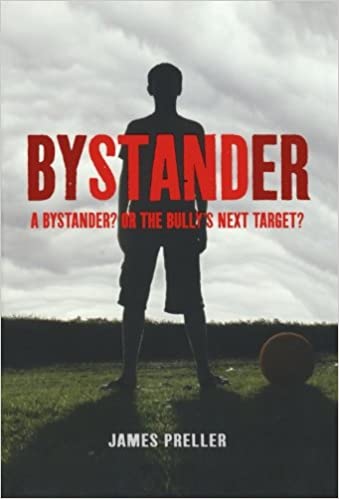
Yes, I have many other books. Four that I’d recommend to you, since you asked:  Blood Mountain, a wilderness suspense thriller; Scary Tales: 3 Spooky Tales in 1, a new collection of scary stories, illustrated by Iacopo Bruno; Bystander, a work of realistic fiction that centers around bullying in a middle school; and Shaken, coming in paperback on 3/17, about a 7th grade soccer player, Kristy, who suffers from a severe concussion.
           
One of my favorite books has become hard to find recently, titled Six Innings, about a championship Little League game.  Better Off Undead is also a wild read with a zombie and a mystery at the heart of it.
I have a new wilderness series coming out in May of 2027, The Survival Code, and the first book is very exciting, Wildfire Escape.
You know, honestly, I don’t think I set out with any real “lesson” to teach with Exit 13. Mostly, I was trying to write an entertaining story. Of course, there are attitudes and values and signals embedded into any story — how characters treat each other, etc. — but I am not really a big believer in “teaching lessons” with my books. Whatever you, the reader, gets out of it, that’s okay with me.
Personally, maybe this is wrong to say, but I like talking to strangers, i.e., meeting new people. Sure, yes, it’s important to be smart about it, to stay safe, but I don’t feel comfortable making a blanket statement to never speak to strangers. I mean, please, don’t be stupid. Don’t climb into any windowless white vans. But I don’t see every new person as a danger and a threat. That said, again, you have to be situationally aware and use good sense. Be wary, be cautious, but if you are in a safe place, with people around who you trust, you can probably venture a little conversation.
The big lesson that I do want to teach with my books: Reading is a pleasure, it’s enjoyable, and it’s a fulfilling way to expand your mind and deepen your understanding of the world around you. In my world, all the best people are readers. And one good book leads to another.
Keep reading, my friend. Any books at all, even mine, 
James Preller

WRITING PROCESS: “Writing Is Structure.” — Vince Gilligan

“The cherry on top

does not support

the ice cream sundae.”

— Vince Gilligan, creator of BREAKING BAD.

Last week I posted about my writing process for a book I was working on, the second in my “Survival Code” series (May, 2027). The deadline was on my mind, a clear line in the sand. A friend asked me how the writing was going and it stumped me. 

Was I even writing yet?

I knew I was working, circling the story, reading and thinking a lot, but I wasn’t actually writing. At least, not in the sense we commonly know it, that whole unpleasant business with words on a page. 

Yet I knew this was essential to the final product. Possibly the most important stage. 

If you are curious, you can click here to find it.

The very next day, I came across this 30-second clip featuring a snippet of Vince Gilligan’s thoughts on writing. He powerfully and simply verbalized something I was dithering about. 

I even transcribed it. But first, to be clear, Gilligan is at first talking about writing for the screen, which is why he begins by discussing dialogue, whereas a writer of novels might describe it differently:

“Oddly enough, people think of writing as dialogue, and to me writing is structure. Dialogue is the cherry on top. The cherry on top does not support the ice cream sundae. It’s a delicious little added thing, but the real storytelling, the real structuring, which is often something in TV we do, all the writers together in a room, working and not actually typing anything, but just talking. Just verbalizing. That to me is the hard part of writing: the structuring, the building of the scaffolding, the skeleton of the story, if you will.” — Vince Gilligan, creator of BREAKING BAD.


CHOOSE YOUR OWN ADVENTURE, Featuring the Art of Norm Grock!

It’s a happy moment when, as the author, you’ve finished writing the book. Then you can sit back and eat chocolates while the illustrator, and editors, and art director, and marketing folks, do all the work. 

Such is the case with my upcoming “Choose Your Own Adventure” book, Fairy House Halloween (July 7, 2026). 

I find writing these books to be challenging and fascinating and so, so different than any other “normal” book. In this case, a book with 13 different endings. That’s bananas. To me, the mission is clear: Simply write the most entertaining book ever. The journey itself is home — because there’s no “there” to get to, no real satisfying conclusion in the traditional sense. No ending sticks. So try to take readers on a wild, imaginative ride.

This is my second Fairy House title, the first one was called, appropriately enough, Fairy House. Crazy, right? And I’m very pleased to report that this new one, Fairy House Halloween, is also illustrated by the unstoppable Norm Grock. 

Man, this guy is so good. He truly understands the assignment.

No, we’ve never met, never spoken, never even exchanged an email. I work for Chooseco, and Norm works for Chooseco, and never the twain shall meet. But I did go to his website for a gander. 

That’s Norm, slaving away (did I mention that these chocolates are delicious? No? Well, they are!).


And here are three pieces of art from the upcoming book, featuring a clumsy, “not-quite-official” fairy named Beezle (pictured in the third photo, after shrinking the YOU in the story). 

Thanks, Norm, wherever & whoever you are! 


THANKS FOR STOPPING BY!


WRITING PROCESS: The Research Feeds the Story — Going Beyond the Inciting Event

I’m working on the second book in an upcoming middle-grade adventure series, “The Survival Code.” The heavy lifting for the first book, Wildfire Escape, is largely behind me.

I should be writing the second one even as, temporarily distracted, I blog this post. The truth is, I am “writing” the book, though I’m not, well, exactly writing-writing. This current phase is a combo platter of research and thinking and brainstorming. It’s impossible to separate them into their own distinct stages. 

For this kind of book, the writing — defined here as words on a page — can’t happen until I figure out details of the plot. In this case, a wilderness adventure set in remote Alaska, I have a lot to learn. There are five characters in a car that careens off an isolated road into a heavy snow bank. The driver, the father, is badly injured. The weather is ominous. And there are four kids, ages 11-13, fighting for his life and their own.

I have the general idea sorted out. Two stay with the father, a medical emergency in a forbidding climate, while the other two go off for help, or shelter, or something. I’m still working that out. But parallel adventures.

Yesterday, I finished reading an incredible book, Where You’ll Find Me, by Ty Gagne. A work of nonfiction, it’s subtitled: Risk, Decisions, and the Last Climb of Kate Matrosova. I’m underlining passages, writing notes in the margins, and reimagining the story that I’m supposed to be, you know, writing. I might as well be scribbling: Eureka!

I stand here before you to defend my honor: This is writing.

The thinking is the writing.

One thing that surprised me about the first book, and once again fascinates me with this second story, is that my focus is not where I expected it to be. It not what I thought I’d be thinking about. You see, from the outset I wanted these kids to be adept at bushcraft. They were experienced in the outdoors life, able to build shelters, start fires, accomplish tasks in natural environments. That’s what I thought I needed to research. And those elements are still there in these stories, but to a lesser extent than I orginally imagined. Because through my reading, I keep returning to the realization that so much of survival is about attitude. I’m fascinated by the traits that help people endure critical situations, and the vulnerabilities that can lead them to potentially fatal mistakes.

One book that greatly informed Wildfire Escape had nothing to do with wildfires. Or, I guess, it had everything to do with surviving wildfires, without specifically being about one. Wait, let me back up: I thought I’d be researching wildfires in a really deep way. And I did. But it was not nearly enough. Because I had to write about characters who made decisions, who acted or failed to act. I kept wanting to know more about that mindset. To that end, the book that helped unlock their inner lives was The Unthinkable: Who Survives When Disaster Strikes — and Why, written by Amanda Ripley.

So why am I sharing this? Because most of the time, across the past 30 years for sure, I continually find that the book I set out to write . . . is not the book I ultimately write. I learn things as I move forward. My focus shifts. The research leads me in new, unexpected directions. The result is a different book entirely.

This happened with my latest middle-grade book, Shaken. I thought it was going to be about concussions. A 7th-grade soccer player suffers from a severe concussion. I’d have to learn all about that medical condition. And that was true. I talked to doctors, read up on things. But what I realized was the story was about a girl, Kristy, who has to pivot, and struggle, and reinvent herself on the fly. The concussion — like the wildfire, like the car accident, like the winter snowstorm — was merely the inciting event. The heart of the story was everything that happens after. 

The research is thrilling. One of the best parts of the writing life, in my opinion. The process fills me up and keeps it new. My brain goes a little haywire with sparks going off all hours of the day and night. I take a shower and wish to reach for pen and paper rather than soap and shampoo. I now have a new insight into Arlo, one of the book’s main characters. I now get how Naomi feels. The book is, I discover, about — in part — the relationship between Arlo and Naomi during a life-threatening crisis. Can they dig out an ice cave? Can they fashion snow shoes out of car mats? Sure, that stuff will be in there. But the real story is what drives them, the mistakes they make, and why, and how together, and at odds, they work to survive. Or not!

You ask if I am writing?

Um, do you mean words on a blank page?

Not yet. Or a little bit. 

But I’m doing something more important than that.

I’m thinking about it!


SHAKEN will be available in paperback on March 17th, 2026. Both books in the SURVIVAL CODE series will be out in May, 2027. Thanks for asking!