Tag Archive for Six Innings

Best Books of 2008, and so on . . .

I have a lot of ground to cover this morning — and hopefully some of it will be in the snow-covered woods and in the company of my dog, Daisy. So check this out:

Sue Corbett, author of 12 Again and Free Baseball, writing for The Miami Herald, named Six Innings in her list of “best children’s books of the year.” Which is just an incredible honor. Though I’ve been involved in children’s books since 1986, the year 2008 was like a coming out party for me. I published two hardcover books (I published only one before, in ’98 or so, and good luck finding it!), started this blog, and have had a lot of nice things come my way.

Sue writes of Six Innings:

The group portrait of the members of a Little League baseball team takes place over the six innings of a championship game. Perceptive and funny, sketches introduce us to the players while the nail-biting action keeps the pages turning. Kids will be nodding in agreement at the truths laid bare.

Sue Corbett’s full list:

NONFICTION

• “Owney the Mail-pouch Pooch,” by Mona Kerby, illustrated by Lynne Barasch.

• “Knucklehead,” by Jon Scieszka.

• “A River of Words,” by Jen Bryant, illustrated by Melissa Sweet.

• “The Trouble Begins at 8,” by Sid Fleischman.

• “We Are the Ship,” by Kadir Nelson.

• “What To Do About Alice?” by Barbara Kerley and Edwin Fotheringham.

NOVELS

• “Airman,” by Eoin Colfer.

• “The Disreputable History of Frankie Landau-Banks,” by E. Lockhart.

• “Graceling,” by Kristin Cashore.

• “The Possibilities of Sainthood,” by Donna Freitas.

• “Six Innings,” by James Preller.

• “What I Saw and How I Lied,” by Judy Blundell.

PICTURE BOOKS

• “A Couple of Boys Have the Best Week Ever,” by Marla Frazee.

• “How to Heal a Broken Wing,” by Bob Graham.

• “Sergio Makes a Splash!,” by Edel Rodriguez.

• “Swing!,” by Rufus Butler Seder.

• “Ten Little Fingers and Ten Little Toes,” by Mem Fox and Helen Oxenbury.

Sue previously gave the book a starred review in Publishers Weekly and (outrageously) compared it/me to Judy Blume. (Thanks, I’ll take a dozen!) I especially appreciate Sue’s kind words, because she’s a real-deal baseball person. I know that Six Innings isn’t for everybody, and I’ve read how some adult readers complain that there’s too much baseball in it, so it means a lot coming from a stranger like Sue who knows and respects that world, who knows those boys, who can read it and say, “Yes, he got it right.”

– – – – –

Over at The Reading Zone, a sixth-grade teacher named Sarah appears to subsist entirely on books, dry toast, and water. After giving her list of favorites for 2008, she writes: “I read about 150 books this year, as of December 26th. These are just a few of my favorites. Ask me again tomorrow, and you will probably get a different list!”

I’m grateful that on this particular day, Sarah thought to mention my book, Six Innings, in such esteemed company. Again: I’m honored and grateful.

Sarah wrote of Six Innings:

I don’t even like baseball and I loved this book! A great book to hand to boys and girls alike, it goes much deeper than just baseball and deals with life. The characters are realistic and easy to relate to. It’s just a great book all around!

Hey, a convert to the Church of Baseball! Sarah’s full list:

Tennyson by Lesley M.M. Blume.

Diamond Willow by Helen Frost.

Every Soul A Star by Wendy Mass.

Six Innings by James Preller.

The 39 Clues (The Maze of Bones, Book 1) by Rick Riordan.

Chains by Laurie Halse Anderson.

My Father’s Son by Terri Fields.

The Underneath by Kathi Appelt.

The Year We Disappeared: A Father-Daughter Memoir by Cylin Busby and John Busby.

The Dead and the Gone by Susan Beth Pfeffer.

What I Saw And How I Lied by Judy Blundell.

– – – – –

I find this funny. Tony Abbott has been running a series on his blog that focuses on writers’ workspaces. He’s received and posted descriptions from Nora Raleigh Baskin, Elise Broach, David Levithan, Cynthia Leitich Smith, and Lisa Yee. But recently it’s all gone downhill.

When first launching the series, Tony wrote:

“The actual earthly position a writer chooses (or maybe doesn’t choose) to do his or her work seems to me vital to the functioning of the art that takes place there. Or, if not, it’s at least interesting to me, and when I visit classes, I never fail to speak in revered tones about where writing happens, and where it doesn’t happen. For some writers, the space he or she works in is, possibly, the only three-dimensional reality they have.”

And at some point, Tony made the miscalculation of asking me. Or maybe it was a good idea, as counter-balance, because I couldn’t be more different. I don’t have any of those sacred space feelings, and am actually embarrassed by my (basically crappy) workspace. No revered tones here. In fact, no offense, I don’t think I’d ever be caught dead referring to it as a “workspace.”

Anyway, to learn more, stroll on over to Tony’s blog by clicking right here!

Shea Memory, Childhood Illness, and Six Innings

As these photos taken by Joe MacDonald show, the destruction of Shea Stadium continues into winter. Come spring, our attention will turn to the new home of the New York Mets, Citi Field, with its beautiful Jackie Robinson Rotunda, and the promise of a new season to come.

But I’m not ready to go there just yet. Instead, my thoughts linger on Shea. I’ve been to many games over the years. My first was in 1967, the Mets vs. Hank Aaron and the Braves. I saw the 5th game of the 1969 World Series. Some great victories and some crushing defeats. A lot of memories.

I learned to love baseball from my mother, a former Brooklyn Dodgers fan who, after the Dodgers fled to Los Angeles, adopted the expansion 1962 New York Mets as her hometown team. She faithfully gave her heart to this hapless bunch in orange and blue. As I grew up, she taught me how to throw and catch, and somehow sold me on the preposterous notion that Ron Swoboda, the Mets thick-necked rightfielder, was graceful. I used to ask her, as I minced across the lawn, “Am I graceful, Mom? Am I graceful?” She assured me that I was. I’ve come to see that my love of the game is impossible to separate from the love of my mother; I cannot imagine one without the other.

In the spring of 2003, my oldest son, Nicholas, was diagnosed with leukemia. It was a relapse. He had first been diagnosed in the summer of ’95, at 26 months. We had been there, done our hard times, and believed the worst was behind us. But again we settled into an exhausting routine of doctors and medicines, blood tests and spinal taps, the chemistry of hope and fear. Much, much harder for Nick the second time around.

Meanwhile, my father-in-law, Ed Ginsberg, a lifelong Yankee fan, contacted the New York Mets. He made phone call after phone call, telling one person after another Nick’s story. Weeks passed. While undergoing treatment, Nick got an infection. His immune system too compromised to fight it, Nick was forced to stay on IV-drips in the hospital for twelve long days until his temperature settled below 101 degrees. On one particularly bad day a letter arrived from Chris Brown, the New York Mets Community Outreach Coordinator. He invited Nicholas and three guests to a special day at Shea Stadium.

When Nick felt strong enough, down we drove from our home outside Albany, New York — Nicholas, his stepmother Lisa, his grandfather Ed, and myself. Chris Brown met us at the gate two hours before the game, shook our hands, and brought us inside to the secret, special places. He opened a door and led us onto the field, where Nick stared in wide-eyed wonder. We stepped into the dugout, felt the bats in their racks, eyed the neat rows of clean helmets, and snapped picture after picture. We walked into a long concrete hallway under the stands, where we stood nearly alone outside the Mets clubhouse door, as real live ballplayers — guys with names like Vance and Ty, Joe and Cliff — walked past us on their way to the indoor batting cages. Some players stopped and briefly chatted, signed baseballs, and smiled for photos with their arms resting on my son’s shoulder.

I couldn’t help but think of my mother, and how our love of the game had brought us to this singular moment. My boy, sick with cancer, smiling into the camera, a Sharpie and a signed baseball in his hand. All those games we had watched together, our spirits dashed by defeat and lifted in victory. All of that time and energy invested, all of that life we poured into the game — all of it, truth be told, a little absurd. After all it is just a game. Not life, not death, and certainly not childhood cancer. But standing in that gray basement of Shea Stadium, I knew with certainty that it all had been worth it.

We loved the game. And sometimes, amazingly, it loved us back.

—–

It was why I wrote Six Innings, why that book was so important to me. Because it’s all in there, all that stuff, a roiling wave that carries the words along, the love of the game, a lifetime of baseball, and sometimes the hard things that get in the way.

Fan Mail Wednesday #20

And so I find that I’ve become what I had always feared:

Homework.

Dear Mr. Preller,

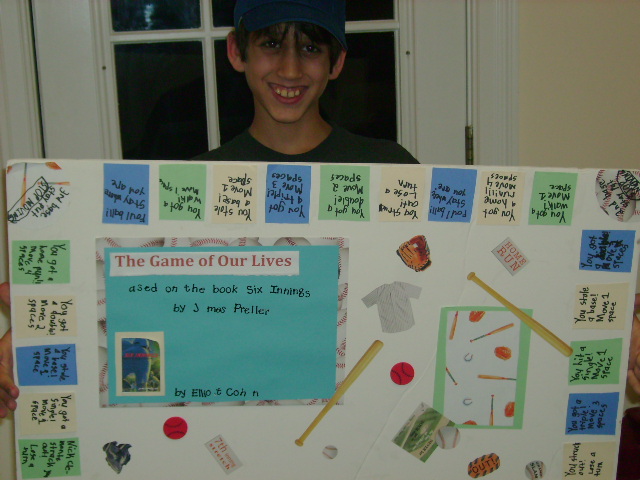
My name is Elliott and live in a small town in the suburbs of Chicago. I did a book report on one of your books, Six Innings, and I thought I should share it with you a little bit and tell you that I thought your book was one of the best books I’ve ever read. I did my book report in the form of a board game, the objective being to start at home plate and try to be the first one to go all around the board and reach it, with obstacles at every corner (I have attached some pictures of my game to this email). I also got an A+ on it, which is another reason I thought I should send it to you. I deeply hope you reply to this email when you get it.

Your reader,

Elliott C.

P.S. I know you’re a Mets fan, and I’m a baseball fan too, but I’m more of a Cubs type. I also know that you’re ashamed that the Mets didn’t make it to the playoffs, so I am deeply sorry.

I replied this way:

Dear Elliott:

I wanna play, I Wanna Play, I WANNA PLAY!

Thanks so much for sharing this with me. I love the photos you sent, too. They confirmed my deep-held belief that I have the best-looking readers in all of children’s literature. Rowling may be making more money, others may get the awards, but my readers brush their teeth.

And that means the world to me.

Elliott, I’m impressed with the energy and creativity you put into your project. Not only did you deserve that A+, I believe your parents should buy you a new car (hopefully one of the more eco-friendly hybrids, but let’s not push it).

A Cubs type, huh? No problem. A couple of years back I finally made the pilgrimage to Wrigley Field. You are lucky to have that historic ballpark in your backyard. My home park, Shea Stadium, is being torn down as I type this; but at least we’ll get new digs, hopefully this time with running water.

But I do have to say that, contrary to your comment, I’m not at all ashamed of my team, the New York Mets. I thought they played hard and came up short. Too many people label that as “choking.” Sometimes you don’t win. I thought their bullpen was deeply flawed. Try as they might, they couldn’t overcome the injuries and roster weaknesses. I thought the effort was there.

But, yeah, it was disappointing. As a Cubs fan, I guess you know all about that.

Thank you again for your letter, for reading my book, and for creating the coolest board game ever. I am humbled and grateful. You should also be thankful to your teacher, who was equally creative and open-minded in accepting, and probably encouraging, a book report that comes in the form of a board game. And, yes, I still wanna play!

Your friend,

James Preller

Fan Mail Wednesday #17

Here’s one that just came sizzling through the wires, presumably typed by an older sister:

Hi!
My brother Tommy is a huge fan of yours. He is reading
Six Innings and is enjoying it very much. My sister Kathy is reading Jigsaw Jones and is also loving it!! Thanks for your time! Please right back.

From, Mary Beth

*Live * Laugh * Love*

Here’s my reply:

Dear Mary Beth, Tommy, and Kathy,

Thanks for the note. This is exactly what I’m talking about, America! Everybody in the house should be reading my books. Even the pets! Wait, I take that back — especially the pets!

Seriously, Tommy, I’m glad you are reading Six Innings. I vividly remember when I played Little League. Once when I was ten years old, the youngest kid in the Majors, I lost a game that I pitched, 1-0. I was crushed. I remember sitting in my dad’s car after the game — hiding, really — fighting back the tears that welled in my eyes. The opposing team’s pitcher, Michael Aldridge, who was 12 years old and the best player in the league, came over and shook my hand. He told me I pitched really well. But I couldn’t even look at him. All I did was sniffle. It’s amazing that I can remember that so perfectly, 37 years later. It must have been important, you know? That’s why I wrote that book. For a lot of boys like me, those games mean, or meant, a lot.

Kathy, that’s cool you are loving my Jigsaw Jones books. As a matter of fact, I am writing a new one, The Case of the Skeleton’s Secret. Anyway, I’ve never had anyone fart in a Jigsaw Jones book. Or burp, for that matter — even after more than 250,000 words. But I’m thinking about writing a fart scene after I finish this letter. Why? I can’t possibly think of a good reason! Except I want it to sound like this . . . poof . . . the softest, quietest sound ever. It’s more about the reaction than the, um, gaseous event. So it’s important WHO farts, you know. Obviously, this requires some DEEP THINKING. So I’ll write it, but I can’t promise the scene will stay in the book. We’ll see what my editor thinks. Do you think it’s too gross? I’m afraid it might be. But like they say, “Everybody farts.” Except for my wife, who simply refuses. I’m worried that one day she’ll explode.

Mary Beth, you must be a great sister. It was nice of you to write the email for Tommy and Kathy. I like that you end your message with: *Live * Laugh * Love* But I think you forgot some other essential L-words, like: *Lollipops * Lungfish * Lilliputian * La-de-da * Leg-of-Mutton * and Ludicrous.

Just trying to be helpful.

JP

Deleted Scenes: Six Innings

During the revision process for Six Innings, I cut more than 10,000 words. It was a very difficult time for me, filled with doubt and uncertainty. But I trusted my wise & experienced editors, Liz Szabla and Jean Feiwel, and understood their concerns. We all wanted the same thing — for this book to be as good as it could be. So I semi-sadly started hacking away.

My original concept for the book was to use a single game as the structural skeleton, on which I’d hang riffs and character studies, the stories that would add flesh to the book. Well in the first draft, that technique got a little confusing at times, and the through-line of the game itself got muddled, so in revision we cut out a bunch of off-the-field moments to achieve, we hoped, better balance. Some sections I simply lopped away like Van Gogh’s ear, some made it through unscathed, while still others survived in severely truncated form. That was the case with the selection below, which was reduced to a couple of brief paragraphs on pp. 53-54. I always liked it; hey, we all did. This was a classic case of removing something that was, in isolation, good (or so I thought), but that in our view did not do enough to serve the narrative arc. This happens with movies all the time. To preserve the narrative flow, the forward march of things, some decent material winds up on the cutting room floor. (And, I guess, eventually winds up on a blog somewhere.)

Here’s a 38-second example of a deleted scene that never made it into the final cut of a popular movie:

You need to a flashplayer enabled browser to view this YouTube video

Back to Six Innings. This is how one section appeared in an early unedited draft, before I stopped by with a machete:

* * * * *

TYLER WEINBERG

“Ty-Ty Smash”

Naked except for a drooping diaper, two-and-a-half year-old Tyler Weinberg swaggered around in his backyard. As usual, he held a large stick in his hand. Tyler spied a squirrel and moved toward it, mischief blazing in his eyes.

“Ty-Ty smash,” he announced to the birds in the bush.
Whap! He smacked the stick on the lawn. Hee-hee. The sound made him laugh. Whap, whap!

“Ty-Ty smash,” he repeated happily.

Whoosh, thwack. He whipped the stick against the hammock, still damp from last night’s rain. The squirrel watched transfixed, alarmed, yet curious. Its tail flicked nervously. The creature sized up the approaching pink-bellied menace and decided: Trouble. A final twitch of the tail and the gray creature scurried a few feet up the trunk of an oak tree, just beyond, it thought, harm’s reach.

Tyler Weinberg pushed against the tree with both hands. He tried knocking it down. Again he swung the stick, leaping to reach the squirrel. Thud, thwap, crack; thud, thwap, crack. Again and again.

The squirrel complained bitterly: Tcccccckkkkkssss.

Thud, thwap, oomphff.

A glorious peel of laughter erupted in the backyard. A whoop of triumph.

Whap, whap, whappp!

The back door flew open, banged closed. “WHAT’S GOING ON OUT HERE?” Tyler’s mother, Amy Weinberg, screamed. “TYLER! TYLER, GET AWAY FROM THAT SQUIRREL! PUT DOWN THAT STICK THIS INSTANT!” Her voice was rising, shrilly climbing toward hysteria. She barreled forward incautiously and twisted an ankle on a battered toy truck.

Tyler turned to his mother and grinned, triumphant.

“Ty-Ty smash,” he explained proudly.

He was holding a dead squirrel by the tail.

And so a slugger was born.

Tyler — or “Red Bull,” as he came to be called by his coaches — was simply one of those boys suffused with an excess of energy. Super-charged. He could not sit still. In truth, he could barely sit at all. Knees popping up and down, toes tapping, fingers fidgeting, brain a blur, arms akimbo. Bouncing was better. Jumping, running, leaping, pouncing, flouncing, crawling, cavorting, gamboling — all good. But best of all, the single act that calmed Tyler, that focused his scattered energies and made his heart soar?

Smashing things.

The world was his piñata. And there he stood, dizzy and daffy and blindfolded, a big stick in his grip, eager to swing and swing again. To batter, bash, smash, and shatter. The boy liked to clobber things. He became a one-boy wrecking crew. And the bigger he grew, the harder they fell: Crash, bash, boom. Broken lamps, cracked windows, whatever was in his path. Especially, and most happily, baseballs.