Tag Archive for Liz Szabla

When That First Copy Arrives in the Mail: Shiver Me Timbers!

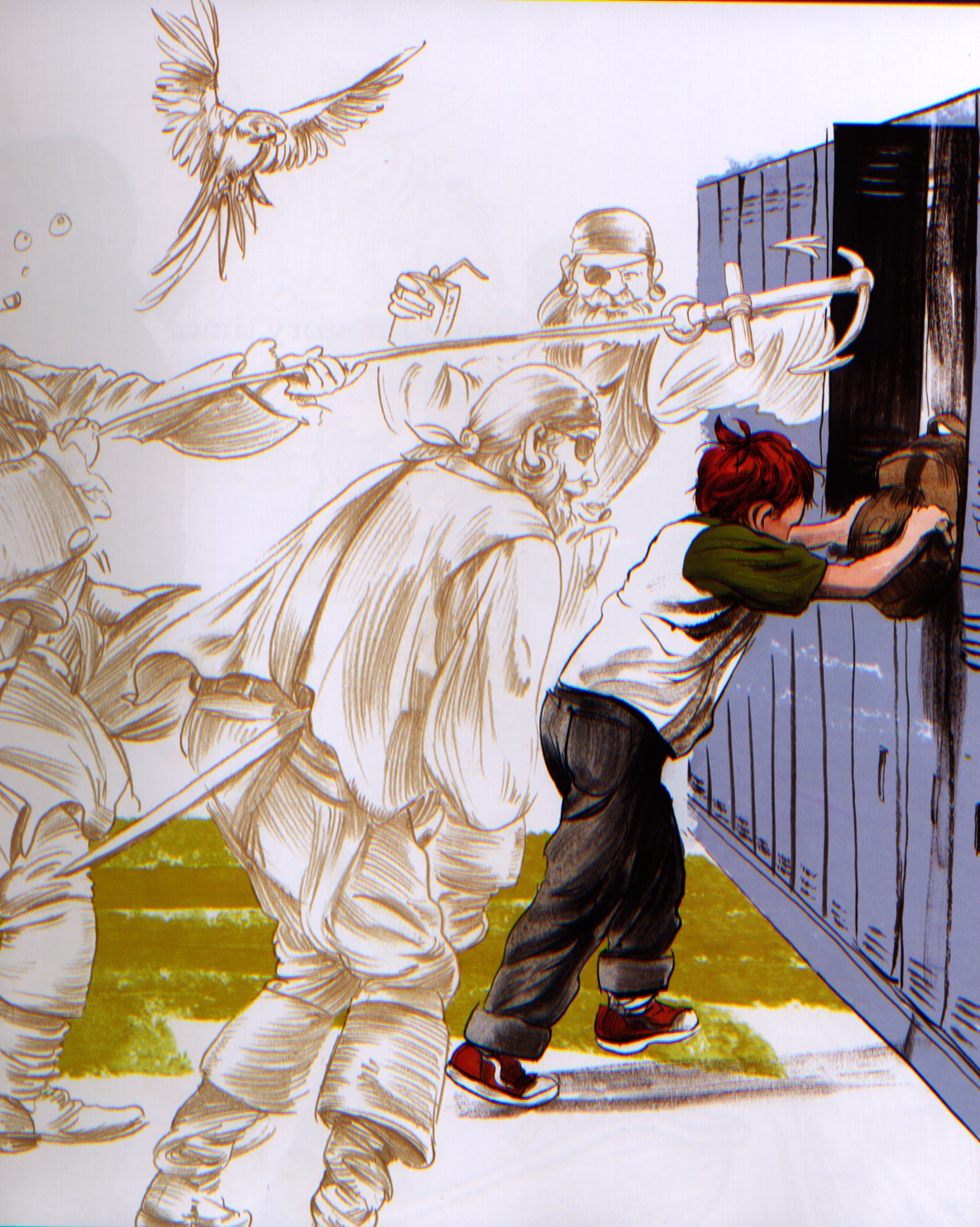
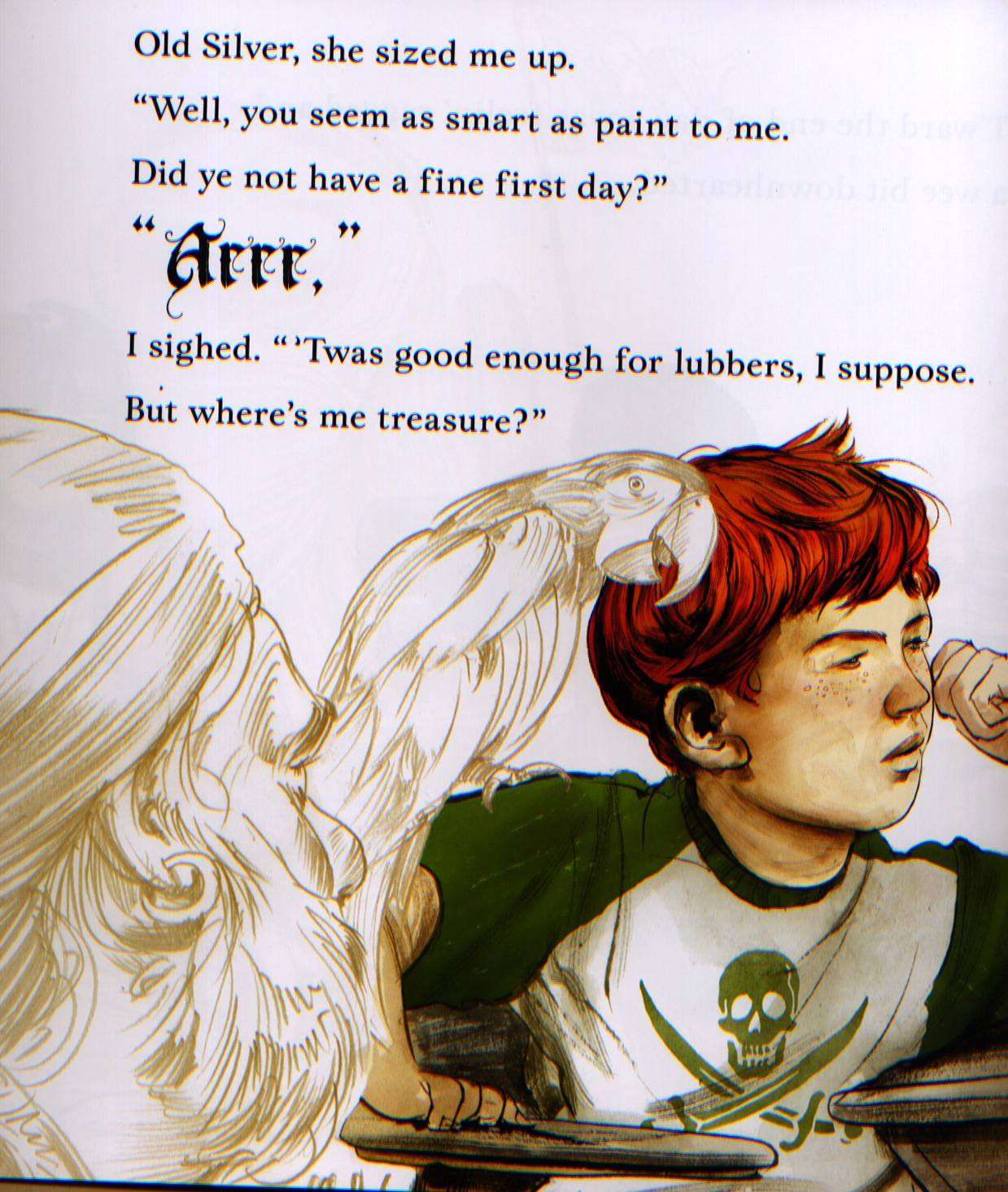
I don’t do happy dances. I’m not a fist-pumper, chest-thumper, or rump-bumper. It’s just an inward satisfaction, and pure pleasure; the culmination of something that’s been brewing for years. In the case of this book, A Pirate’s Guide to First Grade, illustrated by Greg Ruth, my pleasure is tripled by the gratefulness I feel to be so well published.

What does that mean, exactly? Well, for the most part, after you sell a manuscript your editor and publisher will make a hundred small decisions about the book. And each decision boils down to one thing: How much care are they going to put into it? Sometimes it’s money; mostly it’s attention to detail. For example, almost all picture books are 32 pages. But for this book, Feiwel & Friends gave illustrator Greg Ruth the freedom to stretch out the artwork across 48 pages. In doing so, they showed a commitment to story.

As an author, you can see it in the book, in the conversations you have about it, in all the myriad details of how it and you are treated. At times in my twisting, inglorious career I’ve been disappointed and disheartened. So clearly a B-lister.

That’s the most important thing, I think, with my editor Liz Szabla at Feiwel & Friends, the art director Rich Deas, publisher Jean Feiwel, and many others who work so hard there: Dave Barrett, Nicole “May I Buy a Vowel” Moulaison, and the entire “Fifth Ave” sales force (for talking like a pirate on all sales calls). What’s more, they all now bring parrots on all bookstore visits. That’s commitment, folks.

Collectively, they seem to care deeply about every book they publish. And for that I am enormously grateful and, yes, indebted.

The book hits the market for real on July 20, 2010 — just in time for the coming school year.


Fan Mail Wednesday #82-83

I’m running a day late again, and falling behind on everything. So let’s hop to it!

Letter #82:

I replied:

JonJon,

Thanks for the letter and the book report. I’m glad you connected with Six Innings. I’m a big reader of baseball books myself; I’ve actually built up a pretty good collection over the years. It means a lot to me that I now have a book to place on the same shelf alongside some of my all-time favorites.

Where I live, in upstate New York, we’ve finally broken winter’s back. I’m now coaching two baseball teams. One is regular Little League, boys 10-11, and the other is a 10-Under Travel Team. By the time All-Stars is finished in July, I expect I’ll spend about 70-80 days running practices and filling out lineups for games. I love it — and have always, always loved it, for as long as I can remember — so it was natural for me to finally get around to writing a baseball book. It’s a world and a game I know inside out and from a variety of perspectives.

Whenever I think of that book, I’m grateful to Jean Feiwel and Liz Szabla, my editors in New York City, for giving me the opportunity to write it. (By the way, Jean is going to be very angry when she sees that you misspelled her name — it’s the kind of thing that freaks her out completely; my advice, find a safe house somewhere, stay out of the city for a while, lay low.) You know, it  means everything in the world when there’s someone behind you, believing in you, setting you up to succeed. That’s my coaching philosophy in a nutshell: I try to be the guy on the side clapping my hands, saying, Come on, you can do it.

Isn’t that what everybody needs?

Oh yeah, thanks a lot for the self-addressed, return envelope. Very thoughtful and much appreciated.

JP

* * * * *

Letter #83:

I wanted to tell you that my son (6 years old) and I have greatly enjoyed your Jigsaw Jones series.  I picked your series because they were chapter books, but mainly because they were upbeat and friendly.  I was a bit dismayed by the dark  themes that some of the other series contained and was happy to find yours.  Many thanks for all the writing you have done!

As an aside, in one of the books I read “FLY 92” and my curiosity was suddenly piqued!  I was tickled when I realized you are currently in the Capital District.  I grew up in Greenville, NY which is southwest of Delmar.

Blessings to you and your family.  We look forward to reading more of your books (not just Jigsaw!) in the future!

– Rachel

I replied:

Rachel,

I am always so grateful when I receive notes like yours. It means a lot that you, a parent, took the time to say those kind words. I’m touched. And yes, sure, I’m glad somebody noticed! I’ve kept Jigsaw squeaky clean because I’m writing for very young readers. It’s easy to lose track of how little these kids are. I just have a clear sense of where I will and won’t go with that series. I don’t see the need for words like “fat” or “stupid” or mean-spirited behavior, much less what we commonly hear in popular children’s movies today. In fact, I feel a strong need to avoid that language.

Quick story: Yesterday we had a hard moment with my daughter Maggie, who’s in 3rd grade, when someone called her fat (she isn’t, but that’s beside the point). At the same time, I’ve been reading Queen Bees and Wannabes, constantly reminded of the importance of language and the labels we use to hurt or limit others. There she was, crying. And it wasn’t the crying that worried me, but the self-image issues that can make being a girl so difficult in today’s world. Maggie’s mother is 6’1″ — strong and powerful and gorgeous. For Maggie there’s no hope that she’ll be the idealized petite blond in skinny jeans.

I guess we’re growing up.

In fact, I blogged about this same issue — in a totally different context — earlier this week. Words have a power over us.

Thanks for writing. When you are ready to take the next step beyond Jigsaw, you might like Along Came Spider, which is just right for 3rd grade and up. Mighty Casey is a baseball-themed picture book your son might enjoy. Sorry, didn’t want to sound like a commercial there at the end.

Greenville forever!

JP

What I’ve Been Working On: A Brief Sample

In college I had a teacher, Dr. Pat Meanor at Oneonta, who said something that I’ve always taken to heart. He said if you want to write, then you had better shut your mouth. Don’t talk about it. Otherwise all that creative energy escapes out your mouth instead of your hands (writers, after all, work with their hands).

I’ve been reluctant to talk about works in progress ever since. It feels to me like misplaced focus. So easy to talk about it, much harder to sit down and do it. Besides, as everybody knows, talk is cheap, the purview of phonies. The only thing that matters is what you get down on the page. Yet this blog is intended, in part, to document “the writer’s life.” So here’s a quick update.

This summer, I have two hardcover books coming out. First there’s A Pirate’s Guide to First Grade (Feiwel & Friends), a picture book illustrated by Greg Ruth. I think it’s a lot of fun, with real kid-appeal, and Greg Ruth is a brilliant artist. For more on that, click here.

Justin Fisher Declares War! (Scholastic), a middle grade sequel-of-sorts to Along Came Spider. It’s set in the same school and a few characters from the first book reappear in minor roles. This is my Rebound Book after Bystander, which was a far more ambitious novel. That is: Justin Fisher Declares War! is lighthearted, easy-to-read, funny, fast, almost frivolous. NOTE: In no way do you need to read Spider in order to enjoy Justin. The book stands on its own.

What am I writing now? Well, I’m thrilled to be working on my first YA, involving characters ages 16 years old. It’s been a liberating experience as a writer, and I feel as if I’m working in my natural voice. I’ve been pushed and stretched in new ways, and it’s taken a while to find myself on terra firma. I’ve splashed around a bit. Maybe that’s appropriate, because the book is set on Long Island, with many scenes at Jones Beach (my old haunt); it involves a boy-girl relationship, a car crash, summer friendships, and other stuff. The truth? I don’t want to talk about it; I want to write it. So that’s what I’ve been doing.

Below you’ll find a brief sample from an early chapter. Remember, this is YA and contains some language. I must emphasize, we’re talking Unedited First Draft. I’ll certainly make many changes in subsequent revisions before I send this to my editor, ultra-cool Liz Szabla, who has not read a word of it yet. Absolutely no one has seen this before. Raw output. Maybe it all gets scrapped; too soon to tell.

Jude squeezed his eyes shut, blinking away the sun’s glare, and waited for the eight-fifteen-in-the-freaking-morning bus. On a Saturday, no less. The stop was located beneath the elevated Long Island railroad, with rails that hummed overhead and stretched across the length of the island, connecting the farthest points east all the way to Pennsylvania Station in Manhattan. Ever since his family relocated to the island five years ago, New York City had beckoned to Jude, offering an exotic world of freedom and possibility. The city stood as a skyscrapery refutation of his suburban life, escape only a train ticket and 45 minutes away.

He sat cross-legged on the curb, leaned back on his hands, and scanned the road for coming traffic. Most people around here drove like psychopaths and Jude wasn’t eager to have his legs run over. It might ruin his weekend, the bleeding stumps, all that dragging around. Better, he thought, not to get run over in the first place, so he cast a wary eye down the road. Today was the first day of the rest of Jude’s life and he would spend it at Jones Beach – starting a new summer job at a concession stand. Nobody’d want to miss that kind of excitement. Barely awake, he had dressed in the required dweebware, a uniform of black pants and orange t-shirt. Because, like, naturally you wear black pants to the beach. Jude Fox was on his unmerry way to becoming a minimum-wage flunky, a hot dog grilling, soda spilling concession stand worker. Greatness to follow.

The morning sun shone not high above the horizon, garish and bright, so Jude stepped back into the station’s cool cement shadows. It was going to be a hot one, the first scorcher of summer; not a cloud in sight, just blue June skies. In truth, Jude didn’t hate the idea of working. He’d heard that beach jobs could be okay, even fun. But Jude was a realist; he knew it would basically suck. Had to, right? After all, he’d heard people complain about their jobs all his life, why should his job be any different. So he could not help but wonder if taking this job had been a mistake. Sometimes it felt to Jude that he was just like those trains overhead, traveling along between two steel rails, the course of his teenage life mapped out long ago. No steering wheel, no brakes. Jude followed the path carved out for him, no different from anybody else. In two years, college; after that, marriage, kids, and it’s a wonderful life.

These are the thoughts you have when you wake up too damn early on a Saturday.

Bullies and Bystanders

Photo: Igor Dutina

There was a good article in yesterday’s Science Times section of The New York Times. Written by Perri Klass, M.D., it looks at bullying from a pediatrician’s point of view, and provides news about how the American Academy of Pediatrics will be publishing a new policy statement on “the pediatrician’s role in preventing youth violence.”

The article had this to say about the upcoming policy statement:

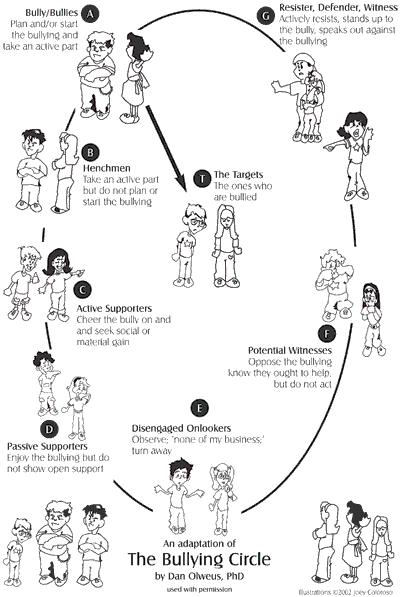
For the first time, it will have a section on bullying — including a recommendation that schools adopt a prevention model developed by Dan Olweus, a research professor of psychology at the University of Bergen, Norway, who first began studying the phenomenon of school bullying in Scandinavia in the 1970s. The programs, he said, “work at the school level and the classroom level and at the individual level; they combine preventive programs and directly addressing children who are involved or identified as bullies or victims or both.”

Dr. Robert Sege, chief of ambulatory pediatrics at Boston Medical Center and a lead author of the new policy statement, says the Olweus approach focuses attention on the largest group of children, the bystanders. “Olweus’s genius,” he said, “is that he manages to turn the school situation around so the other kids realize that the bully is someone who has a problem managing his or her behavior, and the victim is someone they can protect.”

As the author of a new book titled Bystander (Feiwel and Friends, September, 2009), a book that was informed and inspired in part by Olweus’s work, I’m thrilled to read that the American Academy of Pediatrics is taking this issue seriously. I came away from my own research with the belief that our focus has to be on the community, on the school environment, on the bystander’s social and ethical responsibilities. That is, yes, we are our brother’s keepers.

Dr. Sege used a nice turn of phrase later in the article. He spoke of “activating the bystanders.” Here’s another clip from the article:

Dr. Sege said, “activating the bystanders” means changing the culture of the school; through class discussions, parent meetings and consistent responses to every incident, the school must put out the message that bullying will not be tolerated.

So what should I ask at a checkup? How’s school, who are your friends, what do you usually do at recess? It’s important to open the door, especially with children in the most likely age groups, so that victims and bystanders won’t be afraid to speak up. Parents of these children need to be encouraged to demand that schools take action, and pediatricians probably need to be ready to talk to the principal. And we need to follow up with the children to make sure the situation gets better, and to check in on their emotional health and get them help if they need it.

Anyway, this is an issue that means a lot to me, and means a lot to my editor at Feiwel & Friends, Liz Szabla. It has always been my hope that Bystander — not a handbook, but a work of fiction with tension and drama — would help in some way with this issue. That maybe teachers would use it in school, discuss it in classrooms, get kids talking and thinking.

More and more, as this writing career moves into its third decade, I’ve come to the conviction that a book is not an end, but a beginning. It’s about what happens after you read the book. The thoughts that occur, the conversations that take place.

But that’s a big topic, and better left for another day . . .

Mighty Casey: Editorial Letter Excerpts

I’ve been doing a lot of school visits, book signings, and book fairs over the past two months. It’s been a lot of fun, distracting, joyful, happy, hard, and humbly rewarding. One of the highlights of my act — between juggling chain saws and wrestling live bears — has been reading Mighty Casey, illustrated by Matthew Cordell, to audiences up to 200 (squirming, wriggling) children. The book really goes over well (if I don’t say so myself), especially when I stop and go into great uproarious detail about Ronald the Runt, who has to pee, “and decided left field would do.” Kids love that part, and it’s absolutely true to my coaching experience. Happens every year. Some of those little boys just want to play and play until the lastpossiblesecond, not missing a thing, and they don’t always make it all the way to the bathroom.
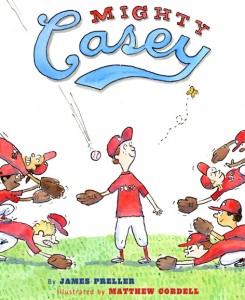
When Ernest Thayer wrote the original “Casey at the Bat,” published in a San Francisco newspaper in 1880, he considered it a mere doggeral. He even used a pen name, to disassociate himself from the poem that would later (ironically) define his career.

I never really thought of Mighty Casey as a poem, per say. It rhymes and bounces along well enough, but it’s not, to me, poetry. Like most published books, it went through various drafts and revisions. And it was definitely made better through the help of my editor at Feiwel and Friends, Liz Szabla. As a rule, anybody with two z’s in their name has to be awesome. Name your child Buzzy and you are guaranteed a terrific kid. Anyway, here I am digressing once again, suggesting names for your children, which, let’s face it, is probably a personal decision and none of my business. But: Buzzy. Think about it.

I just came across an editorial letter from Liz, with comments and suggestions in response to the first draft of Casey (that is, the first  draft that Liz saw; not the first draft I wrote). The way this works for Liz is like this: We’ll talk on the phone, go through things in a general manner, and she’ll follow that up with a more detailed “formal” letter. Most editors seem to work this way. Below you’ll find the bulk of that letter, with only a few passages removed to save the author from further embarrassment. I should also note, for those interested in the publishing process, that I didn’t see that first draft as a finished piece. It needed work and I knew that. But I had reached the point where I needed another eye, another point-of-view. I needed, that is, HELP! And Liz was there to catch me.

MIGHTY CASEY is mighty charming and we’ve enjoyed the time we’ve spent with it. I’m delighted now to be sending you our thoughts as well as a line-edited manuscript. You and I haven’t worked together before – please know that all my suggestions are open to further discussion if anything doesn’t feel quite right.

First and foremost, the Delmar Dogs are hilarious! Casey, as the unlikely hero, is wonderful. And the echoes of “Casey at the Bat” make Casey’s final triumph all the more satisfying, of course.

Let me break in here to comment that all editorial letters begin with a compliment. It’s a trick they teach you early on in Editorial School. The editor opens your ears by saying something positive. I tell this to kids who do peer writing in school: Always begin by saying something nice. Find a part in the story that you like and praise it. That way, you increase the chances of the writer hearing any critical suggestions you might later make. I’m saying: Liz didn’t fool me; I knew there was a big “but” in there somewhere.

You’ll see that I’ve make some suggestions and tweaks on the manuscript to fine-tune the rhythm or syntax in places. I won’t detail those suggestions here, but do let me know if I’ve fouled anywhere (heh, heh). Now onto a few issues to keep in mind as you consider the line-edit….

Note: the “line-edit” is the marked up manuscript, with more detailed comments and suggested changes in the dreaded red pencil. The general editorial letter comes along with a marked-up manuscript, which can be a cold thing, almost painful. Thus, the editorial letter serves as fabric softener to the line-edit’s starch. (Oh dear me, a laundry metaphor? Move on, people, there’s nothing to see here, nothing at all . . . .)

4th stanza
Although the “enjoyed…destroyed” rhyme is marvelous and unexpected, I can’t help but wonder if, in the fourth stanza, the parents’ feelings about the game are at odds with the Dogs’ pride at trying their best. To say that the adults don’t “enjoy” the games is a bit of a disconnect with the spirit of the Dogs. Still, I certainly see how it might be tough for the parents to see their kids trounced, and if this is what you intend, then let’s leave it. But if you want to work on another layer of subtlety – that is, the kids’ pride being stoked by their parents’ empathy, then I believe it’s worth exploring.

This is an example of an editor forcing the writer to think. I had to go back and look at what I was attempting to achieve in that stanza. I suspect Liz’s motherly instinct was to keep the parents cheerful and positive, whereas I wanted the recognition of how tough it can be to sit in those stands sometimes. In the end, I pretty much kept this stanza as is, but Liz made me to think about it and justify those words in my mind.

13th stanza
I’m a bit confused about why so few spectators notice or cheer when Jinn Lee bloops a double and later scores a run. Here’s where I see the Dogs and the parents on their feet, pumping their arms in the air!

Liz was right — and she was right in many places — so I changed it. The revision now reads: “When Jinn Lee clubbed a homer/The crowd stood and cheered.”

18th stanza
As Casey steps up to bat, there are a few things readers should know: How many outs are there? That is, is he the team’s last hope? If he strikes out, do they lose? If the situation is clarified, then you’ll really ratchet up the suspense in this last section.

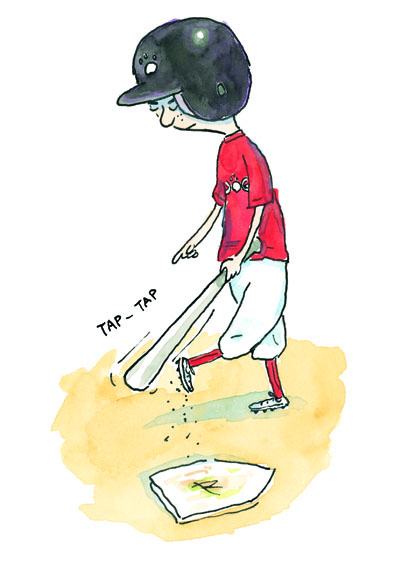
Again, just some essential details that I completely neglected to add. Or perhaps assumed. The facts were there, but I didn’t make them clear, clear, clear. This is a common kind of editorial suggestion — to “pause a beat” — forcing the writer to slow down, to really set the scene for the reader. Sometimes we’re in such a rush to get to the next thing, we don’t always properly build up to that Big Moment. It’s a Hitchcock trick. Once you’ve built up suspense, it’s time to slow things down. Think of those movie shots when we see close-ups of the killer climbing the steps, footfall by footfall. The doorknob slowly, slowly turns . . . or Casey taps his cleats.
The finale
I suspect the ending could have more zing to it…. The mother crying and the father’s heart bursting with pride seem stereotypical amid all the other fresh action and description. The fact that they’re stereotypical does fit the tone and conclusion of “Casey at the Bat,” but I believe descriptions that are as fresh as the rest of the story will complement the tone and mood you’ve established and make for a stronger ending. Also, the “bursts with pride” description echoes the language of the 3rd stanza (“bursting pride”). Would you consider echoing some of the language in the ending for “Casey at the Bat” instead? “[H]earts are light…men are laughing…little children shout…”?

The very last line is also in need of some zing. “Three cheers” feels predictable and “our side” seems too general and not exciting or punchy enough for a conclusion. Perhaps you can work “Delmar Dogs” into the final line, so that it appears in the opening and conclusion, just as “Mudville” does in “Casey at the Bat.” What do you think?

Hey, I knew the ending wasn’t right (to put it kindly). I probably even said so when I handed in that first draft to Liz. I was struggling with it. I remember interviewing James Marshall, tape recorder rolling, back in the early 90’s. He said something that always stuck in my head, simple and profound: “It’s always the ending that gives me the most trouble. The ending is what people remember. If the book fizzles in the end, they remember the whole thing as a fizzled book. It’s important to have a very satisfying ending for the reader. They’ve entered a world and now they are leaving it. So it’s a puzzle that has to be solved. I remember with one of the Miss Nelson books, it took us [the author Harry Allard and I] two years to come up with an ending we liked.

Liz concluded her letter:

This is already so much fun – I believe that with some fine-tuning, it will be an even more dramatic and satisfying experience. Jean and I look forward to seeing what you come up with, Jimmy.

Please call or email me if you have any questions, or want to discuss any of these issues further.

Aren’t I fortunate to have such a warm, insightful, supportive editor? Liz made me think. She offered ideas and suggestions, but always made it clear that it was my book, my decisions. She got me to get back to work, keep hauling those rocks — but without feeling bad about myself, or my book. Instead I was energized, enthusiastic, ready to roll up my sleeves. Now you can see why so many authors dedicate books to their editors. We know we couldn’t have done it quite so well without a lot of help from the unseen hand of a talented editor.

Every time I read Mighty Casey out loud to a group of kids — when they laugh in the right parts, when they lean in to learn what happens next, when they burst into applause at the end — I always think of Liz and my publisher Jean Feiwel, and wish that they could be with me to share in the moment. The applause is also for them.