Tag Archive for Jigsaw Jones

It’s Good to Be Neil Gaiman: Newbery Medal Winner

Neil Gaiman’s The Graveyard was just announced as the Newbery Medal Winner. Amazingly, it’s about the only book on the long list of potential titles that I actually read. I often thought about blogging on it over the past month — it was an interesting book, and I wanted to talk about it — but I decided that I didn’t really want to review children’s books on this site, especially when Six Innings was mentioned by a (very) few as a potential far-flung dark horse candidate. For the record, I never thought so and didn’t even hope, but I felt very glad to be read and considered. After many years of writing the Jigsaw Jones mystery series, I began to get the idea that no adult or librarian or even (most troubling) the editors in my own publishing company read them critically. So I felt truly honored just to somehow squeeze into that Great Conversation with my first hardcover novel, published by Jean Feiwel at Feiwel and Friends. I’ll forever be grateful to Jean for that leap of faith and the great opportunity she gave me to write the best book I possibly could at the time.

I’m happy for my fourth-grade son, Gavin, who is just now in the middle of reading The Graveyard at my urgent, badgering request. They make a big deal out of the Newbery in school, and I’m sure he’ll be proud to say that he’s currently reading it. Cool factor ten. Gavin started it a couple of weeks ago, and interrupted that twice for the latest Wimpy Kid and Knuckleheads. My oldest son, Nick, age 15, also read it on my recommendation. I also urged Liz Szabla to read The Graveyard, and emailed my friend Greg Ruth with the same recommendation.

Should it have won? I have no idea, given my pathetic reading record, though I’m not at all surprised. As much as I thoroughly enjoyed The Graveyard, I did see it as episodic, with a couple of chapters that didn’t work (for me), in that they seemed kind of stand-alone pieces that were wedged into the larger narrative. I also felt that the Harry Potter echoes were at times too strong. We never really learned why Bod’s family was murdered, and I felt it odd that Bod never seemed to really desire to unravel that huge mystery. He never seemed to ask: Why? But I guess we’ll get that in the sequel.

In the end, congratulations Mr. Gaiman, a writer I truly respect and admire, whose blog is an inspiration. I’m quite sure that young readers (4th grade and up, I’m guessing) will very much enjoy this book. It’s fast, exciting, singular in mood, creative, heartfelt, utterly contemporary, and very well-written. And it has a great first sentence: “There was a hand in the darkness, and it held a knife.”

Congratulations also to Honor Winners: Kathi Appelt (The Underneath), Margarita Engle (The Surrender Tree), Ingrid Law (Savvy), and Jacqueline Woodson (After Tupac and D. Foster).

Fan Mail Wednesday: #24 (Friday Edition)

Buckle up, folks. It’s time for Fan Mail Wednesday: The Friday Edition! That’s right, we’re double-dipping this week.

Hi Mr.Preller,

I like the Jigsaw Jones books you write because they are mysteries. I also like the codes and pig latin that you write in your books.

From,
Dave

I pondered this for some time, then replied:

Dear David,

Thanks so much for your nice message. I try to put in a new code every book. As a kid, I loved that stuff — and I guess I still do.

My fourth-grade son, Gavin, has recently discovered Pig Latin. He keeps announcing what everyone’s name would be in Pig Latin. Gavin is especially tickled by the new name of his friend, Matt Sweeney.

Be well — and again — anksthay orfay ritingway!

JP

P.S. Pig Latin has little to do with pigs and even less with Latin. Though there are variations in how Pig Latin is practiced on standard English, most folks agree: For every word that begins with a consonant or consonant blend, you shift those consonants to the end of the word, followed by “ay.” When writing Pig Latin, some folks like to add a hyphen, such as ig-pay atin-lay. That’s up to you. But it’s not really a problem. Pig Latin is mostly a spoken language, rarely written.

Wikipedia offers these examples (and much more):

beast → east-bay
dough → ough-day
happy → appy-hay
question → estion-quay
star → ar-stay
three → ee-thray

P.P.S. You might also enjoy this Pig Latin Translator. In which case, your original email would read:

I-way ike-lay e-thay Igsaw-jay Ones-jay ooks-bay ou-yay
ite-wray ecause-bay ey-thay are-way ysteries-may. I-way also-way
ike-lay e-thay odes-cay and-way ig-pay atin-lay at-thay ou-yay
ite-wray in-way our-yay ooks-bay.

Oink, oink.

Jigsaw Jones Cover: Part 5, Jennifer the Art Director

At last, here’s the fifth installment of a series of posts following the creation of a single book cover. As I follow this trail, coming across talented, creative people along the way, I keep thinking of that scene in The Wizard of Oz, — “Pay no attention to that man behind the curtain.”

Because that’s exactly what we’re doing, demystifying the process. And maybe taking away some of the magic. But in place of magic, hopefully we’re shining a light on some of the fine folks who make the covers — while the author sits around and does nothing. In Part One, back in October, I interviewed Scholastic editor Matt Ringler, and we talked about the origins of the “cover concept.” For Parts Two and Three, we learned about cover illustrator R.W. Alley’s creative process, concluding with a lively chat with R.W. himself. In Part Four, we got to see the rough sketches. Exciting!

Now the process shifts back in-house, with the sketches on the desk of Scholastic art director Jennifer Rinaldi. We’ve gone from concept to rough sketch. So now let’s meet Jennifer and decide whether we like her or not find out a little bit about who she is and what she does.

Hi, Jennifer. How long have you been an art director? Is that a job you dreamed about as a little girl in pigtails?

I have been book designer and an art director for almost fifteen years, but I have always been crazy about books and reading. As I grew up I realized that a big part of what I loved about reading was not only absorbing a great story, but seeing the way the type and pictures were arranged on a page. It took me a while to figure out that this is what I always wanted to do, I had no idea such a cool job actually existed!

R.W. Alley has handed in several different sketches for the new Jigsaw Jones cover.
Do they go to you first? What now?

Yes, Bob sends me the sketches a couple weeks after getting the cover concepts. He usually sends a couple versions of the cover. I place them in a mechanical, which is a layout that shows all the type and the logos in place with the art. I usually choose the color palette at this point. With other books, I wait until I have final art before deciding the colors for the type, but the Jigsaw covers are so colorful I know I can’t go wrong! Also, we have done so many of them, I need to make sure we don’t repeat the colors, so I try to plan ahead.

Do you get to pick your favorite? Or is this a committee thing?

I will usually give my opinion, but I don’t get the final decision. The Book Club manager decides which sketch she likes best.

If you have selected a favorite, why? What goes into the decision?

As you have seen, Bob’s sketches are always really great, so it’s not an easy task to pick the best. Usually it’s just a matter of selecting which elements they want to highlight the most — and Jigsaw needs to be the focus, of course!

There’s an added complication with this book. This is a so-called “Spy and Solve,” a book that includes some kind of snazzy electronic gadget to (cough, cough) enhance the reading experience. That’s yet another element to stick on an already crowded cover.

I can’t wait to see this thing in person once it is actually produced! I will definitely get my hands on a sample “spy ear,” because I always wanted to be Harriet the Spy as a kid.

As a kid, I wanted to be the one driving the sports car in Go Dogs Go!

That’s a good one, too! Remember Are You My Mother? I just found my old much-loved copy of it in my parent’s basement, and had so much fun re-reading it.

Sure, I remember that book as a child and even moreso as a father who read that book aloud many times. It’s just about perfect. Interesting how one of our most cherished children’s titles is centered on probably our deepest, most horrifying fear — separation from the mother. The people at Disney know this well, because you see it over and over again, though not often with the same comic touch. But back to you!

As far as the cover goes, I still don’t know how we’re handling this; I imagine we will add a starburst to the front cover, with some clever copy written by editor Matt Ringler. Usually the people who design the Book Club newsletters (the pages and order forms that kids get in school) will add something into their copy, plus a picture of the gadget, to let readers know what cool item they will be getting with the book.

When the next step is ready, with all the design elements in place, could you please send me a sample? I’ve promised to keep my Nation of Readers abreast every step of the way. A riot can be an ugly thing.

No problem! I think this is a really fun interview series — if only I had read something like this as a kid, I could have spent many more happy years making books

—–

NOTE: True to her word, Jennifer sent along this “sketch mechanical.” I appreciate everyone’s willingness to reveal unfinished work. It takes a certain kind of confidence to pull back that curtain.

Jennifer added in her note:

“l warn you this is really ugly! I haven’t selected the colors yet, these are just place-holders. An interesting note about this cover: we flopped the sketch, because it fit better in the layout. I haven’t actually heard from Bob if he likes this or not!

The notes from Matt requested that Jigsaw be slightly smaller and the skeleton a little larger. It should really pop in the beam of the flashlight. As you well know, our covers are reproduced really tiny in the Book Club news, so we really want the skeleton to stand out when it’s small.”

———-

NOTE: Here’s some links to the all the posts in this seven-part series: One, Two, Three, Four,  Five, and Six, and Seven. Read them all and experience the awe and wonder of the creative, collaborative process!

Doodle in Obama’s White House Gains Momentum, Becomes Movement, Receives Both Praise and Scorn!

Real quickly:

In helping my dog, Daisy, with her research for the “Open Letter to President-Elect Obama,” I found a good website dedicated to Labradoodles and Goldendoodles. Well-organized, well-written, informative. So I sent along a quick hello and received this lovely reply:

Hi James,

The Goldendoodle Website is a site that I put together so that Dood owners could share their dogs and stories. It’s nice to meet you.

It’s an absolute pleasure sharing the link to your Dood’s blog. As I was reading through it the first time, it really seemed too well written to be an ordinary blog. Once finished, I looked at the rest of your site. No wonder it’s so well done! I read your Jigsaw Jones books to my kids when they were younger. We used to get them through Scholastic at the kids’ school. I’ll bet you’ve touched many lives.

Thank you for sending me the link to the blog. It’s a joy adding it to the site. I hope the Obama kids get their Dood!

Nice, right? Clearly, the Doodle Movement has taken on new momentum. It is now a political force in its own right! Unstoppable! Without mercy! Print up the t-shirts! Make up the slogans! We’re going to the dogs!

That said, be sure to read the comments section in the original “Open Letter” entry. Some folks are angry. It seems my dog, Daisy, has raised some hackles. Yipes! I should have never taught her how to type. But I was looking for editorial help at the time, and she worked for scraps . . .

Jigsaw Jones Cover: Part 4, Sketches Are In!

This is the fourth installment of a series of posts following the creation of a single book cover for Jigsaw Jones: The Case of the Secret Skeleton. In Part One I interviewed Scholastic editor Matt Ringler, and we talked about the “cover concept.” For Part Two, illustrator R.W. Alley agreed to giving us a look behind the scenes. In Part Three, our interview with R.W. Alley gave us a fuller appreciation of book covers from the artist’s perspective — it also gave us a chance to “meet” R.W.’s alter-ego, Bob.

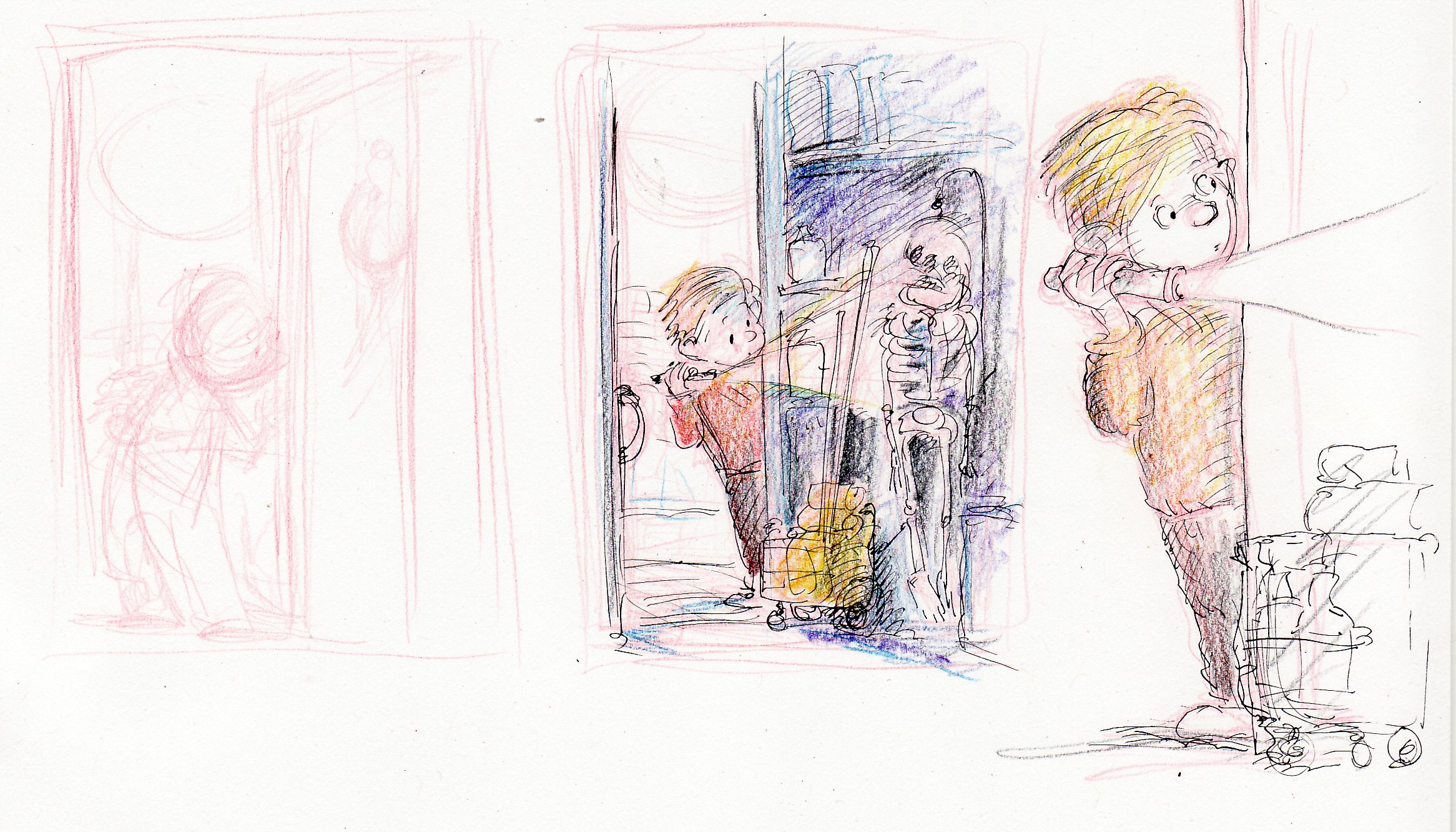
Now it gets fun, as the cover moves from word to image. R.W. Alley just sent me some rough sketches. By way of explanation, he wrote:

Attached here are three (well, one is sort of a repeat) sketches that I doodled up last night. I think I like the one with the case title stacked in the doorway. Smaller Jigsaw (might be a problem), but bigger skeleton. In any case, this is how I usually work. Sketch the idea in with a red pencil (sometimes, blue), go over that with a dip-in-the-ink-bottle pen called a crowquill, then add color pencil to simulate, if not actually create, color. The actual drawings are about four by three inches and not in proportion to the final book size, so that will be something to be annoyed about later on. I’ll send both cover ideas to the editor and wait.


Twenty-eight minutes after the first batch of sketches, Bob sent another email:

Hi Jimmy,

As I was sending the first sketches, this third composition occurred to me. The editors like to have Jigsaw pretty big on the covers, so maybe this will suite better.

Cheers,

Bob


Here’s a reminder of the original cover concept as presented by “the Scholastics” to the illustrator:

Jigsaw Jones is sneaking into the janitor’s storage closet. We see him standing in the doorway. It’s dark but Jigsaw has a flashlight. In a back corner, lit up by the beam of light is a plaster human skeleton, hanging from a stand by its head. The skeleton should be the size of a normal person, like the ones used in science class to study anatomy. Jigsaw looks frightened. We can also see the normal paraphernalia that would be in the storage closet (i.e. mops, brooms, buckets, etc.). Visibly crumpled in the skeleton’s hand is a piece of paper (a clue).

——-

NOTE: Here’s some links to the all the posts in this seven-part series: One, Two, Three, Four,  Five, and Six, and Seven. Read them all and experience the awe and wonder of the creative, collaborative process!