Archive for Six Innings

Everything Was Swell Until the 6th Inning

I came across a photo today and figured I’d tell you about it. Blog fodder, you know.

This is me five years ago, after throwing batting practice on a hot night:

IMG_4249


It was the eve of the championship game for the 10-year-old All-Stars. Bethlehem vs. Colonie. I remember it clearly. My son, Gavin, got the nod as starting pitcher that day (I was coach, not manager, and did not make that decision), mostly by virtue of his being rested and available. He wasn’t our best arm, but on that day he was cool and in control. Gavin hit his pitch count limit after five innings and we had to pull him. Our team was ahead against a very resilient group from Colonie, leading 8-5. Time to go to the bullpen. At that moment, everything that could have possibly gone wrong, went wrong. Three outs from an elusive championship, those poor boys got smoked. It still makes me shake my head in grim wonder. We ended up losing by 10 runs, after one of the most brutal innings I’ve ever witnessed. I’ll never forget that game. I wanted to win, and I genuinely wanted for those boys to experience that championship feeling. Alas, and oh well.

It often amazes me how these games can linger in memory. When I wrote Six Innings, back in 2008, I was struck by how clearly I remembered Little League games that I had played back in the early 70s when I was 9-10-11 years old. It gave me the conviction to write the book in the first place. The games meant something to these kids. That I can vividly recall individual plays across 40 years is a testament to that fact. I can still see that ball rolling through Don Cognato’s spindly legs.

This is a place in life where these boys live. Where a lot of life’s momentous events are played out. It’s a cliche to say that a player leaves his heart out on the field, but that doesn’t mean it isn’t true. I know I left my heart on a lot of ballfields across the years, and I wasn’t the only one.

There’s a moment in Six Innings when I try to capture that feeling. Well, not a moment, exactly; I try to achieve it throughout the entire book. But there’s one particular moment when I suppose I try to elevate the language a bit, try to lift off above the turf. The staccato rhythms give way to longer, more poetic sentences. It happens after a thrilling play at the plate in the top of the 5th:

In that instant, everything freezes, a DVD on pause, then explodes into action. Both teams, the fans, the coaches — shouting, cheering, hooting, protesting — every emotion galvanized at once, a kinetic charge of energy rising up through the five layers of the earth’s atmosphere, their cries and dreams climbing from troposphere to exosphere, soaring into the velvet void of deepest space. A roar that happens on Little League fields every day, in every town, city, state, and country all over the world, from Logansport to Osaka, San Cristobal to Little Rock. The sound the game makes when it is played passionately, with young hearts.

Hey, how’s this for cool? The cover of the Korean translation (uh, it’s the one on the left):
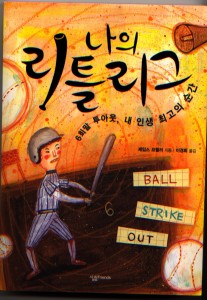
korean-six-innings-207x300          paperback-cover-six-innings-203x300


From Fiction to Fact: We’re Playing in the Championship Game

This coming Saturday, I’ll be coaching a Little League team of 11- and 12-year-old boys in a championship game. For the 12’s, this game will be the culmination of their Little League experience. Some boys will move up to play at the Babe Ruth level, on the big fields, jumping from 60-foot basepaths to 90; for others, this game will be it. The end of a boyhood passage, giving way to skateboards and girlfriends, basketball and boredom and who knows what comes next.


For me, this last Little League game is a happy way to conclude a long relationship at Tri-Village Little League in Delmar, NY. I coached my oldest son, Nicholas, for his last four seasons. Then I coached Gavin’s teams for all seven of his seasons, which overlapped with two years of coaching Maggie, too. That’s 11 years of coaching at the Little League level, mostly as manager. Then you can add 7 years of managing in a men’s hardball league, plus Fall Ball, Travel, All-Stars, etc.

A lot of games. A lot of faces. A lot of hanging around the ball field, staring up at the clouds, hoping the rain holds off.

I played, too. This is my age-12 season. Top row, center. Wantagh Little League.

I threw left, batted right, like Cleon Jones and Rickey Henderson.

But this game on Saturday will be my first championship game at the Majors level. I was fortunate enough to coach a team that won at the Intermediate level, some years back with Nick. Took it to ’em, 6-zip, behind the strong arm of Nick Hodem. Unfortunately, my Nick was sick at that time, fighting cancer, and he missed the final game.

In 2008, I published my first hardcover novel, Six Innings, inspired and informed by my lifelong love of the game. The book, subtitled “A Game in the Life” (and yes, that’s a Beatles reference), is about a single championship game and the boys who play in it. I’m proud to say that it was named an ALA Notable and, by Booklist, one of the TOP 10 BEST SPORTS BOOKS OF THE YEAR.

Here’s a couple of paragraphs that come very late in that book:

Coach Reid watches the boys as they celebrate, resists the urge to join them, to leap arms outstretched on top of the pile. No, this is their moment. It isn’t about Coach Reid, or any other adults. It is enough, more than enough, to stand back and watch.

Branden runs up, ecstatic. “We did it, Dad!” he exclaims. “We did it!”

The son throws his arms around his father, and the father squeezes back, hard, hoping to capture the memory like a summer firefly in his hands, wanting the moment to last forever, burning brightly, and knowing that somehow, amazingly, as sure as they stood, it would.

Wish us luck!

The Similarity Between Reading and Baseball

I have written exactly one piece of fan mail in my life, to the baseball writer, Roger Angell. I’m sorry, that tag does him a disservice; Angell is a writer, period, a great one, a crafter of sublime sentences, a keen observer, a man who feels things and captures living moments. His writing goes deep into baseball and beyond it. Angell’s more than a great writer; I suspect he’s a great man.

I had written Six Innings and wanted him, an important stranger, to have a copy of my book. I wanted him to love it, of course, to recognize me as a fellow traveler, but writers don’t have much say over how the world responds. You release the work into the wild and hope it finds food, shelter, a home, and thrives. Six Innings went on to earn an ALA Notable. And almost as good, Mr. Angell wrote a kind, handwritten letter in return.

Lately I had been thinking about “the ideal reader,” and decided, perhaps cleverly, that my ideal reader would be someone who wasn’t afraid of being bored. That’s been my concern of late, because so many children’s books these days are high concept and plot-driven, because we hear over and over again that boys don’t read, and if they do open a book they will sit still only for wall-to-wall action. And I guess I sometimes fret that I don’t deliver that kind of pleasure. In truth, I only infrequently read that kind of book. So, yes, please, if I may order one to go, I’d like a reader who will hang with me during the slow parts.

And I heard in that wish an echo. And realized, once again, that the notion was not entirely my own. Authentic, yes; original, not exactly.

I remembered something I heard Mr. Angell say at a public reading on March 1, 1989, at Peter Norton Symphony Space in New York. The program was a special evening in Selected Shorts history, dedicated to great writing about baseball, created by Roger Angell along with his friend, A Bartlett Giamatti, who was soon to assume his duties as Commissioner of Baseball. I remember the reading vividly. Years later I tracked down the CD compilation and now revisit selections each Spring. Some of my favorite stories from that night include John Updike’s, “Hub Fans Bid Kid Adieu,” W.P. Kinsella’s “The Thrill of the Grass,” T.C. Boyle’s hilarious “The Hector Quesadilla Story,” and Giamatti’s classic, “The Green Fields of the Mind.”

I recalled, most especially, the night’s opening remarks made by Angell. So I got out the CD, listened and listened again while scribbling on a yellow legal pad, until I could transcribe the brief exchange I’d remembered. As far as I know, there isn’t a transcription available on the net, so here you have one brief moment — an exchange that struck me, and has stuck with me, for more than 20 years. Angell makes a simple comparision, doesn’t extend it much, doesn’t labor over it, gets in and out, yet it made me laugh and it still gets me thinking today.

For here we are: Baseball season, pitchers and Molinas, is almost upon us. The massive spectacle of the Super Bowl has come and gone. It’s time for quieter pleasures. During my workday this past week, I arranged indoor practices for my 12-year-old Travel Team. Sent out emails, talked to the uniform guy about new jerseys. And today in my capacity as a Board Member for my local Little League, I ordered more than $4,000 worth of baseballs and assorted equipment.

All I really want to do is get out that old glove one more time. That simplest pleasure of all, a game of catch.

Well, here’s Angell and Giamatti, as they set the stage back in 1989:

A. Bartlett Giamatti:

“Why does baseball appeal to writers so much?”

Roger Angell:

The similarities between reading and baseball are evident to all of us, and may account for the enormous flood of baseball writing that goes on and on, and so much of it very high quality.

Baseball after all is a linear game. It’s the only one that is linear in the sense that one thing happens, and something else happens, and there’s a pause, and there’s a time for writers to think about it, and keep score, and take notes.

A Bartlett Giamatti:

It’s always occurred to me that intellectuals like baseball because it goes slowly enough so they can understand it.

Roger Angell:

Well, certainly I would hate to try to write intensely moving paragraphs about basketball, which is a swirling and beautiful sport of an entirely different nature, with a different feel to it. But one of the things about baseball which is like reading, in addition to the obvious things like chapters and, ah, is that if you think about both baseball and reading, they are occupations for people who are not afraid of being bored. But — you can laugh, but — also it really is one of the great pleasures of baseball. If you sit there in the early innings, there’s that wonderful time when you wait and see what kind of game this is going to be. Every game is so different from the other, and you need those early chapters, sometimes very slow moving, in order to lead up to the end of the book, the end of the game. Not dissimilar.

Poetry Friday: “In a Red Baseball Cap” by James Preller

Just dug this unpublished poem out of the file cabinet, must have written it about 25-30 years ago, so might as well finally see the light of day. I always liked this one, that connection between the boy and Willie Mays, the white ball a communion wafer, H.D.’s companionship of the flame across time, space, generations.

Speaking of my lifelong love affair with baseball, one of my happiest moments as a writer was the day I published this book, which felt like an outpouring of years and years of baseball thoughts, dreams, memories . . .

I love the new paperback cover.

More on Book Covers: New Paperback Cover for SIX INNINGS

In 2008, Feiwel & Friends published my first hardcover novel, Six Innings, a book that was eventually named An ALA Notable. The cover was fabulous, featuring the work of gifted illustrator Chris Sheban, whose style you might recognize from the covers of Because of Winn-Dixie, Brooklyn Bridge, Punished, The Tiger Rising, and more.

Six Innings sold reasonably okay, earned some kind reviews (and a Judy Blume comparison!), and nobody got rich; we were happy. When it was time for the book to go to paper, my publisher had to make a decision. Come up with a new cover, or simply reproduce the existing cover in a paperback format, which is what they did.

And the paperback edition did not sell. Understatement. It struck out, looking.

This could be for a variety reasons, but one line of thought was that we were dealing with two different markets. The hardcover, with awards and good reviews, sold well in the institutional market. Paperback was a different animal, targeted more directly to the reader. I want to say the less sophisticated consumer, but that’s not right. Children these days are plenty sophisticated, it’s just that their tastes are their own. To them, these days, the photographic approach seems to hold more immediacy.  At least that’s the current thinking.

So check out the new look (the original is up top in the header):

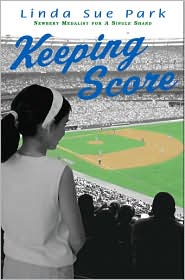
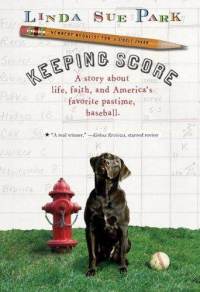
While I’ve got you (as my dad used to say), Linda Sue Park’s Keeping Score was another baseball-themed book that came out at the same time. And I confess: I hated the cover. That poor book, I thought. It just struck me, a former 10-year-old boy, as all kinds of wrong.

Someone must have agreed. Take a gander at the paperback.

Quite a difference, huh? It doesn’t look remotely like the same book. Curiously, in this case, the publisher went from a photographic to an illustrative approach, but more significantly re-thought the cover content and updated the design. A successful change, I think, though a dog and a fire hydrant makes me think of only one thing. Was that the idea? Dog pee? Maybe dog pee figures into the book somehow (I have not read it). The ex-boy in me wouldn’t have picked up that cover, either.

It’s also possible that the book was rewritten, with the girl character replaced by a black lab.

In the end, covers are a tricky business. The author’s job is what’s inside.