Listen: I’ve been on a little Vonnegut kick lately, and it’s been a happy time.
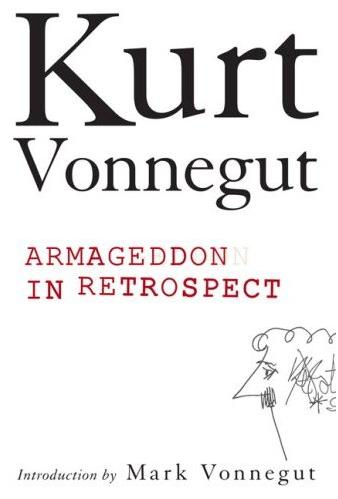
I just reread Breakfast of Champions, and I’m halfway into Cat’s Cradle, after tearing through this one, published posthumously:
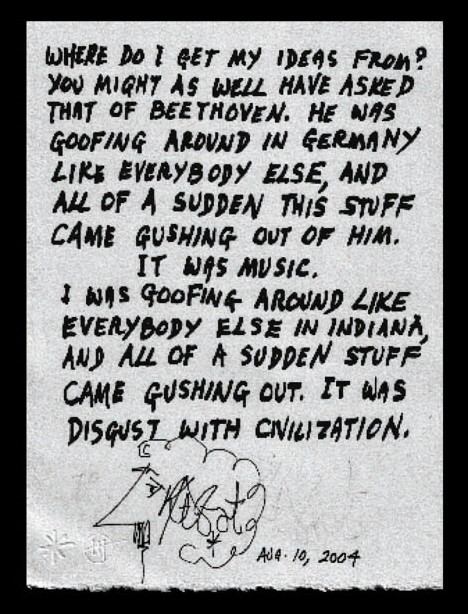
While I’ve got you — as my father would say — take a gander at this photograph from the back of that book.
Wonderful, right? He was a true American Original.
I don’t know how Mr. Vonnegut is regarded in the ivory towers these days, though I do know there’s a large number of loyal fans that will always read and adore him. When he connects with a reader, it comes with a jolt. I’ve gotten my oldest boy to read a couple. Maybe more in the future. He can’t fend me off forever.
As I said before, Vonnegut was my version of YA back in the 70’s — along with guys like Steinbeck and Bradbury. And hey, remember that long-haired hippie, Richard Brautigan?!
My sister Jean, an avid reader, read all of Brautigan’s books and I borrowed them from her. Trout Fishing In America! The Springhill Mine Disaster! Revenge of the Lawn! The Abortion! It’s been years since I recalled those titles. Reading Brautigan’s breezy style possibly set my writing back ten years, or turned me into a writer, I can’t decide which. Maybe it was a combo offer: Turned me into a seriously flawed writer — but a writer nonetheless!And if that’s what’s in the case, Howie, I’ll take that deal.
There was something undeniably cool about the experience of reading Vonnegut and Brautigan, something authentic and accessible and fun. Dad wasn’t reading those guys, that’s for sure (come to think of it, Dad wasn’t reading at all — but that’s a problem for another day). Vonnegut and Brautigan, and why not, let’s throw in the Beat Writers before them, had attitude, a combination of cynicism and idealism, as opposed to today’s more common brand of empty cynicism, minus the hope. Their ideology seemed to matter a lot more than semicolons. They took literature, blew off the dust, and passed it along to me, a lousy teenager. Reading those fast, easy books gave me the idea that maybe I could do it. Write a poem or a short-short story. Take a look around and maybe assess things a little.
By the way, I looked like this around that time, 7th-8th grade:
Here’s me and my brother John, probably five years later (and yes, I’m wearing a macrame belt):
I think what’s happening between Vonnegut and me is that I’m currently writing a new book for older readers, a notch above Bystander. So I’m remembering being 15, 16 years old. The things we did. How it felt. And somehow Vonnegut so perfectly captures those essential youthful feelings. Not that there was intentionality to my selection. I didn’t go to him as a conjurer. I just stumbled upon old Kurt in a couple of bookstores and, for the first time in 30 years, thought, Now feels right.
Part of it is the counter-culture current that runs through everything both men wrote. Their freedom, independence, iconoclastic proclivities. All I can say is: I totally identify with that, growing up in suburbia at the time I did, with a brother off in Vietnam, another constantly smoking a pipe in the back bedroom while banging away on a typewriter, listening to Dylan and trying to write a book on James Joyce, a time of Nixon and Watergate, then Belushi and Radner on “Saturday Night Live” exposing our absurdities . . .
I’m rambling, forgive me. Usually I try to have something coherent to say.
Oh, yes, I remember why I began this entry in the first place! Here’s what Kurt Vonnegut wrote about semicolons in Armageddon In Retrospect:
My advice to writers just starting out? Don’t use semicolons! They are transvestite hermaphrodites, representing exactly nothing. All they do is suggest you might have gone to college.
I’ve been dwelling lately on the concept of “books for boys.” It’s a huge topic, one that I can’t possibly address in a single blog entry. I mean, yes, we’re all aware of the gender gap in reading, that many teachers and parents struggle to inspire in their boys a love for reading. There’s been progress made, an awareness that boys are different from girls, and that their tastes in books often reflect those differences. Enlightened teachers are allowing boys to self-select more of their own reading material; graphic novels are gaining popularity and respect; and so on.
Bu when I encounter lists of “books for boys,” I’m often left deeply dissatisfied — even troubled. Because these well-intentioned lists are often guided by limited stereotypes: boys like action, boys like trucks, bodily humor, adventure, violence, etc. Okay, true enough. But these lists led us to an extremely narrow view of what a boy is, and what a boy could be. What about friendship stories? What about sensitivity to others? Gentleness? Don’t boys love their mothers, don’t they struggle with relationships, don’t they ever feel lonely or afraid?
I’ve been thinking about an old favorite book, Patrick and Ted by Geoffrey Hayes. It is out of print. I first encountered this quiet little picture book back in the 80’s, when I wrote copy for the SeeSaw Book Club, edited by Craig Walker. Yet it has lingered in my memory ever since. I think it’s a perfect story, one of the few books I wish I’d written. So I finally got around to purchasing a used copy. Let’s take a look at it:
Whoops. Because the image is not available on the internet for screen capture, we’ll have to go to my cheap scanner. My apologies to Mr. Hayes — and to you, Dear Reader — for the darkness, the low resolution. The actual book looks a lot better.
It is the story of two boys, best friends. They did everything together, even quarrel sometimes. But those brief spats did not matter . . . “because Ted was Patrick’s best friend, and Patrick was Ted’s.”
Then, one summer things changed . . .
A quick aside: This is such a classic story format, and a great model for new (and veteran!) writers. So many stories begin by establishing a timeless permanence. The well-ordered past, where time is frozen and things are always true. We meet the character, or the place, find out what he or she or it is like. And somewhere along the line we turn the page to find a phrase like this: “And then one day . . .” The story leaps into the present moment (if not literally the present tense). Now the real story begins. I think of these as “and then one day” stories. You’ll find that structure everywhere.
Back to those best friends, Patrick and Ted. One summer, Ted goes to stay with his aunt and uncle at their farm. He even advises Patrick, “Don’t let anyone else use our hideout.”
Patrick is sad and lonely.
But as the days pass, he makes new friends, has new experiences. He joins in with others, he goes to the movies with Mama Bear, he plays alone.
A hideout of his own. Patrick is learning something valuable here, something vitally important.
Then, happy day, Ted returns — with two pet geese!
I love that sentence: “They were loud and quick, and Patrick did not like them.”
The boys argue, get angry with each other — Patrick pushes Ted against their hideout! — but they resolve the conflict to play happily together once again.
And yet there’s been a fundamental shift. Their world has changed . . . inside and out.
“. . . because Ted was still Patrick’s best friend, and Patrick was Ted’s.”
End of story. And by the way, isn’t that great, when you look back at the book, those two illustrations of the swing? First we see Patrick in solitude, seated on the swing, motionless. On the last page of the book we see the swing again: Patrick is smiling, swinging high, pushed by his friend. Again: just right.
Is this not a book for boys? My guess is you won’t find it on many lists. So when we try to serve boy readers, let’s not be so quick to put them in a box labeled, “What Boys Like.” Let’s remember that they have feelings, and struggle with friendships — that they experience confusing emotions — just like everybody else.
I’ve read a lot of books recently about girls trying to make sense of friendships and themselves, so it was a delightful surprise to find and read an advance review copy of a book that deals with boys trying to find where they belong in Along Came Spider, by James Preller (due out September 2008).
Interesting, isn’t it? It came as a surprise to the reviewer, a fifth-grade teacher, to find a book that dealt with content typically found in a book for girls. Things like friendship, discovery of self, fitting in. Does that mean Spider, like Patrick and Ted, is destined for obscurity, the furnace where “out-of-print” books go to die? Perhaps so. Perhaps it’s not a book that most boys will naturally pick up. I mean: I realize that it isn’t. Just as I know that a book titled “Patrick and Ted” isn’t going to bring boys clamoring. But I can’t believe that when they read it, they won’t see themselves reflected in those pages.
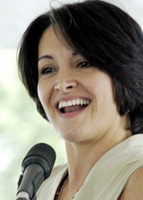
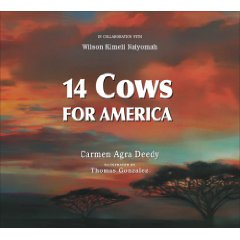
I was happy when I came across the book, 14 Cows for America, written by a long-lost friend, author and storyteller Carmen Deedy. We’ve since exchanged a few emails, caught up on our lives (to the extent that’s possible), and shared the unlikely hope that maybe someday we’ll find ourselves in same place at the same time. Usual stuff: “We’ll have lunch!” To date, it’s happened exactly once. In the meantime, Carmen is someone I’ll be rooting for, cheering from the sidelines. A true talent and a smart, singular woman. Today, I’m glad you’ll get to meet her. Because look, here she comes now . . .
Carmen, wow, great to see you again. We’ve met only once, a long time ago. Was it Paris, sometime after the war?
The Germans wore grey, I wore blue –– or was it plaid?
Oh, wait, I remember now. It was at a convention center in Raleigh. My bad. It’s so easy to confuse the two. So it’s been about fifteen years. At that time, as I recall, you had recently published The Library Dragon. Between then and now, your career has really blossomed.
That’s a generous assessment, old friend. Actually, I spent a whole lot of years as a single mom, and for nearly five of them I did very little writing. School author visits, a good bit of editing, but writing? Not so much. Getting three lovely and creative and maddening young women through adolescence while keeping the roof over our collective heads pretty much sucked every ounce of creative life out of me. “I am woman, hear me whimper,” was the sum and substance of my feminist credo in those days.
I’m fuzzy on the timeline. You’re an internationally known storyteller who has performed at The Kennedy Center and the Folger Shakespeare Library. You gave a talk to the TED folks –- and I’m pretty sure they invite only brilliant people with fertilizer ideas worth spreading. You were (or still are?) a regular contributor to NPR’s “All Things Considered.” Did that all happen after the girls were grown?
Nope. Just wasn’t doing a great deal of writing. The aforementioned events were short and sweet and helped bring in the bacon, as it were. But I couldn’t seem to carve out many stretches of time to write during those years.
Do you see yourself as primarily a storyteller, rather than a writer? What’s the distinction?
The distinction? Um, the WRITING STUFF DOWN part. Storytelling, on the other hand, is the ancient art of live narrative. In other words, someone (preferably carbon-based, as opposed to a dvd, mp3, etc.) opens his or her mouth and, without props, video enhancement, sets or backdrops, or fellow performers, conjures up an entire world –– makes something out of nothing if you will –– employing only the spoken word.
Ah, but I didn’t answer your question. Do I think of myself as a writer or a storyteller? Short answer: a writer. Nonetheless, one art form informs the other.
How does a person become a professional storyteller? Do you just hang out a sign on the front lawn? I mean, forgive me, but it seems like such a phony baloney job. Bankers must look at you and say, “You re a . . . what?!”
My dear Mr. Preller, if I am applying for a loan, I never say I’m a storyteller (and, by the by, saying you’re a writer doesn’t gain you much traction with the banking lot either). I say raconteur. It’s sooooo continental.
I know as a writer of children’s books, I’ll often get those baffled looks from some folks at parties after they ask the usual question: “So: What DO you DO?” You know who I mean, the guy in the suit with the big job. And he’ll always follow up my answer with another question, not even bothering to feign disinterest, “Any books I might know?” This from a guy you can’t imagine having read a children’s book –- even as a kid. So I’ll answer something like, “How ‘bout those Yankees!”
I think it’s pretty common for most people, particularly those who don’t make their living from writing, to read a children’s book and think, “Piece of cake.” When I hear that, I usually smile sweetly, lean in, and whisper, “Dare ya.” The truth is, of course, that children’s picture books do not occupy the same place in the literary world as, say, the works of Leo Tolstoy. But you do have to say a lot with a little — and in that respect, writing a picture book is kind of like taking War and Peace — and turning it into a haiku.
When you started as a storyteller, an old friend came to see one of your early shows. Afterward, she told you, “The truth? I don’t think you’re a storyteller.” How did you overcome that? Is there enough ice cream in the world to heal that wound?
Never underestimate the curative powers of Rocky Road, my friend.
Where do the stories come from?
Brooklyn, NY. It’s the last place you look. But I suppose you want an answer that’s a bit more serious-minded, so I will say this: stories swirl around us constantly: in the subway, at the lunch counter, around the corner from the cereal aisle. They are everywhere, vying for the writer’s attention. Tragically, I can be a mite distractible; I know I’ve let some great ones pass me by.
Your new book, Carmen, 14 Cows for America . . . wow.
What a remarkable story, beautifully told. It’s already gotten some great press. You must be thrilled.
I am very happy that it’s been so well received.
There are a lot of great lines in the book, but the ones that conclude the book really hit me:
“Because there is no nation so powerful it cannot be wounded,
nor a people so small that they cannot offer mighty comfort.”
Those words were especially resonant, like a bright, burning quiver shot to the heart. Do you remember when you first wrote those words? Did you realize –- you must have realized! -– how good it was at the first instant?
I have a nameless elementary school girl to thank for that. Not the precise words, of course, but the sentiment. She reminded me of Aesop’s fable –– the lion and the mouse –– big things need small things, said she. From the mouth of babes.
Yes, but you heard her. You listened. Maybe that’s the real secret to good writing.
Maybe. Then again, maybe I just got lucky.
It’s an interesting perspective to think of 14 Cows as a retelling of “The Lion and the Mouse.” How did the book come about?
I read about the gift in April of 2002 in The New York Times. I sat on my porch stoop and wept. It would be many years and a great deal of research later before I would hold a finished manuscript and eventually find the protagonist, Kimeli Naiyomah, and ask for his blessing. Little did I know that he would join us as a sort of cultural consultant, and even adding his own end note to the book. It has been, in many ways, an strange and wondrous and indescribable journey.
To me, with such a huge story, I’m impressed by your economy of language. I would have been overwhelmed, not knowing where or how to begin. How did you find that voice? Did you have a first sentence, an image? I guess I’m asking, what was the door that first opened for you, allowing you into the story?
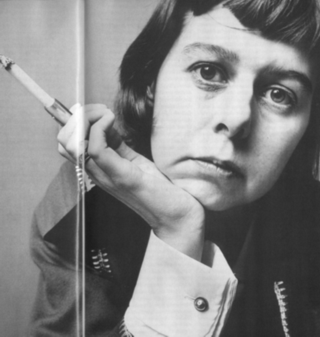
I was at the Carson McCullers House, in Columbus, Georgia.
I had been granted a writing fellowship and was having a devil of a time getting the story down. I should note here that this was, by now, 2007. I had notes, articles, documentaries, and sundry documents that I had compiled and hauled to Columbus; it amounted to years of research and only served to further overwhelm me. I wasn’t new to picture book writing and well knew the perimeters. I had fewer than 32 pages to work with. I was near despair, when I woke up one morning and reminded myself that this was a story for children, and needed to be told simply, just as I would have liked to hear the story when I was a child. To sustain a sense of immediacy, I opted for the present tense. That kept it simple, as well.
Well, you succeeded brilliantly. Lightning round. Five favorite foods?
My mom’s arroz con pollo (chicken and rice), Vietnamese Bubble Tea, chicken pot pie, watercress salad, Thai mango and sticky rice, coq au vin, my dad’s empanadas . . . sorry. It’s not that I can’t count, it’s just that I LOVE food.
Or yeast rolls. What ever happened to yeast rolls in school cafeterias? Now it’s low-fat granola bars. I tell you, my friend, we are witnessing the de-evolution of our race.
As my mother would say, “We’re going to hell in a hand basket.” Still one of my favorite expressions. I love channeling my parents that way, filling my mouth with their words. Now that my father is gone, I make a point of keeping those echoes bouncing around. It’s strangely satisfying to repeat a phrase that he used to say, keep it alive, like a postcard with “Love always” written on the back.
I know what you mean about those voices that linger in our heads. My wonderful and wickedly wise dad love of Cuban aphorisms. Among my favorites: Our wine may be bitter, but it’s our wine. (This one in 7th grade when I was complaining about my mother, my hair, zits, and the banality of reading Steinbeck.) He who laughs alone is remembering his own mischief. (This, when I caught him sitting at his desk, howling to himself, in what he thought was a solitary moment. I never learned what marvelous memory he was recalling, but it only served to increase his mystique as a Man of Mystery.) And my favorite, one that touches on love and true camaraderie, When you cry, I taste salt.
That’s a beautiful line. Of course, the bitter wine aphorism reminds me of a great line spoken by Lt. Frank Drebin in “The Naked Gun” movie: “It’s a topsy-turvy world, and maybe the problems of two people don’t amount to a hill of beans. But this is our hill. And these are our beans!” Next impossible question: Five favorite books?
Shadow of the Wind, A Prayer for Owen Meany, Charlotte’s Web, Great Expectations, The Book of Unholy Mischief.
A diverse, challenging list. What do you admire most about Dickens, or if you prefer, Great Expectations?
Well (coyly), one of my new books (not out yet) is about a street cat, a tower raven, and Charles Dickens. I just re-read Great Expectations this summer, and there were places where I laughed out loud. What a wordsmith, what a keen observer of human nature. Dickens made you see the human being within the characters. Why, even the loathsome and repulsive Miss Haversham (the elder) becomes a pitiable creature by book’s end. And his descriptions, and the marvelous names for his characters . . . ya know, I AM aware that it’s not cool to love Dickens anymore. I mean, a full page devoted to describing a room? But, oh, what a room . . . (I am officially out of the nerd closet now, and I want you to know I’m okay with that.)
Five things about your native homeland, Cuba, that you miss?
My family, heat that penetrates your bones, my first language, cobble stone streets made for perambulation, the sea and its sticky brine perfume.
Politics, briefly: What is your hope for the future of American-Cuban relations? I have a friend from England, a drummer, who visits all the time and loves it there. I’m jealous of him, and jealous of Sky Masterson.
I wish there was openness. Am I wrong about that?
Pass.
Okay, you are on your front porch at your home in Georgia, peaceful under the stars. There’s a song playing and a drink in your hand. What’s the song? What’s the drink?
Carlos Gardel singing “Volver” . . .
. . . accompanied by a whiskey and soda, twist of lime.
Thank you very much, Carmen. It’s really great to catch up with you again. I mean this: I’m so proud of you and all that you have done with this lovely, meaningful book. I hope it finds a place in every library in America. As a parting gift, please accept this (still warm!) cheeseburger from Sonic Drive-In.*
Does it come with plantains?
* No Masai cows were injured in the making of this cheeseburger.
Well, it’s been a wonderful week and I’ve really enjoyed having Lewis Buzbee as my co-host, trailing after me like a lost puppy . . .
Believe me, if I had any idea he’d act like this, I never would have asked Lewis to stay for an entire week. But Don Rickles canceled, Sammy was busy, and Barbra never returns my calls.
Seriously: I don’t hang with authors much. I don’t get invited to conventions or even blog tours or — come to think of it — neighborhood block parties, so it’s not like I get the chance to meet many high-flying literary types. I tend to spend my time with my wife, my kids, and other people here on earth. But when I read The Yellow-Lighted Bookshop, I felt an immediate connection to Lewis. I had to talk with this guy. I wanted to push his doorbell, spend the weekend. Separated by 3,000 miles, I did the next best thing: Asked him for an interview.
I hope you’ve enjoyed this series of interviews half as much as I did. I feel like I’ve not only discovered a terrific writer — someone whose career I will follow, whose books I will read — but also, something more lasting, more meaningful: I’ve found my 163rd Facebook friend.
If you missed the fun, click here to catch up on Part One or Part Two.
And we’re off . . .
Is John Steinbeck still your favorite author?
Least favorite question.
Oh, man. Sorry. Now I feel like Geraldo.
He’s my first writer, for sure. And reading him again and again as an adult, I learn more from him every time. But there’s a million others out there who are my favorite writers. I go with E.M. Forster on this. I don’t see writers in any competition, I see them all working together in the big round reading room of the British Library. Isn’t it a miracle we have so many great writers to read?
So, yes, he has to be my favorite.
What have you learned from him?
I hope what he wrote to a young Peter Benchley, who was in boarding school at the time. He was friends with Peter’s father. Steinbeck wrote, “Only a fool is willfully obscure.”
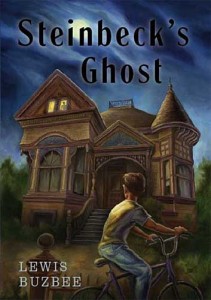
Yes, excellent. You put that in Steinbeck’s Ghost.
In other words: the exact opposite of what they taught us in college! To me, so much of my adult writing life has been about unlearning those lessons, the obtuse writers that we were supposed to admire and love. I mean, yes, some are great. But there’s definitely an Emperor’s New Clothes thing going on: I don’t understand it, I can’t comprehend it, so golly it must be good! More and more, I respect writing that has clarity, directness, and restraint. An absence of flash. I’m striving to write sentences like, “He put the glass on the table.”
Many of my students — I teach part-time in the MFA program at University of San Francisco — are under the impression that subtlety is the goal. And by that they mean murkiness. One of them recently told me, “I love stories that leave you completely confused about what’s happening.” Okay, fine.
Flannery O’Connor wrote that in a time when there is too much noise in the air, and everyone is heard of hearing, the writer needs to practically shout, use primary colors, be bold. Yep.
Talking about Steinbeck, I’m reminded of how I read many of his books as a young teenager. He and guys like Ray Bradbury and Kurt Vonnegut, Jr. (probably my favorite at that age) were the young adult literature of my youth. There was no such thing as “YA.”
I think that that’s my ultimate goal as a writer, to crack open the brain, and unleash the words, of a fourteen-year-old. To meet the big ideas about the world that are just forming in their enormous brains. As a bookseller, who should pay attention to categories, I was never one for categories. Good is good. That’s that. Bradbury, Vonnegut, Steinbeck — that’s a good desert island stack.
You recently wrote your first children’s book, Steinbeck’s Ghost. How did that happen?
Like I said, I wasn’t a voracious reader as a kid, so I missed a lot of great kids’ lit. But the very first bookstore I worked in was run by three wonderful women, who were all passionate experts about kids’ books. And they made certain that I read as much as I could, and that I understand, not only the importance of kids’ books, but the variety and expertise of kids’ books, their sophistication. So my whole adult life, I’ve been a reader of kids’ books. And I’ve always wanted to write my own.
I’m glad you did, just don’t eat up too much of the market share. Oh, wait. We”re not supposed to be in competition. Can’t I just quietly hate you?
You became a father relatively late in life. How do you think that’s affected you as a writer? As a reader?
Lord, what a question. It changed everything.
When my daughter was born, I was halfway through the second draft of a six hundred page novel that was all very clever and erudite and luminous. But I threw myself, gladly, into being a dad, changing diapers and staying up nights for feedings, strollers, all the rest. It was a blast. By the time I got back to that novel, I was disenchanted with it — it seemed so unessential, so small. And I immediately began writing a whole new crop of stories about what I felt were bigger things. That became After the Gold Rush, my first book of stories.
My daughter “restored me to life,” as Dickens said, reminded me what was essential. And since then, I’ve written so many books, with such urgency. She not only reminded me what to write about, but showed me, perhaps for the first time, why I was writing. Dude, seriously, it’s life and death stuff — that’s how it makes me feel.
Katherine Paterson has a wonderful line about that, reflecting on being a parent and a writer: “I can see that the very persons who have taken away my time and space are those who have given me something to say.” There it is, I couldn’t possibly say it better. Like we were talking about before — she said it for us, articulated that chaos of the heart, and I’m grateful to her for that.
God, what a great line. I wish I’d said that. Can we pretend? That’s the wonderful thing about being a parent, and I think a lot of people miss this part — especially the “workaholics”: my pleasures here are purely selfish; she gives me so much.
And then, of course, there was reading to her. She’s eleven now, and we still read together every night. But the first day she was home from the hospital, I read to her — Beatrix Potter, Maurice Sendak. And it’s been such a journey to follow her through that development, through all the picture books, then the chapter books, then the middle grade novels. Yes, that had a huge influence on my desire to get into the kids’ section.
What’s your daughter’s name? I’m guessing it’s Flannery, Harper, or Willa.
Maddy. Yes, Madeleine. Actually named after a character in the Bill Forsythe movie, “Comfort and Joy,” who is a kleptomaniac, and her boyfriend follows her around department stores watching her steal, and he’s always saying, in his Scottish accent, “Ach, Maddy; ach, Maddy.”
Ach, Maddy — that’s funny. What’s next for you?
My second middle-grade reader, The Haunting of Charles Dickens, will come out in September 2010, and I’ve just finished Mark Twain and the Mysterious Stranger, September 2011.
Quick idea here, Lewis, if the series is successful: Marcel Proust and the Madeleine Tea Cake. Kids are always clamoring for more Proust — plush toys, bed sheets, lunch boxes, 8-track tapes. Or how about, Ernest Hemingway and the Disappearing Absinthe. Maybe you could package it with “Death in the Afternoon by Chocolate” brownies or something. Hey, it’s your series — do with it what you’d like. I’m just typing out loud here.
I was thinking more like Kafka Goes Krazy. I think Kafka is the perfect karacter for kids to relate to. I mean, you know you did something wrong, and have to stand trial for it, but you just don’t know what it is you did. Plus, it’s got movie written all over it.
Actually, I think Kafka’s “Metamorphosis” is the most borrowed idea in children’s picture books. Imogene’s Antlers, anyone? A Bad Case of Stripes? There are many variations. And I love that idea today, waking up in a transformed body. It’s probably a great story starter in the classroom.
I’m just starting a new adult nonfiction book, along the lines of Yellow-Lighted Bookshop. It’ll be called Blackboard: The Life of the Classroom, and will concern itself with classrooms and what happens in them. It’ll include history, too, but also the memoirs of a student, and of a teacher.
Wow, huge topic, sounds interesting — I’ll look forward to reading it. Now strap in, Lewis, here comes The Lightning Round. Five favorite TV shows, all-time?
Simpsons, South Park, Cheers, M*A*S*H, iCarly (my new favorite).
Five best concerts you’ve ever seen?
Tom Waits on New Year’s Eve; Elvis Costello’s Spinning Wheel Tour; Bob Dylan’s Slow Train Coming Tour; Talking Heads’ Stop Making Sense Tour; Bruce Springsteen in San Jose, 1978.
I love Tom Waits, and he is a genius. But frankly, a lot of the more recent stuff is just too, well, obscure. I’m not a musical genius. I like songs. I have all his albums up through the early nineties. Then it stops. But I’d love to have lunch with him someday.
Five favorite bookstores?
City Lights; Green Apple Books; Booksmith; Books, Inc.; all in San Francisco. Shakespeare and Co., Paris, because it’s in Paris.
You are outside somewhere, peaceful under the night stars. There’s a song playing and a drink in your hand. What’s the song? What’s the drink?
Van Morrison’s “PIper at the Gates of Dawn,” with a Martini, Sapphire, shaken, very very cold, and only the faintest touch of Vermouth (one should only whisper the history of Vermouth to the martini).
Last five books you’ve read?
Listen, I was told there would be pie. Is there pie? No pie? Oh, okay.
I just met Rebecca Stead, ever so briefly. Got a signed copy of When You Reach Me for my kids. I don’t think she realized how fabulous I was, or else she would have been more excited. Don’t you think? A lot of talk about that book. How’d you like it?
It’s a great voice she has, and a real great, what I call “kid brain.” I also like that she and her publisher were willing to go back to the 70’s. Near history, not movie history. I dug it, completely. Like Konigsburg, she knows how intense every moment of childhood is, and she knows that kids are intensely involved with the lives of adults, too.
Wouldn’t now (cough, cough) be a good time to talk about my books? I mean, dude, throw me a bone here. It’s how we met, isn’t it?
I didn’t know you wrote. Oh, you’re that James Preller! Hmmm. It’s true. I recently read Bystander, and wrote you a somewhat unabashed fan letter. Because, like Stead and Konigsburg and L’Engle and Cormier, you get what the best kids’ writers get and what makes me want to keep doing this: kids are way, way smarter than we think they are, and their lives are as worthy of serious literature as adults. Perhaps more. Then I read Six Innings, which I loved, and I thought, crap, this guy is too good.
Yeah, baby!
But seriously, where’s my pie, Mr. Preller?
I lied about the pie. Listen, bro, thank you so much for hanging around, putting in all this time. I can only hope my Nation of Readers goes out and buys all your books. You should expect a huge spike in sales. Please except this new Kindle 2 as a parting gift. It’s lightweight, 20 percent faster than the original Kindle, and lasts four to five days without needing to be plugged in or whatever. Let’s see a book compete with that! Plus, you can use it as a doorstop.
Can you hand me the chainsaw, please? The chicken is getting antsy.
Last thought, as the credits roll . . .
. . . the nicest thing I can say about Lewis Buzbee is that after you talk to him, you want to go out and buy a book. You want to catch up on all those treasures you’ve missed. You want to walk into a good bookstore, run your fingers down those beautiful spines, bring the weather with you. We all feel it, everybody here. We’re readers. We love books; it’s at the core of everything we do. Thank you, Lewis Buzbee, for reminding us of that love.Now get outta here, ya big lug, before I hit you with a pie.
——-
FOR MORE INTERVIEWS . . .
If you enjoyed this interview with Lewis Buzbee, you might like interviews with other author/illustrator types:
I’m back for Part Deux of our chat with my lovely and talented co-host this week, author Patty Duke Lewis Buzbee. (To catch up with Part One, click here.)
As a nod to tradition, let’s open the show with a brief musical interlude, which expresses in musical terms how I feel about Lewis . . .
They don’t write songs like that anymore. Anyway Lewis, one of the things that comes through in your writing is that you love books, the physical objects themselves.
Books are unique tools. I’ve been thinking a lot about this lately. A CD, say, or a DVD, those are great tools, too. And have some physical pleasures to them. Even certain iPods are lovingly designed. But those objects are just mediums for the message — the sound comes from space still — if only the space in your ears. Or the movie appears on the screen, over there. But a book is the thing it imparts. You cannot separate the two. And because of this, I think, we have decided that books can be beautiful, sensual objects.
A bookseller knows this. Next time you go into a bookstore, watch the browsers. So much of how we choose a book is done with our hands. We pick it up, stroke it, turn it over, weigh it in our hands. We’re buying the thing itself.
Is your book available on Kindle?
No. Not this one. But, hey, I’m open to it.
It was significant to some viewers of Star Trek when Captain Picard pulled down a leatherbound edition of Shakespeare, or whatever it was he read. Actually, I believe he was a fan of the hard-boiled detective genre. Viewers were reassured by that vision of the technological future, which — let’s face it — frankly scares the bejeezus out of us. And of course, I have to mention our shared enthusiasm for Battlestar Galactica, where frak is a word and books are revered, treasured links to a broken past. Those scenes when Admiral Adama is reading to Laura Roslin.
There’s a great scene where one of the detectives is reading to his horse, who is quite ill. They’re in the stall together, and he’s reading to the horse from Faulkner, “another great horseman,” he says. Very moving. And of course, the final scene in Bradbury’s Fahrenheit 451, where all those people have each memorized one book, to preserve it.
It’s clear that the Kindle-monster is here to stay, and too much lamenting will do us no good. But I assert — very strongly — that the book is not going to disappear in the next five minutes.
It’s not a question, really, of either/or, for me, either books or computers, it’s a matter of both. Hey, if someone’s fearful of losing books, there’s a simple remedy. Go buy a book, turn off your damn computer, and read. Simple. World saved. Lamenting about it on Facebook does nothing. Read.
I ordered my copy of The Yellow-Lighted Bookshop from Amazon.com. Does that make me a bad person?
Not at all. Listen, for years people complained about the chain stores, and the ruination . . . yadda, yadda, yadda. Truth is, chain stores have been crucial to keeping alive the literary culture, the publishing business, the diversity of the books we have available to us. The same is true of Amazon. It’s here, it’s not going away, and it does a lot of work on behalf of writers and publishers everywhere. I’m not a Luddite . . .
. . . I just happen to love books and bookstores. And I don’t believe that the bookstore will be replaced, completely, by Amazon. I mean, I still need to get out of the house now and then. And we are Americans, so shopping is what we do best. Books, more than ever, in many ways, are more current than ever. They are more widespread than ever, and there are more of them than ever. And we will want to go to bookstores to buy them.
Listen, if it gets to the point where we can do everything we need to do on a computer — and I can think of three things, off the top of my head, that you can’t do via computer — then go ahead and shoot me. Really don’t want to live in that world.
True or False: The novel is dead, literacy is dead, the computer has triumphed.
Pshaw. Not a chance. In the nineteenth century, with the advent of the bicycle, the op-eds of that day declared the death of literary culture. We would all spend so much time on our bicycles, we’d never read again.
Case in point: “Butch Cassidy and the Sundance Kid.” Katharine Ross and that bicycle. They never read a thing in that movie.
Uh, Ms. Ross to you. And frankly, if I had a bicycle and that woman and a trusty sidekick and a loaded revolver — I’d never read again either.
Please don’t let thoughts of Katharine Ross distract you. But, gosh. Look at her . . .
We were discussing the death of the novel . . .
The novel was declared dead, once again, in 1962, I think. Before One Hundred Years of Solitude, Catch-22, and a thousand other great and important books. Humans are storytellers, we need stories. And long stories. We will build them one way or the other.
Like I said, computers are cool, but they ain’t everything. They’re just another thing. We’re a little bit obsessed right now with them — because we just invented them. We really have no idea what we’re going to do with them yet. It’s been, what, thirty years since they became user-friendly. Books have been around a lot longer than that.
And I want to say, right here, I also don’t believe the whole, “oh, we have such short attention spans” argument. People have always had short attention spans. And long ones. Right now, you know at least a dozen people who can tell you every single thing that happened on every episode of The Wire, or something else. We have huge brains.
I think you are such a good writer. You have this clean, direct style — it’s never, “Look at me, aren’t I clever?” I think when we read a book, it’s so important to have that feeling, to know we’re in capable hands. That this author, like a good limo driver, can take us where we need to go.
Thanks so much. The check is in the mail.
But again with the books. The writers I’ve studied and feel most drawn to are those writers who want to communicate with readers, not impress them. Even at fifteen, I knew there was no real cache in being a writer — dude, I was gonna be a rock star. But at fifteen I also felt the power of communication, what John Irving calls one genius speaking to another genius. I strive to communicate. When I want to impress you, I juggle.
Lewis! Put down the chainsaw . . .
the bowling ball . . . and the live chicken. Right now! I’m not kidding around.
Oh, they’re not for juggling.
You are a sick, twisted man. Nevertheless, I have to say, you are one of the few published authors that I can enjoy on Facebook. You don’t see it as an endless promotional loop . . . and I thank you for that.
I am so done with networking. It’s one of the great fallacies, don’t you think, of the twitterverse — somehow it will make us all rich and famous. My new motto: working without a net. Facebook is one large Post-It note. I’m just amazed that there are writers who spend so much time promoting themselves there. Shouldn’t they be writing?
In the end, for me, all the self-promotion is just so tedious. But here I am, knee-deep in bloggy blogness. Yet I contend there’s a distinction. A reader comes here by choice. I’m giving this stuff away, folks. And I try to keep the self-promotion to a minimum, because it’s boring, borderline tacky, and I don’t think it works. But I do feel that new authors, especially, are getting the message loud and clear from publishers and friends: “You’ve got to promote yourself relentlessly! You have to get out there — and sell, sell, sell!”
Now for a commercial interruption from Dennis Cass, who has struggled with some of the same issues . . .
My publisher suggested that I go on Facebook. And I did. But what I found, instead of a new way to pester people, was a few actual friends. And when I hang out with my friends, I’m not trying to sell to them. And I’d expect the same courtesy from my brother, Al, who is in the insurance business. I don’t want to hear about his work, either. “Al is drowning in paperwork!” — he’d sound like another author, and we don’t need that.
I love it when I’m supposed to stand up and cheer for the most minor accomplishments, too. Oh, I finished a chapter; oh, I applied for a grant. I mean, I’m happy for everyone, but seriously, it’s like doing an end-zone dance for tackling someone on 2 and 7 in pre-season. Too much chattin’, not enough chewin’.
It’s hard to talk about this without sounding a little mean-spirited. And I’m sorry for that. But . . . just do the work and shut up already. Pass along some info every once in a while, sure. But too much is a turn off.
We do live in this weird “provincialism of the contemporary.” If it wasn’t invented in the last twelve seconds, it ain’t worth it, that’s the prevailing ethic. Twitter, Facebook, all the rest, they’re so new. Next year they could be the new Pet Rock. We don’t have a clue, as a culture, what any of this new technology means, or what we’re going to do with it, or really, how it will change us.
Me, I’m going old school for the release of my next book: blimps.
Gee, I hope it’s a good year.
Uh, Mr. Preller, please step away from the jokes; someone could get hurt.
My favorite thing I ever posted as a status update on Facebook was this: Go to blogblogblog.com to read my new blog about why there are too many blogs. People actually looked it up. And it turns out there is a website — it’s weird and Japanese.
So is my dry cleaner, but that’s a story for another day. You seem alert to all the little treasures and surprises in each bookstore. You mentioned one in Vermont, Bear Pond Books, where two signs hang near the front entrance, each with an arrow pointing to a different half of the store. One sign read, FACTS; the other, TRUTH. You had a great line about that, “I’ll let you figure out which was for Fiction and which was for Home Repair.”
With me, home repair is definitely in the fiction section. Ask my family. When something breaks in the house, my daughter says, oh, it’s okay, mom can fix it.
You obviously have great affection for booksellers of all stripes. Perhaps we could take a moment to raise a glass (don’t worry, I’m buying) . . .
. . . to the idea that, as you said in your book, “all readers should be grateful that there are people foolish enough, rash enough, courageous enough, and pig-headed enough to open bookstores.”
Here’s to idiots everywhere! The world would be awfully dull without them.











)
