Archive for Interviews & Appreciations

Cue the Inspiration: “For the Good Times”

This morning I was listening to the remarkable new double-CD by Jamey Johnson, “The Guitar Song,” and toward the end he covered one of the Truly Great Songs, Kris Kristofferson’s 1970 classic, “For the Good Times.”

1970, Monterey Pop Festival.

Photo: Robert Altman.

First, there’s that brilliant opening: “Don’t look so sad, I know it’s over.”

The lyric instantly pulls you into the moment. The ache, the beauty, the sadness of love lived and love lost. Has any song captured it better?

And a couple of lines later, “There’s no need to watch the bridges that we’re burning.”

But it’s the chorus that’s perfection, that neat turn at the end, like a dagger twisting in the heart: “Hear the whisper of the raindrops/Blowin’ soft against the window/And make believe you love me one more time.”

It’s been a widely-covered song for obvious reasons. Ray Price got there first, and his single reached #1 in the country music charts and was later named “Song of the Year” by the Academy of Country Music. There are versions by Johnny Cash, Elvis Presley, Willie Nelson, Perry Como, Al Green, and more.

Wait. Al Green? Really? Oh yes. Here he is on “Soul Train”:

You need to a flashplayer enabled browser to view this YouTube video

FOR THE GOOD TIMES

Don’t look so sad, I know it’s over.
But life goes on, and this old world will keep on turning.
Let’s just be glad we had some time to spend together.
There’s no need to watch the bridges that we’re burning.

Lay your head upon my pillow.
Hold your warm and tender body close to mine.
Hear the whisper of the raindrops,
Blowin’ soft against the window,
And make believe you love me one more time,
For the good times.

I’ll get along; you’ll find another,
And I’ll be here if you should find you ever need me.
Don’t say a word about tommorrow or forever,
There’ll be time enough for sadness when you leave me.

Lay your head upon my pillow.
Hold your warm and tender body close to mine.
Hear the whisper of the raindrops,
Blowin’ soft against the window,
And make believe you love me one more time,
For the good times.

Johnny Cash’s version was released posthumously, just this year, and of course the circumstances — sung by this particular legend, at this point in his long storied life — bring a new layer of meaning to it:

You need to a flashplayer enabled browser to view this YouTube video

Kristofferson may be an underrated songwriter in some quarters, and if you haven’t paid him much attention, I advise you to start by giving a close listen to “Sunday Morning Coming Down” . . .

Here’s the master, at age 74. He never had much of a voice, but the guy can write.

You need to a flashplayer enabled browser to view this YouTube video

SUNDAY MORNING COMING DOWN

Well I woke up Sunday morning,
With no way to hold my head that didn’t hurt.
And the beer I had for breakfast wasn’t bad,
So I had one more for dessert.
Then I fumbled through my closet for my clothes,
And found my cleanest dirty shirt.
An’ I shaved my face and combed my hair,
An’ stumbled down the stairs to meet the day.

I’d smoked my brain the night before,
On cigarettes and songs I’d been pickin’.
But I lit my first and watched a small kid,
Cussin’ at a can that he was kicking.
Then I crossed the empty street,
‘n caught the Sunday smell of someone fryin’ chicken.
And it took me back to somethin’,
That I’d lost somehow, somewhere along the way.

On the Sunday morning sidewalk,
Wishing, Lord, that I was stoned.
‘Cos there’s something in a Sunday,
Makes a body feel alone.
And there’s nothin’ short of dyin’,
Half as lonesome as the sound,
On the sleepin’ city sidewalks:
Sunday mornin’ comin’ down.

In the park I saw a daddy,
With a laughin’ little girl who he was swingin’.
And I stopped beside a Sunday school,
And listened to the song they were singin’.
Then I headed back for home,
And somewhere far away a lonely bell was ringin’.
And it echoed through the canyons,
Like the disappearing dreams of yesterday.

On the Sunday morning sidewalk,
Wishing, Lord, that I was stoned.
‘Cos there’s something in a Sunday,
Makes a body feel alone.
And there’s nothin’ short of dyin’,
Half as lonesome as the sound,
On the sleepin’ city sidewalks:
Sunday mornin’ comin’ down.

Lastly, I leave you with this little discovery. It’s a homemade video made by a young girl after her boyfriend broke up with her. It’s sweet, beautiful, youthful, innocent, heartfelt and, to date, has gotten more than 70,000 views.

You need to a flashplayer enabled browser to view this YouTube video

Art for Sale: Sylvie Kantorovitz Wickstrom

My friend, the lovely and talented and confusingly-named Sylvie Kantorovitz Wickstrom . . .

. . . who was born in Casablanca, raised in France, and ended up in Albany, NY . . .

. . . where she has not only illustrated numerous children’s books . . .

. . . but has also continued to ply her craft as a fine artist . . .

. . . pretty good, right? I think her head might still be in France. I mentioned up top that Sylvie was confusingly named. Look at the book covers. She used to go by the name of Sylvie Wickstrom. Then she changed it to Sylvie Kantorovitz. She’s fun that way. We’re all waiting to see what name she’s going to come up with next. I’m quietly rooting for Sylvie Ishkabibble — just to further confuse the marketplace.

Sylvie just opened an Etsy site, where you can see (and purchase!) some of her original work for very reasonable prices. I just thought I’d give her a shout out. You know, use the powerful platform of Jamespreller.com to promote some beauty in the world.

NOTE: Greg Ruth, the illustrator of A Pirate’s Guide to First Grade, also offers many original pieces of art for sale. Just click here!

Thank you, thank you very much.

Interior illustration, chapter 2, The Haunting of Charles Dickens, by Lewis Buzbee.

My Interview in Bangkok (sort of)

It’s never a good sign when a reviewer confesses that he’s “not into children’s books that much.”

Basically, I get to read them out of necessity, mostly with my students. Such is the case with The Case of the Vanishing Painting by James Preller, the 25th booklet in the Jigsaw Jones Mystery Series which I read with one of my thirteen year old Thai students.

The blogger in this case is a Bangkok-based, Romanian-born writer, journalist and educator named Voicu Mihnea Simandan. And he actually turned out to be better than okay. He gave the book a thumbs-up:

The story is well-written and is likely to keep kids glued to its pages. When a painting goes missing, Jigsaw Jones and his partner, Mila Yeh, try to find out who stole it. As Parent’s Night approaches and the painting is needed for the art exhibition, little detective Jones tries hard at eliminating the usual suspects. Of course, the “thief” is the last person you’ll ever expect. As with all books for children, all’s well in the end and everyone’s friends with everyone again.

Mr. Simandan  did not mention the book’s send-up of Stevie Nicks from Fleetwood Mac, so I thought I would: There’s a loopy, swirling, incense-burning, shawl-wearing substitute art teacher named Ms. Nicks:

Our whole class filed into the art room.

“Yuck, what’s that smell?” Bobby Solofsky complained.

Joey Pignattano blushed. “Maybe it’s me,” he admitted. “I think I stepped in something on the way to school.”

“It’s not you, Joey,” Mila said. “It’s that.”

Mila pointed to a wisp of smoke rising from a clay dish. The dish was in the palm of our substitute art teacher’s hand.

“Jasmine incense,” Ms. Nicks warbled. “It soothes the spirit and improves creativity.”

A few moments later:

“Center your energies,” Ms. Nicks whispered.

“Does that mean ‘sit down’?” Eddie Becker asked.

“I think so,” I replied.

Anyway, I digress. It turned out that Mr. Simandan was impressed by my Fathers Read project — it’s coming soon, promise! — and sent along a terrific photograph. He’s a gifted blogger and book lover with a lively mind, so he asked if I’d be willing to do an interview.

You can read it in full by clicking here. Our conversation rtouched upon my writing process, blogging, school visits, astral physics (no, not really), and we even discussed the future of reading:

VMS: Everyone seems to believe that children no longer read and, with the availability of affordable e-readers, many believe that, sooner or later, children will no longer want to hold books in their hands. Please comment.

JP: I’m not too worried about reading, per say, though I suppose that sustained attention for longer works might be in some danger. Maybe, I’m not even sure about that. I accept e-readers as a natural fact. Things change. I just downloaded some songs to iTunes, for example, and I grew up loving “albums.” But it’s still music, you know. However, however. I do very much believe in the value of THE TANGIBLE OBJECT, whether it’s a CD or a paperback book. I think there’s a relationship to the book that can’t quite be replaced by an e-reader.

My good friends have a daughter, Lucy, who spent this entire past summer carrying around Twilight in her hands. She read it over and over, the book was frayed and dog-eared, it was used, handled, and so obviously loved. I think the book expressed something essential for Lucy, it became part of her self-identity. She was the girl who carried around that book, a Twilight fan, and on some level she wanted the world to know that fact. Again, e-readers are fine. You want to read the new Michael Connelly novel, an e-reader might be the perfect choice. But I think we’ll always need some real books in our lives. We attach to them easier. They seem to mean more.

I should also add what I often say. Books are furniture. I can’t imagine a house without them.

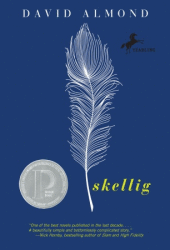
An Appreciation: SKELLIG by David Almond

I enjoyed a remarkable school visit to Sudbury, MA, last Friday. It was for a “One School, One Book” program, where approximately 1,000 students, grades 6-8, all read my book, Bystander, over the summer. I gave three presentations in a large, full auditorium and tried not to disappoint, though I think I’m still figuring out how best to talk about that topic without coming off as didactic.

But that’s not why I’ve gathered you here today.

I want to praise this book:

If I had a few extra lives, I’d start a blog that focused on “re-reviews.” That is, thoughtful discussions on books that had been around for longer than two minutes. So much about our culture is dedicated to the Cult of the New, our consumerist chase of the latest and greatest, that I think we sometimes lose sight of what truly deserves our attention.

So for the drive out and back to Sudbury, almost three hours each way, I took the audiobook of Skellig out of my local library. And really, I have no idea how I found this book, how it came to my hands. When I realized the reading was recorded by the author himself, and not by a professional actor, my first reaction was, “Uh-oh.” But Almond did a tremendous job. There is a gentleness and vulnerability to his voice that perfectly suits the book’s narrator, Michael; I can’t imagine it read by anyone else.

I loved this book as much as I’ve enjoyed any children’s book, period. I’m not sure how Skellig would be categorized these days, now that everything seems to get lumped into “speculative fiction,” but I think of it as “magic realism.” But done with precision and always with an eye toward larger truths.

In the story, a boy, Michael, meets a strange man-creature who appears to be living in an abandoned garage. “What are you?” Michael keeps asking.

I thought he was dead. He was sitting with his legs stretched out, and his head tipped back against the wall. He was covered in dust and webs like everything else and his face was thin and pale. Dead bluebottles were scattered on his hair and shoulders. I shone the torch on his white face and his black suit.

As the story unfolds, we learn the deeper story about Michael’s baby sister, who is struggling to survive in the hospital somewhere between life and death, attached to tubes and wires.

This book reminded me of some essential lessons in writing. Most essentially, the magical element — Skellig himself — is present to serve and deepen the psychological/emotional truth of the story. It’s not there as a cheap fill-in for story itself, or as some handy excuse for plot.

I think in these days we’re seeing more and more so-called magical elements in books, but they don’t seem magical at all — more like marketing, in fact. A tacked-on fad.

Reading Skellig helped me reach this conclusion: The magic has to serve the realism, not as some easy substitute for genuine feeling.

Almond clearly wrote this story from a deep emotional place, there is heart and soul on every page — a book that feels absolutely urgent and necessary — and as we journey into the mystery of Skellig, the character, we sink deeper into Michael’s own fears and turmoil as a sweet, confused boy “in distress” who is trying to make sense of it all.

In a world of strangeness and horror and the sweet stirrings of new love.

Rarely do I ever read a book and think, “I wish I wrote that.” Or more accurately, “I wish I could one day write a book as good and deep and honest as that.” But that’s how I felt about Skellig, a masterpiece.

That said: I have no idea what my kids will make of it. I imagine that some readers might find the book too slow, too sophisticated, with not enough action. But for my taste, and for why I read books in the first place, Skellig blew me away, knocked my head off my shoulders.

Patti Smith Commencement Speech: Direct from the Heart

I am a huge Patti Smith admirer, for many years now, but especially now after reading her fascinating memoir, Just Kids. A fabulous, uplifting book that could have been subtitled: “Portrait of an Artist as a Young Woman.” I’d love to hang out with her for an afternoon, or invite her to one of those miracle lunches when you can bring together a bunch of anybodys.

Patti Smith and Robert Mapplethorpe.

She is a true deep-to-the-bone artist.

Patti Smith recently earned an honorary degree from Pratt College and gave a commencement speech, which you can see in full. I recommend that you watch it.

You can also read the full transcript here, at the Smoking Bop Gun.

The ten-minute talk is filled with great moments, here’s just one of them:

I think of this like Pinnochio, because Pinnochio went out into the world. He went on his road filled with good intentions, with a vision. He went ready to do all the things he dreamed, but he was pulled this way and that. He was distracted. He faltered. He made mistakes. But he kept on. Pinnochio in the end became himself because the little flame inside him, no matter what crap he went through, would not be extinguished.

We are all Pinnochio.

And do you know what I found after several decades of life? We are Pinnochio over and over again. We achieve our goal. We become a level of ourselves. And then we want to go further, and we make new mistakes, and we have new hardships. But we prevail. We are human. We are alive. We have blood.

For a punk rocker and a tough-minded bird, Patti still has a lovely vulnerability and sweetness to her, a purity of intent, as evidenced in this amazing clip when she sang “You Light Up My LIfe” on the TV show, “Kids Are People Too.” She always, always speaks directly from the heart.

You need to a flashplayer enabled browser to view this YouTube video