Ah, the writing life — or a book gone wrong, or right, I don’t know.
Hat tip to my newest blog find, a most worthy site for inspiration: The Improvised Life.
Check it out. Great photos, easy reading. A site that always gives you a quick take-away.
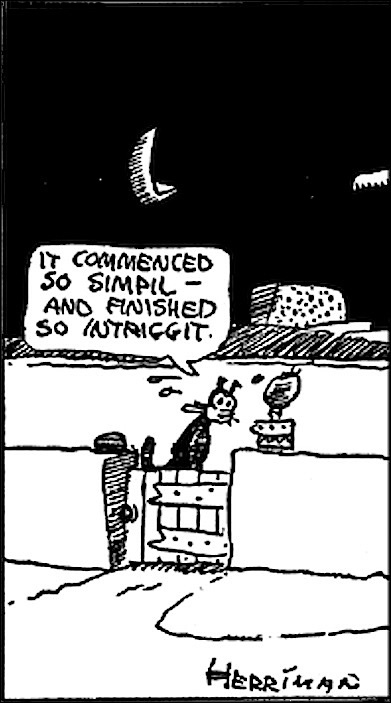
As a kid, I was a fan of Krazy Kat, the brick-tossing Ignatz Mouse, Offissa Bull Pupp, and company. I was too young for the original George Herriman newspaper strip, but enjoyed the cartoons and, later, learned to appreciate Herriman’s singular world view.
Too cool for words, though original, healthy, and legitimate are a good start.
Thankfully, there are pictures.
Those must have been righteous days, when you could open up a newspaper and find Krazy Kat and Nancy, originally drawn by the sublime Ernie Bushmiller.
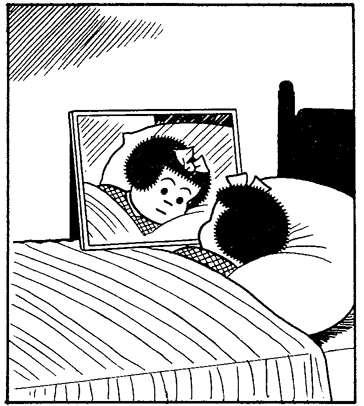
Here’s a favorite, passed along by my pal, illustrator Greg Ruth.
Actually, calling the above illustration a favorite doesn’t quite do it. More like, a recent obsession. I printed it out, now it’s hanging on my wall by the computer. An arm’s length away. I want to write a book that answers that illustration. I want a version of that reflective moment on a book cover.
It reminds me of the ending to one of my favorite films, Bob Rafelson’s “Five Easy Pieces.” For my money, it’s one of the great endings, ever. For the clip below, I’m thinking specifically of the scene in the bathroom at 2:30 – 3:30, though of course the full five minutes are worth watching, as Karen Black (Rayette Dipesto!) in anything so often is. But the real killer is Jack Nicholson catching a glimpse of himself in that mirror, turning away, the head’s slight turn, thinking, wondering, and finally coming back it (the reflection of his self) in that mirror: Who am I? What am I doing with my life? Where am I going?
We all understand that scene. Even Nancy. And I can watch it over and over again.
I recently read Thomas Newkirk’s outstanding book, Misreading Masculinity: Boys, Literacy, and Popular Culture. I sent him a complimentary email and, to my great surprise, he agreed to an interview. My reasons were selfish. I simply wanted to learn more from this very smart, insightful man.
Back in college, I had an English teacher who taught me an important question: So what? I mean, okay, boys don’t read as much as girls. They do other things well. What’s the big deal?
I think there are two responses. Reading well is so tied to school success — and to liking school — that it is unethical to write off a big percentage of boys as non-readers.It may have been possible in previous times to drop out or barely finish school and go on to good jobs. But that is not the case now.
I think the bigger argument that reading is a deeply pleasurable and enlightening activity — or can be. I don’t want boys to miss out on it.
Thomas Newkirk.
One of the things I loved about your book was how you wove in small pieces of memoir, little stories from your life, and connected those experiences to the book’s larger themes. You tell a wonderful story about how as a young man you visited the library in Harvard. You saw a dusty old scholar with a suitcase full of index cards and suddenly recognized the absolute weirdness of the literary life. Silent, isolated, inactive –- and how utterly strange it must appear to a non-reader. As book lovers, I don’t think we fully appreciate the perspective of the non-reader, how foreign it must look to a boy who typically chooses action, companionship, and noise.
Reading doesn’t have to be silent and isolated — although it must appear that way to readers who have never been in what Nancie Atwell calls “the reading zone.” When we enter that zone — identifying with characters, visualizing, hearing the voices of the narrator and characters — we are NOT alone. And if reading can be shared in friendship groups, talked about, it becomes even more social. C.S. Lewis once said that we read to learn that we are not alone, and I believe that.
You made a funny comment, when exploring the tension between literacy and the code of the real boy: “What better disguise could there be for Superman than to turn him into a writer!” It’s just not a very masculine endeavor, is it, shutting one’s self away from the active world, isolated and alone, sitting in a chair in silence. How much more un-boy can you get?
But I think technology is changing that. To compose with the resources of the Internet — to make digital stories, to navigate the various social networks, to create animation. We have recently seen how exploiting these social networks can bring down dictators. This is writing that is anything but isolated. Maybe school writing and reading is too isolated, but digital literacy is anything but.
At one point, you note, “Boys often feel than an open show of enthusiasm for schoolwork, particularly in the language arts, can undermine their identity as a ‘real boy.’” It seems like boy culture –- the codes of behavior — can be a major obstacle for boy readers.
Absolutely. I remember the African American journalist comment on the social pressure for African American boys to see trying at school as being “white.” His comment was: “With friends like that who needs enemies?” One reason parents look desperately for charter and private schools is to find places where trying and excelling at academics is part of the school culture.
As an adult, I enjoy reading closely observed, realistic fiction. Life’s little moments. I love Richard Ford and nothing ever happens in his novels. It takes him twelve pages to go to the store to pick up some muffins. And that fits in perfectly with a classroom emphasis on memoir writing. But I can vividly recall that as a boy I wanted things to HAPPEN in my stories. Otherwise, why write about it? So I think when boys are pushed to write about, say, their trip to the beach, about real things, they are bored and disappointed. A bomb didn’t explode? A shark didn’t attack? Why bother writing about eating chicken salad sandwiches with Uncle Max?
There has been a lot of the imposition of adult tastes on students — who may find fantasy and adventure genres more appealing. I don’t think that means that we give up on asking students to read and write realistic genres — but we need to be open to other tastes as well. Fantasy allows us to escape, to be bigger and braver than we are, to suspend the limitations of time and space. I think we all need that freedom as well.
Many years ago, not long after 9/11, I volunteered in my oldest son’s 3rd grade classroom. One boy, typical of many you discuss in Misreading Masculinity, wrote a story that included exploding bombs. I learned from his teacher that the mandated response was for us to forward the story to a school counselor who would contact the boy’s parents: “Billy’s writing about bombs again!”
Yes, unfortunately, many schools have given up on making meaningful distinctions here. I have never understood, for example, why it is OK to read about violence, even the gruesome violence of Beowulf, and that’s ok, even culturally valued. But if a kid writes something like that, it’s off to the guidance counselor. For me the key question is this: does the writing seem threatening to anyone; does it make anyone feel unsafe or targeted. If is does, it fails to meet the basic rules of any school. But if a kid writes a Star Wars take-off and a space ship explodes, does anybody really feel threatened by that?
I guess it’s natural for us, as enlightened adults, to want boys, or any students, to value what we value. We want them to read and appreciate what we consider to be good books. When those values aren’t shared –- when, say, they like low-brow stuff, AKA, “crap” –- the tendency is for us to see it as a deficiency in them. There’s something wrong with boys.
I think we all like some AKA crap. No one is high brow all the time. So it seems to me OK to ask kids to value what we value; but we also have to understand the appeal of what they like. It can’t be all one or the other. We have values and goals for their reading and writing; but we won’t win the cooperation of students if our attitude toward their culture is one of dismissal. Teaching is a cross-generational trade.
As a man who came to reading through my boyhood love of sports, where I’d dive into the morning paper (pre-ESPN, thank goodness) for the stats and scores and stories, I liked that you included a nod to “the literature of sports tables.” I can read a box score and imagine a half-dozen story lines.
Yes, it’s so rich in information — the scores by quarters or innings. Who’s hot and who’s not. It is still my favorite page in the sports section. I am convinced that one advantage boys have in math is their early immersion in sports statistics.
At times you use the term, “school literacy.” How do you distinguish that from ordinary literacy? Is it a matter of “school-approved” literacy?
School literacy is necessarily a limited subset of possible literacies. It traditionally focuses on the verbal over the visual; on high culture over popular culture; on print over oral expression; on realism over fantasy and escapism; on extended formal writing over informal and expressive writing.
It resonated with me when you gave a historical perspective on oral vs. silent reading, linking it to a “cult of efficiency.” We know that speed readers are taught to eliminate sub-vocalization, and instead to scan chunks of language, eliminating meaningless words. Yet as a writer, some of the best advice I can give is to read what you’ve written aloud, to really hear what you’ve written, the sound and rhythm of the words. That is, it’s the total opposite of what most of us do in silent, sustained reading!
I am convinced that even when we read “silently” we are attending to the intonations of language. In other words, “silent” reading is not really silent. That’s why writers will often read their work aloud to revise—even though almost all their readers will not read it aloud. But I would argue that they still register sound in some way, internally. I will expand that idea in my new book, The Case for Slow Reading. Stay tuned.
You argue for television as a legitimate source of writing topics. Why do you see television as an under-valued resource?
I think schools see TV, the Internet, and video games as the enemy. And this makes some sense—studies show that many students spend way too much time with this media, often multitasking. But I believe that TV can teach dialogue, conflict, characterization, narrative, humor. The visual narratives can provide scaffolds, or cultural props, for students to use in their writing — if teachers let them. They can write parodies or alternative versions with their friends co-exiting with fictional characters — Darth Vadar and the kid down the street — all in the same adventure.
I hesitate before opening this can of worms, since much of my livelihood depends upon the approval of gatekeepers (editors, teachers, librarians, bloggers, book purchasers) who are overwhelmingly female. Clearly, the world of children’s books is a woman’s world. Is that, in your opinion, part of the problem when it comes to boys literacy?
One challenge is to look at books from the boy’s point of view. I don’t think gender is an absolute barrier here. What’s needed is an open mind, a sense of curiosity. What makes this boy tick? What are the themes, passions, competencies in his life that I can build on? To teach we all need to get outside ourselves, and into someone else’s skin. I know many female teachers who are wonderful at this. And it seems to me that when a boy senses a female teacher cares about what he cares about, that boy will be open to other things the teacher asks of him.
Finally, can you recommend any other books on this topic?
I’d read Ralph Fletcher’s Boy Writers. I’d also watch the PBS documentary “Raising Cain.”
I loved Fletcher’s book and commented on it before, so I second the nomination. Thanks, Thomas, for taking the time out to answer my questions. You’ve certainly given me a lot to think about. And I’ll be looking forward to your new book, The Case for Slow Reading. I posted on that subject back in September, 2010, and led with a quote by . . . Thomas Newkirk: “Teachers can enhance students’ pleasure and success in reading by showing them how to slow down and savor what they read.”
My best to you. Keep up the great work. And here’s a clip from “Raising Cain.”
Readers, note: Please check out my other blog, FATHERS READ, for more on the subject of boys literacy. I’ll be away on school visits for most of the week.
Thomas Newkirk is Professor of English at the University of New Hampshire. He has studied literacy learning at a variety of educational levels — from preschool to college. His book, Misreading Masculinity, was cited by Instructor Magazine as one of the most significant books for teachers in the past decade. He is also the author of Holding On to Good Ideas in a Time of Bad Ones: Six Literacy Ideas Worth Fighting For and The Performance of Self in Student Writing.
If you missed Part One of the Alan Silberberg Interview, it’s absurd for you to be here. I mean, really. Please follow the link to catch up.
Don’t worry, we’ll wait . . .
Late in the book, Milo gathers together a number of objects that remind him of his mother, that press the memory of her into his consciousness. Where’d you get the idea for that?
I think that comes from the fact that I really don’t have anything from my mother. Things did get thrown away or given away and it really was like she died and then she was erased. When I was writing the book I started to think hard about my mom and tried remembering objects that evoked her to me. That became a cartoon called “Memories Lost” which were all real objects from my childhood that connected me to her. After making that cartoon, it struck me that Milo would want to go out and replace those objects somehow and that’s why he and his friends hit up the yard sales.
There is a scene toward the end in one of my books, Six Innings (a book that similarly includes a biographical element of cancer), that I can’t read aloud to a group because I know I’ll start to slobber. It’s just too raw, too personal for me. And I suspect that might be true of you with certain parts of this book. I’m asking: Are there any moments that get to you every time?
I think there are two specific parts of the book that choke me up, though lots of little places make me reach for tissues. The chapter where Milo goes to the yard sale and finds a blanket that reminds him of the one his mom had will always get to me. My mom had that blanket, the “pea patch blanket” in the book — so as Milo wraps himself in it and remembers her getting sick — I am always transported to the image of my mom and her blanket. The second place in the book happens in cartoon form, when Milo remembers the last time he saw his mother, which was when she was already under anesthesia being prepped for surgery and she has had her head shaved and he can see the lines for the surgery drawn on her head like a tic tac toe board. That image is directly from my memory of my last time seeing my mother. It’s pretty heavy stuff.
And so powerfully authentic. Milo describes that period after his mother died as “the fog.” Was that your memory of it?
I think trauma at any age creates a disconnect inside us. I think the fog settled in for me slowly. As the initial shock of my mom’s death wore off a sort of numbness rolled in over me. It was a survival technique to cover all that hurt stuff with an emotional buffer and I think that’s what I mean about “the fog”. It’s like I knew there was a pain in me but I didn’t want to touch it or think about. It was just always there as a dull feeling deep inside. The Fog.
Speaking of fog, you watched a lot of TV as a kid.
Ha! My two sisters called me “the walking, talking TV guide” because I always knew what was on and what channel. I’d never be able to do that today with all the satellite and cable channels — but back then, I was an authority on the network TV schedule!
We never got it at my house, but I remember being jealous of families who had subscriptions to TV Guide.
Absolutely! We didn’t have a subscription either but I would read the one at my friend’s house up the street and just soak it all up so I could be the authority for the upcoming week back home! Even before my mom’s death I loved TV — but after she died it really became a safe place to get absorbed into the fiction of other people’s lives. I loved cartoons and comedies the most back then.
You’ve written for television in the past. In what way do you think that helped when it came time for you attempt a novel?
The best thing about being a reformed TV writer is I already knew how to structure a story and more importantly, thanks to my animation writing especially, I was already really good at setting the scene and making sure to also describe the action. Scripts rely on good dialogue so that was a skill I’d already started to hone. When I started Pond Scum (my first book) I thought of it as a long episode of a great TV show and I let the chapters drive the story as if it was a script.
When I talk to students on school visits, I’ll sometimes do a quickie “show, don’t tell” lesson, and I’ll describe it as creating a movie in the reader’s mind — in part because my skin crawls when I hear it described by authors as “painting pictures with words.”
Yeah, the writer as painter image doesn’t quite skew in my head either. And I bet the kids really relate to your idea of imagining a movie in their mind. That’s nice.
I wonder, what did the novel format allow you to do that, perhaps, you couldn’t achieve while writing for television?
TV is dictated by the time of each episode, whether it’s 30 minutes or 60 minutes the writer is being told how many pages to write and where the commercial act breaks appear. There are producer notes and network notes and it really is a bit of writing by committee. I am really thankful for my TV writing experience — but I so appreciate the freedom of writing a novel where I can do whatever I want and am not restricted by time issues or rules of what my characters can and can’t do. I am so much happier being in control of the world I create when I write a novel. Of course there are notes that must be worked with from the editor at the publishing house — but I have always found that to be a collaborative experience to make the book better. In TV — notes were usually a headache and lots of times they never even made sense! My book editors, Donna Bray on Pond Scum and Liesa Abrams on Milo — have made me a better writer and I am so thankful to them for that.
Can you think of anything specifically that they taught you?
I think one of the best lessons I’ve gotten was to stay true to the kid voice of the story. Sometimes I let my characters talk the way I’m thinking and the situation is all kid, but the language comes out too adult. Maintaining the kid POV is always in the back of my head thanks to my editors.
Yeah, I have that struggle, too. Once I created a second-grade character with rheumatoid arthritis who had a fondness for lemon cakes, Jay Leno, and bargain-priced resort wear. I had to rethink it. Question: How do you know when something’s funny?
That’s the million dollar question! I wish I knew that answer. I think I have a good sense of humor so if something strikes me as being funny — it usually is at least amusing. I’m not too big on dissecting jokes or looking for rules of comedy (with the exception of “the rule of three” and “words with a “k” sound”).
Yes, the classic scene from Neil Simon’s “The Sunshine Boys” with George Burns and Walter Matthau. I can’t find the exact quote, but the basic idea: Alka-Seltzer is funny. Chicken is funny. Pickle is funny. L’s are not funny. M’s are not funny. Lettuce is not funny. Cucumber’s funny. Cab is funny. Taxi, not so much.
I saw the play version on Broadway and wish I could remember the cast but my mind is a blank. But it was funny. Very funny. As far as knowing when something is funny or not — I also like to run things by my wife and son — if they don’t at least crack a smile I know I am way off base!
I have this memory from college. This guy Dave used to introduce me to people, saying, “This is Jimmy. He’s really funny.” And I hated that. I finally had to say, like, Dave, dude, you’re killing me here. First, the pressure was ridiculous, and secondly, I didn’t want to play the clown. I can be funny at times, but it has to come in naturally. That’s how I feel about writing, too. I think I’m in trouble when I try to be funny.
Yeah, I was that guy at times but thankfully I can’t tell jokes so no one puts me on the spot anymore. I’m more of the guy who stands in the back of a group listening and then I add a zinger to the conversation — I’m a punch line guy who then shrinks back into the shadows!
Well, then feel free to say something funny, Alan. I’ve been waiting pretty patiently. Zing away. I sense that my Goofball Devotees are becoming restless.
No, really. This is when I bomb. The pressure to be funny will always result in the most un-funny thing possible, which I think I just proved with this last sentence.
No, that was hysterical, I laughed just watching the sweat pore off your head as you tried to think of something funny. Like the great scene with Albert Brooks in “Broadcast News.”
There’s a great line by one of the camera crew in that scene: “Nixon didn’t sweat this much.”
Back to Milo, did you worry that maybe you’d be blowing the appeal of your funny story by including the grief aspect. I mean, did some voice whisper in your ear, “Man, this is not the way to sell books to boys.”
Yes! As I mentioned, the initial goal was to just write a “funny book.” But once I realized what Milo’s story was — that he was the boy whose mom had died — it became a challenge to tell the story in a way that was both touching and funny. I stopped thinking about whether it would sell or not and concentrated on telling the story from a true place inside me. I had some deep seated confidence that this book would find its place and it was meant to find its way to Liesa Abrams at Aladdin. She embraced Milo immediately from her heart. I think that trying to write a “commercial” book is the worst way to go about it anyway.
So you think I should scrap the Geek Supernatural Romance I’ve been trying to write?
What? No vampires or zombies in it?
NOTE TO SELF: More vampires, jump on zombie craze.
Now, where were we? Oh yes, Alan Silberberg! Haven’t you gone home yet? How important are the illustrations to the book’s appeal?
I think it was important for me to add my cartoons to this story, in other words, be able to write and illustrate a book. Though I think the story could stand just fine as a text-only book, it’s clear that cartoons help get the book into certain young hands. But apart from that, I really felt the cartoons could add a dimension of story-telling to the book (not just funny eye candy).
You’ve said elsewhere that the words usually come first, that you are truly illustrating the story. But how does it affect you as a writer, knowing that you’ll have those illustrations? I’d think it would help with, say, a joke or funny moment. You’d be delivering the punch-line two different ways.
Exactly. I find that when I know there can be a cartoon anytime I feel like it — the writer part of my brain and the cartooning part kind of team up. I get a voice inside my head telling me, “Hey, you could punctuate that joke with a great doodle!” Certainly I found with Milo that there are parts of the book where I was having a hard time writing until I imagined how a cartoon would help the chapter be lighter or in some cases the opposite, where a cartoon could tell the sadness of the story in a visual way. I guess the writing was a little easier because I always had my cartoons to fallback on if I got stuck.
Any new books from you on the horizon? Or have you gotten up the courage to finally pursue that career as a catwalk model?
My legs are my best asset! Actually, I am almost done with the first draft of a new book for Aladdin. It’s another book that will include my cartoons but it is much more of a silly book than Milo. It’s a buddy story about two friends who want to be the school cartoonists and get more than they bargained for when their wishes come true.
Lightning round: Adam Sandler or Chris Farley?
Gonna have to go with Sandler.
Ouch. Okay, chin up: Ali or Frazier?
I’ll go with the Kelsey Grammer guy. Never liked Ali McBeal.
Separated at birth?
I think that’s Ally but . . . let’s move right along. The Halloween treat that makes you go back to the house a second time?
Has to be Nestles Crunch!
Top of your head, five favorite books?
A Confederacy of Dunces by John Kennedy Toole and Walker Percy, Adrian Mole by Sue Townsend(any and all), Half Magic by Edward Eager and N.M. Bodecker(it was the first book I remember loving as a kid), The Count of Monte Cristo by Alexandre Dumas, Bird By Bird by Anne Lamott.
Five favorite movies?
The Big Lebowski, Memento, Back To The Future, Monsters Inc, Defending Your Life.
First album you ever bought as a kid?
The Who’s Quadraphenia.
Five most played songs on iTunes? No cheating.
“This Must Be the Place (Naïve Melody)” Talking Heads, “I’ve Had It” Aimee Mann, “New York City Serenade” Bruce Springsteen, “Generator (Second Floor)” Freelance Whales, “Into The Woods” Soundtrack.
Nice list. It’s often a surprise what floats up to the top. Full disclosure, my five most played includes four Dylan tunes (“Love Minus Zero/No Limit,” “Just Like Tom Thumb’s Blues,” “Positively 4th Street,” “Tell Me That It Isn’t True”) and Van Morrison’s, “And It Stoned Me.” So: you live in Montreal, which surprisingly is still in Canada. Five favorite places in the city?
1) Schwartz’s has the best smoked meat sandwiches on the planet. 2) Westmount Library lets me fall asleep in their cozy chairs. 3) The Old Port of Montreal for the relaxed tourist ambiance of Europe with a Canadian twist 4) Shaika Café, where I like to write and watch the other people write while they watch me 5) This chair in my house. Love it!
Alan, thanks for stopping by. I’m glad we got a chance to meet. I’ll be watching your career and rooting for your success. Please accept this set of bamboo flatware as a parting gift. You’ll love giving your meals a tropical twist with real bamboo-like handles! The complete set serves one (and might be missing a fork). Shipping not included.
Some links to more interviews conducted by yours truly:
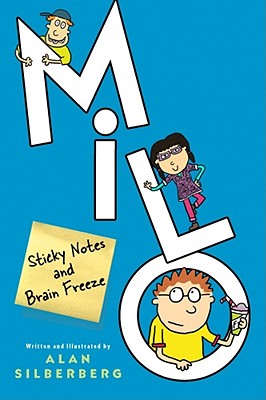
Readers can connect with Milo, by Alan Silberberg, in very different ways. I suppose that’s true of any book, we all bring our disparate selves to the text, but it seems especially true for Milo, a story for middle grade readers that embraces broad goofy humor on one end, and authentic, emotional grief on the other. Actually, that’s not true. Those qualities aren’t on separate ends, but are intermingled throughout. It’s a book where a boy can sneeze on someone’s neck in class, then return home to a house of fog and loss, where no one has quite figured out how to move forward after a death in the family. For me as a reader, it wasn’t the humor that hooked me. It was the humor combined with real emotional depth.
That rare thing in children’s books: a boy in full.
After I read Milo, I wanted to meet Alan because I sensed that he and I shared things in common. So I contacted Alan through his website and requested an interview. There was much I wanted to discuss, and our conversation flowed so naturally, that our Q & A went on slightly longer than The Reagan Years. I decided to break it up into two parts. I’m indebted to Alan for his time and patience and for the care he took in answering my questions.
(Whew. I’m relieved he’s not a Yankees fan.)
Alan! Hey, thanks for stopping by all the way from Montreal. Which is still in Canada, right? Could you please leave the soggy Uggs by the front door? Yeah, the moose, too. That’d be swell.
It’s true, Montreal is still in Canada. But you know, I’m from Boston (Go Red Sox!) so my heart — and shoveling technique — is from New England.
I gather that you didn’t initially set out to tackle this huge, daunting topic –- the death of a parent.
You are so right! When I started writing this book my goal was to write a pretty silly book that would include my cartoon illustrations. What started as a goofy look at a 7th grade kid starting a new school turned into something much deeper once I realized I had my own story to tell.
I know that this book grows out of your own personal experiences. Could you give us a little background on that?
My mom died of brain cancer when I was nine years old. It happened really fast too. It was a terrible time in my life and I guess I have always identified with that lost boy whose mother suddenly went away. In my family “death” never really got discussed so after she died we all just did our best to pretend we were okay, which on one level was comforting because I didn’t have to really deal with the grief and loss. With my sense of humor intact, I moved on from that life-altering event — but always dragging along a sad piece of me like a shadow.
“A sad piece of me like a shadow,” that’s nice. I just finished a young adult novel that grapples with some of the same feelings, where things unsaid are more important than what’s spoken. But I don’t suppose you’d let me steal that “sad piece of me” line, would you?
Be my guest. Just buy me an iced espresso some time. And a cookie. Chocolate chip is always nice.
At one point in the book, Milo says, “I miss a dinner table that doesn’t feel lopsided,” and I completely understood that line. I mean, you got me right there. My oldest brother, Neal, died of AIDS back in ’93. And after that, I often said that our family became like a ship that listed to the side. The ballast was off, you know. We never sat in the water quite right after that.
I think that’s what loss does to a family — even the most messed up families are a balanced whole. And the loss of someone we love just throws that balance totally off. And I think it doesn’t matter at what age we lose someone — that loss sets us adrift. I like your boat metaphor.
You attempt to do something that’s not at all easy –- balancing some traditional, goofy boy humor with a sensitive, heartfelt story about deep, deep loss.
Once I knew that the silly story I started out to write was drawing deeper from my life I made the decision to stay true to who I was back then. Life was suddenly sad — but I was still a funny kid. I think it’s important to have a balance in a story like this because life isn’t all one thing or another and a story about loss can also be a funny story. Of course the cartoons help to give the book a lighter tone, but to be honest, some of the cartoons are quite poignant and a bit sad too.
I have to say, I’m often frustrated when I encounter these limited notions about “what boys like” and, consequently, “what boys are and can be.” So we see books with the goofball stuff –- with varying levels of originality — but not very much in the way of emotion. Because I guess there’s this idea that boys don’t “do” feelings. And perhaps they don’t, I don’t know. But at the same time: it’s real, it’s true, this stuff happens to actual boys. As I’ve said before, it can’t all be farts and firetrucks.
I know what you mean. I hear it all the time that a book is a “girl” book or a “boy” book and sometimes I think that’s just marketing. Whether boys, or girls for that matter, will be drawn to Milo is out of my hands. I have gotten wonderful feedback from kids who have loved the book and have had the experience of knowing first-hand that the book has helped kids dealing with loss. At the other end of the spectrum — I know kids who have read the book because they love the cartoons and think the story is “real” but still made them laugh . . . and made them think. At the end of the day I want Milo to find its way into the hands of kids who like a good story and especially those kids who are ready for the real emotions that I wrote about.
Tell me a little bit about the father. He’s suffering, too, but because we see him from Milo’s point of view, we just get this sense that dad is basically out of it. For Milo, he has to find help elsewhere –- because dad’s not emotionally available.
Milo’s whole family has suffered a loss and though the story is told from Milo’s point of view he experiences his dad as being kind of absent. There’s one cartoon I did where Milo says that he misses his dad almost as much as he misses his mom, because his dad is having a hard time too. I think that’s what can happen when one parent dies. The child can lose two parents.
There are a few helpful adults in Milo’s world, and I think you handle them realistically. They don’t swoop in and save the day. In fact, well, nobody does. Nobody can. But they do help.
I guess it would have been too easy to have some adult be able to make everything “okay” for Milo. But that just isn’t realistic. What I did want to explore though is how Milo learns how to grieve his mom’s death with the help of his older neighbor. She doesn’t make everything right for him but she is the one who opens a door that leads him to say the goodbye he never said. It was a healing part of the book to write for me because I got to be Milo and say the goodbye I never said too. And that all happened through Milo’s relationship with the neighbor character, who was based on one of the moms in my neighborhood who took me in after my mom died.
That must have been a remarkable moment when you were able to hand her the finished book.
It was actually bittersweet because the real Sylvia passed away just after the book came out. I had told her months earlier how she had inspired a character in my new book and she was very happy about that. I was told by her family that they were able to read some of the book to her before she passed and that she was very touched by it.
I’m glad you were able to honor her with that gift of recognition after all these long years. I also really liked Milo’s friendship with Marshall. They are just boys, you know, going to the store, spending their money on junk food, sitting down on the curb, goofing around like a pair of glorious idiots.
And yet at the same time, Marshall is clearly not a total clod. I’m not sure what I’m saying, exactly, other than I think your book respects the complexity of boys –- and as an ex-kid myself, and a father of two boys, I really appreciate that.
Thanks. I really liked creating the relationship between Milo and Marshall. It just felt right that these two would know each other and get along so well. Marshall is a bit left of center, but I was hopefully not writing a geeky character, just someone who lives life in his own unique way. Milo is more of an internal guy and Marshall is an extrovert — so the combo really works. Thinking back to the friendships I had back at that age and being the father of a son who just lived it also helped me channel their relationship.
Alan, let’s pick up this conversation on Wednesday. I assume you can stay over, right? You can sleep on the cot. In the closet. With the Uggs.
And the moose.
PLEASE COME BACK LATER THIS WEEK FOR THE THRILLING, DEATH-DEFYING CONCLUSION OF THE ALAN SILBERBERG INTERVIEW.
CLICK HERE AND BE MAGICALLY TRANSPORTED TO PART 2.
As a kid I loved Curious George and nothing’s really changed about that, despite a slew of less-than-stellar books published after the passing of H.A. Rey in 1977. There was a particular series done in the late 80’s, early 90’s — cheap 8″ x 8″ books based on grainy filmstrips — that was especially loathsome. I hated to see them monkey around so with my literary hero.
Best to stick with the seven “Original Adventures” produced during the lifetime of Hans Augusto Rey in partnership with his wife, Margret: Curious George (1941), Curious George Takes a Job (1947 ), Curious George Rides a Bike (1952), Curious George Gets a Medal (1957), Curious George Flies a Kite (1958), Curious George Learns the Alphabet (1963), and Curious George Goes to the Hospital (1966). After those titles, the quality slips badly. It’s just not Curious George anymore.
Here’s the man, H.A. Rey himself. And friends.
But I digress. My great pal Craig Walker, a late, beloved editor at Scholastic, once explained to me the appeal of Curious George in this way, and I’m paraphrasing:
“No matter what mistakes George makes, no matter how much trouble he gets into, at the end there’s always the Man with the Yellow Hat who forgives him, who loves him, who makes it all okay. Kids respond to that, and I think that’s part of the reason why those books are so popular.”
Isn’t that what a father is supposed to be? The safe place you can always come back to, the place where — no matter what — you’ll always be loved?
The Library partnered with the Ad Council, Universal Partnerships & Licensing and Houghton Mifflin Harcourt Publishing Company to develop public service announcementsfeaturing the iconic characters from the Curious George series to encourage parents to read with their children. The television, print and outdoor PSAs feature George and his best friend and mentor, “The Man in the Yellow Hat” reading books together asking parents to “Read to your child today and inspire a lifelong love of reading.”
NOTE: The trouble with two blogs is sometimes a given post could sit snugly in either location. I put this one here for two reasons: 1) Right now, more eyes land here; and 2) I’m trying to keep “James Preller,” the personal stuff, out of Fathers Read, or at least on the fringes. Basically, I say less over there, and want the pictures to speak for themselves. But by all means, please swing by and check it out. I’m proud of what’s up there, and grateful for the support it’s gotten from folks both famous and far-flung.
As always when it comes to Curious George, lets try to stay legal, shall we, because heaven forfend:







)
