Archive for Interviews & Appreciations

Books for Boys: A Tribute to “William’s Doll”

“William wanted a doll.”

And so begins Charlotte Zolotow’s classic picture book, William’s Doll, illustrated by William Pene Du Bois. Published 38 years ago, and dedicated to Billy and Nancy, it is still relevant today — and very possibly moreso.

This title has been on my mind a lot lately, and comes to mind whenever the discussion turns to “books for boys.” Somehow the collective thinking about boys and reading has become muddled, to the point where “boys” has become a code word for “reluctant readers.”

I’ve talked about this before, here and here and here and elsewhere, and I don’t wish to repeat myself endlessly. Except to paraphrase Walt Whitman: Boys are large and contain multitudes. I find it unsettling, even disturbing, when I come across lists of “books for boys” that offer all the usual standbys: bodily humor, nonstop action, cars and trucks, sports, violence, and so on. You know, the kinds of stuff all boys like.

Imagine such a list for girls. Would it offend you?

And now imagine all the great books, and important thoughts, that would be missing from such a list. Because the nature of such lists is reductionist and simplistic and full of stereotypes, a narrowing of what children are and what children can become. Girls and boys.

Yes, for sure, I am strongly on the side of a teacher or parent who longs to turn a reluctant reader onto books. I can understand the desire for something sure-fire, a book that will turn the trick, unlock the door, open up the world of reading. But once that door has been pushed open, let’s not forget that boys can be sensitive, thoughtful, dreamy, mild, frightened, lonely, tender, loving, sad, and a thousand more things. It’s not just farts and firetrucks.

When my oldest son, Nick, was sick with leukemia, we struggled as parents. It was tempting to give him things, do things for him, make the experience easier and more enjoyable. In short: spoil him. After a spinal tap, how do you not buy that kid a lollipop? And a DVD of whatever he wants. So we did. But not always. My wife Lisa once said one of the most profound things about parenting I ever heard. Talking about this subject, she reminded me: “We’re not only trying to take care of a sick boy — we’re trying to raise a healthy adult.”

I think that applies to boys and reading.

So let’s look at this book, William’s Doll. To me, the best illustration is on the first page, before even the title page. You know, the page we hurry past on our way to the story. It’s a picture, we will learn, of William and Nancy from next door. Nancy is holding a doll. But if you glance quickly at that illustration, look at it from a distance, it is a portrait of every young family in the world. Father, mother, and child.
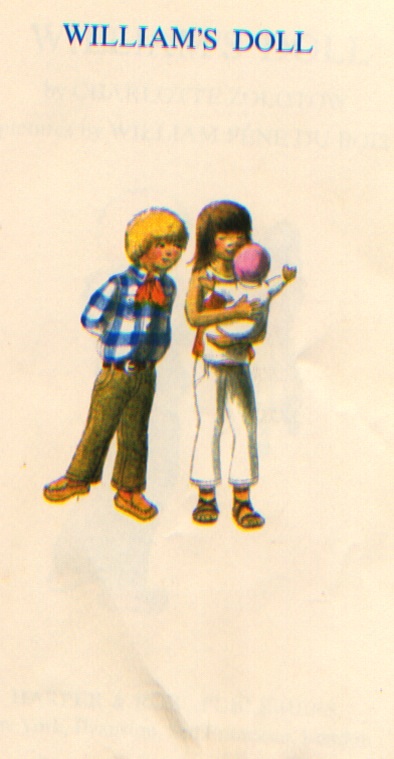
“He wanted to hug it

and cradle it in his arms

and give it a bottle

and take it to the park

and push it in the swing

and bring it back home

and undress it

and put it to bed . . .”

His brother and the boy next door did not approve.
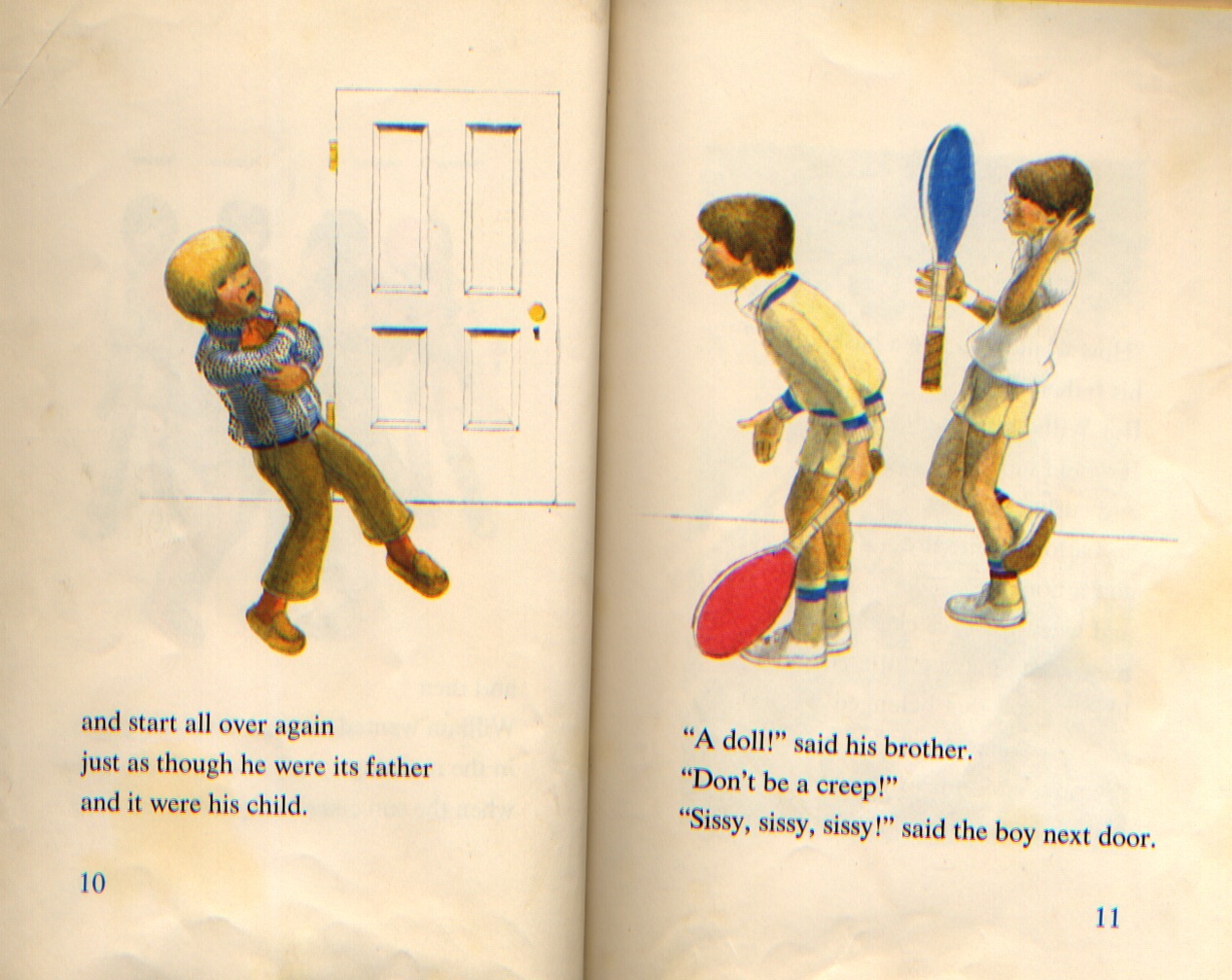
William’s father brought home a basketball instead.

He practiced a lot

and got good at it

but it had nothing to do

with a doll.

William still wanted one.

So his father brought home an electric train. With similar results.

One day his grandmother visited. William proudly showed her the basketball and his new train. He also expressed his desire for a doll, explaining, “My brother says it will make me a creep and the boy next door says I’m a sissy and my father brings me other things instead.”

His grandmother listened attentively.

“Nonsense,” she said.

She bought him a doll. I love the detail in this description, the clicking of the eyes. It reminds me of my mother’s Shirley Temple doll (not that I ever played with it!).

The doll had blue eyes

and when they closed

they made a clicking sound

and William loved it

right away.
William’s father was upset. “He’s a boy!” he said.

And so the grandmother must patiently explain to her son:

“He needs it,” she said,

“to hug

and to cradle

and to take to the park

so that

when he’s a father

like you,

he’ll know how to

take care of his baby

and feed him

and love him

and bring him

the things he wants,

like a doll

so that he can

practice being

a father.”

I highly doubt you’ll find this book on a list of “books for boys.” It’s probably too sissyish. No, instead we’ll give them books about trains and basketball.

ENDNOTE: A song based on the story, with lyrics by Mary Rodgers and music by Sheldon Harnick, was included in the bestselling album, “Free to Be . . . You and Me.” In 1974, it was turned into a television special. According to producer Marlo Thomas, ABC fought to have the song dropped from the show. She recalled: “They wanted William’s Doll cut, because it would turn every boy into a homosexual.”

True to her ideals, and (importantly) armed with enough marketable power to win this battle, Ms. Thomas refused to comply, and the song remained. Somehow civilization was not destroyed — by this show, at least.

Click here for more on the sources of Charlotte Zolotow’s inspiration for this story, which was based on personal experience as a mother and wife. Commented Zolotow: “I wrote it out of direct emotional sorrow.”

Ernie Harwell Remembered

“I have a problem and I hope you’ll understand and bear with me. One of the finest men we have ever met, and a great broadcaster — he’s in the Hall of Fame — Ernie Harwell, the voice of the Tigers for so many years, who started with the Dodgers broadcasting in 1948, passed away today. The strike two pitch is outside, ball one. But there’s a great story about Ernie . . .” — Vin Scully.

In a recent series of interview questions with various children’s book authors who had written baseball-themed books, Doret Canton (The Happy Nappy Bookseller) asked about our favorite baseball announcers. It was an impossible question, really, because we couldn’t possibly make a fair and informed judgment. Most guys we never hear, or only rarely. The voices we love tend to talk about the team we love; we grow attached to those voices.

In this clip below, the great Vin Scully tells a terrific story about another legendary announcer, Ernie Harwell, who recently passed away at the age of 92. It’s worth a listen. And worth noting, too, how effortlessly Scully tells his story without missing a beat on the play-by-play. A true master.

These days, for my money the most consistently excellent, insightful, and entertaining baseball writer is Joe Posnanski. He wrote one of my favorite baseball books, The Soul of Baseball, about Buck O’Neil, which I discussed here in a list of “My Ten All-Time Favorite Baseball Books.” If you’ve got a minute, check out Joe’s lovely tribute to Ernie Harwell. Here’s one little sliver from that wonderful essay:

Of course, everyone who ever listened to Ernie Harwell called him a friend. “It isn’t me that people love,” he said to me once, “It’s baseball.” But, of course, it wasn’t true. People loved him.

NOTE: MLB took down the video link of Scully on Harwell, so here’s a nice tribute to Harwell instead.

You need to a flashplayer enabled browser to view this YouTube video

Bullies in the News: Feature Article on BYSTANDER

The news has been so sad, so disturbing, so upsetting lately. It’s as if the world has woken up and suddenly, wherever you look, there’s news and columns about bullies and victims and bystanders.

On that note, I was recently the subject of a feature article, “A Book for the Bullied,” written by Doug Gruse for the Glens Falls Post Star. Doug is a thoroughly professional, careful, thoughtful writer and I believe he did a great job with the piece. I tend to dread these things — the awkward quotes and mangled quotes and (to my mind) the often misplaced emphasis. But Doug did a great job. Very grateful for that. Here’s how it begins:

Most people outgrow their childhoods, but James Preller relives his almost every day.

Preller, best-known for his “Jigsaw Jones” children’s series, is an author who never underestimates young readers.

“I think from an outsiders’ point of view, people think kids’ books are light and fluffy — until they start reading them and see what’s out there,” Preller said.

The writer, who has published everything from picture books to young adult novels, will appear on April 15 at Barnes & Noble in Saratoga Springs.

His most recent book, “Bystander,” tells the story of a new kid in town who witnesses bullying at his middle school. Although bullies are not a new literary topic, Preller worked to approach the subject from a different and more honest perspective.

“I had the idea that evil has a pretty face. I wanted the bully to be verbally [skilled], charming and charismatic,” he said

The author, who lives in Delmar, made the story more complex than just a big kid at school muscling other students, and he didn’t want to give the book a Hollywood happy ending.
“This is not the revenge fantasy where all the nerds get together and teach the bully a lesson. I resisted the easy solutions because I don’t think they are there,” he said. “I don’t think bullying is going to end, and I can’t provide those simple answers.”

He does, however, believe most students [given support] are strong enough to overcome the negative experience and move past it.

“Bullying does reach its peak in middle school and does tend to diminish as kids get older. When we look back, we survive it and we get through it. It’s not that we triumph and all the bad guys learn a valuable lesson, but the rest of us can figure out how to diminish the harm they do,” he said. In the book, Preller makes it clear that boys aren’t the only ones who engage in bullying. A group of girls in the novel uses the Internet to harass a fellow student.

“Cyber bulling is absolutely a problem. I think with girls, that’s where you tend to see more of the cyber bullying,” he said.

Although the book covers difficult territory, Preller said he made an effort to keep the story entertaining for young readers.

“When you write a book like this that maybe has a hot topic, it gets lost that you are still trying to tell a good story. You don’t want the reader to be conscious that they are being taught a lesson. If they feel that they are, they are going to put the book away,” he said.

For the full article, click here.

For a sample chapter, click here.

And lastly, this blog is filled with background information on the book. Just click on “Bystander” under categories in the right sidebar. I think this entry was especially relevant.

Happy Nappy Bloggy Baseball: Around the Horn with Doret

My friend, Doret Canton, of The Happy Nappy Bookseller blog, goes around the horn with nine authors of children’s baseball books. It’s a pretty cool lineup with some heavy hitters, sure to score runs in bunches.

Doret’s come up with a fun, inventive way of sharing her passion for baseball and baseball books, with each author answering interview questions over a series of days.

Here’s the lineup:

1. Gene Fehler, Change-up: Baseball Poems
2. Linda Sue Park, Keeping Score
3. Kurtis Scaletta, Mudville
4. Alan Gratz, Brooklyn Nine
5. Julianna Baggott, The Prince of Fenway Park
6. James Preller, Six Innings
7. Jennifer E. Smith, The Comeback Season
8. Carl Deuker, Painting the Black
9. Mick Cochrane, The Girl Who Threw Butterflies

Alongside this company, I’m like that kid at second base, murmuring to himself, “Don’t screw it up, don’t screw it up, please God don’t let me screw it up.”

Here’s Round One, questions 1-3.

Here’s Round Two, questions 4-6.

Stop on over and check it out.

By the way, I interviewed Doret back about a year ago. She’s a passionate, voracious reader and I love her attitude. You wanna get real? Go talk to Doret. But don’t believe my word for it, decide for yourself.

After spending time with Doret, you’ll definitely want to put on a squeeze play.

Breaking the Silence: Interview at Boylit.com

I’m breaking my self-imposed gag order to alert my Nation of Readers of an interview I did with Carl DeLuca over at Boylit.com.

Click here like a crazed ferret and you’ll find it.

I think anyone interested in boys and books (together, at last!) will appreciate the effort, commitment, and care that Carl has put into his new website. You should check it out! There’s thoughtful essays, lists, interviews (so far: Jessica Lee Anderson, Laura Manivong, Kurtis Scaletta, and Stephanie Stuve-Bodeen), links, and free pizza and beer for every visitor (no, I’m lying).

Thanks, Carl!