Archive for Interviews & Appreciations

The Craft of Recording Audiobooks: A Conversation with Voice Actor Christopher Gebauer

–

Exciting news, folks: thanks to Recorded Books, there are now 14 Jigsaw Jones titles available in audiobook format. Cheap! The voice actor, Christopher Gebauer, did a terrific job, full of wit and nuance and a sure sense of character. So I looked him up on ye olde interwebs to send along a complimentary note. We emailed back and forth, and I eventually asked Christopher if he’d be willing to do an interview. He waffled until I told him, “Seriously, you don’t have to wear pants.” That seemed to win him over.

–

–

Hey, Christopher. How you holding up? Is it safe to assume you are in sweatpants with a big bowl of Fiddle Faddle nearby? And not the dapper guy I see in this photograph?

Ha! Yes. More than safe. I have grown to love that I can wear pajama pants at all times and have made it my quarantine business attire. Except when I walk the dog or get groceries. That requires real pants. I get “dressed” just for the necessities now.

Okay, so you are in your PJs. That’s a relief. Where are you now?

I currently live in Astoria, a neighborhood in Queens, NYC.

Not far from Flushing and the New York Mets! Pretty sure Mr. Met has a place in Astoria.

–

–

I may have seen him around. Yes, I’m holed up there, but at my girlfriend’s apartment rather than my own. Staying inside and doing the social distancing. Which is odd. As an almost lifelong New Yorker, an empty street slightly terrifies me.

Yeah, it’s got to be strange. My oldest, Nick (26), is in Manhattan, so I’m acutely aware of the experience down there.


–

You came to my attention when I saw that 14 Jigsaw Jones titles had been produced by Recorded Books — and you were the voice actor who read them all. That’s a lot of Jigsaw Jones. Did it make you a little crazy? I haven’t even read that many!

Hahaha. No. I never got tired of these stories. I grew up listening to books on audio cassette tapes, and my favorite stories were the ones that had personality. Sometimes that was as simple as a narrator having that intangible weight or gravitas to their voice (we had a collection of ghost stories and Poe poems read by Vincent Price that I adored), but often it meant having fun characters, each with their own voices and rhythms. And Jigsaw’s world has that in spades. I may have taken a few liberties with some of the characters, but finding their voices was pretty straightforward coming from what I read. It made the whole process an absolute blast. Plus, I got a nostalgic blast of my Elementary school years spent with Encyclopedia Brown and the Hardy Boys.

Many of us enjoy audiobooks, but the process is something of a mystery. How does it work? You get a call? They send you the books? How do you prepare for the recording sessions? I guess there are about eight related questions I could ask. Maybe you could just talk us through it?

It all depends on the source. Many self-publishing authors post their titles on an audition platform like ACX.com and vet a slew of candidates (and there are some new audition sites coming online from major publishing houses now as well), some producers from different publishers or audio production teams will email me out of the blue with an audition opportunity, or sometimes producers just ask if I’m available and willing. Direct offers only come from people I have done a great deal of work for but that was kind of how I was approached on Jigsaw: I do a large amount of YA and kids literature for Recorded Books and they felt like I would be a great fit for the gumshoe genre stylings of Jigsaw Jones (hopefully they were right!).

How do you prepare?

After getting a gig, I read through the book(s), taking notes on words or names I need to check pronunciation on, as well as marking when new characters are introduced in the story. If someone sticks around for a while or returns in another book, I want to remember what they sound like so I track who pops up where and how people describe them and how they sound.


–

After that is settled, I usually record in a studio somewhere in NYC, but I have lately been recording books from my girlfriend’s audio studio (a soundproofed closet) to great effect.

Seriously, you did a fantastic job. And I’ll admit to approaching these things with a feeling of dread. It’s strange to hear someone else read the voice in my head. I guess in your position, you have to try to divine an author’s intentions, while still owning it for yourself? I guess that’s true for all acting in general.

That’s so kind of you: truly. I am honestly often slightly terrified that an author will DESPISE what I do with their words. Especially with children’s and YA literature, I just remember what I loved at that age and I just hope my choices translate into something people don’t hate. So far my instincts have done me well in that regard, but it is a leap of faith. I would be remiss in not pointing out that so many of your characters had such a clear rhythm in how they were written that it really just came down to would you find my voice annoying.


But thankfully I didn’t feel like scrying bones: most of the voices felt like an easy choice.

Scrying bones, oooh, I like that. You must have voiced more than a dozen characters, easily. Two dozen? How do you keep it all straight?

I just try to keep track! Once I realized so many characters would keep showing up throughout the series I noted every time a character would speak in each book. I then recorded samples of each voice on my phone so if I needed to remember what they sounded like I could reference those soundbites quickly.

–

Readers are fussy about how books are read on tape. It’s a huge responsibility. I’ve tried to listen to some and nearly drove off the road. If it’s too fast, I’m done. Are there common mistakes you try to avoid? Give us a pro tip or two!

Pro tip? Ho boy. Pace is everything: while you do need to say everything clearly, you can’t go too slow or too fast. For me that came from being comfortable with public speaking. As a kid I went to an episcopal church and often did readings. To make sure I didn’t read too quickly, I would rest for a beat of silence at every comma, and three at every period (meaning I would count to that number in my head). Between that and memorizing and reciting poems and plays I built a bit of a public speaking/narrator cadence. And that age-old adage is key: practice makes perfect. if you are interested in narrating, find ways to read aloud (even if it is to yourself). Everyone can record themselves with a phone now, so read a chapter or two aloud, listen back and see what you think. Copy your favorite narrators: think about what kind of cadence and flow they have and try it out. None of this was probably useful but it’s what I did!

What’s next for you? More voice work? Film, television, stage? How does a young actor survive during these times? You can’t even wait tables!

You are very right! I was unfortunately laid off a from a restaurant the week before this Covid crazy hit (didn’t extend the 15 year lease and they told us 24 hours before closing down) so these are odd times indeed. Thankfully I can record from home and have been able to audition for a bunch of Voice Over and audiobook
work. In terms of film I have a tiny part that will probably get cut from an upcoming and still unannounced film and otherwise I’ll be finding work wherever it comes. I have been doing live drinking game play readings with a company called Drunk Texts which we have been doing with The PIT improv here in NYC. So yeah…staying afloat and sane while the world is in limbo.

Drunk Texts! Yikes! Now we’re hitting too close to home. Thanks for taking the time to answer my questions. Mostly, I want to thank you again for doing such an incredible job reading my books. You are clearly a talented actor. I’ll be off on the sidelines, quietly rooting for you. I wish you good health and a great career.

Truly, thank you. Your books were an absolute joy to read and it is so kind of you to ask me to do this. I’m lucky I get to perform at all and working on something good makes a world of difference. Thank you for Jigsaw and good luck and health to you and yours sir! Stay Sane!

Too late, my friend!


Born and raised in Manhattan, Christopher Gebauer was fascinated with acting from a young age. Whether it was a performance in one of his favorite movies, the nuance of a narrator for an audiobook, a character’s voice in a video game or animated show, Chris wanted to be a part of that world. Chris graduated from NYU’s Tisch School of the Arts in 2012, where he studied at the Stella Adler Studio of Acting and the Stonestreet Studios for Film, TV, and Voice-Over. Since graduating, Chris has been working in stage and film, including a couple of Off-Broadway shows, and has recently found a tremendous amount of joy narrating audiobooks.


On Birds and the Artist’s Sense of Wonder: A Conversation with Wendell Minor


“To me, birds represent the ultimate form of freedom.

To break the bonds of the earth

and to float in the sky

has fascinated man since the beginning of time.”

— Wendell Minor


It’s hard to know what to say about Wendell Minor. The awards and achievements seem endless. And there always seems to be a new book coming out. In plain truth, Wendell has enjoyed five decades in the publishing world, beginning as a book cover designer and transitioning to children’s book illustrator and author. As a nature lover and history buff, he shares those interests with children through the books he has authored or co-authored with Jean Craighead George, Tony Johnston, Robert Burleigh, Charlotte Zolotow, Margaret Wise Brown, Buzz Aldrin, Mary Higgins Clark, and last but not least, his (fabulous!) wife Florence. His work has been exhibited in museums and galleries throughout the country. But mostly, today, I’m hoping he’ll indulge my newfound fascination with all things . . . avian.


Greetings, Wendell, thanks for stopping by to talk about birds and, not coincidentally, your newest book, Tiny Bird. I find myself newly “woke” to the world of birds. I daresay I’ve become a beginning birder. It’s given me so much pleasure.

–


Hello James, I have to say I’ve been a bird watcher as long as I can remember. I did my first bird drawing when I was five years old. It was a giant Robin. I can’t imagine a world without birds. We have lost three billion birds in America since 1970! That’s about 30 percent of the total population. They are battling loss of habitat and climate change. We should never take them for granted.

Illustration by Wendell Minor, age 5. Obviously, that poor kid is never going to make it. 


I interviewed Ralph Fletcher on a similar theme a while back, because he photographs birds. You draw them. At its heart, the hobby of birding is about seeing. Noticing details. The shape of the tail feathers. The length of a beak. Stopping, pausing, reflecting. All the qualities one needs to become a good artist or writer. It feels spiritual.

–

To me, birds represent the ultimate form of freedom. To break the bonds of the earth and to float in the sky has fascinated man since the beginning of time. Seagulls inspired the Wright Brothers at Kittyhawk. Careful observations of these graceful birds led to the basic understanding of the principles of flight and the first successful flying machine. Who doesn’t want to fly? For me, it’s a creative spiritual experience.


I’ve gone through the same experience with trees. Just waking up to them, noticing more and richer detail. I feel a little foolish about the lost time, but I’m grateful for the moments I’ve been given. It all links for me directly into becoming a better writer, being in the moment and attending to the thing itself. Again, that’s art, isn’t it?

Mother Nature keeps us humble. Perhaps Thoreau said it best: Simplify, simplify, simplify. “Without simplicity, it isn’t possible to live life to the fullest or really be able to be an integral part of nature and Man’s surroundings.”  


Do you use the Merlin app? It was created in partnership with the Cornell Lab of Ornithology. It’s an amazing resource to carry around in our magic phones. Very helpful in making identifications. Which has been another interesting discovery. There’s pleasure in not only seeing and appreciating a bird, but knowing its name: That’s a Tree Swallow, that’s a Cooper’s Hawk, that’s a Downy Woodpecker! Knowing what you are seeing increases the joy.


I use the Sibley and Peterson guide books plus a number of other books. I visit the Cornell site frequently. I decided to do a count of some of the birds I have illustrated over the years. Here’s a partial list:

–

Barred Owl, Great Horned Owl, Barn Owl, Snowy Owl, 

Sandhill Crane, Tri-colored Heron, Crows,

Eagles (Bald and Golden, Yellow Finches, Robins, Stellers Jay,

Pileated Woodpecker, Downy Woodpecker, Pelicans,

Albatross, Laughing Gull, Herring Gull, Anhinga Bird,

Flamingos, Roseate Spoonbills, Cormorants, Mourning Doves,

Red-Tailed Hawk, Red Headed Woodpecker, Raven,

Red Tailed Hawk, Egrets, Red Winged Blackbirds, Blue Jay,

Chickadee, Magpie, Mockingbird, Peregrine Falcon,

Cardinal, and, of course, Hummingbirds.

–

–

–

Let’s talk about your new book. Hummingbirds are tough little birds, aren’t they?

Hummingbirds are amazing! Tiny Bird: A Hummingbird’s Amazing Journey by Robert Burleigh was born out of our mutual interest in their astounding toughness for such tiny creatures. The book covers the cycle of migration of the Ruby Throated Hummingbird from Connecticut to Guatemala, roughly 1500 hundred miles. They fly solo for the entire trip, plus a five hundred mile leap across the Gulf of Mexico: twenty plus hours non-stop!

There’s a really cool website, Hummingbird Central, that features a live map of the hummingbird migration. What a staggering journey. I expect a few ruby-throated hummingbirds to show up in my backyard any day now.

–


Here are a few of the things I learned: a hummingbird’s wings vibrate more than 50 beats per second. They are only about 3” long and weigh less than a penny! Only the female sits on the nest, which by the way is the size of a quarter. Hummingbirds come back to the same place every year. So if you see one in your backyard, you know they’ve traveled 15 hundred miles to be there!


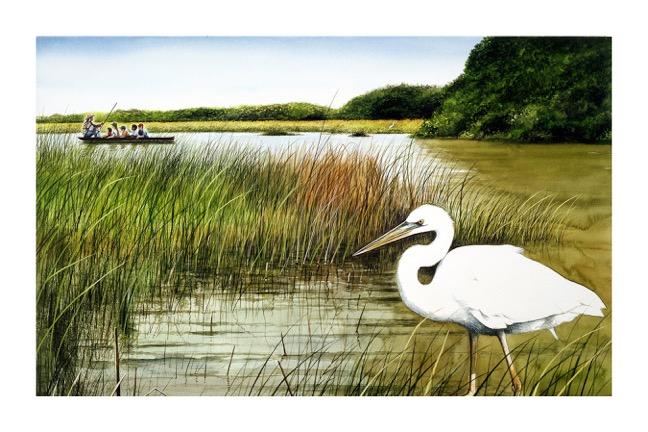
Here’s an image I particularly like, from your book Everglades by Jean Craighead George. It reminds me of a seabirds puzzle I used to love as a kid. I’m curious, have any of your illustrations been used as puzzles? 


Thanks. That book has been in print since 1995! I had one book cover produced as a puzzle several years ago. The book was called Weed Rough by Douglas C. Jones. I have attached the illustration.
–

Ah, that’s so cool. A lot of us are doing puzzles these days. You’ve had a pretty remarkable career, Wendell. In addition to all your picture books and gallery shows, you’ve done quite an impressive array of book cover work, which tends to fly under the radar. Could you name a few we might recognize? I know you’ve done a version of To Kill a Mockingbird, a number of books by Pat Conroy and Jean Craighead George. Oh, just typing those names gives me a pang. We’re losing some of the great ones, aren’t we?


–

Yes, we are! Jean and Pat were my good friends for many years and I still miss them both. Over the years I’ve designed over 2000 book covers. A few that you might remember are David McCullough’s “Truman” and “The Path Between the Seas,” Pat Conroy’s “The Great Santini” and “The Prince of Tides,” Mary Higgins Clark’s “Where Are the Children?,” Toni Morrison’s “Sula,” and Fannie Flagg’s “ Fried Green Tomatoes at the Whistle Stop Cafe.” I could go on but that would take up too much space on the page.

How does that work? You get a manuscript and create a cover image from that? Or does an art director come to you with specific ideas? Covers are hard, so scrutinized by everyone in the publishing company, from editors to salespeople; I imagine there can be quite a lot of back and forth.

I do few covers these days, most of my time is spent doing picture books. I love the freedom of creating books for children. When doing an assignment for a book cover commission, I always insist on reading the manuscript. I owe that much to the authors who have spent months or years writing their books. I usually have the freedom to create my own vision for a cover; however I may do several concepts to navigate the many approval processes. Most of the time, my first sketch wins the day.

By the way, how’s my friend, the lovely Florence Minor doing? Have you two got another collaboration in the works?

Thanks for asking about Florence. She has completely recovered from her cancer surgery last year, and she’s feeling great! Her latest book is about kittens and all the amusing things they do. It’s looking great and will pub within a year from now. Florence sends you her best!

That’s good news. Okay, Wendell, thanks for swinging by. Maybe we’ll take a walk someday and you can be my birding guide. I can hear ’em, but they aren’t so easy to spot. I’ve got so much to learn.

It’s been a pleasure talking with you and I hope the Hummingbirds return to your backyard this year! See you at the next book festival as soon as we’re allowed.


Wendell Minor lives in Washington, CT, with his wife, author Florence Minor. Wendell’s books have received the Cook Prize, Bank Street College of Education’s Best Children’s Books of the Year 2015, Publishers weekly Best Books of the Year 2005, Kirkus Best Books of the Year 2015, New York Public Library’s 100 Best Books for Kids 2017, Junior Library Guild Selections, Notable Social Studies Trade Books for Young Children, Outstanding Science Trade Books, Dolly Parton’s Imagination Library selection, Pennsylvania One Book Every Young Child selection, ALA Notable Book, John Burroughs List of Nature Books for Young Readers. Wendell was honored to be the 2018-2021 Artist Laureate of the Norman Rockwell Museum. Readers may visit Wendell at: www.minorart.com and on Facebook.


Fairy Houses & Creative Learning at Home: A Conversation with Author and Children’s Librarian, Liza Gardner Walsh


“I miss my students.

I miss putting books directly in kid’s hands.

I am heartbroken

that we don’t get to finish the year together.” 

— Liza Gardner Walsh


Liza Gardner Walsh embodies two of my favorite things in one person: no, she’s not peanut butter and jelly. She’s even better. Liza is an author and a children’s librarian. She’s also a certified, fully-authorized, bonafide expert on all things fairies. Liza visits today with some insights about getting kids outdoors, interacting with nature, using their creativity and imaginations, to make learning fun. Let’s meet her.


Liza, it’s nice to connect with you again! Usually we only see each other at the glorious Warwick Children’s Book Festival. I was very happy to come across an article featuring you, “How to Build a Fairy House.” The reporter, Aislinn Sarnacki of the Bangor Daily News, did an excellent job. It inspired me and I hope it might inspire parents, too. Let me quote the intro:

Fairy house building is a creative outdoor activity that can expand the imagination and bring to life the small things in nature that are easy to overlook. All you need is a small outdoor space and a few natural materials. Then — taking as much time as you want — construct a small home, fit for a fairy, frog or any other small creature that comes to mind.

This zero-cost activity is great for kids, families and even adults who are looking for ways to have fun in their own backyards. And right now, as people stay at home and practice social distancing during this stressful time, fairy house building may be just the thing to take people’s minds off the pandemic — even if it’s just for a few minutes.


Why do you think some children are so fascinated by the fairy world? 

This is the hardest question of all but I think this fascination with fairies taps into our innate “sense of wonder” as Rachel Carson coined it.  There is this immediate flood of curiosity that informs the magic of this hobby. Will the fairies come? Will they leave a surprise? What do they look like? Will they like my house? Do they take care of the world? Are they watching us as we build? Seeing the wide-eyed wonder and amazing willingness of children to take the leap into the imagination and the unknown is so incredibly rejuvenating. It celebrates that part of childhood that we as children’s book writers are so connected to and work so hard to intuit in our writing. And it reinforces all the good, trust, wonder, curiosity, consideration, persistence, patience, and laughter!

I love the idea for that activity, particularly in relation to these times, when schools are closed and the focus has shifted to online learning.

I have been watching kids and families make these little houses and worlds for years now and I am always amazed at how much creativity is unleashed. Every single creation is different. One of the premiere benefits is this sense of open-ended play because there are no step-by-step instructions like Lego kits. The materials that kids collect set the parameters. Another benefit is that it completely captures kids’ imaginations and it isn’t a one and done kind of a thing. You can wake up and check on your house and then go back and add another room or a playground. The next day, you can leave a note for the fairies or make a pathway to your sibling’s house. The possibilities are endless. I also like that kids can do this completely on their own and it becomes a way that they can be engaged safely and create a whole world of their own making.

—


I like how so many learning opportunities open up naturally. It’s a perfect jumping-off point for interdisciplinary activities: cooking, writing, reading, science (nature studies), engineering . . . 

I would say, though, that my all time favorite benefit is patience and perseverance. There are always problems to solve when building things out of materials that aren’t all the same or made with straight lines. Things fall apart when the wind blows or your dog might knock the whole thing down in one fell swoop. But a true fairy house builder will pick up the pieces and start again.

–

–

You work as a school librarian. How have you been adjusting to our “lockdown” reality in that capacity?

It’s been way harder than I ever imagined. I miss my students. I miss putting books directly in kid’s hands. I am heartbroken that we don’t get to finish the year together. Thank goodness for technology but zoom meetings are not the same. I do appreciate the creativity that distance learning is forcing on us and I have had some really fun connections with kids through video and zoom but I do spend a lot of my time worrying about our families and the isolation and economic challenges they are facing.

–


I had a friend complain about her disappointment with “learning-from-home-time” so far, the pile up of schoolwork her girls have received from each class. I’m certainly not here to criticize teachers, who are working very hard to figure out this brave new world. I do feel that our current situation presents new opportunities for creative, explorative, interdisciplinary learning. The idea isn’t so much to recreate what happens in the classroom — we can’t do that, especially on the social level — but maybe in some respects we can do something even better. 

Our principle has said the whole time that we are building the plane as we are flying it but I do appreciate the model we are using. We are offering activities, enrichment, and support but not requiring it. We have to keep in mind equity. Sometimes, worksheets are a benign way of making things accessible and easily transmissible through digital means. But I completely agree that this can be an opportunity for a paradigm shift. Kids are always learning. Literacy, math, science, art, movement are all so enmeshed in our everyday lives. I’m hoping that kids are building forts, planting gardens, watching birds, writing letters, and working on engines. Fairy House building is another way that kids can create, engineer, and collaborate. You can write a story about what happens in that house after you leave it. The key is following the curiosity and seeing what emerges. That is something that we don’t often have time to do in the public school day schedule and now is the perfect time to make it happen.

Can you give us a few quick tips? No one wants to build a house that displeases the fairies.

Of course! First, you need to find a good spot that will be safe from dogs, protected from wind, and that has some support. Bases of trees, stumps, and rock walls are all great. Next, grab a bag or a box and gather your materials. Fairy houses should be made from all natural materials. There are so many good things to collect like acorn caps, bark that has fallen off a tree, sticks, rocks, shells, dried beans, dried milkweed husks, the list goes on.

–

–

Once you have all your materials, you can begin to assemble your structure. People usually opt for a lean-to or a teepee type structure but the sky is the limit. And once you have a good house built, you can then work on adding some furniture to welcome your small guests. Fairies are very fond of naps so a bed is an essential. Tables and chairs with acorn cap bowls are also a nice way to welcome fairies. The final touches can include pathways, playgrounds, pools, and whatever else you can dream up. After you have built your house, pay attention for signs that the fairies have visited by looking for tiny footprints, fairy dust, and bent or torn leaves. But the most important advice of all is to have fun!

By the way, how tall are fairies, exactly?

I have “heard” they are about 2-3 inches tall, roughly. But some people describe it as a shimmer of light , almost like an orb, or a little puffball hovering by a flower.

So you’ve never . . . ?

No, I have never seen one. And I’m okay with that!

Well, I’m ready to build a fairy house right now. I only wish I still had a six-year-old at home with me. My Maggie, now 19, used to make them long ago. I wonder if she encountered any, I’ll have to ask. Do you have a new book in the works?

I have the last in the seasonal fairy series illustrated by Hazel Mitchell, The Fall Fairy Gathering, which is due out this summer. And I am working on a historical fiction novel but at a snail’s pace!

Thanks so much for stopping by, Liza. Be safe, stay home, and protect the vulnerable.

Thank you, James, for all that you are doing for kids, teachers, and families and for continuing to write such great stories.


Liza Gardner Walsh is a school librarian and an author of more than a dozen books. She’s worked as a preschool teacher and a high school English teacher, writing tutor, and museum educator. Liza lives with her family in Camden, Maine. And, obviously, she’s terrific.


–


The Creative Process: A Conversation with Mary GrandPre, Illustrator of Harry Potter

–

“I love making art. It’s what I’ve always done

since I was a little girl.

Whether it was realistic in style, or abstract, it didn’t matter,

as long as I had my art supplies,

I was a happy camper.”

— Mary GrandPre

–

––

My apologies for the Potter-grabbing headline. But, true story: Sometime after Feiwel & Friends accepted my manuscript for All Welcome Here, I received a phone call from my editor, Liz Szabla. She was very excited. Guess who we just signed to illustrate your book? Tell me, I said. Mary GrandPre! A pause. Who’s that? Then she told me who that was, the Harry Potter connection, and I said: Oh, wow. Now here we are more than three years later. The book is finished, ready to venture out into an uncertain world, and Mary GrandPre has become my friend. We exchange occasional emails and share tribulations. She’s lovely and wise. Come, you’ll like her . . . 


–

Welcome, Mary, to my cozy little blog. You can sit on the floor or pull up one of those orange milk crates. I hoped we could talk a little bit about your creative process today. But first, yeah, could you please leave the hippogriff outside. No offense, but they make such a mess.

Hello Jimmy! It’s so nice to be here!… I would love to share my experience of creating the pictures for your lovely haiku in All Welcome Here. And, yes! The hippogriff is tied up outside… I’m sure he’ll be fine out there, as long as you don’t mind if he nibbles on your herb garden. … He loves fresh basil!

I trust you had a safe flight. Where do you live? 

My home is in Florida. I live there with my husband and daughter, and our 3 dogs. We moved to Florida, from Minnesota, 15 years ago, when my husband was offered a job at Ringling College of Art and Design. Boy! What a difference in climate! Talk about going from freezing to smoldering temperatures! It was quite an adjustment, but we have come to appreciate all the great things in Florida, like the beaches, the palm trees and tropical flowers, year round water activities, and of course all of the wonderful friends we have made since we moved there.


Mary and her artist husband Tom Casmer (that’s Tom in beard, left).

–

I absolutely love your paintings. It’s fascinating that you still do both, picture books and “fine art,” as they say.

–

–

–

–

–

–

–

–

–

Thank you, Jimmy. I love making art. It’s what I’ve always done since I was a little girl. Whether it was realistic in style, or abstract, it didn’t matter, as long as I had my art supplies, I was a happy camper. By the time I was in art college, I still wasn’t really sure about what kind of artist I wanted to be. Eventually I focused on illustration. Once I was out of college, I worked as a freelancer for a variety of companies, but illustrating picture books became one of my favorite kinds of illustration. Telling stories through pictures was so much fun. I could create characters and environments, and bring a whole range of emotions to my pictures through color, light and composition. After several years of working on picture books, I realized that painting abstractly, was also a lot of fun. It gave me a new kind of challenge in my exploration of color, light and composition, and in an interesting way, it still at times, told a story!

–


Illustration from Caldecott Honor Winning Book, THE NOISY PAINT BOX, written by Barb Rosenstock.

–

I imagine that a manuscript comes to you and then you decide if it’s something you’d like to illustrate. How do you reach that decision: this is the one.

You are correct, Jimmy, it starts with the manuscript. I like to take some very focused, quiet time to read the manuscript so that I can clearly envision the pictures in my head as I read through it. I like to see how the story flows, and how it makes me feel, what emotions am I feeling as I read this, and how I can relate to the story on a personal level. When I read All Welcome Here, I felt such a variety of emotions… excitement, joyfulness, warmth, and playfulness, as well as some feelings of shyness and awkwardness, as I remembered what it felt like to be in a new group of kids on that first day of school. I also loved the rhythm of the haiku, and the way it moved so smoothly from page to page, like a day unfolding from morning to afternoon. I enjoyed meeting all the various characters in the story, as I imagined a whole world of children, each uniquely interesting, becoming school mates and friends. Honestly, I just had to read All Welcome Here once, to know that I definitely wanted to illustrate it.

–

Illustration from ALL WELCOME HERE.

–

With our book, you faced an interesting design challenge, since it is written in connected haiku. I didn’t include any art direction in my manuscript (which authors often provide), other than this general note: “The poems offer the illustrator opportunities to show a rich variety of children –- wild and brave, silly and earnest, friendly and a little frightened. Through the artwork, illustrations should highlight recurring characters and allow readers to see happy interactions and first steps toward friendship. We are witnesses to the beginning of a new, diverse, and open-hearted community.”

There definitely were some design challenges, but I like a good challenge! Finding a way to connect all the poems was key, and I used the fact that it progressed literally, on a timeline, from the morning at the bus stop, to meeting Principal K, to finding the classroom, and witnessing all the various classroom happenings, then lunch and recess, and back to classroom for a quiet afternoon rain, and finally back home to reflect on all that we experienced on our first day of school.

Yes, we had some weather consistencies to iron out, among other details. I was glad we were able to zing emails back and forth. That doesn’t often happen in the picture book world. We kind of opened a back channel. 

The structure of how the poems were ordered was largely based on how the day would unfold. In that way, it became a story, as well as a collection of wonderful haiku. Bringing characters back into view here and there also helped bring some cohesiveness… and allowed the reader to recognize a familiar face in the crowd… just like what would happen in real life. Also I tried to incorporate more than one poem into a scene whenever I could, because it allowed us to experience more than one fun thing within a setting, offering more visual connectedness from poem to poem.

–

Sketch from ALL WELCOME HERE.


–

–

The artwork is spectacular. I particularly admire your thought process –- the decisions that went into each spread. There’s a lot of thinking that goes into a children’s book before you ever set brush to canvas.

Thank you so much, Jimmy. I was so taken with your poems, the sensitivity, the humor, as well as relevance of what we need today in this diverse world we live in. You gave me so much to work with… and I felt a strong connection to your writing. It was important for me to take the time to make the illustrations reflect what you were so beautifully writing about.

That’s kind of you to say, Mary.

But you are right. There is a lot of time spent laying it all out with pencil on tracing paper, where several changes are made throughout the sketching process. Diverse characters are developed, environments are planned out, compositions that combine poems on each spread within a single setting, all the while, figuring out how and where the text should go, and making sure color and light is balanced from spread to spread.

I find that’s true in my writing, by the way. There’s a long, necessary gestation period that looks suspiciously like doing nothing at all.

Yes. I get that. A lot of work behind the scenes.

–

–

Let’s talk about your process. This might be easier if we examine one specific illustration. Let’s take the library, for instance. How do you do that??!! I mean, ha, you use all these patterns. The sweaters, the rug, the wallpaper. This is an illustration that rewards a deeper look. Would this be called mixed-medium or collage or . . . um . . . ?

–

–

Ah yes, The Library! I loved making that piece! After I get all the pencil sketches done, and approved by the art director, I move onto the actual color art. I choose a very thick illustration board to work on, because it’s going to hold many layers of collage paper and paint. So you are correct, it is collage,.. also referred to as mixed medium. I carefully transfer the drawing on to the board using a transfer paper, and tracing the sketch onto the board. I then begin with color by using large brushes and acrylic paint to lay in the main colors I will be working on. It’s very loose and messy at this point.. no color details yet.

At what point do your introduce the textures and patterns?

–

–

I just keep in working in paint for a while until I feel like it’s time to add some intersect patterns and texture. I have an assortment of printed papers that look like fabric, or tree bark, leaves, and all kinds of flat geometric patterns. I trace out what the shape of the pattern should be, and cut it out, and carefully glue it into place with acrylic gel medium, and then blend it back in with paint. It’s a back and forth process.

I could ask you questions forever, and I apologize if I’ve already gone on too long. Any last thoughts on this book, and what you tried to express in the illustrations?

I really just wanted to bring your amazing haiku to visual life. We really need to celebrate our diversities, and help our children feel like they belong. We need to open our hearts to accept others in our community and around the world, and our children need to know this is how we live together, successfully. It’s such a relevant book, now more than ever.

Thank you so much. And thank you, of course, for your brilliant work as the illustrator for the definitive American editions of the Harry Potter books. It’s incredible to think of how many of us have looked at your work and been moved by it. I’m truly honored that we now have our own book, something we made together, Mary and me. I’m so grateful for that.

Oh, Jimmy. I am honored to have created artwork for your thoughtful and beautiful poetry. I count this book as one of my favorites. I am so pleased that we were able to connect through this project. It has touched me personally, and creatively. I have to say also, that it was great getting to know you Jimmy, and I look forward to seeing what you do next.

–

–

Readers can learn more about Mary — and see many more of her abstract and figurative paintings — by stomping on this link.  In addition to the Harry Potter books, Mary has illustrated many picture books, including The Noisy Paint Box; Through the Window; How the Leopard Got His Claws; Cleonardo, the Little Inventor; and more. Speaking for myself, I’m not often awed by the writers and illustrators I met. But Mary strikes me as a special person. Not just her talent, but the warmth and sensitivity and kindness she beams into the world. I’m fortunate that the universe brought us together, however fleetingly, to collaborate on All Welcome Here. 


Magic and Heritage and New Voices: A Conversation with Debut Author, James Bird

–

“I was dropped into a place where I knew no one and nothing about the place. The wind was different. The trees and water were different. The people were different. Cold was a different kind of cold I was used to. So everyone I met and every situation I found myself in, was a discovery. And If you are discovering things on a day to day basis, that means you are on an adventure. And adventures are magical because all the unknowns unfold in front of you.”

— James Bird

–

There’s something enormously appealing about debut authors. A new voice joins the choir. Collectively we grow stronger, richer, more diverse. And what a feeling of accomplishment for that new author. Personally, I published my first book at age 25, back in 1986. But I remember it well, holding that slim book in my hands, and how kind so many people were to me. Today we’re celebrating Native American author Jame Bird and his magical debut, a powerful work of middle-grade fiction, The Brave. Let’s get to know him.

–

–

Congratulations on your debut children’s book, James. Welcome. Normally we’d go over the secret handshake, but, well, these are not normal times.

For now, I think we’ll both just have to hold up our hands and shake them at each other.

Hopefully one day we’ll raise a glass together. You have a young child at home, I believe. How is it going? We have two of our college-age children at home with us. In some respects, it’s felt like a gift.

My son Wolf is 20 months old. I’m very glad he is young enough to not know what’s going on in the world around him right now. His passion for toys, books, and games is keeping me busy and happy, and in a way, allowing Adriana and I to not focus on this pandemic 24-7. Which is very much needed.

Before we get into your book, give us a little background information. I mean to ask: Who are you?!

Who am I? Hmm.

Yeah, I know, we ask the deep questions here at James Preller dot com!

I come from the film industry. Born and raised in Los Angeles. I’m used to working on projects with at least a hundred people involved, sometimes more, so it’s quite interesting writing and publishing book. It’s like going from living in a busy city to moving to a small island. I feel like Tom Hanks in Cast Away… My agent is Wilson the volleyball and my editor is the fedex package.

Do you self-identify as a Native American author? Or does that feel like a box that people put you in?

I am very proud to be Native American, because after everything my people went through, and continue to go through, I am proof that no matter how hard America tried to erase us, we are still here. So I guess everything I do can have Native American slapped on to it. I’m a Native American author. I’m a Native American director. And in a few minutes I’ll be a Native American diaper changer.

Wonderful answer, I love that. What led you to write a children’s book?

I’ve been telling stories all my life. It was kind of my escape. I’ve told stories in every way possible. Through film, photography, drawing, music, poetry, comic books, screenplays, animation, and even fashion design… Now it’s time to tell stories through books. And so far, MG is my favorite.

How did you experience with screenwriting help you as a writer for this novel? Similarities and differences?

Writing a book is far more complex than writing a screenplay. A script is like train tracks. One direction from beginning station to the final station. It’s simple, strong, and you just move in one direction the entire time. Writing a novel is like riding a horse. You can go in any direction, you can be too slow, or too fast, you can fall off, you can get lost. It takes far more focus, patience, and skill to write a novel.

Collin, age 12, has an interesting numeric condition. Tell us about it.

Collin counts the letters from whoever speaks to him. So if someone asks “How Are You?” he’d reply with “Nine. Fine.”

–


Where did that idea come from? Why did it appeal to you?

When I was a kid, in school, teachers had no idea what to do with me. I’d dissect sentences and words and give them personalities and merge the letters to make them form new words. Because of this, I got really bad grades and put in the not-so-bright classes, but also because of this, I became a writer. I love words. I love how we all use the same words, same letters, but use them so differently. It fascinates me. I love authors.

At the beginning of The Brave, Collin feels isolated and disconnected. Is that a feeling you’ve experienced yourself?

I think we’ve all felt that way, especially in our childhood, but to answer your question, personally, yes, I grew up very poor and in rough neighborhoods. Poverty has a way of making you feel disconnected from everyone else.

––
Collin has felt like an outsider his entire life. Raised by a distant, alcoholic father, Collin has never met his Native American mother –- he doesn’t even know her name — until life’s circumstances led him to go live with her, a complete stranger. I thought that was a brilliant stroke of storytelling. Collin brings with him all the usual assumptions and misconceptions about Native Americans. It’s not his fault, nobody ever told him. So, he learns about his own Native American heritage at the same time as the reader. What do you think most people get wrong about Native American culture?

In my experience, when most people think of a Native American or pick up a Native American story, they assume it will be about the west, cowboys, feathers in hair, bows and arrows, buffalos, and warpaint… I want to show people that yes, Native Americans were here yesterday, but they are still here today, and they will be here tomorrow. And we wear jeans, tell jokes, and deal with all the problems other people do. We’re all the same in the end. Our stories may be told differently, but we are all the same.

Little Wolf, looking adorable.

Did you write the book with that mission in mind?

In a way. I really wanted to bring some magic back to people but not force them to enter an entire new world. Because the truth is, you don’t have to leave this world to experience magic. It’s all around us, right here.

Yes, I love this, and it shines through in your book. Were you influenced by the Magical Realism of, say, Gabriel Garcia-Marquez? Or more directly from your heritage?

When I was young, there were times when my family lived in a car, or all stayed in one room, or had to crash with relatives, so as a way to keep me happy, my mom would tell me stories. They were always filled with magic because reality was too harsh back then. So, I’d say my mom was my biggest influence.

There are people who are very uncomfortable with the idea of magic. And yet at the same time, a certain young wizard managed to scratch up an audience.


People are uncomfortable with the unknown, and magic is the unknown. But at the same time, magic fascinates everybody too. So I fully believe that people, whether they’d admit it or not, find being uncomfortable fascinating. It’s a feeling you need to face. And the feeling of making the unknown finally known. That is a feeling we all strive for. We also call it learning. We yearn to learn. So in a way, learning is magic.

You set a good part of your novel in Fond Du Lac Reservation in Minnesota. This is a world you know?

My Ojibwe family is from Duluth, Minnesota. It’s a very magical place if you get to know it. First glance, it’s just a industrial city on a lake, but if you speak to it, and open up to it, the place is full of magic.

What does that mean to you, full of magic? Could you expand on that a little bit? 

When I say full of magic I mean that I was dropped into a place where I knew no one and nothing about the place. The wind was different. The trees and water were different. The people were different. Cold was a different kind of cold I was used to. So everyone I met and every situation I found myself in, was a discovery. And If you are discovering things on a day to day basis, that means you are on an adventure. And adventures are magical because all the unknowns unfold in front of you. You give them meanings, you give them reasons, you get to direct your adventure any way you choose to… you’re a magician. That bird that sang to me told me I’m going to meet a new friend today… If you believe in that magic and make it happen. You are using magic. And you get a new friend too.

Once settled in Duluth, Collin meets Orenda, a neighboring girl. You have an affection for beautiful eccentrics and outsiders.

I’m a sucker for the oddballs, underdogs, outcasts, and weirdos. I think if everyone was comfortable with being themselves and not worrying about how they appear through the eyes of society, we’d see that most people would be viewed as strange. And I like that. I’m happy to admit that I have not yet once met a normal person.

Thank you, James, I’m very glad your original, magical voice has been added to the children’s literature community. I wish you the best of luck. And I’m sorry, yes, that your debut has to come during these awful times.

Thanks James.


James Bird is a screenwriter and director at the independent film company Zombot Pictures; his films include We Are Boats and Honeyglue. He lives with his wife and son in Swampscott, Massachusetts. His book will be published in June 2020 and is available for preorder now.

You want to make a debut author happy? Read his book!