Archive for Bystander

Meryl Streep on Character

As a movie buff and husband to a self-professed “foodie,” it hasn’t gone without notice that Meryl Streep and Amy Adams star in the upcoming film, Julie & Julia — a comedy in which Streep portrays the eccentric Julia Child.

Streep was recently interviewed in the August 7 edition of Entertainment Weekly. This exchange had me nodding my head in recognition and agreement:

EW: Julia Child had such a joyous personality that a friend of hers once compared her to a Christmas tree. How did it feel to play someone so in love with life?

STREEP: Well, for me, it was a way of paying homage to my mother, who was born with a joie de vivre. I honestly was thinking about Mary Streep, not Julia Child, most of the time.

I think that’s a great insight into the creative process. Not only for actors, but for writers as well. Somehow you have to, it seems to me, personalize the process. Make some kind of personal connection to the material. I’m not saying that’s where Streep’s creative process ended — obviously there was research and video and wardrobe and more that all contributed to her transformation into character — but rather where it began.

To describe a character in a story (he could be anyone, a murderer, a college professor, etc.) you might think about the man who walks his dog down your street every evening. His erect posture, the dignified tilt of his chin, the shape of his glasses. Or it could be some mannerism, the way his fingers go to his chin when he listens, his long slow exaggerated heel-to-toe strides, whatever, that helps you get inside this new character. I often like thinking of characters in terms of animals: a sparrow, a doberman, a duck. Those images lead to physical characteristics, mannerisms. A character might snarl or waddle or flutter, and those outward descriptions help define (or contradict!) inner character.

I’ve never thought of a character as a Christmas tree, but I can see how that could work. But even then, there is so much personal history that comes into it, and so many sorts of trees to consider, each with its own associations and meanings:

Writing Bystander, for example, I remembered a specific kid in Junior High, and kept him in my mind all the while. He inspired me, and I used some of his physical characteristics as a starting point. At the same time, I didn’t feel restrained by this, or limited, and gradually my fictional character became someone else entirely. Or, that is, wholly himself. To describe Griffin Connelly’s father, I drew upon the memory of another friend’s father, thought of his fierce hulking presence, white t-shirt on the sofa, beer cans on the table, and how it felt to me when I visited that stifled house as a 13, 14-year-old boy. When it came to the missing figure of Eric’s dad — a presence strongly felt in spite of, or because of, his absence — I thought deeply (and felt deeply) about my own brother. His mental illness. His suffering. How it affected his own children. And in doing so, a world of emotion (and imaginings) welled up inside me. Without those personal connections, I don’t think I could have written anything, or made those characters ring true. By that I mean they become characters that stand for themselves, steady and self-contained, not just faint duplicates of a real thing, but a real thing in and of itself. To me or even, amazingly, to you.

How does Meryl Streep, perhaps the greatest actress of her generation, fill the role of a specific historical character? She thinks of her mom! And in doing so, it frees her up. It’s the key that opens the box. And I think, Yes, exactly. That’s how it often works for me.

——-

GRAMMAR NOTE: Here’s a handy mnemonic for remembering the difference between affect and effect. First, affect is generally used as a verb; effect tends to be a noun, a result. The memory trick: “The arrows affected Aardvark. The effect was eye-popping.” Hat tip to the blog, Grammar Girl: Quick and Dirty Tips for Better Writing.
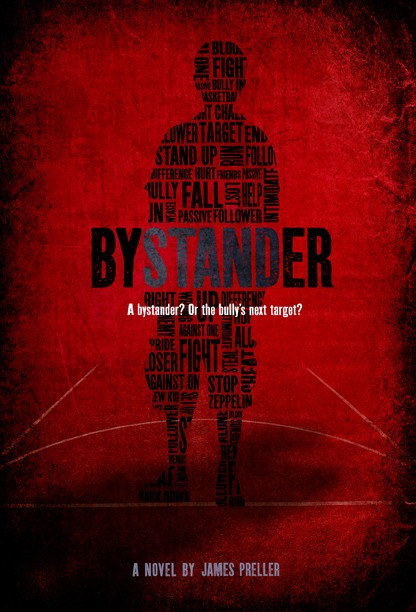
Final Cover: Bystander

I remember how I first dreamed of a book with my name on it.

I’d read about other writers and how they felt. The way William Faulkner exalted on the day when he finally received the finished jpg file in an email from his editor . . . and how he immediately posted that image on Facebook with the status line, “HOW COOL M I?”

Oh, the magic of those times.

I mean to say: Look at this! It’s only been kicking around in slightly-unfinished form since forever, because the art director, Rich Deas, needed to hold onto it for last-minute microscopic tweaks and noodles. And believe me, nobody tweaks and noodles like Rich. I owe that guy about twelve beers and a bowl of tweaks and noodles.

Anyway, I love this cover, I think it establishes the right tone. It’s appropriately dark and graphic and — oh, lord, here comes that word we can’t escape these days — edgy.

But regardless of the cover, I always make the same comment: My name should have been bigger. I’ve read that Faulkner felt the same way.

I’m told that I’ll be holding an advance copy of the book sometime in August, that it will hit stores in late September. You work and work, then wait and wait, worry and fret. I’ve learned that the only solution to this sorry state is to be working on a new book. Which reminds me . . . I’ve got to go!

“Bystander” Reviewed, Sort of, by Author Andrew Smith

Author Andrew Smith, in addition to writing YA novels and teaching in a high school, writes a lively, informative, open-hearted blog. He’s nothing if not tireless. Though we’ve never met, Andrew and I seem to share a lot in common. We publish with Feiwel and Friends, have more than half-a-dozen brothers between us, blog regularly, love music — and we both share the (fading) dream of one day becoming catwalk models for Dolce & Gabbana.

Andrew’s debut book, Ghost Medicine, earned a starred review from Publishers Weekly and was listed as an ALA Best Books for Young Adults. But that’s nothing. VOYA said, “This book is a pitch-perfect coming-of-age tale destined to be held aloft alongside other classics of young adult literature. The story flows like stark, lovely poetry shared by best friends around a mountainside campfire.”

Great review. My only quibble is that whenever I’ve sat around a mountainside campfire with friends — which I did a few nights ago, in Vermont — the only things we shared that “flowed” came in cans, and it sure wasn’t “stark, lovely poetry.” (I must be hanging out with the wrong class of campers.)

His upcoming book is titled In the Path of Falling Objects (September, 2009). Man, I love that title. There it is, already a suggestion of menace, of trouble coming, violence. Yet at the same time, flat, even-handed, clear. Just a sign on the side of the road. First paragraph:

The only shade there is blackens a rectangle in the dirt beneath the overhang of the seller’s open stall. The girl stands there, behind a row of hanging wooden skeletons that dangle from the eaves.

Nice, right? The specificity and clarity of the language. The concreteness. A whiff of Cormac McCarthy there, don’t you think?

Anyway, last week Andrew blogged about my upcoming book, Bystander. He began by talking about his desire to highlight that rare, most misunderstood of creatures, the book for boys. While I don’t see Bystander as exclusively for boys — I sure hope it’s not, as compared to, say, Six Innings, which pretty much is — the book does center on the male variants of middle school bullying (with a crucial female character, Mary O’Malley, going through her own thorny friendship issues and cyber-struggles).

Andrew hopes to continue to feature books for boys in upcoming posts, so you may wish to bookmark his most excellent blog. He writes of Bystander:

If you’re a middle-school teacher, I think you should buy an entire class set of James Preller’s Bystander, a tense, suspenseful, fast-paced study of bullies, their victims, and the consequences involved with being a “bystander.”

Ultimately, bullying connects all of these players, whether they see themselves as intentional participants or not . . . . Every boy who’s gone through junior high and high school has found himself in these same situations that Preller sets down so clearly in Bystander. The real value for boys here, I think, is the no-nonsense realism of the plot: There are no tidy and clear-cut answers; and just being “good” isn’t always good enough.

Boys are going to love the fast-paced arc of this story. The first 20 pages build so much understated tension that it’s impossible to stop reading. Most importantly, Bystander is a powerful and valuable resource for any school looking for additional perspectives on educating kids about bullying.

Recommended for ages 10 and above.

Thanks, Andrew!

NOTE: I have to say this. I recognize that at its worst, the kidlitosphere is filled with back-slapping and suspect praise. A cynical reading would deduce that we all read each other’s books and blogs, and praise each other, so that we in turn will “earn” some praise, that we’re an inbred group, that we’re a “we” at all, and that it all amounts to a swirling vortex of sycophantical blather. I get that. I really do. And I guess you could submit all of the above as evidence of that crime. But, but, but. In the end, as my father would say, you have to consider the source. And judge for yourself. I now throw myself on the mercy of the court.

Bullies and Bystanders

Photo: Igor Dutina

There was a good article in yesterday’s Science Times section of The New York Times. Written by Perri Klass, M.D., it looks at bullying from a pediatrician’s point of view, and provides news about how the American Academy of Pediatrics will be publishing a new policy statement on “the pediatrician’s role in preventing youth violence.”

The article had this to say about the upcoming policy statement:

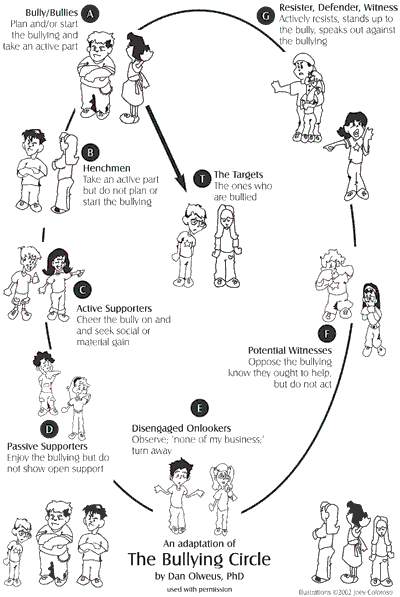
For the first time, it will have a section on bullying — including a recommendation that schools adopt a prevention model developed by Dan Olweus, a research professor of psychology at the University of Bergen, Norway, who first began studying the phenomenon of school bullying in Scandinavia in the 1970s. The programs, he said, “work at the school level and the classroom level and at the individual level; they combine preventive programs and directly addressing children who are involved or identified as bullies or victims or both.”

Dr. Robert Sege, chief of ambulatory pediatrics at Boston Medical Center and a lead author of the new policy statement, says the Olweus approach focuses attention on the largest group of children, the bystanders. “Olweus’s genius,” he said, “is that he manages to turn the school situation around so the other kids realize that the bully is someone who has a problem managing his or her behavior, and the victim is someone they can protect.”

As the author of a new book titled Bystander (Feiwel and Friends, September, 2009), a book that was informed and inspired in part by Olweus’s work, I’m thrilled to read that the American Academy of Pediatrics is taking this issue seriously. I came away from my own research with the belief that our focus has to be on the community, on the school environment, on the bystander’s social and ethical responsibilities. That is, yes, we are our brother’s keepers.

Dr. Sege used a nice turn of phrase later in the article. He spoke of “activating the bystanders.” Here’s another clip from the article:

Dr. Sege said, “activating the bystanders” means changing the culture of the school; through class discussions, parent meetings and consistent responses to every incident, the school must put out the message that bullying will not be tolerated.

So what should I ask at a checkup? How’s school, who are your friends, what do you usually do at recess? It’s important to open the door, especially with children in the most likely age groups, so that victims and bystanders won’t be afraid to speak up. Parents of these children need to be encouraged to demand that schools take action, and pediatricians probably need to be ready to talk to the principal. And we need to follow up with the children to make sure the situation gets better, and to check in on their emotional health and get them help if they need it.

Anyway, this is an issue that means a lot to me, and means a lot to my editor at Feiwel & Friends, Liz Szabla. It has always been my hope that Bystander — not a handbook, but a work of fiction with tension and drama — would help in some way with this issue. That maybe teachers would use it in school, discuss it in classrooms, get kids talking and thinking.

More and more, as this writing career moves into its third decade, I’ve come to the conviction that a book is not an end, but a beginning. It’s about what happens after you read the book. The thoughts that occur, the conversations that take place.

But that’s a big topic, and better left for another day . . .

Times Article, Columbine, Picture Book Countdown, and Some Vacation Photos

It’s Tuesday the 21st, and I’m back at the desk, working under a deadline. I have to admit that I’m not in Full-On Blogger Mode — it’s like I’ve forgotten how — but here’s what’s up exactly now.

I’m still stunned by yesterday’s cover article in The New York Times, written by C.J. Chivers.

Photo: Tyler Hicks.

A tense, dramatic, tautly-written account of an ambush in Afghanistan, it struck me as such a different kind of article than I remember seeing before. Maybe I’m wrong, but my sense is that after years of regulations that attempt to control war coverage, perhaps now there’s a new openness about war reporting. Could that be true? Regardless, this article signaled to me that there was a shift of some kind. I applaud this article, the courage of the reporter, and the Times by putting this story front and center, above the fold on page one. It’s too easy to forget that we’re at war, that young men are killing and dying, that there’s a cause and a cost. By all means, read the story.

I did a school visit recently, where I spoke with approximately 400 6th-grade students. In part, I focused on my upcoming book, Bystander, which centers on bullying and its effect on five main characters: Dylan, Griffin, Mary, David, and Cody. The idea for the opening scene was inspired by a piece of information I picked up on Columbine and ketchup packets. If only for myself, I needed that allusion echoing through my book. When I asked the students if they’d ever heard of Columbine, only two hands were raised. I guess that surprised me. After all, that event changed our schools forever. Just the other day I was in an elementary school when they had a “lock-down drill,” you know, because there’s “a wild animal loose in the school.” I imagine my second-grade daughter, Maggie, picturing a deer skidding through the halls, like a clown in socks.

Anyway, this new book, Columbine by Dave Cullin, is at the top of my reading list. The cover designer for the book, Henry Sene Yee, recently posted a detailed account of how he arrived at that remarkable, understated, haunting cover. Fascinating.

On a different note, Elizabeth Bird at Fuse 8 continues to deliver great content at a reasonable price (free). She’s been counting down the top 100 picture books of all-time (based on a readers’ poll), and if you haven’t gotten over there, it’s a real treat.

Art from Virginia Lee Burton’s, The Little House.

Elizabeth isn’t just providing another tired list, she’s doing research, showing artwork and videos, clips from reviews, and personal commentary. It makes you want to go back and read those books all over again; and in some cases, discover the few that somehow fell through the cracks.

Lastly, a few shots of Canyon de Chelley, Navajo land, in Arizona near the New Mexico border, another one from Taos Pueblo, one from Mesa Verda, and a couple of shots of people who came along for the ride. It was a great vacation/adventure.