I got a fat package in the mail yesterday, sent by my editor at Feiwel & Friends, Liz Szabla. It contained their Fall 2009 catalog, along with ARCs for eight upcoming novels:
Bystander by . . . that would be me (and for the record, I can’t wait to talk about this book, and the topic of bullying in general)
One of Jean Feiwel’s stated missions for her new publishing venture, after something like 20 years at Scholastic, was to Keep It Small. And so far, she’s stuck to that goal, despite the temptations to grow, and Grow, and GROW. But still: Feiwel AND Friends. If you are like me (read: hopelessly cynical), then you probably think, “AND Friends,” yeah, right.
But I do feel a difference. Part of that is based on my association with the merry crew that makes things happen at F & F. It’s a small staff and I think I’ve met them all, even the person who gives Liz and Jean their weekly pedicures, and I’ve even Facebooked a few. (Yes, it’s a verb now.) But there’s also, for me, a sense of community with the other authors and illustrators. We’re all on the same team, so to speak, and like a fan in the stands, suds in hand, I’m rooting for them.
Will I read all these galleys? Nope. I mostly read adult books. But I’m eyeballing that new Andrew Smith book, curious about what he’s done with it. And Julie Halpern is a fresh, original voice — so uncool that somehow she’s totally the coolest one of all. Then there’s Spellbinder, a debut novel, which on the surface seems familiar and yet strange at the same time. Who is Helen Stringer, anyway?
A confession: I’ve never had much interest in cultivating friendships with other authors. I know a few on Facebook and whenever I read their status updates on new galleys or their writer’s block or revision process or whatever — well, it just turns me away. I’m just not interested (as I sit here, blogging, semi-ironically, at this Shrine to Myself). The idea of going on, say, an “artistic retreat” with a bunch of other writers makes my skin crawl. I’m not sure why that is, exactly, but it’s real for me. Maybe I like regular people better. Or maybe I’m too competitive, or too insecure. Maybe it’s like ordering a Bud in a can when there’s some snazzy cherry-flavored micro brew available. I don’t know.
But this crowd at Feiwel and Friends? It’s hard to explain. Just a sense I guess, a feeling that’s kind of sloppy and formless, like a first wet kiss. A little creepy, but kind of nice, too. A little like . . . friendship. With benefits. Like free ARCs!
And by the way: I’m back from vacation. Hear me roar.
On Facebook, it’s popular for people to make lists of the 25 albums that “affected them profoundly.” As a music lover, I figured such a list was for me, but found it an impossible and wholly unsatisfying task. Yet I couldn’t quite let go of the idea.
Eventually it struck that a mere list was part of the problem. I needed to talk about the music a little, why it meant something to me. You see, music has played a central role in my life for as long as I can remember. The youngest of seven children, I inherited a great, vast collection of 60’s/70’s music. Recalling these albums, I began to see my life unspooling, circling like a needle on vinyl, as my growing mind took on new shapes, colors, and sounds.
A friend of mine, a 7th grade English teacher, recently read my upcoming novel, Bystander (Feiwel and Friends, Fall ’09). One line that he mentioned to me — and it’s often surprising to hear what folks connect with, or what gets quoted in reviews — was this: “Music helps.” And I think it does, and certainly has for me, just as it helps that book’s central character, Eric Hayes.
So appropos of nothing, here goes . . . something.
1) Batman, Original TV Soundtrack Album
I got this as a kid and wore it out. Actually, I think I got bubble gum stuck on it. But nevermind! It was the first album I’d reach for, over and over again, wearing a towel as a cape, pretend-fighting the Penguin, the Joker, the Riddler, King Tut and more. And I always, always won.
2) Monkees – Greatest Hits
Another childhood favorite, watching that silly TV show and listening to my sister Jean’s Monkees albums. As I grew up, my tastes became more sophisticated, and it took me another couple of decades before I fully appreciated the pure pop structures and giant, tooth-decaying hooks of these Boyce and Hart tunes.
3) Beatles – White Album
The Beatles have to be on here and this is the one I’d pick, despite all the flaws and warts, or perhaps because of them. Everything’s already been said about this disk, and this band; I just keep coming back to it, and hearing new things, finding new favorites, and it’s been more than 40 years ago today. I remember my brothers coming home with this one, and that strange plain white cover, the gatefold, and the four glossy photos inside. That’s how I learned their names, quizzed by my elders: “This one is Ringo, that’s George, he’s John, and the other one is Paul.”
4) Led Zeppelin – s/t
With four older brothers and two older sisters, I inherited one of the great record collections of all-time. We had everything, it was when classic rock was NEW, and I listened to it all at a very young age. I remember when this disk came out and how I liked the cover of that blimp exploding. Probably my first “heavy” album. This video is a cheat, “Immigration Song,” from the (underrated) 3rd album — but definitely definitive with a monster riff.
5) Andrew Lloyd Webber – Jesus Christ Superstar
I have a very specific memory of when my oldest brother, Neal, brought this album home. We were a Catholic-school family, and the very idea of this disk kind of freaked my mother out. True story: All seven kids crowded into Neal’s room — this was 1970, so I must have been nine — and we listened to it all the way through, both disks. And Mom and Dad were not thrilled. It gave me the inkling that rock could be dangerous, driving a wedge between generations. How cool was that?! Also: a great lyric booklet to study and sing along with! “Prove to me that you’re no fool/Walk across my swimming pool!”
6) Yes – The Yes Album
Like so many vets, my brother Bill returned home from Vietnam with a most excellent stereo system –- including one of those (cheesy) light boxes, with flashing colored lights that responded to the music. I remember sitting in his room, a bunch of his friends gathered around, listing to this album and just staring in red-eyed stupification at that dumb light box. Music became . . . a head thing. Steve Howe was probably my first guitar hero.
7) Allman Brothers – Fillmore East
Maybe not the greatest collection of tunes ever assembled –- and I am absolutely a song craft geek who loves Burt Bacharach and the Brill Building-era songwriters -– but the performances on this live album are staggering. Duane Allman at the peak of his prowess, that slide guitar rising up from some deep backwoods place, Dicky Betts playing alongside him, the two drummers churning, moving it all forward, Greg Allman’s white-boy soul-stirring vocals. This is also a double disk and one that defined a certain time and place for me, one of the first “air guitar” albums where you just had to play along. A great guitar album that still makes me think of an old childhood friend, Jimmy A, a transplanted Georgia boy who loved his Allmans.
8) Jimi Hendrix – Electric Ladyland
This is the first disk where Hendrix really took control in the studio, and thusly spread his wings and waved his freak flag in the sky. I’m stunned by the variety, the skill, the confident cool of this double disk. And I still get a kick out of listening to “Still Raining, Still Dreaming” on my headphones, hearing that guitar whoosh through my brain, one ear to the other, like some kind of 60’s skull rinse.
9) Neil Young – After the Gold Rush
One of the ultimate singer/songwriter disks, filled with sad lonely tunes from a sensitive young Canadian. It was a revelation: Oh, a boy can have feelings -– and express them?! “Oh, oh, lonesome me . . . .” Everybody, it seems, has a sad summer that they spend listening to Neil Young, and this was the album I heard. “Only Love Can Break Your Heart,” indeed. But, hey: “Don’t Let It Bring You Down.” This is a disk that makes me remember certain people, specific times, and it’s all good.
10) Bob Dylan – Blonde on Blonde
If I had to pick one Dylan album –- and I have nearly all of them –- this has to be the one. Or maybe “Blood on the Tracks?” Or “Highway 61 Revisited?” Anyway: Ranging from the pure blues of “Leopard-Skin Pill-Box Hat” to the visionary, surreal writing of “Visions of Johanna,” this is Dylan’s magnum opus. Here’s Bob at the height of his powers. He is absolutely my favorite all-time musician/songwriter; I consider him the greatest American artist, any genre, of the 20th century –- and he’s still kicking. No one is in second place.
11) Rolling Stones – Exile on Main Street
The template for a style of rock and roll I still love today, sprawling, a little sloppy, a little dirty, raw and imperfect. It’s about the spirit, not the polish. This isn’t a great singles collection, but a unified whole, though “Tumbling Dice” was the cool kids’ tune for the summer of 1972, But still: “Rocks Off,” “Sweet Virginia,” “Loving Cup,” “Ventilator Blues,” “Shine a Light,” 18 songs that define rock and roll. Also, amazing piano on this one from the unheralded Nicky Hopkins.
12) Genesis – The Lamb Lies Down on Broadway
This is the album that made me pour over the liner notes and parse the lyrics, attempting to figure out what the hell they were writing about. The story puzzled and intrigued me. While most prog has not dated well, this disk still stands up for me –- even if I’m still not sure what’s going on in this concept album’s surreal tale. Vintage Peter Gabriel on voice, some understated solos and guitar effects by Steve Hackett, great drum fills by Phil Collins, production touches from the great Brian Eno, Tony Rutherford on bass, and maybe too much keyboard wankiness from Tony Banks; it created a world and swept me away. Clip: Excerpt from “Supper’s Ready,” from “Foxtrot,” a song inspired by the Book of Revelations.
13) Stiffs Live
My first true introduction to punk, this 1977 compilation kind of baffled and frightened me. Uneven and imperfect, it nonetheless featured a rowdy take on Nick Lowe’s “I Knew the Bride,” “Wake Up and Make Love with Me” by Ian Dury and the Blockheads, and Elvis Costello and gang doing the mock-anthemic, “Sex & Drugs & Rock & Roll & Chaos,” the way another generation might play, “Will the Circle Be Unbroken.” At a time when I was impressed by musical virtuosity, this disk helped me value the importance of attitude.
14) Talking Heads – More Songs About Buildings and Food
It was 1978 and I was still listening to prog bands like Yes and Genesis, though that was clearly dying, when my oldest brother visited from NYC and handed me this brand-new disk. It took a little while before I got it, and it sent me hurtling in a new musical direction. I went on to become a huge Talking Heads fan for much of the 80’s . . . until they ran out of steam.
15) David Bowie – Ziggy Stardust
Here’s the English dandy, the art rock, the glam side of things. When so many in my environment were listening to southern rock or heavy metal, I was seduced by this disk’s crazy artistic pretensions and writerly concerns. “Starman,” “Suffragette City,” “Rock ‘N’ Roll Suicide” –- and it’s not just me. This is one of the most influential albums ever made. Music aspiring to . . . art. Connecting to Marc Bolan and T. Rex, and Robert Fripp, Brian Eno, Talking Heads, U2, etc.
16) The Clash – London Calling
Is this list too obvious? Am I boring you? Well, what can I say except, um, too bad. Released at the dawn of the Reagan Era, the Clash collectively cemented themselves as the only band that mattered. To me, the perfection of snarling punk spirit, with great songwriting and energetic performances that embrace ska, punk, rock, and even a touch of Motown. Mick Jones and Joe Strummer forever. This came out my first year of college and when I hear it, that’s where I am again, every time.
17) Richard and Linda Thompson – Shoot Out the Lights
Thompson is one of my musical heroes, an inventor of folk-rock, master guitarist, brilliant songwriter. And Linda has the voice of an angel. These deep, penetrating, personal tunes combine to make one of the great records, ever. That Richard & Linda’s marriage was breaking up during the recording of this disk somehow makes it all the more harrowing: “Shoot Out the Lights.” The track below, “A Heart Needs a Home,” is a cheat; it originally appeared on the album, “Hokey Pokey,” but it’s such a nice moment I had to share it.
18) John Coltrane – A Love Supreme
This is the sound of the soul unfolding, pure and free, a master of his instrument searching, experimenting, going off. Absolutely wild, it represents the opening up of all possibility in music. Not at all the slick jazz I once listened too – you know, those albums for “refined tastes” – this was as insane and alive as anything ever put on vinyl. He was a giant and to listen to this was to stand in his footprints.
19) REM – Murmur
Here was another album that came along, around 1984 or so, and made me rethink music. Punk and New Wave had come and gone, bland Hair Bands were ruling the airwaves, and this raggedy collection of guys from Athens, Georgia –- of all places –- arrived with a new sound. And what was up with that singer? What was he mumbling about? The guitarist wasn’t that good, but he had a certain something. They struck me as fresh and original. These guys only got better for a nice long stretch . . . until they got worse. Hey, it happens.
20) The Band – Music from Big Pink
Great American roots rock -– from a bunch of Canadians. The songwriting, the musicianship, the blend of traditional (“Long Black Veil”) and the new (“Chest Fever”), with some classics thrown in: “The Weight,” “This Wheel’s On Fire,” “I Shall Be Released.” The arrangements are ragged and rough, no shiny veneer at all, blending country, rock, R & B, folk, and soul. A perfect document of a particular place and time –- and also, timeless.
21) Beach Boys – Pet Sounds
It took me a long while to come to this album, since I tended to dismiss the Beach Boys as dumb surf dudes who were writing superficial ditties. Somewhere along the line I discovered song craft, and melody, and harmony, and realized that Brian Wilson was a genius, and that this was his shining hour. “I Just Wasn’t Made for These Times,” “God Only Knows.” This clip kills me.
22) Marvin Gaye – What’s Going On
I love 70’s soul, all those great singles, but this is the album, the unified whole, that transcended the genre. The nine songs lead directly into each other in a fluid song cycle that addresses themes such as the Vietnam War, drug abuse, the environment, economics, justice –- and you could dance to it. A disk that amazes me. “Mercy Mercy Me (The Ecology),” “Inner City Blues (Make Me Wanna Holler),” “What’s Going On,” “Save the Children.” If you’ve never heard this as an album straight through, then you are in for a treat.
23) Bob Marley – Songs of Freedom Box
This is a cheat, of course, because it’s a box set and has nearly everything, but that’s only because for Marley it wasn’t about one disk or one song. He was the first World Music superstar, and he opened my ears to sounds outside the familiar comfort zone of my own Western culture. Beyond the easy riddums and sunny vibe, there’s this incredible man writing deep, meaningful tunes. “Redemption Song,” anyone?
24) Guided By Voices – Bee Thousand
This came out in 1994 and introduced me to the lo-fi, indie scene, with beguiling, hook-laden tunes recorded in a basement. From the opening fuzz of “Hardcore UFO’s,” here’s a 30-song buckshot of unfinished ideas, broken melodies, and hipster cool. Again, an album that just sort of changed my ideas of what an album could be. They were doing it themselves, without permission from the big record companies.
25) Elliott Smith – Either/Or
Styles change, but it always comes back to the songs for me, and the songwriter. Some guy at a piano, or idly strumming a guitar, picking out a melody. So I’ll end with this 1997 disk by Elliott Smith. Depression, drug addiction, suicide, and great songs: What more could you ask for? (Life, O life!) An indie darling with hushed vocals, as far from arena rock bombast as you could get, Smith connects Nick Drake with the Beatles, Ray Davies with Big Star, AC/DC with Modest Mouse. And of course he admired Dylan. Said Smith, “I love Dylan’s words, but even more than that, I love the fact that he loves words.” Elliott Smith died on October 21, 2003, and he is missed.
I’ve been messing with the “second pass” galleys for Bystander (Fall, 2009). These last corrections are minor, twenty pages can go by untouched, and these last changes won’t be reflected in the ARCs (Advanced Reader Copies) that go around to reviewers, etc.
So I warmed up my scanner — a new toy for me — and decided to give a blow-by-blow of a minor revision through four separate stages. Of course, there were many more stages of doubt and second-guessing (I mean: revision!) that happened before I sent the book out. To me, it’s an uncountable process.
Part of me thinks: No one cares, this is all too self-obsessed. But the other part of me loves process, the journey, and thinks that maybe somebody else does too. If you think this is a worthwhile thing for me to do with this blog, let me know.
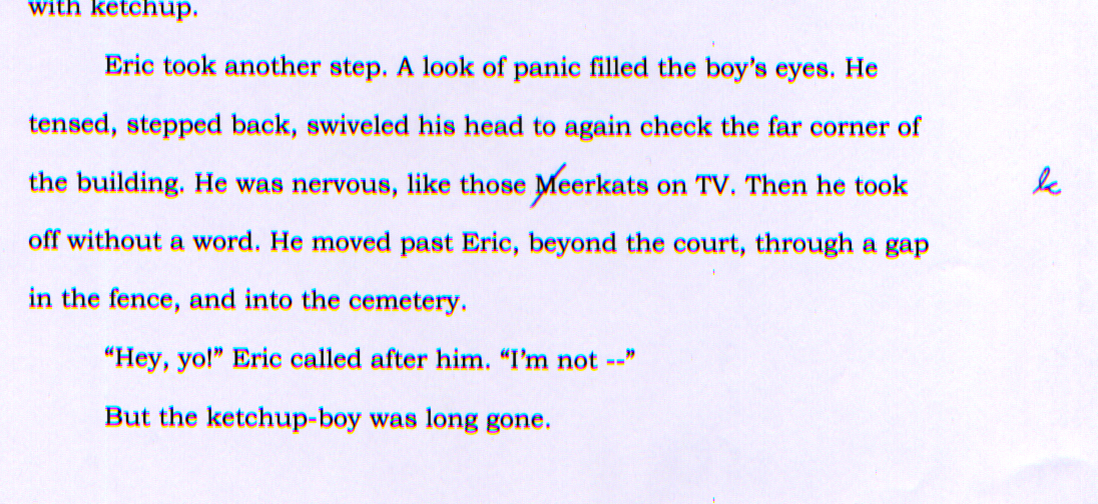
FROM THE FIRST DRAFT that went to Feiwel and Friends editor, Liz Szabla:
SECOND DRAFT. You’ll note two changes: 1) I felt that the prairie dog reference, though okay for a kid from South Dakota, was wrong for Eric, wrong for Long Island. I felt that he wouldn’t think to make that comparision. 2) I cleaned up that last sentence, he’s no longer “racing,” because that was the wrong word; there’s now the specific “gap in the fence”; and overall it’s just a little leaner and better, IMO.
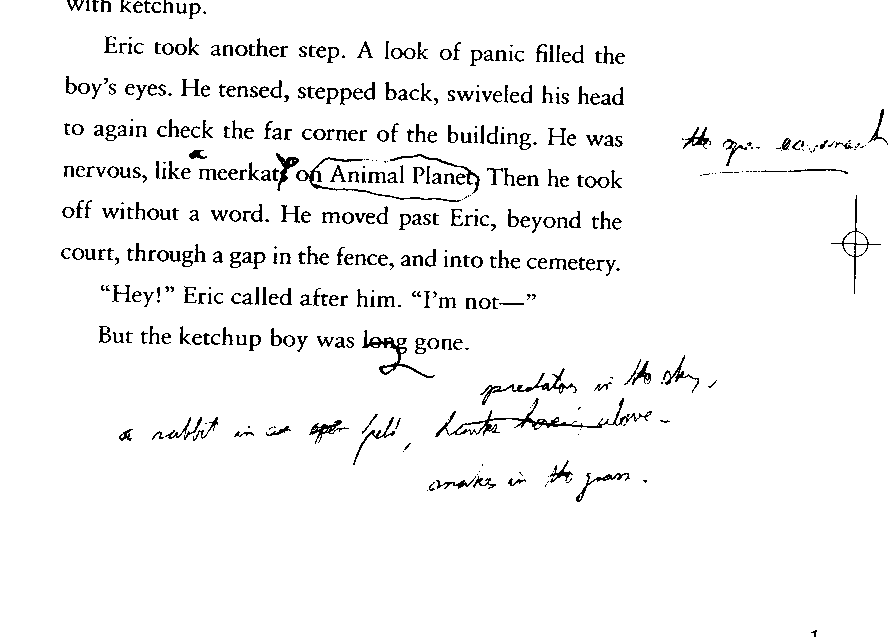
FIRST-PASS GALLEYS. Here we see the manuscript set into type. I still disliked the sentence, “. . . those Meercats on TV.” Somewhere in there I changed it from “TV” to “Animal Planet,” went singular rather than plural. But a new concern entered, or more likely I began to listen to an old concern: Was the image too contemporary, ephemeral. Would it date the book? “Meerkat Manor” wasn’t going to last on TV forever. Maybe in five, ten years people won’t be as conscious of meerkats as they seem to be now. And like the prairie dog image, even a meerkat simile seemed too much of a reach. You’ll see below my hasty script, where I’m fooling around with more localized comparisons: “a rabbit in the field, hawks in the sky, snakes in the grass.” Searching for something that might work.
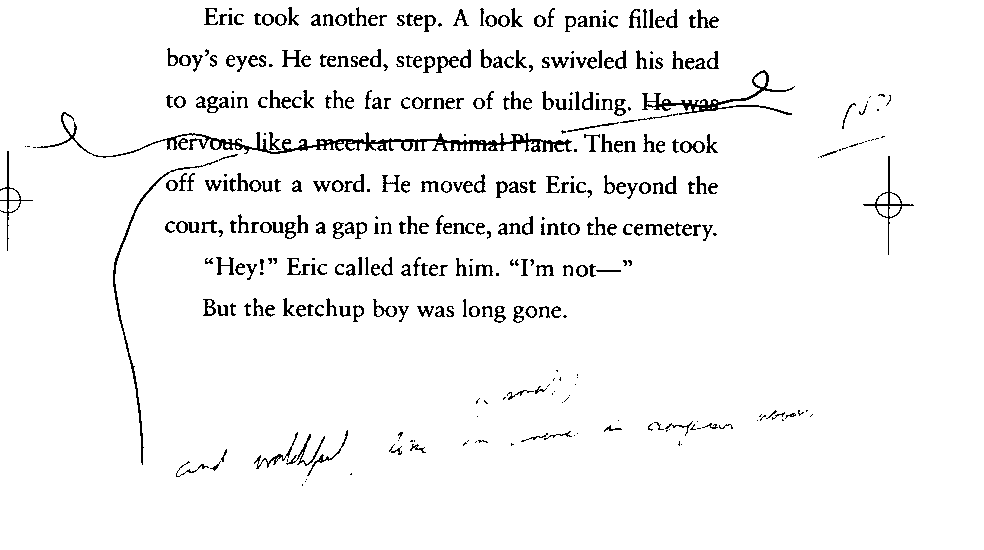
SECOND-PASS GALLEYS. I spoke with Liz on the phone. What you see below is the scribblings I made before I spoke with Liz, and then the result of that conversation. First, I was still hating that sentence: “He was nervous, like a meerkat on Animal Planet.” I tried to come up with some other images, and scribbled below: “and watchful, like a small animal in dangerous woods.” That wasn’t a proposed sentence so much as the kind of image I was grasping for, a frightened chipmunk sort of thing. Not working.
At that point, I solved it the way so many of these things are solved. Because often when a sentence gives you this much trouble, it’s a sign that maybe it should go away completely. I crossed it out and wrote “NO” on the side of the page. On the phone, Liz and I looked at it and agreed. We already saw he was “tensed,” saw that he was watchful. I didn’t need a simile; what I needed was to keep this boy on the run — because the bad guys are coming. We lose the distracting simile, which I never got right, and move on to the next sentence: “Then he took off without a word.” By cutting we didn’t actually lose anything; and we gained pace, forward movement.
FINAL NOTE: You may notice that I flip-flopped on that last line, “was long gone,” or the simpler alternate, “was gone.” Liz and I both thought about it, talked about it, that extra word “long,” and decided to reinstate it.
And that’s one glimpse into a late stage of the revision process.
NOW, ABOUT THE KETCHUP:
This is a reference I’m not sure many will get, but it’s something that I had to put into the book. To me, no discussion of bullying, regardless of how seemingly benign the form, can take place without a recognition of Columbine as an extreme result. It’s always there, that vision of what could happen if good people — the bystanders — don’t act. The two shooters in that massacre, Eric Harris and Dylan Klebold, were originally victims of bullying. This is a common scenario, “the bullied bully,” widely recongized in the literature. So many targets go on to target someone else in a cycle of hurt and intimidation. Anyway, Harris and Klebold were once severely humiliated when they were splattered with ketchup packets. When I came across that while researching Bystander, I knew I wanted to use it somehow — so my book opens immediately after it happens to another boy, and the book’s protaginst, Eric Hayes, sees him running, running. Because even though my book does not go the extremes of Columbine, it’s a haunting scenario that remains forever present, like a ghost in the room, a reminder and a lesson we dare not forget.
When I was working on Bystander (Fall, 2009), a book that centers on bullying, I kept running across different quotes by Martin Luther King, Jr. He would often express the same idea in subtle variations. In essence, Dr. King issued an indictment against the tyranny of silence, reminding us all of our responsibility to speak up. King believed in the common good. He had an abiding faith in his fellow man. If only we would all stand up and be heard, then justice and democracy and human kindness would surely prevail over cruelty and prejudice.
That’s partly why I named the book, Bystander. Not bully. Not victim. I wanted the focus to be on the overwhelming majority of us who stand by as mute witness; and how we are, therefore, complicit in acts of cruelty, our silence a form of tacit agreement. For responsibility is nothing if not an “ability” to “respond.” That’s where we find hope for real change. In our voices.
Here’s a few relevant quotes from Dr. King:
“In the end, we will remember not the words of our enemies, but the silence of our friends.”
“The ultimate tragedy is not the oppression and cruelty by the bad people but the silence over that by the good people.”
“Our lives begin to end the day we become silent about things that matter.”
“Cowardice asks the question, ‘Is it safe?’ Expediency asks the question, ‘Is it politic?’ But conscience asks the question, ‘Is it right?’ And there comes a time when one must take a position that is neither safe, nor politic, nor popular but because conscience tells one it is right.”
This brief, one-minute clip is from Martin Luther King, Jr.’s last speech. He knew what was coming, he knew.