
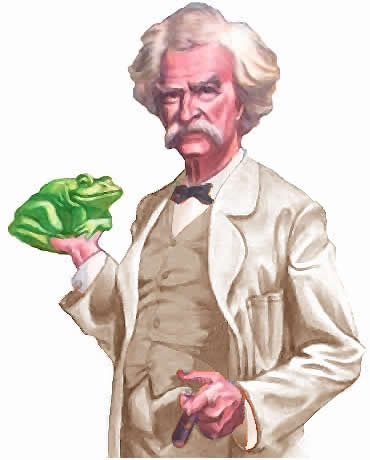
There’s a little bit of Mark Twain in this book, mostly from two sources, his short story “The Notorious Jumping Frog of Calaveras County,” and, of course, his Huckleberry Finn character.
The story begins with a standard thriller device, the ticking bomb. Throw a deadline into a standard mystery and you immediately ratchet up the tension. In this case, look at the book’s opening paragraphs:
“My frog is missing,” croaked Stringbean Noonan. “And I MUST have him back by this Sunday at noon.”
“Sunday at noon?!” Mila exclaimed. “That’s only twenty-four hours from now.”
Stringbean stuffed two dollars into my coin jar. “There’s more where that came from,” he sniffed. “Just find that frog.”
Adonis, the missing frog, was no ordinary frog. (Love that name, btw.) He was a champion jumper with hops to spare, and there was a big frog-jumping contest coming up — with a $20 cash prize for the longest leap.
So already we’ve added motive to the mystery.
“Twenty dollars,” I whistled. “That’s a lot of money.”

I borrowed the first Twain idea in Chapter Five, “Want to Bet?” Most famously, there’s a character in Twain’s “The Notorious Jumping Frog from Calaveras County,” a noted gambler named Jim Smiley, who loves to bet. On anything. And everything. Twain describes him thus in the story:
“If he even seen a straddle bug start to go anywheres, he would bet you how long it would take him to get to — to wherever he going to, and if you took him up, he would foller that straddle bug to Mexico but what he would find out where he was bound for and how long he was on the road.”
Anyway, I reread the story during the brainstorming stages of the book, when I was casting about for ideas, so I decided to give that character trait to a minor character, Jigsaw’s classmate, Eddie Becker, who I had established in previous books as being highly motivated by money.
Eddie loved to bet — and there wasn’t anything in the world he wouldn’t bet on. Two birds might be sitting on a telephone line. Eddie would bet which one would fly away first. He’d bet on a ball game or the color of the next car that drove down the street. The weirder the bet, the happier he was. Eddie was just one of those guys who needed to keep things interesting. Regular life wasn’t quite enough for him. Nah, there had to be something riding on it.
Jigsaw and Eddie enjoy a friendly bet. Later Eddie casually mentions a new suspect, Sasha Mink (another name I love). With Adonis now out of the way, Sasha stands to win the frog-jumping contest with her entry, Brooklyn. Eddie tells Jigsaw that she lives in the big house on the corner of Penny Lane and Abbey Road.

(These Jigsaw Jones books are loaded with pop culture references that likely float over the heads of 98% of readers. Just for fun — and for Mom or Dad who might be reading the story aloud.)
Jigsaw eventually decides he needs to learn more about frogs, so he enlists the aid of Slim Palmer, the best frog trainer in town. Here’s an illustration of Slim, as drawn by the book’s wonderful illustrator, Jamie Smith.
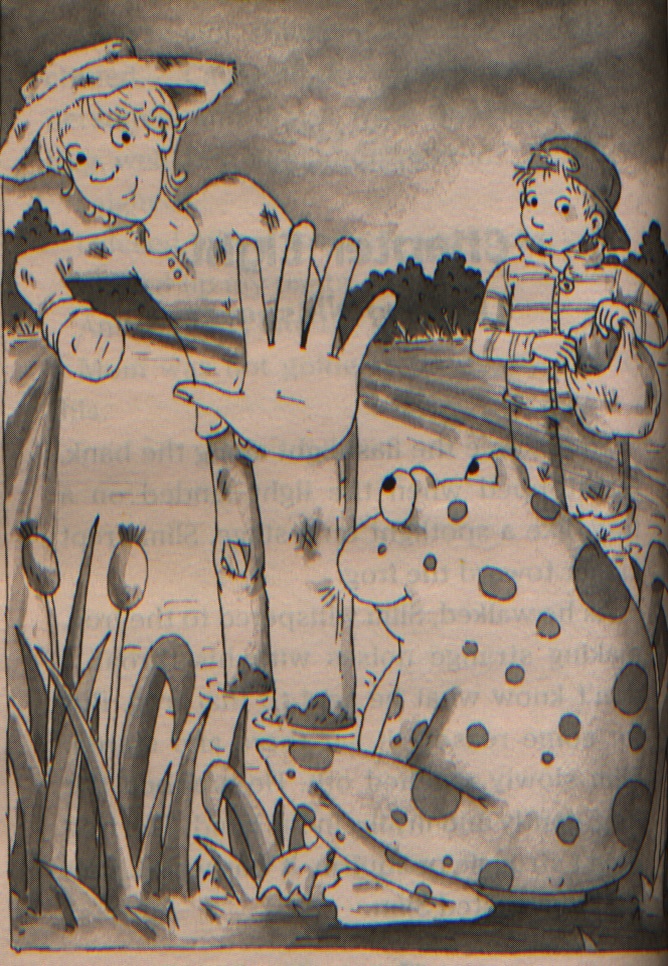
Look like anybody you know?
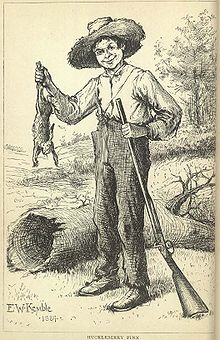
That’s Huckleberry Finn, folks. And the resemblance is intentional.
I had great fun writing the “frog whisperer” chapters, where Jigsaw meets 14-year-old Slim Palmer (and there’s a nod to Chili Palmer here, too, from the movie “Get Shorty,” based on the book by Elmore Leonard, just his casual cool). Another side note: that’s one of the advantages of writing detective stories. Each new mystery takes the detective out into the world — a bastion of moral integrity in a world gone sour: in this case, the second-grade version — where he meets new characters, good and bad. It keeps the series fresh for readers, and entertaining to write, too. Whenever the series felt boring or stale, I knew it was time for Jigsaw (and me) to encounter new faces and places.
“You’re going about this case all wrong,” Slim told me. “First thing you got to do is you got to start thinking like a frog.”
“Thinking like a frog?” I repeated.
“Exactamundo,” Slim said with a sharp nod.
“Ribbit,” I croaked.
“I’m not joking,” Slim protested. “Frogs are serious creatures. They don’t joke around.”
I researched on the internet how to catch frogs, learned some things about using a burlap bag and a flashlight, so wrote a scene where Slim urged Jigsaw to step (reluctantly) into a rather gross lake. Together they succeed in snagging a frog, and before he departs, Slim offers one final bit of advice:
“Oh, don’t you worry,” Slim said. “You’ll be fine. Just remember what I said. You have to be kind to that frog. Treat him nice, like he’s your little brother or something. A happy frog is a good jumping frog. You have to love him. A frog gets scared or nervous, he’ll jump sideways, backways, anyways. You’ll never win nothing with a jittery frog.”
Slim also advised Jigsaw to keep his frog with a pan of water. It was important to keep them wet. As he explained, “You don’t want a dry frog. They don’t jump so good when they’re dead.”
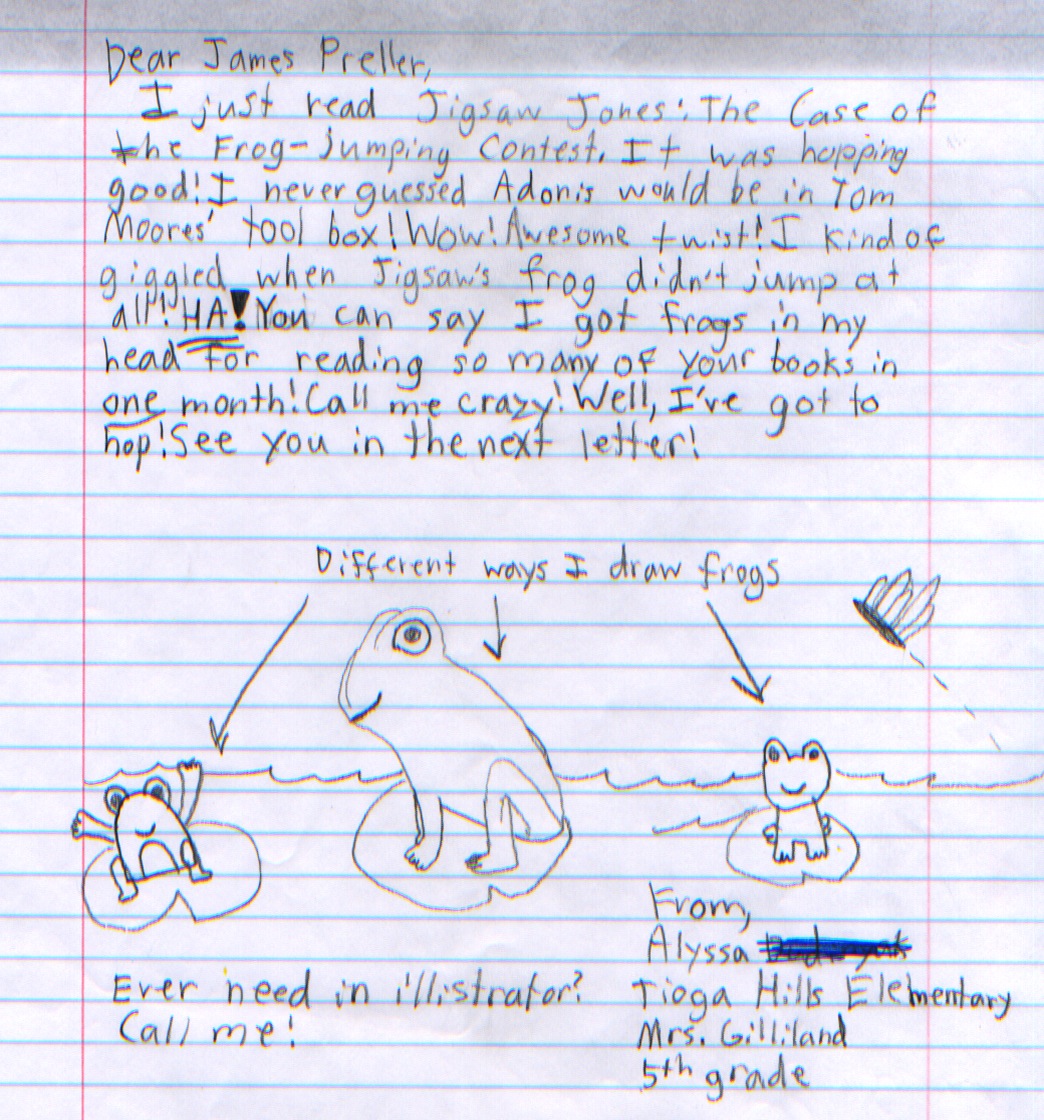
POSTSCRIPT: I have to share this letter that I was handed last week on a visit to Tioga Hills Elementary. One student, Alyssa, apparently read a book a day in preparation for my arrival — and wrote a letter to me about each one. Amazing, amazing. I have more than a dozen letters from Alyssa. Here’s the one she wrote for The Case of the Frog-Jumping Contest. Thank you, Alyssa, you rock.
NOTE: THANKS FOR STOPPING BY, I’LL BE AWAY ON SCHOOL VISITS ALL WEEK, THIS TIME TRAVELING DOWN TO SICKLERVILLE AND MARLTON, NEW JERSEY.

