Archive for Interviews & Appreciations

Lois Ehlert, Remembered (1934-2021): A Tribute

–

“I’m trying to use my art
to teach a little — making children
a little more appreciative
of the flowers they can see,
or helping to open up their eyes
to the beautiful birds
flying overhead.”

— Lois Ehlert


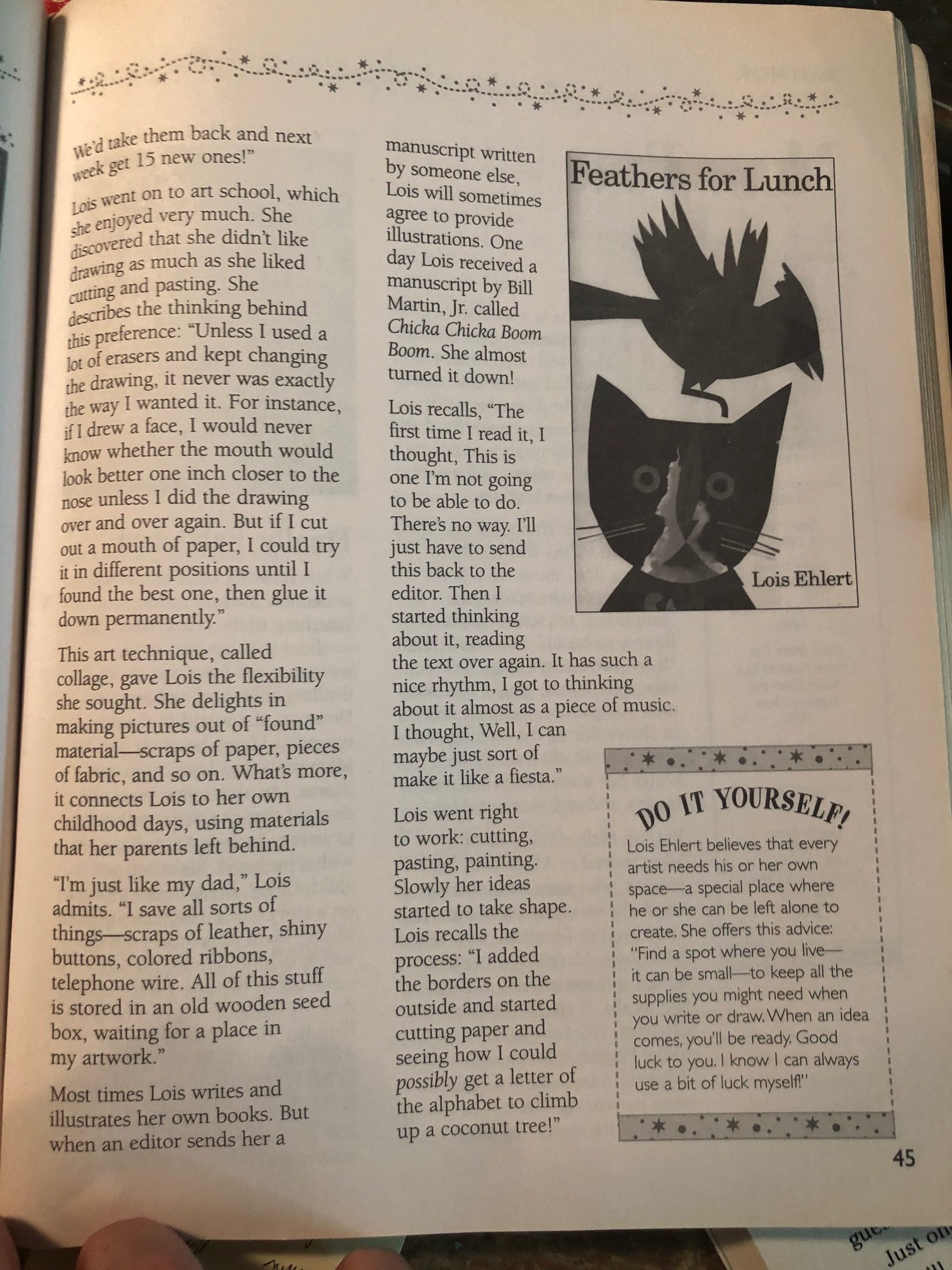
I learned today that Lois Ehlert has passed away. Born in Beaver Dam, Wisconsin, on November 9, 1934, Lois went on to do great things as an author and illustrator of children’s books.

I had the privilege of interviewing Lois for a book almost 30 years ago. The interview was updated at a later point, around 2000, for the cleverly titled, The Big Book of Picture-Book Authors & Illustrators. I used to spy that book on the shelves in classrooms during school visits, though I suspect that’s hardly true anymore. Are teachers as interested in children’s books as they used to be? I’m not so sure.

Anyway, here’s the two-page spread on Lois as it appeared in that collection of profiles. The writing is directed at dual audiences: educators as well as interested young readers. 

As a writer, it’s often a little scary to go back and look at old writing. Will it be embarrassingly bad? But in this case, I felt none of that. I was simply heartened to remember Lois Ehlert again, to bring those great books back to mind, and appreciate the fine work she did.

May her wonderful books, full of color and beauty and respect for the natural world, live on.


–

(Sorry for the crummy photos; it’s how I roll.) 

–

–

TALKING ABOUT WRITING with Andrew Smith: Award-Winning Author, HS Teacher, Reader, Music Lover, Free Thinker

–

I wanted to try something a little different with today’s interview — which actually took place across weeks and several emails — and I knew that Andrew Smith was exactly the kind of writer who would be up for it. I simply wanted to talk about writing. Learn some things, maybe come away inspired. And hopefully offer up something that might be of interest to you, Oh Dear Reader. May this post lead you to check out some of Andrew’s (most excellent) work. He’s an original voice.

–

–

Andrew, your career has been marked by brave choices and a restless, out-of-the-box creativity. Recently on social media you shared some favorite Fan Fiction, where readers responded to your books with their own art. I love that.

I’ve collected so much over the years. I definitely hold onto things, and I guess in many ways we’re lucky that our careers in writing started in the Paper Age and is now in the Digital Age. But the hardest part for me here was finding where exactly I was keeping all this stuff.

Einstein had similar problems. Let’s see what you can put your hands on. 

These first two were sent to me digitally from fans of GRASSHOPPER JUNGLE.

–


–

Whoa, that’s inspiring. 

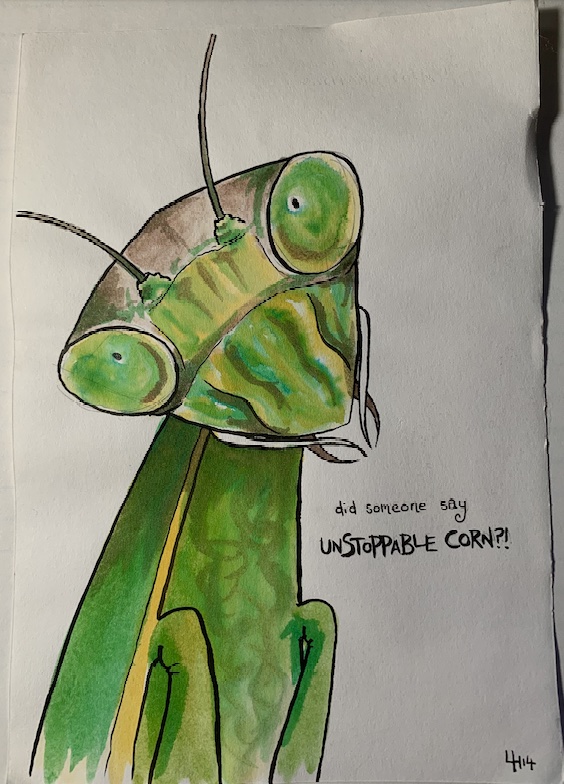
And these are on paper. The first is from a fourth-grade student in Kansas who read my middle-grade The Size of the Truth, and the second is a pen-and-watercolor from a fan of Grasshopper Jungle who mailed this to me all the way from England.

–


–

What a tribute — you must be blown away?

This is a difficult feeling to express. I think sometimes I feel as though I’m two people at the same time, and this other, more fortunate self is a kind of dream state that has been cleaved from me, and that guy has access to all the things I don’t believe I deserve. So when I look at these gifts, or when I read the letters I’ve received, it’s almost like I’m living vicariously through the experience of someone who is by every measure blessed.

That’s lovely. Yes, there are times in our profession when we are truly gifted, when we receive. For example, I’ll meet a six-year-old who loves my books. The purity of those eyes, that face, what those books mean to that particular child. And there are no satisfactory words for that experience, at least none that I can conjure up. 

Well, I will say that when I went out on tour for my first middle-grade novel, I visited kids from grades four through eight, and I could not believe how kind and adorable those kids are. But then, too, I once visited a high school (and—ugh!—I think it was in Minneapolis or Chicago, but I can’t remember), and my host told me that the majority of the kids in the school were non-native speakers of English. And I thought, cool, I come from California and I am totally comfortable in schools like that. But all these kids came from Poland and Lithuania! And, after reading Grasshopper Jungle, which has a lot of Polish history in it, they all wanted to teach me swear words in Polish. That’s pretty kind and adorable too.

That’s such an Andrew Smith-type story. I’ve often had the experience that a great book will make me look out the window. You know what I mean? Instead of the usual goal that a good book keeps you turning pages, turn turn turn, for me a great book actually achieves the opposite. I stop reading because it got me wandering down the rabbit hole of my own thoughts. It’s the ultimate “reader response.” Spacing out to the rumble of your own mind. These young people read your work and were inspired to create.

It is a remarkable thing; and it’s something that I never thought I would accomplish, even if I never really articulated in my mind what exactly it was I wanted to accomplish through my writing, if anything. But it does give me a kind of ache in my chest to see people of all types and ages, from all over the world, who wanted to make something of beauty and then gift it to me after reading a story I wrote. That’s the kind of stuff that raises gooseflesh on me. I get very choked up by it. And I can honestly say that although I love to draw, I have never drawn anything from reading. On the other hand, when I feel like I’m getting dragged-down in my own writing or when I want to try to give my mind a new way of seeing things, the first thing I go to is some great new book that I haven’t read yet.

You strike me, from a distance, as “prolific” to the point of “borderline obsessive.” I know you work full-time as a high school teacher. Let’s just call it productive. What are your work habits?

I’m a list-maker, for one thing. I keep lists of things I need to do and I cross them off as I go. I don’t feel bad if I don’t get through a list, but I feel really great when I do. I start every morning before school with one cappuccino and then exercise and a 3-mile run. I’m usually working on my writing every day whenever I can (even on days when I teach school). I don’t set arbitrary word goals per day because I don’t write on spec. I just want to do something GOOD every day, even if GOOD means one tight, necessary paragraph—because that’s forward progress. 

Thank you for that. I cringe whenever I read authors boosting about that day’s word count. Sometimes it’s best when there’s a negative word count. A day of cutting, dumping, ditching. We get closer to the stuff worth keeping.

Sometimes I will stop what I’m writing and just go back to the beginning and read what I’ve done, always asking myself, “If this book were in my hands, would I keep turning the pages? Would I NOT want the story to end?” Those are my objectives when writing. 

Right now, I am in the final act of a novel I’ve been writing throughout this year of the pandemic, and I keep asking myself those questions because I’ve gone back to read it from the beginning, and I kinda don’t want it to end, which may explain why I’ve spent a year now writing it.  

Do you revise as you go? The standard advice tells us not to do that — but I have to confess, I’ve never just been able to blast through with a completely horrible first draft. I reread and revise constantly, while still trying to maintain some forward motion.

Yes! I frequently claim that I do not revise, but that’s not entirely the case. What I do not do is draft spew to race to the finish line with the intention of fixing or cleaning things up. So in that regard, I don’t revise in the traditional sense. But I can spend days (or more) on a single paragraph or line until it fits properly into the thing that is assembling in front of me. So every day begins with going back over the previous day’s writing, and I will invariably change words or discover something that needs to be brought forward, illuminated more.

That’s one of the things about getting some books under your belt. You begin to learn how you work. It’s an individual thing. Even in the darkest storm, you develop the confidence that you know how to land the plane.

Yes, but the technology of the plane itself is changing and I guess you have to adapt to new flying conditions. I have definitely seen a change in my approach over the years and all the books. Like my running, or my hikes through the hills these days, I am slower than I used to be, but I also appreciate that slowness and how it gives me the ability to look around and absorb things, to take a breath once in a while. There used to be such an urgency in getting through a project and then getting on to the next one, and the next one after that. But now, it’s like what’s the rush? I know where I’m heading. How about you? Do you feel a different kind of natural stride at this point in your life as a writer?

Yeah, I’m writing a lot of haiku! My attention span — and my patience — are both shrinking. Or, less glibly, I do suppose there’s a minor tradition of older writers moving toward an increasingly spare, spartan sort of writing. Leaner, closer to the bone.

When I was younger, I never allowed myself to step away from my work, but in the past 14 months or so I have found times when I just can’t do it. Psychologist Adam Grant refers to this Sargasso Sea of the pandemic mindset as “languishing,” but to me it has been more like simply being pissed off. 

An unsettled time, for sure. The other thing is that I don’t do well unless I’m inspired. I need to build up a certain internal pressure, like a tea kettle, for the whistle to blow. I’ve never been one of those 1,000 words a day, come hell or high water, type writers. I’m not afraid of not finishing once I get started. The trouble comes with the “getting started” part.

I never focus on how many words I write in a day. I’m into key strokes, so I’ve been using a ridiculous amount of punctuation. Kidding. As a matter of fact, I have been using less punctuation in my writing. Not that it’s technically flawed, I have just always disliked certain punctuation marks—most notoriously commas and exclamation points (cringe). I think Henry James said something once about striving to get that one perfect sentence. If I can get down one perfect sentence from a day’s writing effort, then I’m satisfied. Of course, that sentence may look completely flawed the next morning, in which case I may spend three or four trips around the block trying to reorganize it.

When I was in high school and college, my girlfriend’s mother, Mrs. Loretta Flynn, was a voracious reader. I was deep into “real literature” at that time. Whereas she would usually read page-turners, just consuming books by the armload. Her biggest complaint about certain writers was always the same, “Too many words!” I didn’t understand that for a long time. Why read if you don’t like words? But now I totally get it. I also make the same complaint about some guitarists, “Too many notes!”

I have become a less confident writer as I’ve aged, but a more confident reader. I think that’s proof of what happens when you learn more, and become more aware of how much you don’t know. I don’t know what I’d do if I didn’t have a fresh stack of unread books waiting for me to get to. That said, I’m totally with you on the TOO MANY WORDS parade, but I would qualify that with the caveat that I can’t tell if a book has too many words by feeling its thickness. For example, Chang Rae-Lee’s nearly 500-page My Year Abroad is absolutely perfect—I wish it were twice as long! But then I’ve also read some 250-page novels that could stand losing about 50 or 60 pages and still be just fine. (Not naming names there.)

Thanks for this diversion, Andrew, for taking time out just to aimlessly chat about writing rather than, you know, yammering on about the new book. But — what they hey! — would you mind yammering on about the new book? You’ve been exploring middle-grade fiction of late, after establishing yourself in the YA galaxy.

Yes, well I did write two middle-grade novels (the most recent, Bye-Bye Blue Creek came out in October 2020), but they may have been exceptions for me. I wrote them entirely for David Gale, my editor at Simon & Schuster who recently passed away. David was one of those people who could inspire me to try harder and do things I wouldn’t normally do. He completely saved my novel 100 Sideways Miles, which went on to be a National Book Award nominee. There is a great story behind that book’s evolution that I will probably never tell, and unfortunately it was overshadowed by another book I wrote that year, Grasshopper Jungle, which went on to get a Printz Honor. What was I ever thinking, putting out two books per year??? At the moment, I find myself receding back into my isolation—and only writing for myself with no real goal to place what I’ve been working on, which I hope is sufficiently vague. I’ve spent the last year during the pandemic writing a multi-perspective, multi-timeline novel for adults that somewhat rekindles where I was when I wrote The Marbury Lens, unsurprising considering the time during which I’ve been writing it. I suppose the pandemic is going to churn out a lot of horror in fiction.


–

Andrew, I see that we’ve run out column inches. Thanks so much for stopping by. It’s been a pleasure connecting with you and sharing our passions. I’ll be sending along a complimentary set of steak knives. 

It’s been terrific chatting with you, James. You always get me thinking about things: writing, music, reading. One day maybe we’ll record our thoughts on contemporary music or books. Like, what are you reading at the moment? I just finished reading a debut by a young author named Caleb Azumah Nelson—the novel, Open Water,  and it is absolutely radiant, tingling with life and music.

I love that you share your enthusiasms, Andrew — and so enthusiastically. I’ve been making my way through a few books: re-reading Stephen King’s Pet Sematary for what I can steal; working my way through George Saunders’ A Swim in a Pond in the Rain (brilliant!), slowly reading Pablo Neruda’s Residence on Earth (2-3 poems a day); and on the children’s literature front, I just finished and loved Amy Timberlake’s Skunk and Badger. For music, my 21-year-old son, Gavin Preller, was signed by Kramer at Shimmy-Disc, in partnership with Joyful Noise Recordings. His debut, “There Is Wonder,” comes out on May 21st, this Friday. I hope you check it.


ANDREW SMITH is the award-winning author of several Young Adult and middle-grade novels, including the critically acclaimed Grasshopper Jungle (2015 Michael L. Printz Honor, 2014 Boston Globe-Horn Book Award, Carnegie Medal Longlist) and Winger. He lives in a remote area in the mountains of Southern California with his family, two horses, two dogs, and three cats. He occupies himself by writing, reading, and taking long, slow morning runs on nearby trails. You can learn more about him by using Google, because that’s all I’ve got.

–

–

As for me, James Preller (since you asked!): You might know my Jigsaw Jones mystery series. My newest book is called Upstander, a stand-alone novel that also serves as sequel/prequel to Bystander. It follows Mary’s experiences, enters her home life, and includes a strong Substance Use Disorder (SUD) storyline. I’m proud that both books were named Junior Library Guild Selections — ten years apart. You can click here for more info. 

–

–

A Conversation with Travis Jonker: Librarian, Podcaster, Instagram Star, Children’s Book Influencer, and Author of BLUE FLOATS AWAY

–

Maybe you know someone like Travis Jonker. He’s a popular podcaster, and a blogger, an Instagram star, an elementary school librarian, and an acclaimed author. In his spare time, he probably helps turtles cross busy highways. In other words, the type of overachiever I usually loathe. But that’s the trouble with Travis. He’s annoyingly likable. He’s warm, funny, kind, intelligent. I want to hate this guy, but I can’t. You probably won’t be able to, either. But please, for me, try. Travis has written a new book, illustrated by Grant Snider, and, yeah, you guessed it — it’s really good. Rats and snails!


–

Greetings, Travis! Nice to see you again. Sorry about the mess. Just shove those candy wrappers, beer bottles, and peanut shells aside. And I wouldn’t touch that green stuff if I were you. Sorry, I would have cleaned up if you were a bigger deal.

We all just live in our own filth now, right? But I am curious, who would I have to be in order for you to break out the Swiffer?

Cordell. Only because he’s so damn fussy.

Illustrators.

Agreed. They’re like Siamese cats. “Is this sanitary? What’s this green mold? Are you sure I can eat this?” It never ends with them.

Typical.

People ask me, “Jimmy, what did you miss most during the pandemic?” And I always say the same thing, “I miss Travis Jonker’s packing-for-ALA videos.” To me, that’s a sign that all is right with the world. 

Ha! Well, I’m sorry you’ve lost your North Star. Hopefully packing will return in . . . 2022?

Controversially, you are a roll-the-clothes-up advocate rather than a traditional folder.

I dabble in rolling and traditional layering. You gotta be flexible in your thinking on this. Don’t commit so hard to the life hack that you can’t employ traditional techniques if needed.

Any other packing tips?

Here’s the key, and I can’t state this strongly enough —

Travis, you don’t have to stand on the table. It makes me nervous.

This coffee table seems wobbly, but I’m going for it . . .

When traveling to a conference, pack almost nothing. Conference travel is very different than other types of travel. At a conference, you’re inside a temperature-controlled conference center most of the day. For men, if you have a shirt with a collar, jeans, and casual shoes (not sneakers) you’re ready for just about any situation the conference can throw at you. My motto for conference travel is No Options. Pick one outfit for each day you’ll be there and don’t pack anything else.

Okay, terrific interview. Thanks for stopping by. See you later!

Um?

Wait, did you actually think I invited you here to discuss your new book?

People always ask for packing tips under the guise of an interview, so I’m used to it.

Let’s pause for one moment while we view a historical perspective of your fabled packing exploits over the years . . .

–

–

Okay, I might be a stalker, but moving right along. I’m impressed by the warmth and simplicity of your story. You achieve something that I often struggle with — you distill this tale down to the essence. To me, that seems like one of the keys to writing a successful picture book.

That really seems to be the challenge — how to give the story enough pieces to work, but not to load it down.
Funny how this circles back to packing, isn’t it? We get in trouble when we try to cram too much into it.

You’re a master of theme, Jimmy — it definitely connects.

How did this book work for you? Do you write too many words and then whittle it down? An image, a sentence, an idea?

When I’m writing-writing a story, I tend to underwrite.

That’s not the usual answer. I’ll have to try that.

To be honest, I want to get the hell off the page as quickly as I can. I fear boring the reader. Maybe too much. In later drafts I realize, “Oh, yeah, I should probably add a little more character development and dialog here.”

How did this story begin for you?

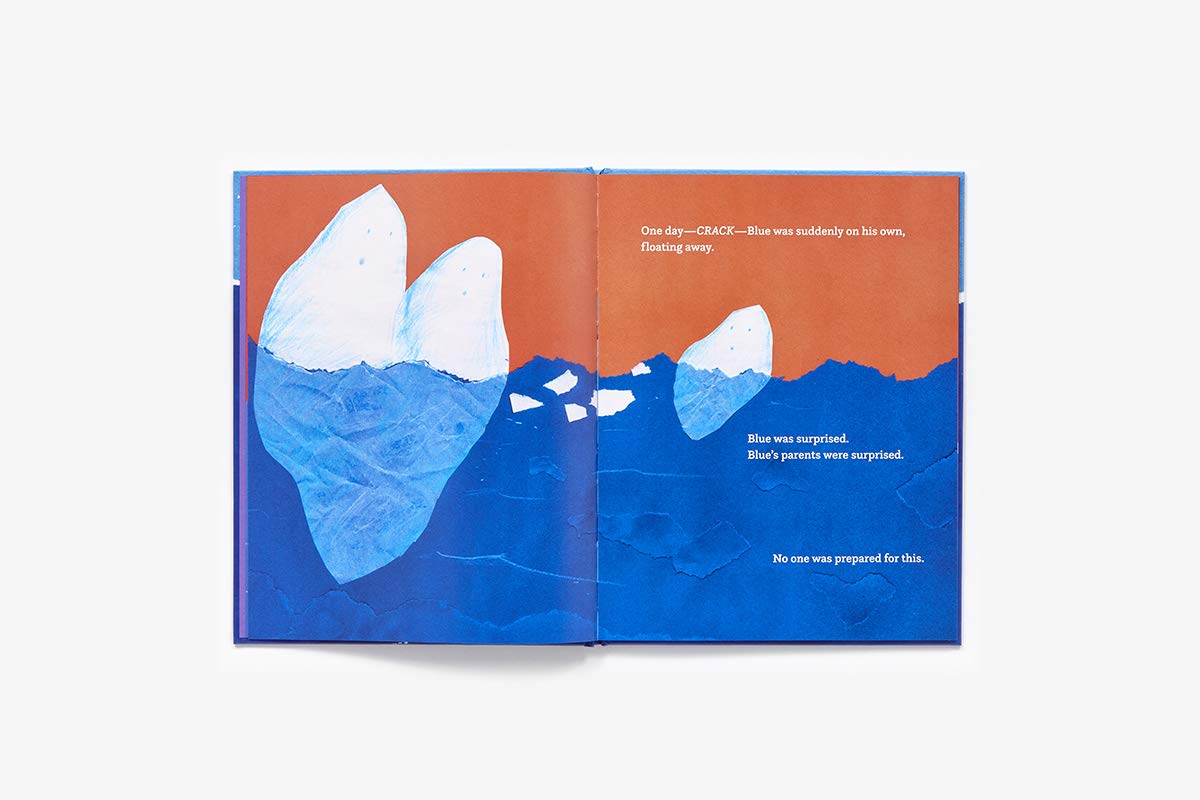
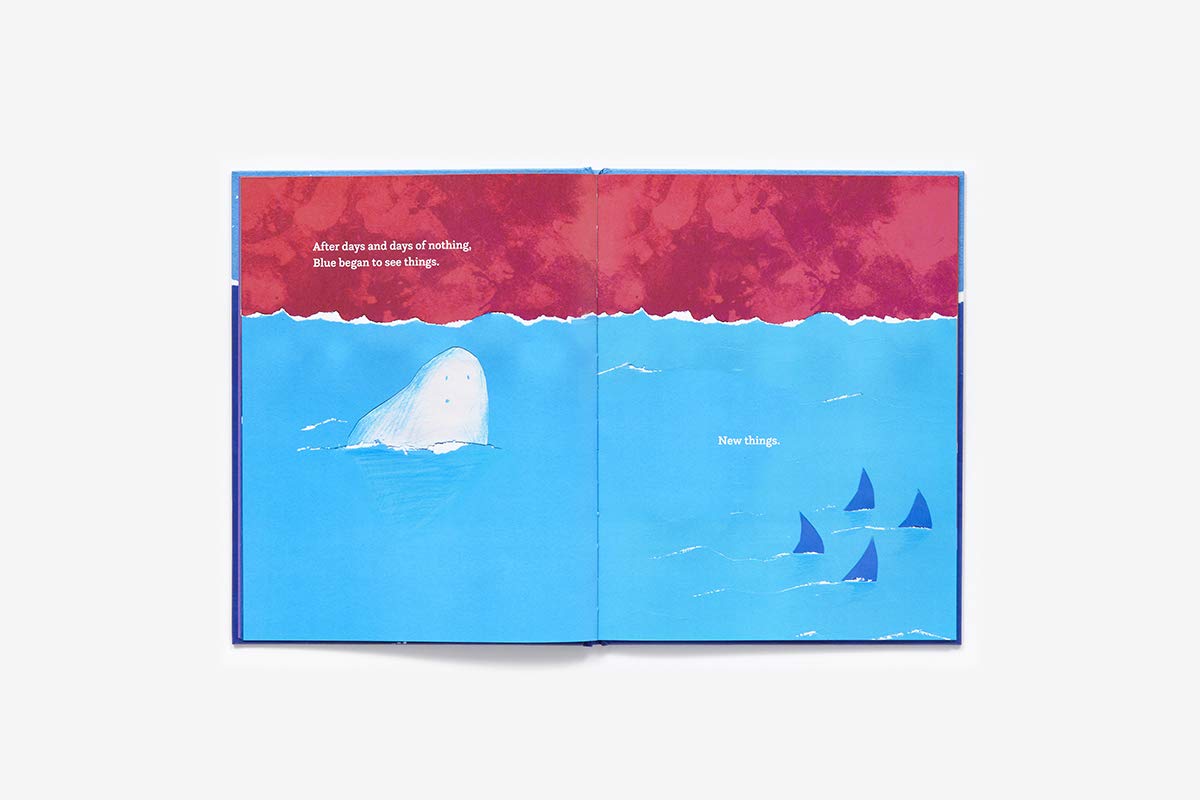
The initial idea for Blue Floats Away came after an uncle of mine passed away. Because of my memories of him, I was thinking about how he was gone, but not really gone. I wondered if I could make a story where something like that happens, and then I thought of an iceberg melting into the ocean – gone but not really gone. In the first draft, the iceberg melts and that’s sort of the end. That was a real bummer, though, so my thinking on the story shifted to themes of independence and growing up. I like the idea that as we get older we change, yet we still feel the same on the inside, in many ways. So Blue returns at the end — different, but the same.

I connect with this because I think what you are saying is that this book began with a feeling — rather than an intellectual idea. You experienced loss and were moved to write. To me, the feeling, the emotion, is the heart of almost all expression. Ideas come later.

It does. That feeling or emotion has to be there to create a meaningful book. I think sometimes you can reverse-engineer it at the beginning — having a great plot idea and then going back to find the feeling or emotion, but those always take longer and often don’t work out at all. Beginning with the feeling usually leads to more successful writing.

In your day job as an elementary school librarian, you have the opportunity to read aloud to groups of children. You get to see what works . . . and what doesn’t. That experience must be incredibly valuable to you as a writer/storyteller.

After reading so many books with kids, I feel like I’ve sort of internalized the picture book audience. I carry that with me. It comes in handy for later drafts, but can be a problem for first drafts, where I want to be loose and not care too much about how a reader might react.

You really do have to entertain yourself and, ultimately, trust your instincts.

Yeah, I think it’s important to notice your own initial reaction to an idea. If I have a story idea and it makes me laugh out loud or gasp or something, that’s a really good sign. Not that I’m just laughing and gasping at my own ideas all the time, but I think you know what I mean.

Huh, interesting. Laughing and gasping. In my case, when I have an idea, I get the hiccups. And gas. I even wrote a hiccups book once, an out-of-print classic. But I’ve left flatulence for the masters.

You gotta play to your strengths.

What do you see when you read books with kids? You must have times when you think, “They are going to love this!” And they just don’t. And vice versa.  Have you learned anything at all?

With read alouds, I’ve learned that the way the book is presented has a lot to do with how it’s received. And I don’t mean that if I tell kids “This is a great book,” they will think it’s a great book. If the reader can make a connection with kids about the topic or themes of the book right away, the chances that the story will be well-received are much better.
Picture books seem to have gotten younger, with fewer words. Is that your perception?

Definitely fewer words. In some ways this is a good thing – there were plenty of picture books in the past that were too long and could’ve used some editing. But I think there are some great longer picture books that might not be published today (or would be edited down to nothing) because of this trend, and that’s too bad. If the voice is strong, I think you can write just about any length picture book you want.

I sorely miss the words in picture books these days. The rich language. I’ve often wished there was a separate award for the writing of picture books, because it’s an under-appreciated skill. Just as —- obviously, to me —- there needs to be a separate award for the writing of graphic novels. It’s insane to expect Newbery committee members to compare the writing of a graphic novel to, say, a 300-page novel without any images.

I’ve had many a late night conversation at the American Library Association conference about everything you just mentioned. It seems like a common argument against it is that A) There are already too many awards, and B) The more awards there are, the more it devalues all the awards. Oh, and C) The current award categories are broad enough to accommodate graphic novels and picture book writing. But I’m with you — a graphic novel award and a picture book writing award make sense.

With a novel, a writer is painting pictures with words, bringing all his/her/their creative talent to bear on the language to create the “movie” playing in the back of the reader’s skull. With a graphic novel, the writer is painting pictures with . . . pictures. Often there’s no descriptive language at all. I’m not arguing better or worse — but surely — surely! — an entirely different animal.

A completely different reading experience.

And writing, too. Did you have any interaction with illustrator Grant Snider? Did your manuscript include parenthetical notes to the illustrator? Or did you leave that wide open?

This book didn’t follow the traditional path. Grant and I met a few years ago and had talked about possibly working together. When I saw his comic On the Beach [above], I thought the style would be a great fit for Blue Floats Away — it reminded me of the torn paper illustrations in Leo Lionni’s Little Blue and Little Yellow. I sent Grant the story and he liked it and decided to illustrate it.

Lionni’s Frederick might be my favorite children’s book. 

I made a few illustration notes in the manuscript, but I kept it as brief as I could. I didn’t talk with Grant at all as he was illustrating the book. I knew Grant was a pro, so I got out of the way as much as I could. I’m amazed with his art in this book. I think if you hold your story too tightly, problems arise.

These days, we’re seeing more and more books with back matter, author notes, etc. This is partly a function, I would submit, to the “fear of words” we’re seeing in today’s picture books. They all get crammed in at the end on a rather dull page or pages. Your book has an Author’s Note. Was that your idea, or something that came from editorial?

Editor Courtney Code and I talked about adding an author note very early on. I don’t remember who brought it up first, but I was all for it. Since the story has such a clear connection to scientific topics – climate change and the water cycle – it just made sense to me that I talk a little bit about those real-world connections. I tried to write the author note with the audience for the book in mind.

Yes! I liked that aspect of it, especially when you advised them not to drive their trucks. You weren’t talking to only the educators in the room.

I really don’t understand why author notes often talk to grown-ups instead of kids. Many times I’ve read a book with kids and there’s an author note and I’m like “Oh, hey – this will be great I’m going to read this part to kids now and they’ll know more about what went into the book.” Only to slam the breaks because I realize it’s just a bunch of blabbing to grown-ups. 

I view it as a convention of our times, a trend driven by the library market (certainly not by actual kids), and also the standards of the nonfiction world crossing over into fiction. In some cases, back matter represents (to me: again, I haven’t heard anyone else complaining about this) a failure of the book itself. A successful story doesn’t need it. I don’t think your book needed it. There’s no back matter in Arnold Lobel’s Frog and Toad books or, say, Where the Wild Things Are. Nobody needs to know what Maurice Sendak was really thinking or how he got inspired or what web sites we should all go visit to save the planet. The story is the book and the book is the story. It is enough. That said, if an editor asked me to do it, I probably would (grumblingly).

[Jimmy pauses; climbs off wobbly table.]

Sorry, I don’t mean to become THAT GUY complaining about the state of the world. But I yam what I yam.

–

–

I hear you on the assertion that a successful story doesn’t need it. Fortunately, an author note is just hiding back there after the story is already done. But now I want someone to write a fake author note for the back of Where the Wild Things Are, because that could be pretty funny.

Pretty sure that hot sandwich was a tuna melt. Anyway, hey, Travis Jonker, my friend. I want to say that I have admiration and respect for the work you do in the world of children’s literature. I know that the “celebrity librarian” is a thing these days, and you were an early part of that influencer wave, but you have always kept the focus on the books. And more than that, the core has always been about inspiring young readers. And now I’m glad to see you finding your voice as a writer.

When we did our chat way back in 2009, you asked if I wrote fiction. Do you remember that? I do. That was really meaningful for me. To have a pro like you ask that question, it gave me courage to try it. Thank you for that.

A pro? I prefer the term, grizzled veteran. But was it twelve years ago? Wow. I actually do remember. And I’m happy if I encouraged you in any way. Seriously, you know books — you care about kids — and you are a terrific writer. I’m sure there are many more books to come. Where else can teachers find you?

I write four posts a week at 100scopenotes.com. And I put all my secret drawings on Instagram: instagram.com/100scopenotes. Oh, and the podcast! blogs.slj.com/theyarn.

Thanks for coming by. I love the simplicity and warmth (sly climate change reference there) of Blue Floats Away and I root for your continued success. Sorry that I went on that jag about back matter. I’m kind of a dope that way, these clumsy, passionate feelings. The truth is, I know you are a smart guy who engages with a lot more books than I do. Safe travels, my friend.

Next time I’m bringing Cordell, so I expect this place to be tidied up.

For a hotshot like Cordell, I’ll even buy one of those automatic robot vacuum cleaners — but I’ll do it grumblingly. It’s how we roll here at James Preller Dot Com.


Travis Jonker is an elementary school librarian and creator of 100 Scope Notes, a kidlit blog hosted by School Library Journal. He was a member of the 2014 Caldecott committee. Jonker lives with his wife and two children in Zeeland, Michigan.


–

–

Hey, folks. If you made it this far — congratulations! We’ll be sending you a $20 gift certificate to Blockbuster Video! You might know me from my Jigsaw Jones mystery series. As it happens, I also have a new book coming out tomorrow, May 11th. It’s called Upstander, a stand-alone novel that also serves as sequel/prequel to Bystander. It follows Mary’s experiences, enters her home life, and includes a strong Substance Use Disorder (SUD) storyline. I’m proud that both books were named Junior Library Guild Selections — ten years apart. You can click here for more info. 


–

Conversations with Myself: James Preller Interviews James Preller About His New Prequel/Sequel to BYSTANDER

–

Today’s a special day here at James Preller Dot Com. Over my career in children’s publishing, which began more than 35 years ago (gulp), I’ve interviewed more than a hundred children’s book writers and illustrators — many of whom were legends. My first interview came as a junior copywriter at Scholastic when I nervously sent out a carrier pigeon to author Ann McGovern (Shark Lady). I’ve since enjoyed long telephone interviews with the likes of Barbara Cooney, James Marshall, Ashley Bryan, Faith Ringgold, Karla Kushkin, Bernard Waber, Vera B. Williams, and many more. These days I post interviews on ye olde blog, including lengthy ones with James Bird, Lesa Cline-Ransome, Matthew Cordell, Ralph Fletcher, Jordan Sonnenblick, Wendell Minor, Deb Pilutti — so many. In addition, I’ve hosted contributions from Lois Lowry, Nick Bruel, Eugene Yelchin, Joseph Bruchac, Karen Hesse, Linda Sue Park, and on and on. 

You’d think maybe I’d learn a thing or two along the way.

But nope, you’d be wrong!

Not a thing. 

But then it hit me. The one person I’ve never interviewed, the one person who truly gets me . . . who completes me . . . 

I decided to interview myself.

Look! Here I come now!


James, thanks for stopping by.

You can call me Jimmy.

Same!

Or Jimbo.

Same!

That’s great. This is going really swell. When do the questions start?

Right about now. It’s been 10 years since you wrote Bystander. Many readers have asked about a sequel. But you always said no. What changed your mind?

First of all, that’s an awesome question.

Thank you.

I finally figured out that it wasn’t a longer story — it was a larger story. It wasn’t what happened next, after Bystander ended, it was simply a bigger canvas, stretched up, down, and sideways.

Genius!

I know!

But this time around, the focus is on Mary.

There were a couple of reasons for that. First of all, I always said that Mary was a minor but crucial character in Bystander. She was the character who changed the most. But also, I think, Mary’s character was a little underwritten. I had made the decision to follow Eric, and really hone in tight there. I felt there wasn’t time, in terms of pacing, to explore Mary’s world. So she was kind of left on the sidelines. This new book gave me a second chance to tell her story. 

The timetable for Upstander begins about six weeks before Bystander.

Yes. Working that out was a challenge. I took events that occurred in the previous book, pulled out a calendar, and worked backwards to figure out the dates. In my unedited manuscript, I wrote in the dates to help keep the narrative straight in my mind. We took that out for the final version.

It turns out that Mary has a lot going on in her home life.

She really does. And don’t you think that’s true for all us? We have these bright, shiny surfaces that people see — classmates, friends, neighbors — but beneath that, we don’t really know what’s going on with anybody. I mean, with Bystander, right in the beginning, we see Mary hanging out with Griffin and getting involved in a pretty awful situation.

Ketchup, yes, love that chapter.

Thanks.

No, you’re awesome. Seriously. I’m a big fan.

Thanks again.

No, really. I don’t know if you hear that enough, James. I feel like deep down inside you’re just a wounded bird . . . or a very sad baby seal . . . or . . .

Anyway — um, don’t grovel, Jimbo, it makes me uncomfortable — I felt that with this book I could explore that relationship. Why was Mary with those guys? That’s the prequel aspect, where we get to see Mary’s home and social life up close, including how and why she got involved with Griffin.

And about halfway through the book, you catch up with the Bystander timeline.

Yes, it was so much fun. I knew I didn’t want to just retell the events of Bystander from a different point of view. I wanted to cover new ground, painting on that bigger canvas. But at the same time, there were a couple of scenes that I had to revisit, which I think attentive readers of both books will really enjoy looking at and picking apart.

Bystander begins with Eric already covered in ketchup. In Upstander, you wrote the scene where it happened.

I know. The cruelty of that scene was unpleasant to write. Not fun, but I felt it had to be done.

Mary’s older brother, Jonny, has a substance use disorder.

Yes.

Why did you go there?

Substance abuse is a pervasive illness in our world, but it’s also a hidden disease, all too often associated with stigma and shame. We don’t like to talk about it. But people are sick and suffering and dying. I felt that with this topic, I had some things I wanted to say. I wanted to humanize the victims and also show how their experience affected the entire family.

–

–

We see it through Mary’s eyes.

Exactly. Mary doesn’t fully understand everything that her brother is going through. But she feels it, and she sees what’s happening in their home. Here’s the thing: I grew up as the youngest of seven children. Five of them were more than 7 years older than me — they might as well have lived on different planets. So I was very aware of watching these older brothers and sisters living mysterious lives that I could barely comprehend. I’d be six and watch my sister wearing lipstick run off in a car with her boyfriend. Or, disturbingly, see a brother get into a physical altercation with my father. Or hear loud music bleeding through the walls. So I guess that’s a familiar perspective for me, observing the complicated, confusing lives of my older siblings.

How did you research the topic?

I read a lot of incredible books, told from various perspectives. I also hooked up with a man, Young Do, who runs a treatment center in downtown Albany. We talked, had lunch, I visited the center, and Young read the finished manuscript. I was lucky to meet up with him. In fact, a personal experience that Young told me about — how he used to get locked out of his house, needing to wake his brother to let him in — inspired the opening scene of Upstander.

So if anything in the book is wrong, can we blame him?

Yeah, totally.

–


We learn a lot more about Chantel in this book.

Yes, I felt that was important. Readers needed to know more about that story and Mary’s part in the cyberbullying. I was glad to get to know Chantel better, spend time in her kitchen, meet her family, describe her tennis game.

Is that how it works for you? You put two characters together, they start talking, and the scene writes itself.

Ha! Not quite. I do all the work. But I will say that it was a blast to revisit old characters. Hakeem plays a larger role in this book. Eric, of course. And then there’s the school resource officer, Mr. Goldsworthy. He played a small role in Bystander, but I think we get a richer picture of him in this book. I’m proud there’s a positive portrayal of a compassionate police officer in this book. Just putting that out in the world feels right.

For all his flaws, Griffin becomes something of a sympathetic character by the end of Upstander.

I hope so. He’s got a lot going on in his life, too. You know, I hate putting labels on people, stuffing them into little boxes. Griffin as “the bully.” Because that’s not how the world works. Bullying is a verb, not a noun. It’s a behavior, not a person. Griffin Connelly is a lot of things — Whitman’s “I am large, I contain multitudes” — so I really wanted to show his range and, again, his humanity. I didn’t want him to be reduced to the role of big, dumb, slobbering bully. Life is far more complicated than that. At the same time, he’s responsible for his own actions and he did some very uncool things. 

Well, it looks like we’re out of time.

Yeah, I’ve got a thing.

Me, too.

But thanks for having me over. No one ever asks to interview me.

Yes, I know, sad.

But this has been enjoyable, talking about the book. You asked great questions. Super insightful.

Really?

Oh, yeah. You were incredible.

Aw, I thought you were incredible. Can we hug?

Gee, you know, I’m still waiting on that second vaccine shot to kick in. You understand. 

Sure, pal.

Let’s just say that we’re both wonderful and leave it at that!


UPSTANDER is available now for presale where all books are sold. Educators may be able to acquire advance, unedited PDF files, for free, via NetGalley. Not exactly sure how that works. I truly appreciate your support. The book officially publishes May 11th. While it is a story that stands alone — you don’t need to read Bystander to enjoy it — I’m hoping that fans of Bystander will get a huge kick out of it.

–

Both books were listed as Junior Library Guild Selections.


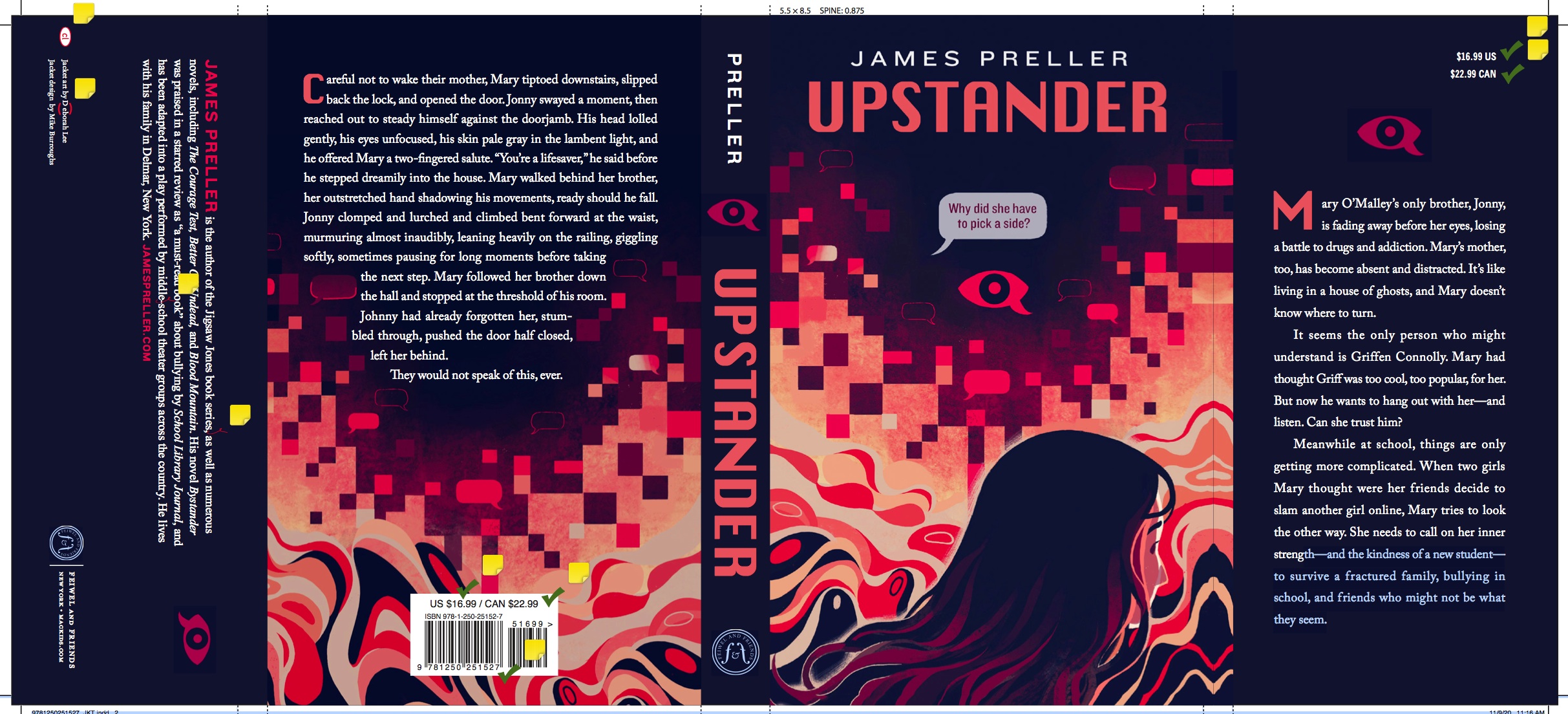
The full cover art for UPSTANDER, including flap copy, etc.

A Conversation with Judy Bradbury — former Classroom Teacher, Reading Specialist, and Author of the New “Cayuga Island Kids” Series

–
“I was deep in the trenches with kids
who struggled with learning.
We all rolled our sleeves up
and dug in
to make sense of what they had trouble grasping.
I’ve spent years around learners of all ages
and it’s the joy
of seeing someone’s eyes light up
when they achieve a goal
or nail a concept
that wins the day for a teacher.”
— Judy Bradbury


I love it when a classroom teacher steps out and decides to write for kids. I mean, teachers know, right? All the research that I do to try to get things right, these teachers experience on a daily basis. Judy Bradbury began her professional life as a classroom teacher. Since that time, Judy’s rich and varied career has centered around reaching and teaching learners of all ages (from adults all the way up to preschool). Today we’re celebrating the launch of Judy’s new chapter book series for young readers, “The Cayuga Island Kids.”


Welcome, Judy! We met at the Rochester Children’s Book Festival some years ago. At the time, I thought of you as primarily a professional books writer. An educator more than, say, a fiction writer. Forgive me if I got that wrong. 

I am actually both (and I make a mean mushroom risotto, too). 

Risotto? Wait, did you say . . . mushroom risotto? Cancel the interview! I’m hungry NOW!

Sorry, Judy, I kind of lost my head there. So, um, what were you saying?

As long as I can remember, I wanted to teach. I had an entire classroom set-up in our basement, from a chalkboard, to a plan book, to a row of those wooden desks with ink bottle holes that my father snagged when the school down the road was remodeling. I’d get all the neighborhood kids to play school, and they knew going in that I was going to be the teacher. I also wrote throughout my childhood—a letter to convince my dad to let me take more dance classes (that was probably my first persuasive essay), a “book” for my younger sister about the twin dolls she received for Christmas, letters to the editor, and more. I began my teaching career as an elementary teacher at the age of 20 and eventually became a reading teacher. I taught struggling readers in high school for many years. I also have taught at the college graduate level. My first books for children were picture books in a series that featured math in each story. I’d say that project perfectly blended my love of teaching with my desire to write for children.  

I’m always interested when a children’s writer has an academic background. You have a real sense of how children learn and what they need to succeed.

I like to think that’s true, though I don’t see myself as an academic. I was deep in the trenches with kids who struggled with learning. We all put our sleeves up and dug in to make sense of what they had trouble grasping. I’ve spent years around learners of all ages and it’s the joy of seeing someone’s eyes light up when they achieve a goal or nail a concept that wins the day for a teacher. For authors, it’s when readers connect with characters, are tickled by text, or find another solution to a problem they’re facing—one they might not have thought of had they not read that book. In many ways, books and teachers can be game changers and maybe life savers for kids.  

Though I’m eager to discuss your new chapter book series, first I’d like to learn more about your background with professional books. 

I have always had a passion for reading and reading aloud to kids. Even as a high school teacher I read to my students every day. These kids, who wouldn’t have opened a book if you promised them there was gum inside, would beseech me to continue reading when I stopped. Gradually, they’d start asking me to read stories with certain themes. I’d notice them perusing the magazines and books in my classroom library. (I had a couch in the room and I used a big portion of my yearly budget on trade books and an array of magazines that teens would be interested in reading.) As a mom, reading together with my daughter was a treasured time. We still talk about books with one another. It’s a lifelong bond we formed before she could talk that has carried on through her life. So it is sort of natural that the professional resources for educators I have written center on reading aloud to kids. They offer methods, materials, activities, book recommendations, poetry connections, and ways to connect kids with books and develop a love of reading. 

How can a parent encourage “the reader” in their child?

My advice is simple: read to your kids. Read widely. Enjoy the experience with them daily. 15-20 minutes is all you need. Have reading materials available everywhere—from bedrooms to bathrooms, to seat pockets in your car. Visit the library. Buy books as gifts. Encourage your children to explore books on their interests, and also widen their horizons by choosing books they might not have thought to pick up, but that you feel certain they will enjoy. Oh, and I tell parents this. Reading with your children goes beyond just reading picture books when they’re young. Your books for older readers, for example, would be ideal. They are excellent conversation starters. So, I say to educators and parents alike, read to kids, even when they’re in college. 

I’m curious about your work as a former “character education columnist.” You wrote about issues that centered on emotional learning? 

I did. Before it was known as social-emotional learning, this realm of interpersonal skills was called character education. Each month I wrote a column focusing on trade books that related to the month’s theme and also had a strong SEL component. I absolutely loved writing for LibrarySparks. Those articles were very satisfying to pull together. My Children’s Book Corner blog is an outgrowth of that experience. Each month I interview an author and/or illustrator of a new release and offer resources for using the book with kids. I choose books with strong SEL themes that also connect in some way to curriculum.

It seems like kids are going through so much right now that it’s almost impossible to measure the impact of their Covid experience.

I think that’s true, and it’s why I am buoyed by the reports that sales of books—especially children’s books—have risen during this unprecedented time. As readers we know that books can transport us to other places, offer us fresh perspectives, and lighten our spirits.  

Anxiety appears to be at an all-time high.

It does, and I like to think that books have helped, as have all the authors and illustrators who reached out to offer readings, virtual visits, activities, and more to schools and home-schooling parents scrambling with the new normal this past year. The kidlit community—including publishers—came to the aid of educators and families in a big way; it was heartwarming to witness such a meaningful and well-executed expression of support. It demonstrated solidarity and a willingness to assist. Uplifting moments such as these help us breathe. I hope as 2021 moves forward we are able to move away from such high anxiety and that with distance we are able to look back and find solace and takeaways in some of the silver linings in the Covid cloud. I hope we can focus on how positive expressions are an option even in distressing times: they lift us all up—those who give as well as those who receive.

So now you’ve made this exciting shift. You are the author of a new mystery series. Would it be fair to say that this series is a dream come true for you?

It is indeed a dream come true. I was always writing for children, working on my craft while I was deep into creating resource books for educators. But in reality, I didn’t have enough time to do both. I decided a few years ago to put all my energies solely into writing for children. I turned down a few requests to write another educational resource, and that was hard to do, but I had spent some time assessing my priorities. My heart was in writing for children. That gives me the most joy. So I committed to that fully. 

–

–

That’s impressive. And a great lesson in persistence and following your bliss. Please tell our readers about the books.

I’m very excited for this series! The seed of the idea for The Mystery of the Barking Branches and the Sunken Ship resulted from a feature article published in the Niagara Gazette in 2015. It detailed the discovery of a cannonball in the backyard of a resident of Griffon Avenue on Cayuga Island. He was installing a fence when he unearthed it. Cayuga Island is a small residential island a few miles upstream from Niagara Falls. Griffon Avenue is named for the Griffon—a treasure ship built in the 1600’s by Niagara Frontier explorers in the area where the cannonball was discovered. It is at the center of one of the most intriguing mysteries of the Great Lakes. The ship sank in 1679 and was never recovered. Well over a million dollars has been spent trying to locate its remains. With the backyard find, the question was, Could the unearthed cannonball be from the Griffon?

My cousin sent the Gazette article to me because I grew up on Griffon Avenue on Cayuga Island. (So did she. I guess you could say we are Cayuga Island Kids). She figured the article would interest me, and she was right! I found myself thinking about whether there was a story there for kids. Finally, I contacted the owner of the cannonball—a high school teacher in Niagara Falls with five kids. He was gracious enough to meet with me, show me the cannonball, and detail the discovery. I began to think about writing a story for kids centering on the discovery of a cannonball. I wanted it to be realistic fiction: part mystery, part adventure. The Mystery of the Barking Branches and the Sunken Ship is the result. It is set in present time on Cayuga Island and features five diverse, resourceful, likeable, and lively friends who love a good mystery and are always up for adventure. 

These kids are kind to each other. They are bright and interested in the world. How important was that to you?

You nailed it, Jimmy. It was everything to me that the overarching common quality in these diverse kids would be kindness. I am so pleased when readers get this. Yes, these kids have different interests and skills, attention spans and insights, but above all and in spite of their differences, they care about each other, support each other, have fun together, and work to solve problems together. They are friends. And they care about their world—which continues to be evident in Book 2, The Adventure of the Big Fish by the Small Creek, in which they organize a community event, and in Book 3 The Case of the Messy Message and the Missing Facts when they tackle misinformation, jumping to conclusions, glitter pens, and chocolate chip cookie recipes.

I think the illustrations capture that feeling. 

I absolutely adore the illustrator of the Cayuga Island Kids series! Gabriella Vagnoli is amazing; she “got” these kids from the first sketches she submitted when being considered by our publisher to work on the Cayuga Island Kids series. She is intuitive, fun to work with, and smart. She brings life to my characters and overall warmth to the series. I am grateful to be working with her.

You didn’t go into this thinking “series,” did you?

No, the idea to make this story book 1 in a series (The Cayuga Island Kids) grew from conversations I had with my terrific publisher Marti Gorman of City of Light Publishing. After she acquired it, she asked me to consider making it into a series. Of course I said yes. The second book, The Adventure of the Big Fish by the Small Creek, will be out in September 2021, and the third book, The Case of the Messy Message and the Missing Facts, follows in Spring 2022.

Well, Judy, thank you for stopping by. I wish you good fortune with this lovely series. Thank you, too, for all the work you’ve done supporting teachers and children in the classroom. 

Thank you, Jimmy, for inviting me to talk with you about reading and writing, The Cayuga Island Kids, and my mushroom risotto!


James Preller is the author of the Jigsaw Jones mystery series and many other books, including Bee the Change (from the “Big Idea Gang” series), All Welcome Here (a picture book of connected haiku), and Blood Mountain (wilderness thriller for middle-grade readers). Look for Upstander, a prequel/sequel to Bystander, coming this May.  And then buy it. Cheers!

–

–