“Now look, pal! I know a country where March comes in like an emu and goes out like a tapir. And they don’t even know what it means!” — John Belushi
Do you remember listening to comedy albums? I sure do. In the 60’s, I inherited some classic Bill Cosby disks from my folks, plus the great Allan Sherman. I wore the grooves off his debut record (below), which featured tracks such as “The Ballad of Harry Lewis,” “Shake Hands with Your Uncle Max,” “My Zelda,” and “The Streets of Miami.”
According to the usually reliable Wikipedia, Sherman’s 1962 disk, “My Son, the Folksinger,” became the fastest-selling album up to that time. Think about that for a minute. Imagine everyone on the show “Mad Men” running around quoting Allan Sherman. Soon after, I guess, the Beatles showed up and changed everything.
The Cosby album that I loved was “I Started Out as a Child,” and again, I listened to it over and over again. Those routines are burned into my skull: “The Giant,” “Sneakers,” “Oops!,” “The Lone Ranger,” and “Ralph Jameson.”
As I got older, I remember when Pat Sweeney and I discovered his older brother’s album, “Big Bambu” by Cheech & Chong, which came out in 1971 (“Sister Mary Elephant,” “Ralphie and Herbie”). Oh my, oh my. The original album, as I recall, came packaged with rolling papers! We didn’t even know what they were for . . . yet. Comedy was taking on a new edge, an outsider status — and we loved that subversive quality. Just listening to it felt like a small criminal act. For that reason, we loved George Carlin, who raised the stakes considerably. In 1972, he came out with “Class Clown,” featuring “I Used to Be an Irish Catholic” and, most famously, “The Seven Words You Can’t Say on Television.”
Again, it’s hard to describe the naughty thrill we felt as boys huddled around the turntable. We lapped it up and laughed and laughed, and somehow that counter-cultural strain seeped into our consciousness and shaped the way we looked at the world. Looking back now, I realize that I was at the exact right age for that moment in America, a tween when all the hypocrisy was hilariously exposed.
In 1976, when I was fifteen, I got a new album for Christmas (it was on my list, taped to our refrigerator), featuring The Not-Ready-For-Prime-Time Players. We had moved past Watergate and Vietnam, the 60’s were morphing into the Carter era and Disco was beginning to thump from speakers — as the Sex Pistols began gearing up against the bloated rock excesses of bands like Pink Floyd — and somehow this troupe of Saturday Night Live regulars had its collective finger on the pulse of America.
The stars are now legendary: John Belushi, Garrett Morris, Gilda Radner, Jane Curtin, Dan Aykroyd, Loraine Newman, and Chevy Chase — with a memorable guest appearance from Richard Pryor (“Word Association”).
The one skit that inspired me to write this today came from John Belushi, as a high-strung weatherman. Here he plays with the notion of March coming in like a lion and out like a lamb. (See full transcript below.) You can also click here to listen to a 30-second snippet of that routine, plus many other classics (“Emily Litella,” “News for the Hard of Hearing,” “Uvula,” “Dueling Brandos,” “Jimmy Carter,” and more). I loved that album, just as I loved the excitement of staying up late to watch the weekly show.
It may be an overstatement to say that comedy was dangerous, but it was definitely no longer my dad’s old Allan Sherman albums. Times had changed and it was reflected in what made us laugh.
Here’s the skit:
Chevy Chase:
Last week we made the comment that March comes in like a lion and goes out like a lamb. Now here to reply is our chief meteorologist, John Belushi, with a seasonal report.
John Belushi:
Thank you Chevy. Well, another winter is almost over and March true to form has come in like a lion, and hopefully will go out like a lamb. At least that’s how March works here in the United States.
But did you know that March behaves differently in other countries? In Norway, for example, March comes in like a polar bear and goes out like a walrus. Or, take the case of Honduras where March comes in like a lamb and goes out like a salt marsh harvest mouse.
Let’s compare this to the Maldive Islands where March comes in like a wildebeest and goes out like an ant. A tiny, little ant about this big.
(holds thumb and index fingers a small distance apart)
Unlike the Malay Peninsula where March comes in like a worm-eating fernbird and goes out like a worm-eating fernbird. In fact, their whole year is like a worm-eating fernbird.
Or consider the Republic of South Africa where March comes in like a lion and goes out like a different lion. Like one has a mane, and one doesn’t have a mane. Or in certain parts of South America where March swims in like a sea otter, and then it slithers out like a giant anaconda.
There you can buy land real cheap, you know. And there’s a country where March hops in like a kangaroo, and stays a kangaroo for a while, and then it becomes a slightly smaller kangaroo. Then, then, then for a couple of days it’s sort of a cross between a, a frilled lizard and a common house cat.
(Chevy Chase tries to interrupt him)
Wait wait wait wait. Then it changes back into a smaller kangaroo, and then it goes out like a, like a wild dingo. Now, now, and it’s not Australia! Now, now, you’d think it would be Australia, but it’s not!
(Chevy Chase tries to interrupt him)
Now look, pal! I know a country where March comes in like an emu and goes out like a tapir. And they don’t even know what it means! All right? Now listen, there are nine different countries, where March comes in like a frog, and goes out like a golden retriever. But that- that’s not the weird part! No, no, the weird part is, is the frog. The frog- The weird part is-
(has seizure and falls off chair)
—
As a final comment, and coming full circle, I have to confess to lifting some of those ideas for a brief scene in Jigsaw Jones Super Special #1: The Case of the Buried Treasure (maybe my favorite out of all the Jigsaw books, and amazingly still in print). I don’t think I consciously made that connection to Belushi and SNL, but in hindsight I can see that my roots were showing.
Setup: Jigsaw and Mila are at the bus stop, talking with Joey Pignattano. Note to teachers: the book focuses a bit on similes — it’s a minor theme running through the story — and you may find that instructive/helpful.
“I was wondering,” Joey Pignattano said to me. “What kind of animal do you think January would be?”
“What?!” I replied.
“I mean, if January were an animal, what kind of animal would it be?” Joey pondered.
“Do you understand what he’s talking about, Mila?” I asked. “Because I sure don’t.”
Mila smiled. At least I think she smiled. There was a big, fluffly scarf wrapped around her head like a hungry boa constrictor. “Maybe Joey is trying to think of a simile,” she offered.
Joey nodded gratefully. “You know how they say March comes in like a lion and goes out like a lamb? Well, I’m thinking that January would be an aardvark.”
I sighed. “Let me get this straight. March comes in like a lion. So you think January comes in like . . . an aardvark?”
“Yes,” Joey answered. “Or do you think maybe it’s more like an American bald eagle?”
“A woolly mammoth,” Mila stated.
I turned to her in surprise. “Nuh-uh,” I retorted. “January is definitely a skunk. This weather stinks.”
Sorry, you’re going to have to wait a minute. I know you’re in a big hurry and everything. People nowadays expect their blog entertainment to run like clockwork, click, click, click on that mouse. Well, go grab a seat. There’s some old Field & Stream magazines on the table.
It shouldn’t be too much longer. Please have your co-pay ready.
I’m waiting for author Kurtis Scaletta, who agreed to come here all the way from his home in Minneapolis for an interview. But you know how that goes, bad weather, costly delays: snow, ice, Vikings . . .
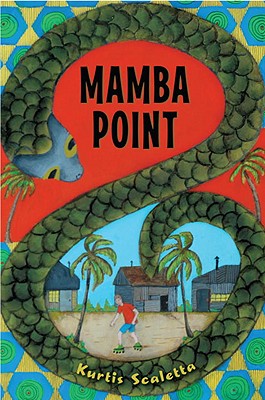
Seriously: Kurtis is an original new voice in children’s literature. His first book, Mudville, earned him wide acclaim, including being named one of the Top 10 Sports Books for Youth in 2009 by Booklist. His next book, Mamba Point, is due out in July, 2010. Even better, Kurtis claims to be writing a completely crazy book, hopefully for 2011. The truth is, I’m rooting for Kurtis Scaletta — and I know that after meeting him, you will be, too.
Hey, Kurtis. Finally, you’re here! Thanks for coming all the way from Minneapolis. Take off your wet things. Yes, the snow pants, socks, and mittens, too. I’ll throw them in the dryer while we talk. Here’s a terry cloth bathrobe and some bunny slippers.
Thanks. It’s great to be here in balmy Albany. Your orange tree is doing great. Um, do you mind turning on the A/C?
Not a problem. Are you bothered by the noise from the steel drum band in my backyard? I could ask them to stop, but like most of my neighbors in upstate NY, I could listen to “Shake, Shake Senora” all day long — and frequently do.
I actually listened to a lot of Caribbean music while writing the last one, but more Marley and less Belafonte.
Now that you mention Harry Belafonte, I remember that song gets featured nicely in Tim Burton’s “Beetlejuice.” But don’t try to sidetrack me, Kurtis. I’m onto your tricks. We’re primarily here to talk about me. I mean, Mudville. The book turns on what strikes me as just a wonderful, imaginative leap –- a rain delay that lasts 22 years. Do you remember the circumstances of getting that idea? Was it a lightning bolt moment?
It’s kinda predictable, but I was watching a baseball game that went into a rain delay and one thing led to another. I did already have some of the characters in mind and I was trying to figure out what to do with them.
But that was a fantastic idea, literally, and introduced an element of magic realism into the story. Have I got that right? Is it something you resisted at first? Or do you have an interest in speculative fiction?
I like to tread a fine line between the improbable and impossible. All of my books do it. I call them “tall tales” myself. Sounds less pretentious. I mean, I ain’t Marquez or Borges. I read a lot of speculative fiction when I was younger, especially Harlan Ellison, but I don’t really see myself in that arena.
Are you excited about Mudville coming out in paperback?
Definitely. Something about the Yearling logo makes it especially neat. I remember a lot of great books having that horsey from when I was a kid.
It’s cool because Six Innings is coming out in paperback around the same time. Come to think of it, we should be bitter rivals. Where’s my trident?
Yeah, I guess other kids baseball writers are in competition. Unfortunately, they’ve also proved to be decent dudes. I’ve met John H. Ritter, Mick Cockrane, and John Coy, and in all three cases had to pocket my shiv.
Ah, disappointing. Nothing quite beats a brawl between children’s authors. After Mudville, was there an expectation that you were going to follow with another sports book?
I did worry for a while that I would be expected to deliver a series of sports books. I figured I could write one or two, but I’m not Mike Lupica and I have a lot more interests besides sports. I remember my wife saying, “In seven years when you’re writing the lacrosse book, you’ll wonder what the heck you’re doing.” But when I started talking to my editor about ideas for a second book, she was more taken with the Africa book than other suggestions, which included sports books. So I chalk that up to landing at a great house with a great editor.
I had a similar experience after Six Innings. I remember when your lovely wife said to me . . .
She encouraged you to write the Africa book, right?
Exactly! She’s been helpful in so many, many ways. I was wondering, how do you deal with reviews? You received such wonderful notices for Mudville. Are you thick-skinned, or more of a whimpering baby like me?
I really appreciated the good reviews, and the non-mention in one major outlet actually hurt more than the slam in another. I mostly just want people to know I exist, I think.
Are you hungry? I’ve got a Yodel, a Ho-Ho, or a Devil Dog. Which one do you want? Orange soda or root beer? And yes, Kurtis, it’s raining gum drops. That’s the way we roll here at jamespreller.com.
Yeah, and I guess the definitive word is “roll,” with that kind of diet. I’ll have the Yodel and the Orange pop, thanks.
Sorry, all out. Here’s a can of tuna fish and a hammer.
I’ll bring the tuna home. My five cats will appreciate it.
Five cats? I’m not going there. You went to school for writing, didn’t you? So is it safe to assume that you believe writing can be taught?
Well, the truth is that it was 17 years ago and I mainly had to figure out what to do with myself. But I do think I benefited from working with my advisor Elaine Ford, who is a terrific writer and was very frank and helpful with her feedback on my works in progress.
I can’t deal with “frank and helpful.” I’m more of a looking-for-false-praise kind of guy.
I’ve read that a lot of sensitive geniuses are like that. Anyway, it was a long time before I actually got published, but that had to do with me and not the University of Maine. Still, I think creative writing is in a weird position where there is both an abundance of non-academic “how to” manuals and workshops but very little serious scholarship on teaching and learning and very little about best practices or pedagogy that is based on evidence. My day job in higher ed is showing here I think.
Kurtis, you have a pretty active blog and I enjoy reading it. Do you think it’s helped you professionally? And if so, in what ways?
Now I use my blog as a way to connect to readers, librarians and teachers, but the biggest help it’s given me was before I got published. Before I had my professional authorial blog I had a book review blog, now defunct, and a personal/chatty blog, also defunct. Blogging was a turning point for me as a writer because I started writing every day and I met and started talking to other writers and people who care about kids books. My day job is not in writing or literature and I was way out of the loop, so I’m glad I got connected to a community and started writing again.
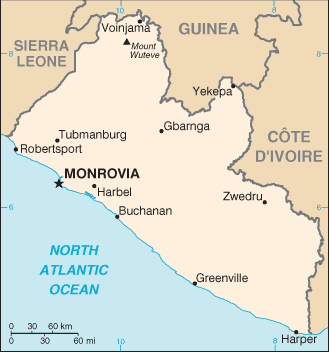
You have a new book coming out, Mamba Point, inspired in part by your experiences living in Monrovia, Liberia. That’s not near my old haunts on Long Island, is it?
Well, they’re on the same ocean, so sure. Just a skip across the pond.
So the story involves . . . dancing?
You’re just trying to get me worked up, aren’t you? One of my missions now is to get people to learn the difference between a mamba, which is a deadly snake, and a mambo, which is a risque latin dance.
A confusion that has led to many senseless deaths, I might add.
Seriously, because those mambo dances are tougher than they look!
Do not confuse the Mamba with the Mambo. Kurtis Scaletta is here to help.
Please, Kurtis, continue about your book.
Mamba Point is about a kid who moves from a small midwestern air force town to Montrovia, Liberia, in 1982. He’s worried about making new friends, just starting to get curious about those creatures called girls, and mostly wants to read comic books and play games. So far, that’s pretty autobiographical. But this kid is harassed by a black mamba… at first he’s scared out of his wits, but ends up kind of befriending it. They have a kind of connection. Then there’s a little adventure story thrown in, for good measure. Needless to say, that gets pretty far away from my own experiences. But there’s a lot of stuff that’s straight from my own life, and a lot about what it’s like for an American kid to move to Africa.
We both felt the death of J.D. Salinger, in my case more than expected. You mentioned “The Laughing Man” as your favorite Salinger story. What’s so great about it?
There’s lots to love about that story. The outer story is the typical spare, haunting modern story we all read in lit classes, but then there’s a completely ridiculous, endless, laugh-out-loud adventure story that’s narrated throughout. And there’s a pretty sweet baseball scene, too.
You’ve also written elsewhere about your admiration for the books of Betsy Byars.
You identify with the misfit, don’t you?
That was definitely what attracted me to her books. In the late 70s/early 80s when I reading her books, there was often a quirky misfit kid at the center. I really connected with them. I think she’s one of by biggest influences; I think I learned a lot of what I know about creating characters from Betsy. I really became aware of it in the middle of writing Mamba Point.
Do you read a lot of children’s books?
Yep. More than I read grown-up books. You kind of have to know what’s going on in the industry, so I read a lot so I know how to position my own books in a crowded marketplace. I do try to work in a couple of grown-up books but it’s hard to keep up as it is. Right now I’m in the middle of several books including The Evolution of Calpurnia Tate and Marchello in the Real World. They are both great.
Okay, tell me about this new “work-in-progress.” But it has to be in 139 characters or less; I’m tougher than Twitter and I think it’s time people knew it.
Wake, ME is about a small town in Maine that’s taken over by a giant fungus and couple of kids who believe it portends the town’s doom.
I want that book right now! Lightning Round: I know you’re into music, Kurtis. Give us ten songs on your imaginary mixed tape.
This one goes to eleven: “Train Whistle Blues” by Merle Haggard; “Driver 8” by R.E.M., “Play a Train Song,” by Todd Snider, “Waiting for a Train” by Jimmie Rodgers, “The Train Carrying Jimmy Rodgers Home” by Greg Brown, “Trains” by Ryan Adams, “Let the Train Blow the Whistle” by the Old 97s, “Freight Train Blues,” by The Weary Boys, “King of the Road” by Roger Miller, “Downbound Train” by Bruce Springsteen, and “Downtown Train” by Tom Waits (not Rod Stewart). Sorry, I have a one track mind.
Got any Oscar favorites? Best Picture of the Year?
I seriously love “Up.” It’s probably the only nominated movie I saw, and I don’t think it’ll win best picture (just best feature-length animated film), but the first 15 minutes of that movie are beautiful. It’s a really wonderful and imaginative story after that, and the dog was great, but it’s that long prologue that gets to me. Sniff. That being said, the smart money is on “Avatar.”
I thought the opening minutes of “Up” were extraordinary, compressed storytelling. Beautiful. After that, I didn’t care so much. I’m going to go with “The Hurt Locker.” Five favorite blogs?
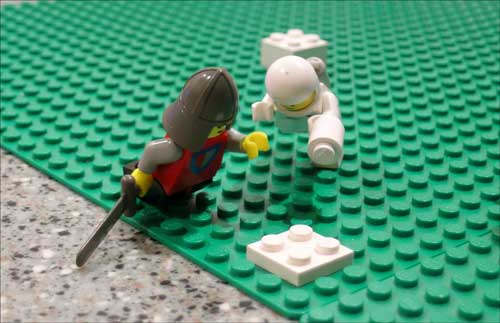
Oh, I loved bat-girl! “Less stats, more sass.” She also did those incredible Lego recreations of great (and not-so-great) moments in Twins baseball history.
I’m glad she’s appreciated even outside of Twins’ territory. You might also know her alter ego, Anne Ursu, who’s written a terrific fantasy series for kids. My wife says her grown up books are good, too, but I don’t really read grown up books.
I’m your reverse in that way; I read mostly adult.
Besides the time issue, I’m like an open pitcher of milk in the refrigerator. It’ll take on the taste of whatever’s around it. So when I read something, especially something really stylized, it affects my own voice. So I have to avoid getting deeply immersed in a novel when I’m writing. And these days I’m almost always writing. Kids books, I can usually read in a day, and shake it off.
Interesting, and again, that’s the exact reason why I don’t read them — especially when I’m deep into my own writing, when it’s an absolute no-go for me. We’re like two peas living in completely different apartments.
I worry about having too much consciousness about the marketplace. You start to hear about what sells and what doesn’t, and become too familiar (I think) with the conventions of the business — a business that’s often predicated on ripping off ideas from the bestseller list. Follow that to the end and you’re writing about a boy wizard with a sassy friend who falls in love with a smoldering vampire who’s really a geek who . . . and on and on. It seems like too much information can get in the way of originality. Thoughts?
It’s more about voice than subject matter. I’ll read a collection of essays by David Sedaris and start writing like David Sedaris, even though I’m still writing my own completely original work about the boy wizard who falls in love with a fairy, but to win her love he has to battle the vampires in dystopia with his werewolf buddies and his pet dragon. Or I’ll read Cormac McCarthy and start writing like Cormac McCarthy, even though I’m working on a tween romance.
You know what I like about you, Kurtis? Even though you strike me as having this heightened awareness of the business, you went out and wrote Mamba Point, a personal, deeply-felt story that has NOTHING to do with the trends of the marketplace. Last I looked, kids were not clamoring for more books set in Liberia. Yet you wrote from the heart. And that sound you hear is cheering, my wishing you success with this story.
Okay, whew. I hate it when Jamespreller.com gets all soggy. It seems like we’ve drifted a fair distance from our original list of bloggy goodness. By my count, you’ve only listed four.
Well, you know, I know a billion writers with blogs, but yours stands out. A newby writer like me learns stuff about the profession of writing. I also like the reader mail, which I’d love to do myself but I don’t get enough of to do. I think your blog is a good example of what writer/bloggers should do, connecting with teachers and readers. So much of it ends up being us writers just talking to each other.
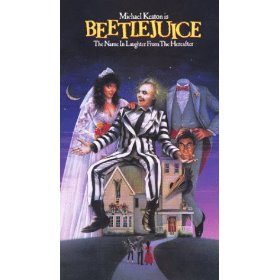
That’s very kind of you to say, thanks. But I can tell from the buzz of my Kenmore dryer that your clothes are dry and it’s time for you to depart balmy Albany — alas, before you had time to visit nearby Cohoes, just ten miles north on 787, alleged home of Kilgore Trout — to brave the Minneapolis winter. As a parting gift, please accept this rare, 1988 VHS edition of “Beetlejuice.” It may look like it’s just a crummy old tape found in the bottom of my closet, but that doesn’t mean it’s not true.
Um. So, thanks for the interview . . . yeah. Are you sure you don’t have an extra Yodel?
Oh, fine. Knock yourself out.
——-
FOR MORE INTERVIEWS . . .
If you enjoyed this interview with Kurtis Scaletta, you might not like the others. They aren’t very good.
“I hope to hell that when I do die somebody has the sense to just dump me in the river or something. Anything except sticking me in a goddam cemetery. People coming and putting a bunch of flowers on your stomach on Sunday, and all that crap. Who wants flowers when you’re dead? Nobody.” –J.D. Salinger, The Catcher in the Rye
I guess I’ll have to pull this one off the shelf again — and read it yet another time — and always with awe. What a voice. Rest in peace, Mr. Salinger. And thank you.
I understand that in some exotic cultures poetry — actual poetry — is celebrated on Fridays. For example: here, and here, and here. This week I decided to play along. But with a difference. Here at JamesPreller.com, we’re all about winning. So I’m getting a head start.
Seriously, if you know a teacher, you might want to share this.
Here’s slam poet Taylor Mali answering the question, “What do teachers make?”
Mali is a vocal advocate of teachers and the nobility of teaching, having himself spent nine years in the classroom teaching English, history, math and SAT test preparation. He has performed and lectured for teachers all over the world, and his New Teacher Project has a goal of creating 1,000 new teachers through “poetry, persuasion and perseverance.”
The slim book does not need my praise, so I’ll refrain from making a testimonial. But every once in a while I’ll remember that it exists, usually by virtue of keeping the physical object in plain sight. Lately it’s been on my desk, and I’ll sometimes page through it in a disorganized way.
My 1962 edition of The Elements of Style by William Strunk, Jr. & E.B. White is a lean 71 pages (each revised edition gets longer, alack) with generous open spaces at head, foot, and margins. A paradigm of economy, readability, and clarity.
For the purpose of this blog, and for you, Dear Reader, as well as for my own edification, I decided to put down here the list of 21 reminders featured in Chapter V: An Approach to Style.
Before we get to that, I liked this prefatory passage:
Writing is, for most, laborious and slow. The mind travels faster than the pen; consequently, writing becomes a question of learning to make occasional wing shots, bringing down the bird of thought as it flashes by.
In the following, I’ll retype Strunk & White’s reminders accompanied by a salient line or two from the relevant text. For fuller context and clarifications, you’ll need to pick up the book.
1. Place yourself in the background.
“. . . to achieve style, begin by affecting none — that is, place yourself in the background. A careful and honest writer does not need to worry about style.”
2. Write in a way that comes naturally.
“The use of language begins with imitation . . . it is almost impossible to avoid imitating what one admires. Never imitate consciously, but do not worry about being an imitator; take pains to admire what is good.”
3. Work from a suitable design.
“You raise a pup tent from one sort of vision, a cathedral from another. This does not mean that you must sit with a blueprint always in front of you, merely that you had best anticipate what you are getting into.”
4. Write with nouns and verbs.
“In general . . . it is nouns and verbs, not their assistants, that give to good writing its toughness and color.”
5. Revise and rewrite.
“Remember, it is no sign of weakness or defeat that your manuscript ends up in need of major surgery. This is a common occurrence in all writing, and among the best writers.”
6. Do not overwrite.
“Rich, ornate prose is hard to digest, generally unwholesome, and sometimes nauseating.”
7. Do not overstate.
“A single carefree superlative has the power to destroy, for the reader, the object of the writer’s enthusiasm.”
8. Avoid the use of qualifiers.
“Rather, very, little, pretty — these are the leeches that infest the pond of prose, sucking the blood of words.”
9. Do not affect a breezy manner.
“The breezy style is often the work of an egocentric, the person who imagines that everything that pops into his head is of general interest and that uninhibited prose creates high spirits and carries the day.”
10. Use orthodox spelling.
“The language manages somehow to keep pace with events.”
11. Do not explain too much.
“It is seldom advisable to tell all. Be sparing, for instance, in the use of adverbs after ‘he said,’ ‘she replied,’ and the like . . . Inexperienced writers not only overwork their adverbs, they load their attributives with explanatory verbs, sometimes even with transitive verbs used intransitively; he consoled, she congratulated. They do this, apparently, in the belief that the word ‘said’ is always in need of support, or because they have been told to do it by experts in the art of bad writing.”
12. Do not construct awkward adverbs.
“Do not dress words up by adding ly to them, as though putting a hat on a horse.”
13. Make sure the reader knows who is speaking.
“Dialogue is a total loss unless you indicate who the speaker is.”
14. Avoid fancy words.
“Do not be tempted by a twenty-dollar word when there is a ten-center handy, ready and able.”
“Never call a stomach a tummy without good reason.”
15. Do not use dialect unless your ear is good.
“The best dialect writers, by and large, are economical of their talents; they use the minimum, not the maximum, of deviation from the norm, thus sparing the reader as well as convincing him.”
16. Be clear.
“When you say something, make sure you have said it. The chances of your having said it are only fair.”
17. Do not inject opinion.
“Unless there is a good reason for its being there, do not inject opinion into a piece of writing. We all have opinions about almost everything, and the tempation to toss them in is great . . . Opinions scattered indiscriminately about leave the mark of egotism on a work.”
18. Use figures of speech sparingly.
“The reader needs time to catch his breath; he can’t be expected to compare everything with something else, and no relief in sight.”
19. Do not take shortcuts at the cost of clarity.
“The longest way round is usually the shortest way home, and the one truly reliable shortcut in writing is to choose words that are strong and sure-footed, to carry the reader on his way.”
20. Avoid foreign languages.
“Write in English.”
21. Prefer the standard to the offbeat.
“The young writer should learn to spot them — words that at first glance seem freighted with delicious meaning, but that soon burst in air, leaving nothing but a memory of bright sound.”
“‘But,’ the student may ask, ‘what if it comes natural to me to experiment rather than conform? What if I am a pioneer, or even a genius?’ Answer: then be one.
And lastly, from the book’s penultimate paragraph:
The whole duty of a writer is to please and satisfy himself, and the true writer always plays to an audience of one.