

Archive for Around the Web

BEFORE YOU GO: Running & Writing & Books (2 Quick Excerpts)
Over the past year I’ve twice crossed paths with a near-legendary editor, the much respected Christy Ottaviano. She works at Macmillan and, no, Christy can’t be blamed for any of my books. I follow her page on Facebook and just generally have a good feeling about her as a person. She seems nice.
On Monday, Christy wrote this:
I’ve been running all my adult life. I used to do it primarily for exercise, now I find I do it mostly for the peace of mind it gives me. My love of running has gotten more intense with age, perhaps because it is one of the few times during the day when I feel free of technology and the pressures of work and home. When I think of all the places I’ve visited or lived over th…e years, what’s imprinted in my mind in addition to the hotels, apartments, and houses are the various running routes I’ve repeatedly trekked — Cleveland Circle Reservoir in Boston; Henry and Clinton Streets in Carroll Gardens, Brooklyn, and now the small neighboring town on the water near where I live in Connecticut. In our busy lives, we are all running from here to there, so it’s rather ironic to me that running is exactly what I do to take my mind off all the running around. How does this post connect to writers? In all my time publishing books, I’ve only had the pleasure to edit one novel where the protagonist is a runner. Is that because running appeals to a more solitary adult sensibility? Probably, but it’s a fact that there are more teen runners now than ever before so young adults are happily embracing the activity. Maybe there’s a way to put their passion for the sport in your stories. For all the writers out there — just some food for thought…
I replied that the main character in BEFORE YOU GO is a runner.

Here’s two brief excerpts — brief, because we don’t wish to bore anyone here at jamespreller dot com! — excerpts, because we (the intrepid staff here at jamespreller dot com!) don’t want anybody to think I’m making up this running thing. Of course, you might say I make things up for a living. But I’m not making it up about having made something up about running. I really did make it up!
What? Nevermind!
First excerpt, pp. 104-105:
Jude hit the snooze button three times before rising. He felt sour, his mouth stale and parched, his teeth wearing sweaters after a night of too much rum and coke and heartache. The house was silent. Jude shambled into the bathroom for a long, reviving shower. It helped. Failing to find a fresh work shirt, Jude fished the cleanest dirty shirt from the hamper. Sniffed it, frowned: pretty ripe. The shirt matched his mood. Mad at the world.
In the kitchen, Jude gulped a tall glass of orange juice. A note on the counter informed him that his father had gone out for a long, slow run. His father ran to get away from it all, yet despite all the hours logged and miles slogged, he always returned to the same place; the road never rose to lift him to some new, shimmering elsewhere.
Jude considered himself a different kind of runner entirely. First of all, his father jogged; Jude ran. Big diff. His father was one of those old guys who stopped after his run, winded and panting, two fingers on his neck, counting the beats of his pulse while he stared at the watch on his wrist. Goofy shit, if you asked Jude. A lot of times, Jude headed out in just a pair of shorts. No shirt, no shoes, a barefoot runner in the burbs. Nobody could say nothing, because Jude was faster than them all.
——
Second excerpt, pp. 163-164, after an argument with his mother:
And he ran. Barefoot. Ran without hope, without destination . . . ran to burn off the anger, ran as if he were chased. He started out too fast, puffing hard like a sprinter, churning through the changeless sprawl, the suburban streets named after Civil War generals, Sherman and Grant, Thomas and Meade. Then came the streets with the names of colleges, Princeton and Adelphi, Yale and Amherst. Finally his gait evened out, the strides became long and powerful, his breathing regulated. Becalmed. He stopped for a moment, flicked a thumb across his iPod, found Arcade Fire, and turned it up loud. You don’t know how it feels, he thought. How it feels to be me.
)
CVS, Please Stop the Paper Waste: My Receipt Was 40 Inches Long!
I recently picked up a few items at our local drugstore. The cashier asked if I had my CVS card to scan? I handed it over, zap. Did I want to give $1.00 to ALS? Not today, thanks. Would I like to update my email information to receive more discounts. No, thank you. Thinking: I haven’t changed my email info since the early ’90s. AOL or die!
I paid in cash, and received my change along with a receipt that was longer than my leg.
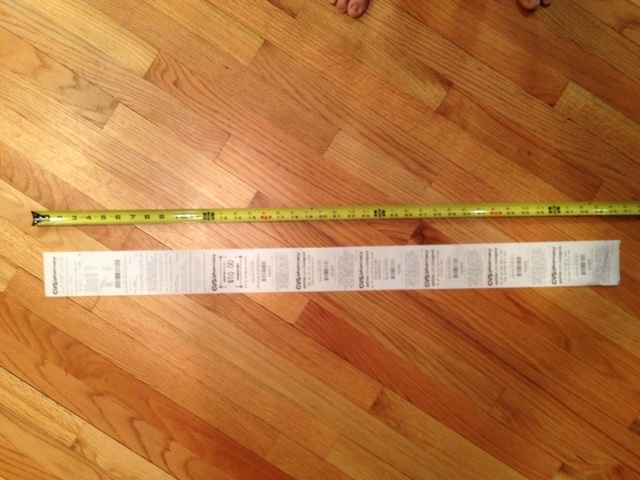
Here, look closer:

Evidently, this is part of a marketing strategy for CVS — bang a bunch of discount coupons on the end of every receipt handed out. Do you know what happened to mine?

Then it will go in the recycling bin.
We are living in a time when enlightened individuals and progressive businesses are attempting to reduce paper waste. Folks bring reusable bags to the market. My publisher, Macmillan, no longer prints catalogs — they’ve gone digital. Those are two small examples.
And then we have the insane, irresponsible receipts at CVS.
Please note:
“Worldwide consumption of paper has risen by 400% in the past 40 years leading to increase in deforestation, with 35% of harvested trees being used for paper manufacture. Logging of old growth forests accounts for less than 10% of wood pulp, but is one of the most controversial issues. Paper waste accounts for up to 40% of total waste produced in the United States each year, which adds up to 71.6 million tons of paper waste per year in the United States alone.”
Consider These Not-So-Fun Facts from the Clean Air Council:
- The average American office worker uses about 500 disposable cups every year.
- Every year, Americans throw away enough paper and plastic cups, forks, and spoons to circle the equator 300 times.
- After Ireland created a 15-cent charge per plastic bag in 2002, bag consumption dropped by 90 percent. In 2008, the average person in Ireland used 27 plastic bags, while the average person in Britain used 220. The program has raised millions of euros in revenue.
- The state of California spends about 25 million dollars sending plastic bags to landfill each year, and another 8.5 million dollars to remove littered bags from streets.
- Every year, Americans use approximately 102.1 billion plastic bags, creating tons of landfill waste.
- The average American uses about the equivalent of one 100-foot-tall Douglas fir tree in paper and wood products each year.
- The average office worker in the US uses 10,000 sheets of copy paper each year. That’s four million tons of copy paper used annually. Office workers in the US generate approximately two pounds of paper and paperboard products every day.
- The estimated 2.6 billion holiday cards sold each year in the U.S. could fill a football field 10 stories high.
- Between Thanksgiving and New Year’s, an extra million tons of waste is generated each week.
- 38,000 miles of ribbon are thrown away each year, enough to tie a bow around the Earth.
- In 2008, Paper and paperboard made up 31% of municipal waste.
- In 2008, the average amount of waste generated by each person in America per day was 4.5 pounds. 1.1 pounds of that was recycled, and .4 pounds, including yard waste, was sent to composting. In total, 24.3% of waste was recycled, 8.9% was composted, and 66.8% was sent to a landfill or incinerated.
While I’m at it, here’s some more FACT ABOUT PAPER AND WASTE (click here for the much, much longer list — but don’t print it unless you really have to!):
- Average worldwide annual paper consumption is 48 KG per person with North America accounting for
- over 1/3.
- Asia has surpassed Western Europe in paper consumption and will soon surpass the United States.
- Although paper is traditionally identified with reading and writing, communications has now been
- replaced by packaging as the single largest category of paper use at 41% of all paper used.
- The paperless office, once predicted as a result of information technology (IT), has not transpired.
- Industry analysts estimate that 95% of business information is still stored on paper.
- Recycling 54 KG of newspaper will save one tree.
- Paper manufacturing is the 3rd largest user of fossil fuels worldwide. Paper manufacturing is the largest industrial user of water per pound of finished product.
The average American uses more than 748 pounds of paper per year.
The US uses approx. 68 million trees each year to produce 17 billion catalogues and 65 billion pieces
of direct mail.
The average daily web user prints 28 pages daily.
115 billion sheets of paper are used annually for personal computers. - 700 pounds of paper are consumed by the average American each year.
- 10,000 trees are cut down annually in China to make holiday cards.
It’s a beautiful planet. And our only one.


The Problem with Math Problems, Common Core, Standard Tests, etc.

I’ve been meaning to write an epic post recounting my visits to schools this past year. The things I’ve seen, the things I’ve learned, but gosh, I keep watching it slide down my list of things to do.
In short:
* It’s INSANE that elementary schools don’t have full-time librarians. Crazy, backwards, tragic, stupid, ill-conceived.
* Writing that above bullet point, I know that I should try to do more.
* April used to be the first month that filled up with school visits. It was the perfect time of year for it. Nowadays all I hear after we take out the calendars, “=April is out — that’s for testing.” Okay, I’ll admit that I have a bias, but what we are saying is, “In April, there’s no time to celebrate literacy and inspire a love of reading and thinking and writing — we’ve got to give hours upon hours of lousy tests instead.”
* When educators rally around the state capitol in Albany and chant, “Let us teach, let us teach, let us teach!” that’s just a really sad thing. I wish that we would, you know, listen to them.
Some links:
* An ALA-supported education bill that aims to help support school libraries: “For too long, research has shown that students have a better chance of succeeding academically when they attend schools with strong library programs,” said Emily Sheketoff, executive director of the American Library Association’s Washington Office. “This bill will ensure that students will have access to professionals who can help them make connections between subject areas, retrieve information, and think independently.”
* I’m so sorry I missed this important public statement, but was off coaching a ballgame. A sincere “thank you” to everybody who showed up to fight the good fight.

* NY Principals: Why new Common Core Tests failed.
We New York City and Metropolitan Area Principals hold ourselves accountable to ensuring that all of our students make consistent and meaningful academic progress. Although we are skeptical of the ability of high stakes tests alone to accurately capture students’ growth, we understand a system’s need for efficiently establishing and measuring milestones of learning.

Quick Link: Baseball, Childhood Cancer, and a Family Comes Full Circle
This is a story I’ve told before, 4-5 years back, but recently retold over at my other blog, 2 Guys Talking Mets Baseball. The name pretty much says it all.
So I’ll direct you to it. Right this way, people —> Click on this link right here.
A sample of what you’ll find there, my oldest boy, my beautiful wife . . .
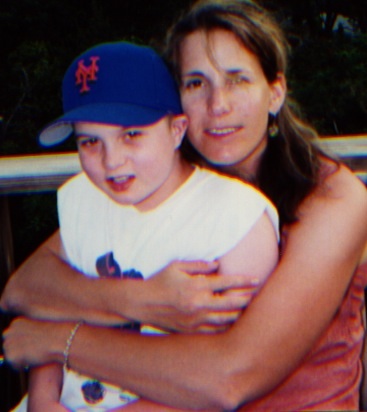
Standing within the gray, concrete hallways of Shea Stadium, I couldn’t help but think of my mother, and how our love of baseball had brought us to this singular moment. My boy, sick with cancer, smiling weakly into the camera, a Sharpie and a signed baseball in his hand. All those games we had watched together, our spirits dashed by defeat and lifted in victory. All of that time and energy invested, all of that life we poured into the game — all of it, truth be told, a little absurd. After all it is just a game. Not life, not death, and certainly not childhood cancer. But standing in that basement of old Shea Stadium, I knew with certainty that it all had been worth it. We will always be grateful to the Mets organization for the kindness of that day.

Category: Around the Web, Family, New York Mets / Tags: 2 Guys Talking Mets baseball, James Preller Mets, Preller Family