Archive for Current Events

Dick Robinson, Chairman, President, and CEO of Scholastic (1937-2021): A Few Memories from the Wayback

I felt a pang when I learned of the passing of Dick Robinson, chairman, president, and CEO of Scholastic. Part of that was nostalgia for a long ago time in my life, but also that I had interacted with him, saw him in the halls and elevators, and respected him.

After a hazy period of cutting lawns and waiting tables, I got my first real job after college in 1985 at Scholastic, Inc., on 730 Broadway, two blocks east from Washington Square Park. I was hired as a junior copywriter to write the SeeSaw Book Club. I was also assigned the role of copywriter for the Text Division, run by Eleanor Angeles and Loretta Marion. I wrote the bulk of their catalog copy, plus ads and direct mail packages.

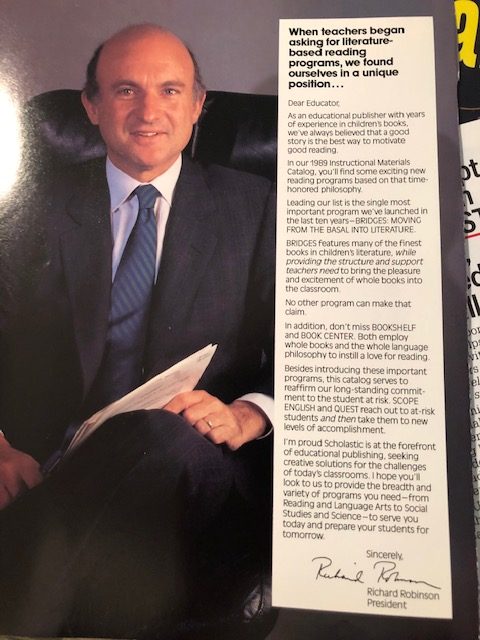
As it happened, it was a tradition for Dick Robinson to write an intro letter on the inside cover of the main catalogs. Only he didn’t write the letters. He rewrote them.

I was elected to be the guy — a young whelp earning a cool $11,500 a year — who would write Dick Robinson’s letters. I’d navigate the long hallway to his office on the 10th floor for a brief discussion. Just the two of us. I wasn’t nervous; curiously, he seemed more nervous than me. Dick Robinson wasn’t an easy conversationalist, nor did he possess a breezy charm. But he was always kind, authentic, never intimidating. There was nothing to be nervous about. We’d talk a bit — he had a deep love for the Magazines Division, and Scope texts, which his father pioneered, and the company’s overarching mission — and I’d go off and try to write something that wasn’t too terrible.

The next day I’d drop a couple of not-altogether-awful, double-spaced pages into his mailbox.

Then he’d rewrite the crap out it.

But he was decent about it, always with a smile, his pen moving across the pages, crossing out sentences, tweaking phrases, inserting a new introduction, gently cutting my work to ribbons. 

For my first few years with Scholastic — and this became a regular joke with my pals Holly Kowitt and Craig Walker — whenever I’d see him in the elevator he’d turn to me and say, “Hello, Jim. Writing lots of copy?”

I always assured him that I was.

Reams of it.

Out the wazoo.

So I got to know the man in that peculiar fashion. Not as the decision-maker at the head of the table. I wasn’t privy to that side of his business acumen. I only met the gentle, halting, vaguely ill-at-ease man who walked the halls like an avuncular school principal. He knew everyone’s name and, mnemonically, I believe, remembered what we did.

In my case, I imagine that his interior Rolodex read: Jimmy Preller, writes copy.

I remember overseeing a poster that showed a map of the world. It was another project for the Text Division. There was some copy in a sidebar and the poster was used as a promotional giveaway for a new Social Studies textbook. Unfortunately there was a typo in it and Dick was the one — of all people! — who found it. Turns out we spelled hungry wrong. The country. Ugh. (It’s Hungary, grrrr.) So that sucked. Dick wasn’t mean about it, he never raised his voice, but I felt bad and he wanted me to feel bad, too. I still do feel embarrassed by it, that dopey mistake.

I let the old man down.

Not long before I arrived at Scholastic, in 1985, there had been a tough profile on Dick in The New York Times Business Section. Scholastic struggled in the early 80s. There were missteps and miscalculations and significant losses. The company went all-in on computing a little too soon, and ineffectually. The Times article, as I recall, brutally summed it up as: He took over his father’s company and flushed it down the drain.

It was rough stuff.

I think about how that article must have devastated him. A knife to the heart. Public humiliation from the old Gray Lady, the voice of record, The New York Times. And what did Dick Robinson do? He quietly persevered. He made some great hires. He brought in Dick Krinsley, who in turn hired Barbara Marcus (my first boss), and Jean Feiwel, a dynamic combination, to take over Book Group. He leaned more heavily on Ed Monagle and Dick Spaulding. I’m sure there were other people that I’ve failed to mention who played instrumental roles. Together, that small, tight, smart group helped turn the company’s fortunes around.

Dick Robinson, justly protective of his family’s legacy, built a business that would have made any father proud.

He did good.


A Guided Tour of Delmar’s Little Free Libraries

Wouldn’t it be cool, I thought, if somebody could make a map of my town’s Little Free Libraries?

After all, we love ’em, right?

I see them here and there in a random, disorganized way. Where are they exactly? And how many are there?

So I did a little crowdsourcing — and internet sleuthing — and came up with a starter list. I doubt that it’s complete. And one could certainly make the argument that such a list should include other nearby, closely connected neighborhoods of Bethlehem proper.

But I’m happy to just start the ball rolling. If you know of another neighborhood LFL that I’ve missed, please let me know and I’ll include it here in what could ultimately become a Master List.

As for that nifty map? Sorry, I don’t have those cartography skills. Truth is, I hardly have any skills at all!

HERE’S WHAT HAPPENED

For the tour, I grabbed a bunch of books that were around the house, since the concept of a LFL is to “Take a Book, Leave a Book.” Because we recently had a “bear scare” in our little town, I figured that young readers might be primed for Jigsaw Jones: The Case of the Bear Scare. Besides, I had a pile of ’em doing nothing in a closet.


ADDENDUM NOTE (6/18/21): I’ve updated this list with 4 more LFLs, addresses at the bottom of the tour. 

14 PARTRIDGE ROAD


A lovely beginning. This LFL contained almost exclusively adult titles. Neat and tidy. As our tour proceeds, I’ll refrain from rating individual libraries. I imagine that the quality of the books ebb and flow, according to usage, though I am convinced that the best LFLs are actively curated. Some old titles are better tossed in the trash, especially if no one grabs one after a period of time.

9 CATHERINE STREET


Gorgeous — I wish my house looked this good. And during my visit, this fine libary featured almost exclusively children’s books! Perfection.

101 ADAMS PLACE


There’s a fun hit-and-miss quality to visiting a LFL, not unlike stopping at a garage sale or thrift shop. Sometimes you hit gold, other times you decide to check back another day. Regardless, I’m always happy to leave a book — and grateful to the owners for sharing these libraries with our community.

160 ADAMS PLACE


A surprisingly high percentage of these people are my friends. Maybe not that surprising, since I’m drawn to book people and, of course, these LFLs are in my purview. Here’s an example of the odd kind of book you can find. Nothing I’d ever search for, or even think I’d like, but interesting. I didn’t take it home — but I almost did.

107 ELSMERE AVENUE

This is on the corner of Elsmere and Norge. I drive past it all the time. The trick is to turn on Norge, climb out of the automobile, and take a look. Or, better yet, walk or take a bike. Worth a stop.

25 LINDA COURT


We don’t play favorites here at James Preller Dot Com. But this is the sweetest LFL I came across on the tour. Good vibes abound, you can sense a child’s touch. Also, a different approach in the construction. It looks . . . portable!

18 WOODRIDGE ROAD


Beautifully constructed and curated with a nice balance of children’s and adult’s, literary and popular. Big bonus for the tasteful peace sign attached to the side. Just the right touch. Book people are the best people.

24 TIERNEY DRIVE


Must have been my lucky day, because I coveted quite a few titles in this LFL. Excellent balance of children’s books on the top shelf, literary fiction for adults in the main section. I was tempted to saw it off at the base and carry it home. But that would have been wrong. Right?

1 JUNIPER DRIVE

.       

An interesting location, in front of Adams Station Apartments. The books here were, on this day, very much the type that are consumed by avid readers. My money says this is a much-frequented LFL.

RAIL TRAIL, ADAMS STREET. & HUDSON AVENUE


I don’t know who takes care of this LFL — but what an awesome location. Next time you go for a walk on the Rail Trail, or a jog, bring a gently used (and enjoyed) book that’s sitting around your home. Trade it in for something new.

311 KENWOOD AVENUE

Fancy lighting, don’t you think? This one is super close to the middle school, sure to get a lot of readers passing by. If you’ve good books for grades 6-8 readers, this is the place where you could donate a few.

51 FAIRWAY AVENUE

This is the last stop on our tour, 12 Little Free Libraries in all. This one has no window, no sign — but don’t let that fool you. It’s yet another LFL, sharing books with anyone who stops by, complete with a nearby bench where weary travelers can read, rest, and reflect. The owners will even let you jump in their pool. Well, maybe you ought to ask first.


THUS ENDS THE TOUR . . . 12 LITTLE FREE LIBRARIES IN ALL . . .

BUT MOSTLY, ALL I REALLY WANT TO SAY IS . . . 

THANK YOU!


OWNERS, CARETAKERS, NEIGHBORS, READERS,

FOR PROMOTING LITERACY IN OUR COMMUNITY,

FOR BRINGING BOOKS FRONT AND CENTER,

FOR SHARING THE LOVE OF READING,

FOR DOING ONE SMALL THING 

TO MAKE OUR TOWN A LITTLE BIT BETTER. 


ADDENDUM, UPDATE!

I’ve learned of four more local Little Free Libraries at the following locations: 

93 Winnie Street

12 Plymouth Avenue

192 Adams Street

Rail Trail II: A big one on the Trail at the main parking lot off Kenwood, near MegN’s and the New Village Deli.


POSTSCRIPT I


Here’s the result of my haul that day. I guess I have some reading to do. And when I’m done, I’ll pass the books along to a LFL near you.


POSTSCRIPT II


Our neighborhood had a black bear (or two!) visit the area recently. The above photo was posted by a resident. Yes, bears love birdseed and compost heaps. Events like that inspired my book, Jigsaw Jones: The Case of the Bear Scare, which is the title I stuck in every neighborhood Little Free Library. Watch out for those clues! The bear scat is highly suspicious . . . 

Lois Ehlert, Remembered (1934-2021): A Tribute

“I’m trying to use my art
to teach a little — making children
a little more appreciative
of the flowers they can see,
or helping to open up their eyes
to the beautiful birds
flying overhead.”

— Lois Ehlert


I learned today that Lois Ehlert has passed away. Born in Beaver Dam, Wisconsin, on November 9, 1934, Lois went on to do great things as an author and illustrator of children’s books.

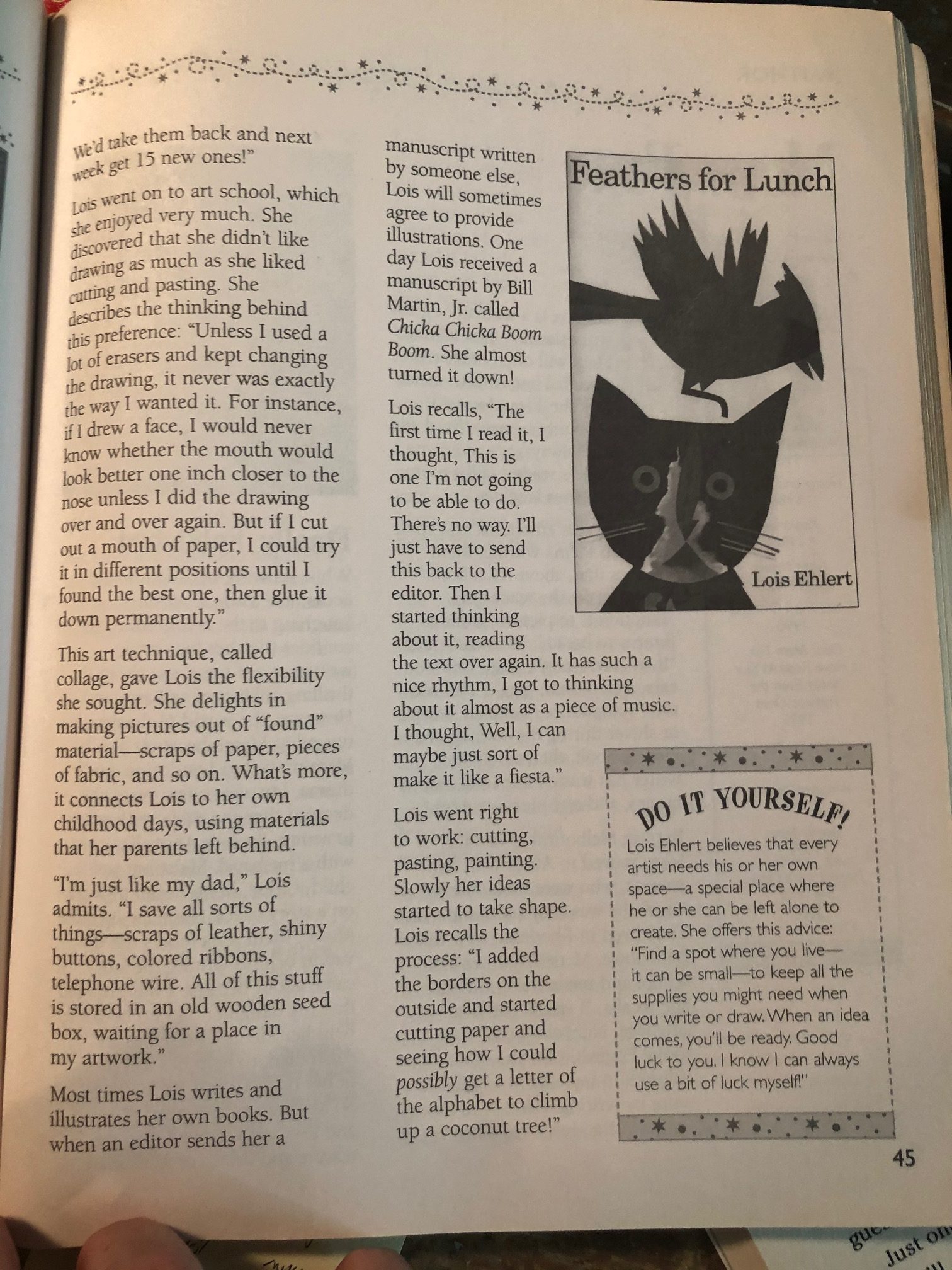
I had the privilege of interviewing Lois for a book almost 30 years ago. The interview was updated at a later point, around 2000, for the cleverly titled, The Big Book of Picture-Book Authors & Illustrators. I used to spy that book on the shelves in classrooms during school visits, though I suspect that’s hardly true anymore. Are teachers as interested in children’s books as they used to be? I’m not so sure.

Anyway, here’s the two-page spread on Lois as it appeared in that collection of profiles. The writing is directed at dual audiences: educators as well as interested young readers. 

As a writer, it’s often a little scary to go back and look at old writing. Will it be embarrassingly bad? But in this case, I felt none of that. I was simply heartened to remember Lois Ehlert again, to bring those great books back to mind, and appreciate the fine work she did.

May her wonderful books, full of color and beauty and respect for the natural world, live on.


(Sorry for the crummy photos; it’s how I roll.) 

Revisiting THE FIVE CHINESE BROTHERS — A Chinese American Perspective with Phoebe Yeh, VP and Publisher at Crown Books

We recently witnessed the kerfuffle regarding Dr. Seuss Enterprises’ decision to no longer publish six titles that it deemed offensive. It brought to mind an experience I had back in the late 1980s when I worked at Scholastic. So I reached out to my old friend, Phoebe Yeh, to ask her about it. Like me, Phoebe was young at the time, an editorial assistant for our beloved friend, Craig Walker. These days Phoebe is kind of a big deal, a widely respected VP/Publisher of Books for Young Readers at Crown, an imprint of Random House Children’s Books.

Honestly, I’m just grateful she answered my email. 

Jimmy? Jimmy who?”


Phoebe, thanks for taking some time out for this topic. I know that it’s close to your heart. We met in 1986, back when I was a junior copywriter at Scholastic and you were hired as Craig Walker’s editorial assistant. We were both earning salaries in the (barely) five figures. I remember talking with you about the 1938 book, The Five Chinese Brothers by Claire Huchet Bishop. It was your mission in life, it seemed, to produce a new, authentic retelling of that ancient Chinese folktale. You were deeply offended by Kurt Weise’s illustrations. Can you remember what your feelings were at the time?

Yes, indeed.  And even though more thirty years have passed, my opinion about The Five Chinese Brothers hasn’t changed. Full disclosure: I grew up reading this book. As a child, I took the illustrations for granted, the slanty eyes, the yellow skin tone.

Fast forward. I’m basically in my first real job after college. I think I must have had a lot of nerve. I marched myself into my boss’ office even though I knew I was going to complain about a book that sold like crazy for See Saw Book Club (kindergarten/first grade readers).

I shared my reservations with Craig Walker — also sharing that it wasn’t like the author, Claire Bishop, had even come up with the premise. I had read Chinese versions of the story about the brothers with the super powers but Bishop had added whipped cream or some such to her version. And everyone knows, many Chinese people are lactose intolerant so adding this detail made no sense.


Craig was incredibly supportive and felt that we should bring up the idea of publishing a new version with our editor-in-chief, Jean Feiwel.  The Seven Chinese Brothers by Margaret Mahy, illustrated by Jean and Mou-sien Tseng, became my first acquisition as an editorial assistant (still virtually unheard of -– usually you don’t start acquiring until you are, at least, an assistant editor).  And prideful though it sounds, this version is still in print.

What was challenging for me was that I LOVED that book as a kid. It was such a great story. One brother drinking the whole ocean! Another brother with the unbreakable iron neck! I read it over and over again. And I wasn’t the least bit offended by any of it! So talking to you, on one level, I could intellectually understand where you were coming from . . . but I didn’t feel you, if you know what I mean. It was a long time ago, I had a lot to learn (still do!), and I wondered at first if perhaps you might be over-reacting. What was I missing?

Jimmy, you weren’t missing anything.  How would you know?  How could you know? I didn’t know either, when I was reading the book as a kid.  But by the time I was at my first job, I had read Maxine Hong Kingston and Zora Neale Hurston, other women writers who weren’t “taught” in high school, poetry and novels about the European exploitation in African and Caribbean nations.  I subscribed to a weekly newspaper, Asian Week that enumerated crimes and other discriminatory incidents against Asian Americans.  My second encounter with The Five Chinese Brothers was informed by this context.

I knew that there was a way to retain the humor, the absurdity without ridicule.  And since I don’t have slanty eyes, there should be a way to show the brothers more authentically. To be fair, an educator colleague who was raised in Taiwan, doesn’t have the same issue with The Five Chinese Brothers.  But she also recognizes that Chinese Americans have a problematic history: we are the only immigrant group who had not one but two exclusion acts forbidding entry; the trauma of building the Transcontinental Railroad, etc etc so in the mid 80’s,  I was interpreting the Bishop book from a vastly different lens.

I’m curious. Do you think your version of Seven Brothers could be criticized by today’s standards for going with a white author from New Zealand? In today’s world, would you have worked harder to find an “authentic” retelling by a Chinese American author?

We signed up Margaret Mahy, a non-Chinese American author after a fruitless search to find a Chinese American who was interested in writing a children’s book. I tried everyone — Maxine, Bette Bao Lord, Nien Cheng, etc and I think this was before Amy Tan. I didn’t approach Larry Yep because I erroneously thought he only wrote MG. So I found an author who could do justice to the humor. To her credit, Mahy was worried about authenticity/sensitivity but I knew I could walk her thru it because of my background. I didn’t speak a word of English until I was 3. I took Chinese (language) classes in college and lived in Taiwan for a year after college. And I felt confident that I had context and resources if questions arose. So besides being a gifted writer, Mahy knew what she didn’t know, a key, I believe, to writing about a protagonist who isn’t from your background. The illustrators had enormous context and experience. This also made me feel that we could do justice to this new version.

I remember your great pride and deep satisfaction when you signed up a new, updated retelling. That was a book you fought for. And I can still see the pleasure on your face on the day when the Tsengs’ art came into the office. As a Chinese American, can you express what it meant to you then — and what it means to you today — to make that kind of difference in a children’s book?


I was thrilled (and relieved) when The Seven Chinese Brothers received critical attention. And that it sold, proving my point that a new version would resonate. I loved seeing it in bookstores. But even better, finding it in libraries and school classrooms.

Fast forward to a midpoint in my publishing career, when I signed up Ellen Oh to write her first children’s book, Prophecy (Ellen  later became a co-founder of WE NEED DIVERSE BOOKS). But guess what book was the first time she saw Asian characters: The Seven Chinese Brothers.


Recently I had a similar moment with another Asian American who was creating children’s books for MOMA.  Unlike Ellen, who grew up in Brooklyn, this gentleman was raised in New England.  He told me the same thing.  Until The Seven Chinese Brothers, he hadn’t seen a children’s book with Asians depicted without mockery.  Who knew that one book could have this kind of impact?

Things are so much better now but in the mid-80’s when I started in children’s publishing, there was a dearth.  I’m profoundly grateful to Craig and Jean for giving me a chance, one that has pretty much informed the rest of my children’s book career.

Thanks for sharing your thoughts, Phoebe — and for the  meaningful, important work you continue to do. Proud of you!


FUN FACT: The food at Phoebe’s wedding, somewhere in Chinatown, was amazing. On long winter nights, I still think about that meal thirty years later. But also: Jigsaw Jones has a best friend and a partner named Mila Yeh. So, yeah, that’s where I borrowed that name. A direct lift from Phoebe — because I was seeking something that evoked for me the qualities of tough, smart, loyal, fierce, kind.

Mila Yeh, Jigsaw Jones, and a Children’s Literature Fundraiser Against Anti-AAPI Racism


Every alert reader of the Jigsaw Jones mystery series knows that Mila Yeh is the brains of the partnership. I mean, Jigsaw is no slouch, but his strength is his energy and never-say-die attitude. Jigsaw never, ever gives up. As his best friend and partner, Mila Yeh quietly keeps asking questions, coming up with clues and new ideas, keeping the investigations (and Jigsaw!) on track. I don’t know where he’d be without her. Theirs is an equal partnership; they split the profits 50-50. And I’m glad, today, that Mila Yeh stands as a bright, lively, caring, strong female character in the world of children’s books — who also happens to be Asian-American. Fun fact: Mila Yeh is named after my old friend at Scholastic, Phoebe Yeh, who is still editing books today. 

Mila Yeh arrives at the home office, singing a song, at the start of a new case in JIGSAW JONES: THE CASE FROM OUTER SPACE. Art by R.W. Alley.


It’s been upsetting and heartbreaking to read about how attacks on Asian-Americans are up in this country. I don’t fully understand it, though obviously the former president’s racist insistence on called the Coronavirus the “China Virus” has contributed to an ugly groundswell of hatred and blame.

Here’s some info from a fairly typical recent article, as reported by Alexandra E. Petri and Daniel E. Slotnik in The New York Times:

Hate crimes involving Asian-American victims soared in New York City last year. Officials are grappling with the problem even as new incidents occur.

Sam and Maggie Cheng on the street where their mother was attacked last week in Flushing, Queens.

Maggie Cheng could stand to watch the video only once.

“I’ve never cried like that before,” Ms. Cheng said, describing her reaction to security footage that showed her mother being shoved to the ground last week on a crowded street in Flushing, Queens. “To see my mother get thrown like that, she looks like a feather. She looks like a rag doll.”

The attack on Ms. Cheng’s mother, which was highlighted by celebrities and gained widespread attention on social media, was one of four against Asian-American women in New York City that day. Taken together, they stoked fears that the wave of racism and violence that has targeted Asian-Americans during the pandemic was surging again in New York. Those concerns intensified after a man of Asian descent was stabbed Thursday night near Chinatown.

The number of hate crimes with Asian-American victims reported to the New York Police Department jumped to 28 in 2020, from just three the previous year, though activists and police officials say many additional incidents were not classified as hate crimes or went unreported.

<snip>

In New York City, where Asian-Americans make up an estimated 16 percent of the population, the violence has terrified many.

“The attacks are random, and they are fast and furious,” said Jo-Ann Yoo, executive director of the Asian American Federation, a nonprofit network of community groups. “It has stoked a lot of fear and paranoia. People are not leaving their homes.”

<snip>

The increase in attacks in the city mirrors a trend across the United States. Stop AAPI Hate, an initiative that tracks violence and harassment against Asian-Americans and Pacific Islanders, recorded more than 3,000 reported incidents from the start of the pandemic, said Russell Jeung, one of the group’s leaders and chair of the Asian American Studies Department at San Francisco State University. Of those, at least 260 were in New York City.

These attacks have lasting effects, said Kellina Craig-Henderson, who works for the National Science Foundation and has studied the psychological impact of hate crimes. She said that people targeted because of their race and ethnicity can suffer ailments like post-traumatic stress disorder, often more acutely than victims of other crimes.

“If you’re a minority person and this happens to you, you’re going to be more fearful, you’re going to question your place in the world,” Dr. Craig-Henderson said.

I think many of us ask, “What can I do?”

It’s hard to know. We’re all different. One answer that I like is . . . to do what you’ve always done, but with more intention. You don’t have to become a new person, or a raging activist if that isn’t your comfort zone. Attend a rally, have a conversation, make a phone call, write a book, spread the kindness — find a way, even a small way, to make a difference.

One group of children’s literature professionals has put together an auction fundraiser. That’s one thing you can do. Click here — and give. I learned about it too late to contribute. But if you or your classroom does give to this cause in any many you see fit, doesn’t have to be this particular fundraiser, let me know at [email protected] and I’ll send you a signed book (until supplies last).