Archive for June 10, 2009

Bullies and Bystanders

Photo: Igor Dutina

There was a good article in yesterday’s Science Times section of The New York Times. Written by Perri Klass, M.D., it looks at bullying from a pediatrician’s point of view, and provides news about how the American Academy of Pediatrics will be publishing a new policy statement on “the pediatrician’s role in preventing youth violence.”

The article had this to say about the upcoming policy statement:

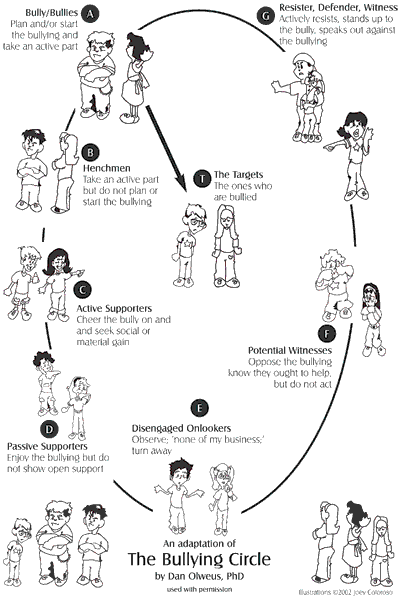
For the first time, it will have a section on bullying — including a recommendation that schools adopt a prevention model developed by Dan Olweus, a research professor of psychology at the University of Bergen, Norway, who first began studying the phenomenon of school bullying in Scandinavia in the 1970s. The programs, he said, “work at the school level and the classroom level and at the individual level; they combine preventive programs and directly addressing children who are involved or identified as bullies or victims or both.”

Dr. Robert Sege, chief of ambulatory pediatrics at Boston Medical Center and a lead author of the new policy statement, says the Olweus approach focuses attention on the largest group of children, the bystanders. “Olweus’s genius,” he said, “is that he manages to turn the school situation around so the other kids realize that the bully is someone who has a problem managing his or her behavior, and the victim is someone they can protect.”

As the author of a new book titled Bystander (Feiwel and Friends, September, 2009), a book that was informed and inspired in part by Olweus’s work, I’m thrilled to read that the American Academy of Pediatrics is taking this issue seriously. I came away from my own research with the belief that our focus has to be on the community, on the school environment, on the bystander’s social and ethical responsibilities. That is, yes, we are our brother’s keepers.

Dr. Sege used a nice turn of phrase later in the article. He spoke of “activating the bystanders.” Here’s another clip from the article:

Dr. Sege said, “activating the bystanders” means changing the culture of the school; through class discussions, parent meetings and consistent responses to every incident, the school must put out the message that bullying will not be tolerated.

So what should I ask at a checkup? How’s school, who are your friends, what do you usually do at recess? It’s important to open the door, especially with children in the most likely age groups, so that victims and bystanders won’t be afraid to speak up. Parents of these children need to be encouraged to demand that schools take action, and pediatricians probably need to be ready to talk to the principal. And we need to follow up with the children to make sure the situation gets better, and to check in on their emotional health and get them help if they need it.

Anyway, this is an issue that means a lot to me, and means a lot to my editor at Feiwel & Friends, Liz Szabla. It has always been my hope that Bystander — not a handbook, but a work of fiction with tension and drama — would help in some way with this issue. That maybe teachers would use it in school, discuss it in classrooms, get kids talking and thinking.

More and more, as this writing career moves into its third decade, I’ve come to the conviction that a book is not an end, but a beginning. It’s about what happens after you read the book. The thoughts that occur, the conversations that take place.

But that’s a big topic, and better left for another day . . .
Hodge-Podge Books Closing Its Doors

My local newspaper, the Albany Times-Union, ran an article today on a local legend of sorts, Frank Hodge, who has successfully operated the independent bookstore, Hodge-Podge Books, for the past 27 years.

Written by Chris Churchill, it begins:

ALBANY — By now you’ve heard the story, because there’s no shortage of funereal tales about the closing of a yet another independent book, video or record store.

You don’t need a newspaper to tell you that losing such enterprises is a blow to a city’s cultural life, another step toward a blander and more homogenized future. That’s pretty obvious.

So for this story about the June 30 closing of Hodge-Podge Books, let’s focus on the positive. Let’s avoid the hand wringing and consider instead the accomplishments of its 78-year-old owner.

First off, Frank Hodge opened the children’s bookstore in 1982 and kept it open for 27 years, making it an institution, of sorts, and one of the oldest of Lark Street stores. During its tenure, Hodge-Podge gained national esteem.

“Those of us that love children’s books know of the independent bookstores around the country that have great reputations,” Franki Sibberson, a teacher and librarian in Dublin, Ohio, said in an e-mail. “Frank Hodge’s reputation for knowing children’s literature goes far beyond Albany.”

For the complete text, begin insanely clicking right now.

Faithful readers of this blog — and aren’t you all? — may recall that I previously wrote about Frank here, explaining how I put him in a Jigsaw Jones mystery, The Case of the Ghostwriter. In fact, even his cat, Crisis, played a minor (but cuddly) role.

Book people, from editors to librarians to readers, quite possibly know of Frank without any help from me. He remains a singular character in our shared community of children’s books. The article concludes by stating that Frank is threatening to blog at this site. At this point, I think Frank is lining up his ducks, closing the store, sweeping out the closets. He hopes to be blogging by the end of July.

So let me be among the first to roll out the red carpet. In the meantime, Frank’s little store (I keep hearing Paul Simon’s, “My Little Town”) will be open through June, and I hope to swing by. To me, he’s like that long-lost relative you never see often enough. Time passes and you think, I really ought to visit Frank. Well, now I really ought to.

Last comment: I mentioned to my son, Gavin, almost 10, that Hodge-Podge was closing. “Oh, no, I love that place!” he lamented.

“Really? You haven’t been there that often,” I said.

“He gave me the first Wimpy Kid book — for free!” Gavin explained. And that’s typical Frank. He knew how to make friends for life.

The trick? Shove a good book in their hands.

Fan Mail Wednesday #49 (Tuesday Edition)

Get out your old Kool & The Gang records, people, and let’s bust a move — it’s Fan Mail Wednesday!

But first, let’s just take a moment to be awed by the amazing fact that I receive any fan mail at all. And not so much that it’s me, James Preller, getting the mail (though that’s astonishing enough). But that a book can be written, and later read, and that somebody out there can be moved to reach out to that author, to say kind words. I’m humbled every time I get a letter. So thank you all. When I started this series with Fan Mail Wednesday #1, I wondered, What if the letters just stop? What if I don’t get enough to sustain it? But somehow, some way, that hasn’t happened . . . yet.

How lucky am I?

Dear Mr. Preller:

My name is Braden. I am a sixth grade student from McCants Middle School in Anderson, SC. We had an author project in class and I came across your book, Six Innngs. I couldn’t put it down until I was done reading it. I love that book!

I did some research and saw on your blog that you did not start out wanting to be an author.  I read that you wanted to play baseball for the New York Mets. I like baseball too. I play on the USSSA baseball team called the Anderson Alley Cats. We play tournament ball and travel all over the state. We are fortunate to be number one in the state of South Carolina right now. We are hoping to finish out the season in the number one spot and go to the USSSA Little League World Series in Charleston, SC.

I like your style of writing. It is intense  and moves fast from topic to topic. My favorite part of the book was the last pitch. It had me guess what was going to happen and thinking of all the outcomes. You can tell that you have a love of baseball in your stories. Do you have plans to write other baseball stories?

I also saw on your blog the suggestions for books. I can’t wait to read Mudville by Kurtis Scaletta. That looks like it would be a good one too. Is the style of the author similar to yours? If so, I know it will keep me wanting more.

I hope to read more of your books, and I also hope that you will write more about baseball. I will definitely buy them!

Sincerely,

Braden

I replied:

Braden,

Thanks for writing. I loved getting positive feedback from a real ballplayer like yourself. Yes, you’re right, I do love baseball, and from many different perspectives — childhood memories, times shared with my mother, as a player, a coach, a father, a fan, a reader and a writer.

I once did a book signing for Six Innings, soon after it was published. I expected to see a lot of kids like you, boys who loved playing ball. So I was a little surprised to see many kids who were clearly not athletes. Of course, I quickly realized: They were readers. And also: These kids loved the game, but the game, alas, did not love them back. I always think of those kids, the ones who were never quite good enough, who struggled and failed and faced terrible disappointment, but who loved the game just as much (if not more) than any star on the field. You are fortunate that you are such a good player, that you have that gift. You give to the game through hours of hard work and effort, and to you the game gives back. It’s nice when that works out — and it’s how I feel, too. Blessed.

Since you asked, I have no immediate plans to write another baseball book. But . . . I do have an idea for another baseball story. It’s stuck with me for the past few years, and my mind wanders over it from time to time, almost absently,  like a pitcher’s fingertips across the stitches of a ball as he bends in to look for the catcher’s sign. I’ve got a slim file, filled with bits of dialogue, phrases, small moments and false starts. I want to do something along the lines of Magic Realism, where the story is very realistic, down to earth, but then something utterly impossible happens and you go with it. W.P. Kinsella writes books like that (I recommend Shoeless Joe); and, of course, Gabriel Garcia Marquez is the master of that genre, but he’s someone you might want to wait a few years before tackling.

Anyway, here’s a brief passage from my notebook, which I’ve never before shown to anyone. It’s about a boy’s first game at a real ballpark, and the magic of that event,  a dream come true:

——-

“There it is, the stadium,” my father pointed. I followed the line of his finger. Wow, there is was, huge and magnificient. My first real ballpark.

I was going to eat three hot dogs.

We parked the car. “H-12,” my father murmured, noting a sign on a nearby light pole. “Remember that, Slugger. We parked in area H-12.”

I promised to remember. And of course I would. I’d remember everything.

If you beat the crowds, and waited by the player’s entrance, you could sometimes get lucky, my brothers said. So we waited with a group of other die-hard fans, clutching Sharpies and baseballs, eager for autographs.

The team bus arrived, large and splendid, and one by one the players filed past. They weren’t in uniforms, but still you could tell by the way they walked, by a certain glint in their eyes, they had something special. An athlete’s swagger.

A few signed autographs. Most strode on by, bigger things on their minds. A short, squat man — older, grizzled with stubbled gray hair — grabbed the ball from my hand. He signed it, “Luke Standahl.”

“He’s the manager,” my father whispered into my ear. But I knew that already. Mr. Standahl walked a few steps, then turned and threw me the ball. I snatched it with one hand. His eyes narrowed. “Southpaw,” he murmured, then spit. “I’ve been around this game fifty years, and you look like a ballplayer to me.”

“I am,” I replied.

“We’ll see about that,” he muttered, and spat again.

——-

Do you think anybody would want to read a story like that?

Listen, Braden, good luck with the Anderson Alley Cats. I hope you do well, make it all the way to the World Series. I’ll be rooting for you. And in the meantime, I agree, Mudville by Kurtis Scaletta sounds like a pretty cool book — with a little magic in it, too.

My best, and thanks again for writing,

JP

Fan Mail Wednesday #48 (Tuesday Edition)

I was all set to go with a different piece of fan mail when I opened this note from a school librarian. I’ve deleted her name and school district, for the sake of privacy:

Dear Jimmy,
It is with much regret that I tell you I will have to cancel your author visit to __________ School District, NJ. Due to our school budget not passing and budgets cuts in May the library program in both of our buildings is being cut. I will not have a position in September. Though, I am fortunate that I can retire.  I was looking forward so much to having you be our author for 2009- 2010 for our students and teachers. I know we did not have any specific dates. This is such a hard e-mail for me to write.
Best wishes,
_________,
___________ Librarian, for now

Well, how do you reply to that? As a small mom & pop operation, I work directly with the teachers and librarians who contact me for visits. We exchange many emails, sometimes talk on the phone. And many times I come away really, really liking these people. More than that, I come to admire them. I see the work they do, their enthusiasm for books, the commitment they have to the children in their schools. In tough economic times, our libraries are more important than ever. It’s insane that’s where we make the first cuts.

I share her letter because she is not at all alone, and her plight effects us all. I’m hearing more and more stories like this one. I want to remind readers, parents, teachers, and librarians alike, of The American Association of School Librarians Crisis Toolkit, which I’ve written about before in a post titled, “Who Needs a Librarian Anyway?”

The Toolkit begins:

If you are looking at the AASL Crisis Toolkit, chances are your program is danger of being reduced or eliminated. This kit is designed to assist you as you build meaningful and effective support for saving your program. That means educating and rallying stakeholders to speak out on behalf of school libraries.

If cuts are not imminent, visit AASL’s School Library Program Health and Wellness page for prevention strategies. The ideal time to start advocacy efforts is before there is a crisis.

The kit is remarkably comprehensive, and includes topics such as “Crisis Planning,” “Crafting Messages,” “Getting People Involved,” “Research,” “Advocacy,” and more. There are also handy links to studies that have found correlations between library programs, media specialists, and test results. One point keeps coming up: Librarians need to communicate with and educate the parents in the community. If you do something great, let people know about it. For too many people, their concept of a school librarian is antiquated and ill-informed. “What does she actually do, anyway?” Well, let ’em know. Send out a newsletter, publicize your programs. If an author visits, invite parents and PTA members to get involved. Share the findings from study after study that links library programs to improved scores on standardized tests. Let them see the important work you do — before it’s too late.

As for the letter above, I mustered this reply:

Dear _______,

I’m very sorry to hear about the budget cuts, and your retirement. I’m sorry for the pain and disappointment you now feel. Times are hard and there are very human costs. I believe that things will get better, eventually; in the meantime, I hope that schools make wise choices in their decisions. It seems too easy, and far too short-sighted, to cut librarians and valuable programs from the educational system.

As for me, don’t give it a second thought. Good luck to you — and stay in touch.

JP

—–

NOTE: I wanted to get this out today, because I’ll be away for a few days on a road trip to see the New York Mets. This is the 4th annual trip with a great friend who lives down in NYC. So far we’ve been to Chicago, Washington, D.C., and Philadelphia — and this year we’re headed for Pittsburgh. Baseball with a buddy always makes me happy.

Thanks for stopping by.

Research: Finding Gems

I want to tell a quick story about doing research. Specifically about Crayola crayons and the book, Along Came Spider. But first, a little back story:

As I was writing Spider, I did a lot of research in different directions. As I began circling this character of Trey Cooper, trying to figure out who he was, I wanted to show in his personality a number of traits that were consistent with children “on the Spectrum,” as they say.

Trey has difficulty reading social cues, struggles during transitions, and generally comes off to his classmates as a quirky, even weird, kid. I also wanted to show Trey’s many strengths and outstanding qualities. He’s an expert on birds, for example, and builds wonderful bird houses. One of his talents is an interest in art and coloring. He loves his huge set of Crayola crayons.

In order to write about that, I did some quick research on Crayola. Specifically, I was looking for the names of their crayons. Well, one click led to another and I found this factoid:

1962: Partly in response to the civil rights movement, Crayola decides to change the name of the “flesh” crayon to “peach.” Renaming this crayon was a way of recognizing that skin comes in a variety of shades.

Wow, I thought, and immediately knew it would have to find its way into the book. Just a little nugget, a gem I came across while looking for something else. And I think that’s the core of research, trying to stay open to what you might find, casting a wide net, and recognizing the gems along the way. Sometimes what you (think you) want isn’t what you need.

What would Trey think of a crayon called Flesh? Would he know, or care? (He hates the name Fuzzy Wuzzy Brown, which was added in 1998 — way too babyish.)

I’ll sometimes talk about all this on school visits. I’ll say something like, “When doing my research, I learned that Crayola used to have a color named Flesh. But they changed that name in 1962. Would anyone like to guess why?”

The answers are often surprising. And maybe a little disappointing. One boy speculated that it was too disgusting — flesh, yuck, gross me out the door. But sooner or later, with or without a hint, somebody figures it out. We’ll talk about it briefly and move on. But hopefully it gets these kids to think a little, about research, about differences, our assumptions and our attitudes.