Tag Archive for Lewis Buzbee

James Preller Interviews . . . Carmen Deedy, author of “14 Cows for America”

I was happy when I came across the book, 14 Cows for America, written by a long-lost friend, author and storyteller Carmen Deedy. We’ve since exchanged a few emails, caught up on our lives (to the extent that’s possible), and shared the unlikely hope that maybe someday we’ll find ourselves in same place at the same time. Usual stuff: “We’ll have lunch!” To date, it’s happened exactly once. In the meantime, Carmen is someone I’ll be rooting for, cheering from the sidelines. A true talent and a smart, singular woman. Today, I’m glad you’ll get to meet her. Because look, here she comes now . . .
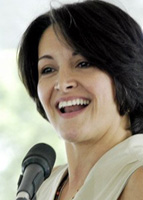
Carmen, wow, great to see you again. We’ve met only once, a long time ago. Was it Paris, sometime after the war?

The Germans wore grey, I wore blue –– or was it plaid?

Oh, wait, I remember now. It was at a convention center in Raleigh. My bad. It’s so easy to confuse the two. So it’s been about fifteen years. At that time, as I recall, you had recently published The Library Dragon. Between then and now, your career has really blossomed.

That’s a generous assessment, old friend. Actually, I spent a whole lot of years as a single mom, and for nearly five of them I did very little writing.  School author visits, a good bit of editing, but writing? Not so much. Getting three lovely and creative and maddening young women through adolescence while keeping the roof over our collective heads pretty much sucked every ounce of creative life out of me. “I am woman, hear me whimper,” was the sum and substance of my feminist credo in those days.

I’m fuzzy on the timeline. You’re an internationally known storyteller who has performed at The Kennedy Center and the Folger Shakespeare Library.  You gave a talk to the TED folks –- and I’m pretty sure they invite only brilliant people with fertilizer ideas worth spreading. You were (or still are?) a regular contributor to NPR’s “All Things Considered.” Did that all happen after the girls were grown?

Nope. Just wasn’t doing a great deal of writing. The aforementioned events were short and sweet and helped bring in the bacon, as it were. But I couldn’t seem to carve  out many stretches of time to write during those years.

Do you see yourself as primarily a storyteller, rather than a writer? What’s the distinction?

The distinction? Um, the WRITING STUFF DOWN part. Storytelling, on the other hand, is the ancient art of live narrative. In other words, someone (preferably carbon-based, as opposed to a dvd, mp3, etc.) opens his or her mouth and, without props, video enhancement, sets or backdrops, or fellow performers, conjures up an entire world –– makes something out of nothing if you will –– employing only the spoken word.

Ah, but I didn’t answer your question.  Do I think of myself as a writer or a storyteller? Short answer: a writer. Nonetheless, one art form informs the other.

How does a person become a professional storyteller? Do you just hang out a sign on the front lawn? I mean, forgive me, but it seems like such a phony baloney job. Bankers must look at you and say, “You re a . . . what?!”

My dear Mr. Preller, if I am applying for a loan, I never say I’m a storyteller (and, by the by, saying you’re a writer doesn’t gain you much traction with the banking lot either).  I say raconteur. It’s sooooo continental.

I know as a writer of children’s books, I’ll often get those baffled looks from some folks at parties after they ask the usual question: “So: What DO you DO?” You know who I mean, the guy in the suit with the big job. And he’ll always follow up my answer with another question, not even bothering to feign disinterest, “Any books I might know?” This from a guy you can’t imagine having read a children’s book –- even as a kid. So I’ll answer something like, “How ‘bout those Yankees!”

I think it’s pretty common for most people, particularly those who don’t make their living from writing, to read a children’s book and think, “Piece of cake.” When I hear that, I usually smile sweetly, lean in, and whisper, “Dare ya.” The truth is, of course, that children’s picture books do not occupy the same place in the literary world as, say, the works of Leo Tolstoy. But you do have to say a lot with a little — and in that respect, writing a picture book is kind of like taking War and Peace — and turning it into a haiku.

When you started as a storyteller, an old friend came to see one of your early shows. Afterward, she told you, “The truth? I don’t think you’re a storyteller.” How did you overcome that? Is there enough ice cream in the world to heal that wound?

Never underestimate the curative powers of Rocky Road, my friend.

Where do the stories come from?

Brooklyn, NY. It’s the last place you look. But I suppose you want an answer that’s a bit more serious-minded, so I will say this: stories swirl around us constantly: in the subway, at the lunch counter, around the corner from the cereal aisle. They are everywhere, vying for the writer’s attention. Tragically, I can be a mite distractible; I know I’ve let some great ones pass me by.

Your new book, Carmen, 14 Cows for America . . . wow.
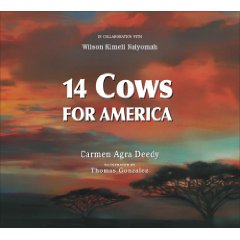
What a remarkable story, beautifully told. It’s already gotten some great press. You must be thrilled.

I am very happy that it’s been so well received.

There are a lot of great lines in the book, but the ones that conclude the book really hit me:

“Because there is no nation so powerful it cannot be wounded,

nor a people so small that they cannot offer mighty comfort.”

Those words were especially resonant, like a bright, burning quiver shot to the heart. Do you remember when you first wrote those words? Did you realize –- you must have realized! -– how good it was at the first instant?

I have a nameless elementary school girl to thank for that.  Not the precise words, of course, but the sentiment. She reminded me of Aesop’s fable –– the lion and the mouse –– big things need small things, said she. From the mouth of babes.

Yes, but you heard her. You listened. Maybe that’s the real secret to good writing.

Maybe. Then again, maybe I just got lucky.

It’s an interesting perspective to think of 14 Cows as a retelling of “The Lion and the Mouse.” How did the book come about?

I read about the gift in April of 2002 in The New York Times. I sat on my porch stoop and wept. It would be many years and a great deal of research later before I would hold a finished manuscript and eventually find the protagonist, Kimeli Naiyomah, and ask for his blessing. Little did I know that he would join us as a sort of cultural consultant, and even adding his own end note to the book. It has been, in many ways, an strange and wondrous and indescribable journey.

You need to a flashplayer enabled browser to view this YouTube video

To me, with such a huge story, I’m impressed by your economy of language. I would have been overwhelmed, not knowing where or how to begin. How did you find that voice? Did you have a first sentence, an image? I guess I’m asking, what was the door that first opened for you, allowing you into the story?

I was at the Carson McCullers House, in Columbus, Georgia.
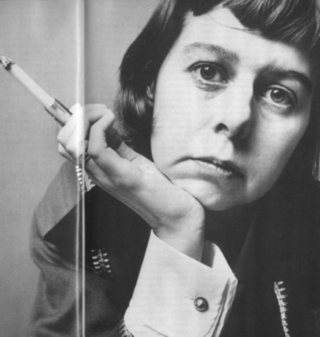
I had been granted a writing fellowship and was having a devil of a time getting the story down. I should note here that this was, by now, 2007. I had notes, articles, documentaries, and sundry documents that I had compiled and hauled to Columbus; it amounted to years of research and only served to further overwhelm me. I wasn’t new to picture book writing and well knew the perimeters. I had fewer than 32 pages to work with. I was near despair, when I woke up one morning and reminded myself that this was a story for children, and needed to be told simply, just as I would have liked to hear the story when I was a child. To sustain a sense of immediacy, I opted for the present tense. That kept it simple, as well.

Well, you succeeded brilliantly. Lightning round. Five favorite foods?

My mom’s arroz con pollo (chicken and rice), Vietnamese Bubble Tea, chicken pot pie, watercress salad, Thai mango and sticky rice,  coq au vin,  my dad’s empanadas . . . sorry. It’s not that I can’t count, it’s just that I LOVE food.

Nobody makes a good chicken pot pie anymore.

Or yeast rolls. What ever happened to yeast rolls in school cafeterias? Now it’s low-fat granola bars. I tell you, my friend, we are witnessing the de-evolution of our race.

As my mother would say, “We’re going to hell in a hand basket.” Still one of my favorite expressions. I love channeling my parents that way, filling my mouth with their words. Now that my father is gone, I make a point of keeping those echoes bouncing around. It’s strangely satisfying to repeat a phrase that he used to say, keep it alive, like a postcard with “Love always” written on the back.

I know what you mean about those voices that linger in our heads. My wonderful and wickedly wise dad love of Cuban aphorisms. Among my favorites: Our wine may be bitter, but it’s our wine. (This one in 7th grade when I was complaining about my mother, my hair, zits, and the banality of reading Steinbeck.) He who laughs alone is remembering his own mischief. (This, when I caught him sitting at his desk, howling to himself, in what he thought was a solitary moment. I never learned what marvelous memory he was recalling, but it only served to increase his mystique as a Man of Mystery.) And my favorite, one that touches on love and true camaraderie, When you cry, I taste salt.

That’s a beautiful line. Of course, the bitter wine aphorism reminds me of a great line spoken by Lt. Frank Drebin in “The Naked Gun” movie: “It’s a topsy-turvy world, and maybe the problems of two people don’t amount to a hill of beans. But this is our hill. And these are our beans!” Next impossible question: Five favorite books?

Shadow of the Wind, A Prayer for Owen Meany, Charlotte’s Web, Great Expectations, The Book of Unholy Mischief.

A diverse, challenging list. What do you admire most about Dickens, or if you prefer, Great Expectations?

Well (coyly), one of my new books (not out yet) is about a street cat, a tower raven, and Charles Dickens. I just re-read Great Expectations this summer, and there were places  where I laughed out loud. What a wordsmith, what a keen observer of human nature. Dickens made you see the human being within the characters. Why, even the loathsome and repulsive Miss Haversham (the elder) becomes a pitiable creature by book’s end. And his descriptions, and the marvelous names for his characters . . . ya know, I AM aware that it’s not cool to love Dickens anymore. I mean, a full page devoted to describing a room? But, oh, what a room . . . (I am officially out of the nerd closet now, and I want you to know I’m okay with that.)

Five things about your native homeland, Cuba, that you miss?

My family, heat that penetrates your bones, my first language, cobble stone streets made for perambulation, the sea and its sticky brine perfume.
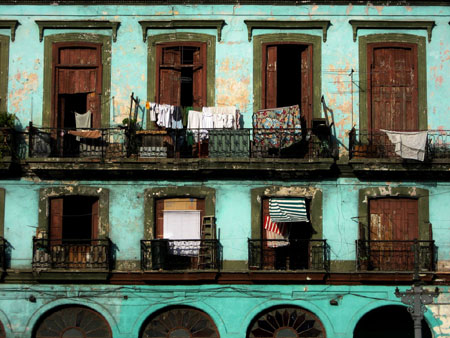
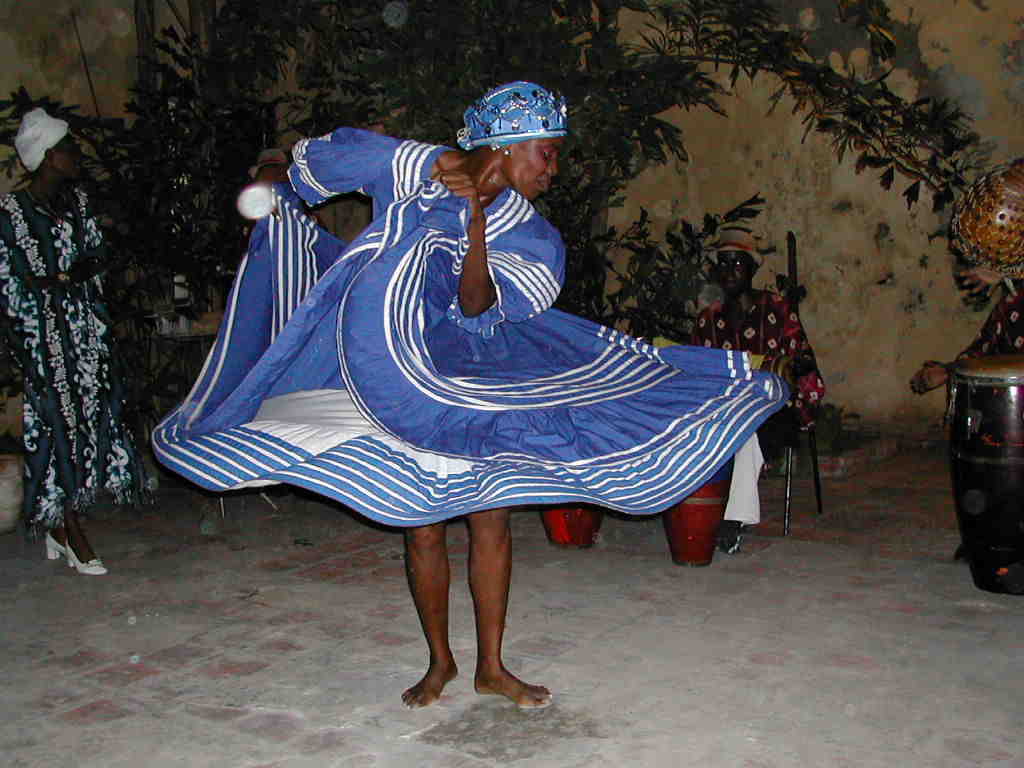
Politics, briefly: What is your hope for the future of American-Cuban relations? I have a friend from England, a drummer, who visits all the time and loves it there. I’m jealous of him, and jealous of Sky Masterson.

I wish there was openness. Am I wrong about that?

Pass.

Okay, you are on your front porch at your home in Georgia, peaceful under the stars. There’s a song playing and a drink in your hand. What’s the song? What’s the drink?

Carlos Gardel singing “Volver” . . .

You need to a flashplayer enabled browser to view this YouTube video

. . . accompanied by a whiskey and soda, twist of lime.

Thank you very much, Carmen. It’s really great to catch up with you again. I mean this: I’m so proud of you and all that you have done with this lovely, meaningful book. I hope it finds a place in every library in America. As a parting gift, please accept this (still warm!) cheeseburger from Sonic Drive-In.*

Does it come with plantains?
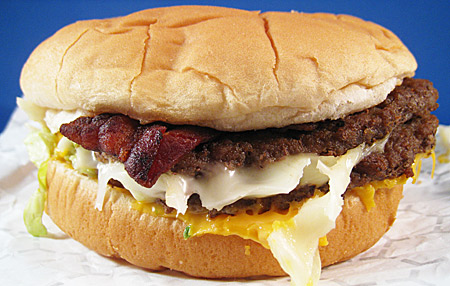
* No Masai cows were injured in the making of this cheeseburger.

Note: If you enjoyed this interview with Carmen Deedy, you might also like this recent interview with author Lewis Buzbee.

Let’s close with Carmen telling a story . . . for that happy-go-lucky TED crowd.
You need to a flashplayer enabled browser to view this YouTube video

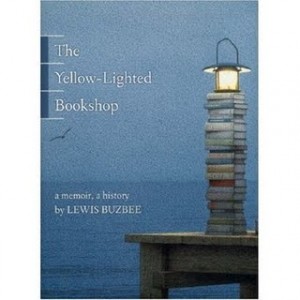
James Preller Interviews . . . Lewis Buzbee, Author of “The Yellow-Lighted Bookshop.”

As a kid, I used to come home from St. Frances De Chantal Elementary in the late 60’s and early 70’s to find my grandmother sitting in front of the television, sipping brandy, watching the soaps. She especially loved “The Edge of Night.”  Then at 4:30, I’d get up and switch the channel for her, turning the big knob over to “The Mike Douglas Show.”

It was a daily, syndicated variety show, and Mike would begin each day’s show by singing a popular song. I loved it. I sat with Granny Good Witch — as we called my grandmother — for many, many hours watching Mike Douglas. He seemed like such a nice man.

One of the great things about the show was that he’d have guest co-hosts who would stay for the full week. It could be Sammy Davis, Jr., Richard Harris, Charo, Soupy Sales (photo, below), Barbra Streisand, whoever. Most famously, Mike snagged John Lennon and  Yoko Ono for the week-long co-host gig, February 14-18, 1972. It was an inspired invitation, and made for legendary, if at times uncomfortable, television.

That’s how I want to play it this week. I’m Mike Douglas, and my guest co-host will be author Lewis Buzbee, and he’ll be hanging out all week long. There will be laughs and there might be pie.

Originally, we set out to do a standard interview. But as happens with good conversations, we couldn’t stop talking. Lewis is a terrific guy, quick on his feet, with deep thoughts and insights, and a sense of humor, too. Mostly, he’s a book lover and a man of great passions (fortunately, I carry a taser). I know you’ll like him.

What follows is Part One of a Three-Part Mini Series, titled “The Never-ending Lewis Buzbee Interview.”

——

Hey, everybody, look — it’s my co-host for the week, Lewis Buzbee! The man who asks the question, “How do you press a wildflower into the pages of an e-book?”

Everything all right, Lewis? You look a little drawn. Ho-ho. Seriously, thanks for stopping by, Lewis. No, we don’t need to hug. I mean it, DUDE. That’s enough. I’m warning you! I keep a taser in my man purse . . .

. . . and I will tase you, bro. Go sit in the big comfy chair.

Don’t tase me, bro!

And don’t tase my bro, either.

Congratulations on your first children’s novel, Steinbeck’s Ghost. I definitely want to talk about that book later in the week. But first, I have to say: I loved The Yellow-Lighted Bookshop.

Thank you, Mr. Preller.

Please, not so formal. “Mr. Preller, Sir,” is fine. Your book opens with a confession of sorts:

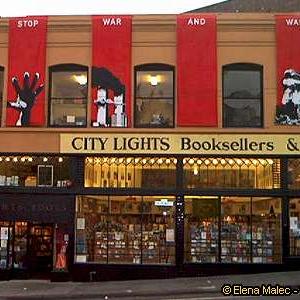
“When I walk into a bookstore, any bookstore, first thing in the morning, I’m flooded with a sense of hushed excitement. I shouldn’t feel this way. I’ve spent most of my adult life working in bookstores, either as a bookseller or a publisher’s sales rep, and even though I no longer work in the business, as an incurable reader I find myself in a bookstore at least five times a week. Shouldn’t I be blase about it all by now? In the quiet of such a morning, however, the store’s displays stacked squarely and its shelves tidy and promising, I know that this is no mere shop. When a bookstore opens its doors, the rest of the world enters, too, the day’s weather and the day’s news, the streams of customers, and of course the boxes of books and the many other worlds they contain — books of facts and truths, books newly written and those first read centuries before, books of great relevance and of absolute banality. Standing in the middle of this confluence, I can’t help but feel the possibility of the universe unfolding a little, once upon a time.”

First, Mr. Buzbee, Sir, that was beautiful. But as I read your book, I kept worrying about your family. Do they have enough to eat? Does his daughter have new clothes for school? You seem to buy a LOT of books.

You know, we do buy a lot of books, but now that I’ve given up bookselling for the glitzy life of a writer, well, it’s just money, money, money.

It’s a funny question, though, that I get a lot. People assume if you buy hundreds of books a year that, well, it’s somehow superfluous spending. But people with $60,000 cars never get the same sort of grief. I mean 60 G’s for a car? You’ve gotta be kidding.

You’ve lived a life that’s been centered around the reading life. Tell us about your background.

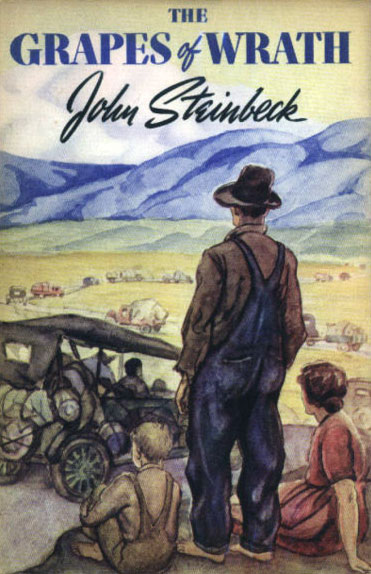
I grew up in a very working class home in San Jose, California, where we had books, of course, and where my parents read for their own pleasure, but nothing too New York Review of Books about it. My parents, children of the Great Depression, looked at books as a way for their kids to get a better education. But I never set out to be a bookseller or a writer. It happened, and quite by accident. I was on my way to being a rock star,  when my life was changed by a high-school book report on Steinbeck’s The Grapes of Wrath.

I was fifteen. I had never before felt anything so powerful, his words, and I had never felt so connected to the rest of the world either. After that, the other pieces of my life followed, if not purposefully, then easily. When I was eighteen, I got a job in a bookstore; I’d heard you got a discount on books. And when I discovered that booksellers sometimes got free books, well, that was it.

Can you remember a specifc scene in the book when the light turned on for you? I have to confess, I read it for the first time this summer — and I was staggered by the writing, the pure telling of it. Also, Steinbeck’s humanity, the strong feeling he so obviously had for those characters.

It’s that first chapter, the description of the Dust Bowl, one of those epic, overview chapters. Seeing the world described with such power — that’s magic isn’t it? You put some black squiggly lines  on a page, and an entire world appears.

And it was that sudden. I read that first chapter — somewhat grudgingly — and put the book down, deciding there and then that I would become a writer. Then I wrote my first short story, and it was only I finished that story, that I went back to the book. And the world just kept getting bigger and bigger.

The Yellow-Lighted Bookshop feels like an inevitability — this unlikely book that absolutely had to happen — and that it had to come from exactly you.

I knew a long time ago — many years into my writing career, and after my first novel, that I would have to write this book. Perhaps fifteen years before I actually sat down to write it. There were, I knew, a lot of books about the antique book trade, but nothing, really, that was a general appreciation of the new bookstore. I suppose I needed to write it, too, because, as I said earlier, the bookstore had given me so much. So much pleasure.

Easy, Lewis. Get back in the chair.

Not the ta —

BbzzzzzzzzttTTTT!

Man, I love that crackly sound! You should have seen your face, Lewis, the way your eyes bulged out! Hysterical. Now please continue . . .

Um, okay. Just let me get the feeling back in my arms and legs. I think I waited to write the book until my bookselling career — as both a bookseller and sales rep — had come to an end. I needed that distance. I never wanted to write a critique or an expose. It had to be an appreciation.

I can identify with that, because I knew I’d always have to write a baseball book of some kind or another. Baseball had seeped into every aspect of my life, as a boy, as a father, in my relationships with people, these powerful associations with my own mother, my sense of competition and play. It had to spill over into my writing.

There is a tired old maxim, write what you know. It’s often misinterpreted, of course. I think it has to be this: write what you love. Even if you’re arguing with it, or hating it at the moment, write what you love. Yes, I know bookstores, but thousands of other people know much more than I do about the business. No one, though, has quite loved the bookstore as much as I do. I’ve stared at it for decades, and always with love.

Yes, write what you feel. We can learn about all sorts of things, do research, find out, know. But unless the heart attaches to it, well, I don’t know how you can go to work each day.

I once had a student who offered up a great piece of advice — write about what you are most ashamed of. An interesting tack, that. It immediately calls you to powerful emotions.

Obviously, you analyzed the marketplace and decided: What the world needs now (besides love, sweet love) is a book that’s part memoir, part history of bookstores. Instant bestseller! Why James Patterson didn’t do it already is beyond me.

Well, that would have required Patterson to write much longer paragraphs. So, that answers that. But a psychotic murderer in the bookstore — hey, let me  write that down.

Actually, I did know the book would do well — it did quite well, thanks. Because I’ve spoken with too many people over the years who feel as deeply about the bookstore as I do. And I knew they would want to the words to express that feeling, words to help them see it new.

I love that observation, Lewis. Writers can provide that, I think; so can good public speakers. Many people don’t seem to have the language to articulate those feelings. We see it at weddings, funerals, toasts at family events. I’m always so grateful to those people who can kind of, I don’t know, say it for us.

Of course, I am thinking of all those copywriters at Hallmark.

My mother is possibly the greatest supporter of Hallmark cards in the country, by the way. I get Thanksgiving cards from her! Thanksgiving cards? Amazing. And very specific ones — Thanksgiving cards that extol the virtues of a “very special son.”

I’m not dissing this, by the way, I’m glad people have that outlet. Otherwise, whoo, what a world.

There were so many moments in the book that I enjoyed — and not just that it came in at the optimal length of 225 pages — but sentences I had to underline, paragraphs where I’d put exclamation points in the margins. There’s a line you wrote, “to remember a book is to remember the child who read that book.”

It’s sort of a crib from Proust actually. I had the idea, of course, for a long time, but in his wonderful essay, “On Reading,” he helped me put words to it. When I remember a favorite book, I’m remembering, too, who I was at the time I read it. I just re-read Ray Carver’s first book of stories, Will You Please Be Quiet, Please?, and as well as being reminded of his genius and moved by the stories, I also remembered being a freshman in college who did nothing during spring finals week but read Carver instead. It was not a good semester grade-wise.

I guess that’s where the memoir aspect of this book became inevitable for you. You couldn’t talk about books without memories flooding back — it was impossible to separate the reading life from your actual life.

I knew that the memoir of a bookseller was bound to be pretty dull stuff. It’s not an amazing life, in that way. My father was a deep-sea diver for the Navy; now that’s a life worth writing about. I included the memoir bits kind of strategically. I wanted to put in enough of my own experience — but not too much — so that the reader would be able to relate to the memories, and yet still have enough space to put in their own memories. My memoir, as if were, is really only there as a touchstone.

But it’s true. I am a reader — and I would guess you are, too. In fact, anyone reading this, well, it goes without saying. But I’ve always been suspicious of people who want to separate the “reading” from the “life.” For many of us, reading is an integral part of life, not a vacation from it. And not in a self-help way, either. It’s just a part of what I do, and it influences how I go into the world, how I engage with it. I’ve always considered reading an active undertaking, not passive.

Wow, Lewis. Word.

——-

End of Part One. Please come back on Wednesday for Part Two (or click here right now!) of “The Never-Ending Lewis Buzbee Interview” — he’ll be here all week! We’ll talk about the Kindle, Star Trek, Facebook, Katharine Ross, the “death of the novel,” the twitterverse, and raise a glass to idiots everywhere!

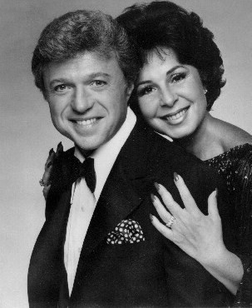
Next week my co-hosts will be: Steve Lawrence and Eydie Gorme!

Music Video Weekend: Ryan Adams, “When the Stars Go Blue”

“Where do you go when you’re lonely? Where do you go when you’re blue?”

I think about music all the time. Always have. Listen to it, read about it, close my eyes and feel it. I hate to say this, but I think I care about music the way Lewis Buzbee cares about books. And yet I’m not too clear on how that relates to this blog. It always feels a little self-indulgent whenever I talk about music and show clips. I think: There’s some reader out there who gets really annoyed whenever I do this.

But I.

Can’t.

Stop.

Myself.

By way of throwing a bone to that angry, hostile reader, I’ve moved “Music Video Friday” to “Music Video Weekend,” because somehow that fits better.

Anyway: I’ve listened to this song a lot over the past month or two. A truly sublime melody, deeply beautiful. For those new to Ryan Adams, please don’t confuse him with Bryan Adams (yuck). He’s done a lot of great work over the years, but I think his recent disk, “Easy Tiger,” would be a good place to start. The track below is from his 2001 disk, “Gold.”

You need to a flashplayer enabled browser to view this YouTube video

What’s Going On?

Some quick hits today:

* “Ritual” would be too big a word for it, too religious; “tradition” doesn’t feel quite right either. But when I begin a new book, I go to my local CVS and buy one of these bad boys:

Which I did yesterday. It’s more than a little daunting. I don’t know what this book will be about, exactly. I mean, yes, I have some notions, a few seeds, but mostly: a boatload of blank pages and a world of possibilities. Exciting, to venture out into that snow.

* I’m really happy that my fifth-grade son, Gavin, just read and enjoyed this book:

I discovered it over at Literate Lives and the book sounded interesting. So I went to the library and picked up a copy, hoping that it might pass Gavin’s sniff test. I think the baseball on the cover helped. As some sort of boy’s defense mechanism against poetry,  Gavin still contends that the book — written in free verse — “wasn’t really poetry so much.” He identified with the main character, who plays piano and baseball; but the book also stretched him in new directions, in terms of format and content. You can read some reviews here and here. Congratulations to first-time author, Ann Burg. You did good.

* I’m plotting a long conversation with author Lewis Buzbee. I just finished reading (and loving!) this book . . .

and I intend to read this one, too . . .

Sometimes you read an author, or a blog, and you just simply like that person. Which is not at all a requirement for liking a book, mind you. Anyway, I’m excited about getting to spend time with Lewis, and I know my Nation of Readers will enjoy him, too.

* I get it, nobody really thinks they have thirty minutes to waste spend watching a video. But think about it. If the time invested inspires you, gives you ideas, colors the way you look at the world, entertains you, than thirty minutes is a low, low price to pay. That is: You do, you really do. I found this over at Talkworthy and all I can say is, make the time. The video is titled “The Art of Possibility” and features a talk given by Benjamin Zander. It will inspire you. And as a parent with three kids who take piano lessons, in a house where music is important and valued, I found it especially relevant. Check. It. Out.

* The next book I’m reading:

* Let me send you away with this great cover of “What’s Going On” by Los Lobos. Silky cool, like the other side of the pillow on a warm summer night.

You need to a flashplayer enabled browser to view this YouTube video