Tag Archive for Greg Ruth

Artwork From the Cutting-Room Floor

Greg Ruth, illustrator of A Pirate’s Guide to First Grade, recently shared a piece of art that never made it into the book.

Don’t you love it? The thick brushstroke of blue, the off-kilter headlong forward whoosh of the whole thing. How can something that great not make it into a book? What else is in Greg’s garbage pail? Can you imagine having that much talent?

I should note that to their great credit, the folks at Feiwel & Friends expanded the book beyond the industry standard of 32 pages, going to the expense of a full 48 pages. Very rare, these days. I believe they reached this decision when Greg’s artwork came in, and sometime after they picked themselves up from the floor. When you look at Greg’s illustrations — his first true picture book for children — you can understand why they felt compelled to give him the scope and space his work deserved. Something special was happening.

I wonder if the sample above was an abandoned cover concept, since it conveys a similar energy to that of the final cover art (see masthead, up top). I’ll have to ask Greg about it. And if true, I can understand the wisdom of moving from 1950’s-styled wagon to a yellow school bus. (POSTSCRIPT: Greg confirmed that my speculations were correct.)

Here’s an early sketch that Greg also shared, another scene that didn’t make it into the book:

For more on deleted scenes from a writer’s perspective, here’s a few blasts from the past:

* Deleted Scenes: Six Innings

* Deleted Scenes 2: Six Innings

* Deleted Scenes 3: Six Innings

* Deleted Scenes 4: Six Innings

* Deleted Scenes 5: Six Innings

Booklist Online Gives PIRATE’S GUIDE a “Twins’ Thumbs Up!”

Thank you Cindy Dobrez and Lynn Rutan, writing for Booklist Online, for the kind comments about A Pirate’s Guide for First Grade.

Cindy and Lynn take a collaborative, two-headed approach to book reviews, giving the traditional book review the old Siskel & Ebert update. I think it’s a cool idea that works — and that might even work best when they disagree.

For the full review, please click here or walk the plank. Your choice.

The money quotes:

“A whale of a tale perfect for young buccaneers . . . Reassuring and packed with humor, this is a perfect choice for any small swabbie feeling a little nervous about setting sheets to the wind for first grade.” — Lynn

And:

“My favorite illustration of Greg Ruth’s is the one of the young lass walking the plank (a teeter totter being held horizontal). I also appreciate the author and illustrator’s inclusion of just how tiring it is to be at school for a whole day. I’m headed back next week and I am ready for a nap already.” — Cindy

Cindy notes the book includes a nod to libraries, but I’d also like to echo her thoughts and give a nod to nods. I could use a nap myself!

Detail from double-page spread, art by Greg Ruth. Wish I could scan the whole thing, since the facing page is so much fun, but I can’t, so there you go.

An Author Thanks the Stars

I formed my diabolical master plan back in 1989.

At the time, I still worked at Scholastic on the book clubs, and Is Your Mama a Llama? was a huge seller. Now no offense to the book’s author, Deborah Guarino, but I strongly felt that the success of this title rested on the huge talent of illustrator Steven Kellogg.

In other words, nice text, great illustrations. Thus Deborah Guarino enjoyed the fruits of a bestseller, but if her manuscript was illustrated by someone less spectacular, it would not have had close to the same popularity. I’m saying: the author got lucky. And that says nothing bad about Deborah Guarino.

Right? That’s not an outrageous theory. Sometimes the illustrations make the book. For an author, that can be tough to swallow — the words do, after all, inspire the pictures! — but 95% of picture books live or die on the illustrations. I bet Jane Yolen thanks her lucky stars for Mark Teague’s incredible work on the (seemingly inexhaustible) “How Do Dinosaurs” series, where he takes a good, sturdy text and lifts it to something superbly popular.

Jane also wrote one of the most beautiful picture books of all time, Owl Moon, which I consider one of the most perfect books ever created. Jane can be absolutely brilliant, a masterful writer. But thank goodness for those gorgeous illustrations by John Schoenherr. Rarely have words and pictures achieved such harmony, a transcendent whole.

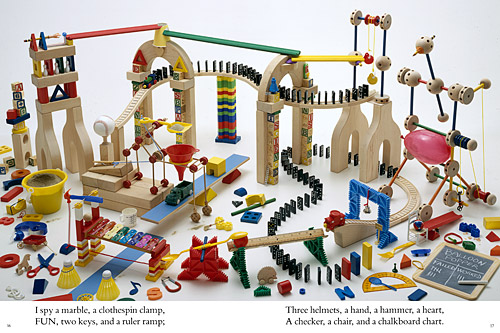
And I’m sure Jean Marzollo feels the same about Walter Wick. Jean’s rhyming text for the “I Spy” books is fine, and she deserves much credit for conceiving of that idea, but it was Walter’s execution that hit it out of the park.  After that first book, anybody could have written the sequels — but only one person could have created those photographs.
Times like that, an author smiles, thankful to the stars for aligning. Because heaven knows, it’s a rough slog and there are many long stretches when the sky looks cloudy and gray.

So that was my diabolical plan: Come up with a serviceable text, then have some genius come along to lift it to the stratosphere.

Which is all preamble for how I feel about Greg Ruth’s work on A Pirate’s Guide to First Grade. Yes, I produced the idea and the words for a good picture book. But it was Greg who made it soar. Now I’m just riding the wind, hanging on to his kite tail.
Greg’s work has distinguished this book from so many other fine, deserving titles. A Pirate’s Guide has earned two starred reviews and many strong notices. Most recently, Karen McPherson wrote a  round-up of “classy new school-themed” book for Scripps Howard News Service that included our salty tale. This is especially gratifying because these articles are distributed to hundreds of newspapers nationwide. Good press, indeed.

Here’s Karen’s commentary:

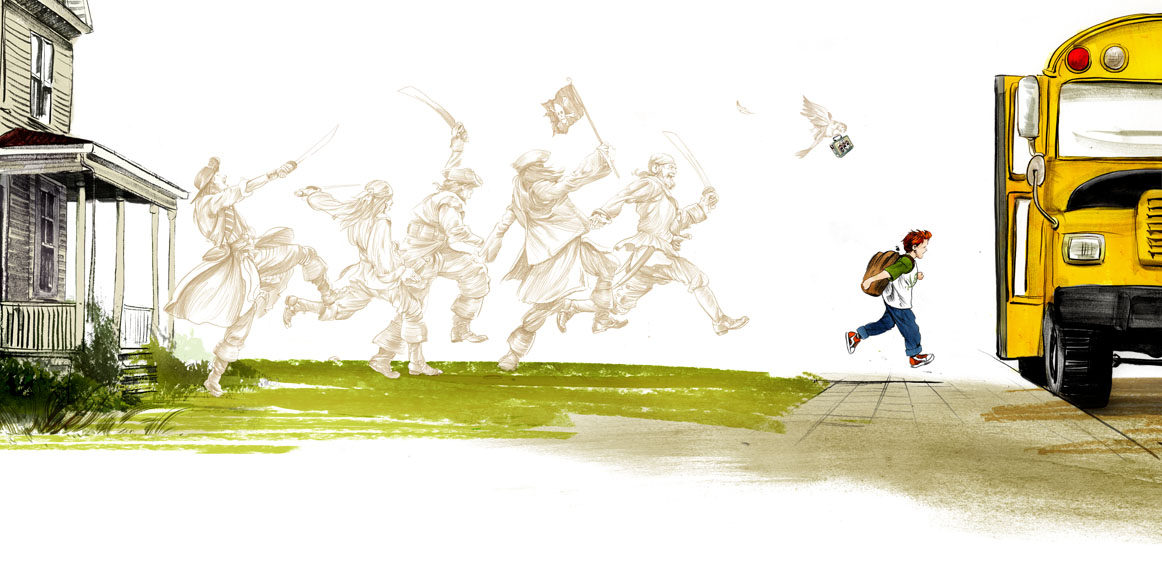
“A young pirate fan takes readers through an unusual school day filled with swashbuckling buccaneers in “A Pirate’s Guide to First Grade” (Feiwel and Friends, $16.99). Written entirely in pirate lingo by James Preller, this book will have young readers shouting “Arrrr!” and “Shiver me timbers!” in no time. But it’s the illustrations by Greg Ruth that really put a spotlight on the protagonist’s active imagination; Ruth shows the boy surrounded by pirates — drawn in brown — wherever he goes. Kids will love the contrast between the antics of the imaginary pirates and the regular school-day routine. (Ages 4-8.)”

THANK YOU, GREG RUTH. SOMETIMES DIABOLICAL MASTER PLANS REALLY DO WORK!

Guest Blogger at Mackids

I contributed to the cyber-clutter by posting over at the Mackids blog. Kathryn Hurley had asked me to write something about A Pirate’s Guide to First Grade. I mulled that over for a week or so, and came up with this, below.

Funny, in clipping it and pasting it here, I decided to ditch the first paragraph. That happens a lot with writing. You scribble and scribble, then realize that the story starts why down in the fourth paragraph. It would have been faster to start there in the first place, but I suppose you’ve got to go through the process of getting there . . .

I have vivid memories of playing alone as a little boy, the youngest of seven children. Inspired by “Batman” and “The Wild, Wild West,” I used to create epic battles in my living room. I’d fight imaginary villains, hurl myself headlong into the cushions, throw wild left hooks into the air, crash the bad guys’ heads together like coconuts. Likewise, I’d often go outside to pitch a rubber baseball against the shed behind my house. I’d imagine myself as a big league pitcher going up against the great hitters of my time: Willie Mays, Hank Aaron, Roberto Clemente and more.

And here’s the thing: There was always an internal narrative going on in my head.  “Two outs, bases loaded . . .” I’d mumble to myself, setting the scene. I didn’t realize it at the time, but I was telling myself stories, inhabiting an imaginary world, learning how to write. This made me, of course, no different from any other kid I’ve ever met. These days, I’ll look out the window and see my son out by the pool, waving his arms, lips moving, telling himself some kind of story. It seems like it’s a fundamental aspect of being a kid, living in that imaginary world of our own making. Maybe that’s why we dream, I don’t know. Maybe it’s necessary.

So when it came to writing A PIRATE’S GUIDE TO FIRST GRADE, I think I was drawing on those memories of being a boy, a head full of imaginings. The boy in the book thinks about pirates. They are alive to him, and as he goes through the day they remain vital in his mind. The narrative itself isn’t much, a fairly uneventful first day at school –- with story hour and lunch and recess and a trip to the library. But I like the creative core of this book, the hard truth of a boy’s imaginings, the story in his head.

For an author, it’s a magical experience when an illustrator breathes new life into the manuscript, adds color to that black-and-white page. I’m blessed that Greg Ruth did such an amazing job with this story. But then again, Greg was a kid once, and somehow he still has that map that allows him to return to that creative place of the mind, a boy making things up. Maybe that’s the treasure to this job after all, where X marks the spot and we find ourselves alone in a room, lips moving.

Another Starred Review for “A Pirate’s Guide”

This makes me happy. A Pirate’s Guide to First Grade earned a second starred review, this time from Publishers Weekly . . .

“This rambunctious first day tale is fit for any young buccaneer. Leading an imaginary crew who are drawn in pale pencil, the red-haired protagonist shines his “snappers” (brushes his teeth), breakfasts on grub and grog, and boards the “great, grand jolly boat” (also known as the school bus), journeying to meet his teacher: “Silver was her name, and a fine old salt was she!” The pirates are ever-present companions, sharing in the ups and downs of the day (“We counted and spelled ’till we nearly dropped, brain-addled and weary”). Preller’s buoyant pirate-inflected storytelling and Ruth’s illustrations, which have a decidedly vintage flair, form an exuberant tribute to imagination and a spirit of adventure.”