In 2008, Feiwel & Friends published my first hardcover novel, Six Innings, a book that was eventually named AnALA Notable. The cover was fabulous, featuring the work of gifted illustrator Chris Sheban, whose style you might recognize from the covers of Because of Winn-Dixie, Brooklyn Bridge, Punished, The Tiger Rising, and more.
Six Innings sold reasonably okay, earned some kind reviews (and a Judy Blume comparison!), and nobody got rich; we were happy. When it was time for the book to go to paper, my publisher had to make a decision. Come up with a new cover, or simply reproduce the existing cover in a paperback format, which is what they did.
And the paperback edition did not sell. Understatement. It struck out, looking.
This could be for a variety reasons, but one line of thought was that we were dealing with two different markets. The hardcover, with awards and good reviews, sold well in the institutional market. Paperback was a different animal, targeted more directly to the reader. I want to say the less sophisticated consumer, but that’s not right. Children these days are plenty sophisticated, it’s just that their tastes are their own. To them, these days, the photographic approach seems to hold more immediacy. At least that’s the current thinking.
So check out the new look (the original is up top in the header):
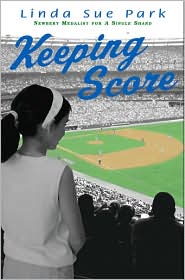
While I’ve got you (as my dad used to say), Linda Sue Park’s Keeping Score was another baseball-themed book that came out at the same time. And I confess: I hated the cover. That poor book, I thought. It just struck me, a former 10-year-old boy, as all kinds of wrong.
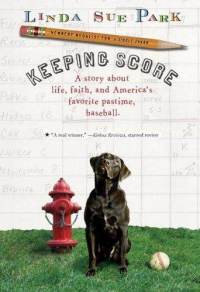
Someone must have agreed. Take a gander at the paperback.
Quite a difference, huh? It doesn’t look remotely like the same book. Curiously, in this case, the publisher went from a photographic to an illustrative approach, but more significantly re-thought the cover content and updated the design. A successful change, I think, though a dog and a fire hydrant makes me think of only one thing. Was that the idea? Dog pee? Maybe dog pee figures into the book somehow (I have not read it). The ex-boy in me wouldn’t have picked up that cover, either.
It’s also possible that the book was rewritten, with the girl character replaced by a black lab.
In the end, covers are a tricky business. The author’s job is what’s inside.
Thanks for your letter. I’m sorry for the delay in my reply. Despite my best efforts, every year I seem to reach a point when I get hopelessly behind in my fan mail. I guess my goal of “keeping it real” isn’t the most efficient approach. I once printed up cards that I’d sign and send, but it felt too phony, like I was working in a factory rather than responding to a real person.
Anyway.
I can’t believe you played in a State Championship game! Wow, that must have been an exciting experience. I know a few players I’ve coached who would throw up before big games, that crazy mixture of emotions, fear and nervousness and over-the-moon excitement. I hope you played well (and avoided hurling).
“Play ball,” yes, that’s what it’s all about. Just going out there, playing a game you love, and giving it your best, win or lose. The idea, I think, has been with me all my life. I grew up loving baseball, and still vividly remember Little League games from my childhood. As an adult, I’ve coached my three children in Little League, Travel, and All-Stars. I also spent seven years coaching a men’s hardball team. Coached more than 500 games, easy. Baseball offers up a world that I know. Also, I’ve read a ton of books about the sport, so it felt like a dream come true to contribute something to the bookshelf in my office that’s dedicated to baseball. There I am, next to writers like Roger Angell, Daniel Okrent, Bill James, Roger Kahn, Charles Alexander, Lawrence Ritter, Arnold Hano, Mark Harris, and many more. All of us pulling on the same oar.
Since you asked: You might enjoy my book, Bystander. It’s pretty much written at the same level as Six Innings, and is set in a middle school. Click here for more information.
Don’t you love the icon that I use for every Fan Mail Wednesday? A word of explanation for younger readers: It’s an illustration of something we used to call “a letter.” You see, long ago, we used to — and you’re not going to believe this — write words on actual paper (made from trees!) to our friends and relatives and business associates. Then we’d place the paper in a sealed envelope, called an ENVELOPE, and then . . .
–
Nevermind.
–
A girl sent this one via the interwebs. I removed her name for privacy:
–
Hi, I was at the school that you were at today at Vail Farm 3/30. I was wondering how you come up with titles because I’m a writer too. I’m writing a book that is about a girl who gets picked on a lot just like the book bystander. But just so you know I didn’t steal it from you. But any way I can’t come up with a title for it so that’s all I want to know.
Love,
X
–
I replied:
Hey, X. Thanks for writing. You must have been one of those students with your hand raised when we ran out of time. Sorry I didn’t call on you.
–
Titles are a tricky business. I can’t say that I’m an expert. With books like Six Innings and Bystander, I had those titles very early on. In fact, writers will often plug in a “working title” for a book in progress. It’s not the final title, or at least doesn’t seem to be, it’s just something handy to call the untitled book. For Six Innings, my working title was . . . Six Innings. That was always the concept for the book from the beginning, very clear in my mind. So when it came time to officially name the book, I used the working title.
–
With Bystander, my first title idea was Predator. That’s because I began by focusing my research and note-taking on the bully character, Griffin Connelly. But after a short while, I became convinced that the real story was with the bystanders. In life, there are a few bullies and some victims, and then there’s the rest of us, the overwhelming majority, the bystanders. We are often silent, yet hold all the real power. I knew it should be the focus of my book, and the title. Of course, there are all sorts of bystanders. The floaters and the enablers, the watchers and the cheerers and the ones who simply walk away — all with our own roles to play in the schoolyard drama. Few of us are purely innocent.
–
Speaking of bullies, have you ever noticed that they almost always need an audience? They don’t bully unless there’s somebody to watch it, to cheer them on, to laugh. Fights are the same way. It’s interesting when you think about it, isn’t it? What would happen if there was no audience? Do bullies need bystanders in order to exist? Are we their oxygen?
–
Back to titles: In many cases, writers don’t have a title until the book is finished. Editors have told me not to worry about the title, just write the story, worry about the title later on. It can be hard, because you do need a good title. I wanted my title for Justin Fisher Declares War to be Justin Fisher Declares War on Fifth Grade, but that was vetoed due to length. I never felt that we got that title right.
–
–
When I begin a book, I often purchase a composition notebook. My working title for Justin was Talent Show. Maybe I should have stuck with that.
–
–
Here’s the first page from that notebook. I wrote it in the Bethlehem Library in Delmar. I had this idea of Justin defacing a poster in school and it’s the first scene I wrote, event though it doesn’t happen until Chapter Four of the book.
–
Often writers will go back over a story and see if there’s a word or phrase in the text that somehow stands out. You’ll see that a lot when you read books, the book’s title buried somewhere deep in the pages of the book. I’d recommend that strategy for you. Reread your story. Does a character say something that could work as a title? Is there a symbol in the book that somehow represents a character or an idea?
–
With Jigsaw Jones, my publisher wanted a title from me before I even wrote the book or, in some cases, knew what it was about. It drove me crazy.
—
The other strategy is to ask for help. That’s what I do. I’ll have a reader — my editor, almost always — read the manuscript and we’ll talk about titles together. Sometimes it takes another person who has some distance from the story to see what it’s really about. And isn’t that nice, when someone can give you the title?
–
Lastly, brainstorm. I’ve created long lists of potential titles. Then you can review them, whittle them down, and maybe share them with other people. Maybe even people who haven’t read your story. Which titles appeal to them? Is there a title that gets them curious? Nowadays this is called “crowd-sourcing,” when you simply ask a bunch of random people for their opinions.
–
Anyway, sorry, long letter. Good luck with your story. It’s always nice to meet a young author.
If you missed Part One of the Alan Silberberg Interview, it’s absurd for you to be here. I mean, really. Please follow the link to catch up.
Don’t worry, we’ll wait . . .
Late in the book, Milo gathers together a number of objects that remind him of his mother, that press the memory of her into his consciousness. Where’d you get the idea for that?
I think that comes from the fact that I really don’t have anything from my mother. Things did get thrown away or given away and it really was like she died and then she was erased. When I was writing the book I started to think hard about my mom and tried remembering objects that evoked her to me. That became a cartoon called “Memories Lost” which were all real objects from my childhood that connected me to her. After making that cartoon, it struck me that Milo would want to go out and replace those objects somehow and that’s why he and his friends hit up the yard sales.
There is a scene toward the end in one of my books, Six Innings (a book that similarly includes a biographical element of cancer), that I can’t read aloud to a group because I know I’ll start to slobber. It’s just too raw, too personal for me. And I suspect that might be true of you with certain parts of this book. I’m asking: Are there any moments that get to you every time?
I think there are two specific parts of the book that choke me up, though lots of little places make me reach for tissues. The chapter where Milo goes to the yard sale and finds a blanket that reminds him of the one his mom had will always get to me. My mom had that blanket, the “pea patch blanket” in the book — so as Milo wraps himself in it and remembers her getting sick — I am always transported to the image of my mom and her blanket. The second place in the book happens in cartoon form, when Milo remembers the last time he saw his mother, which was when she was already under anesthesia being prepped for surgery and she has had her head shaved and he can see the lines for the surgery drawn on her head like a tic tac toe board. That image is directly from my memory of my last time seeing my mother. It’s pretty heavy stuff.
And so powerfully authentic. Milo describes that period after his mother died as “the fog.” Was that your memory of it?
I think trauma at any age creates a disconnect inside us. I think the fog settled in for me slowly. As the initial shock of my mom’s death wore off a sort of numbness rolled in over me. It was a survival technique to cover all that hurt stuff with an emotional buffer and I think that’s what I mean about “the fog”. It’s like I knew there was a pain in me but I didn’t want to touch it or think about. It was just always there as a dull feeling deep inside. The Fog.
Speaking of fog, you watched a lot of TV as a kid.
Ha! My two sisters called me “the walking, talking TV guide” because I always knew what was on and what channel. I’d never be able to do that today with all the satellite and cable channels — but back then, I was an authority on the network TV schedule!
We never got it at my house, but I remember being jealous of families who had subscriptions to TV Guide.
Absolutely! We didn’t have a subscription either but I would read the one at my friend’s house up the street and just soak it all up so I could be the authority for the upcoming week back home! Even before my mom’s death I loved TV — but after she died it really became a safe place to get absorbed into the fiction of other people’s lives. I loved cartoons and comedies the most back then.
You’ve written for television in the past. In what way do you think that helped when it came time for you attempt a novel?
The best thing about being a reformed TV writer is I already knew how to structure a story and more importantly, thanks to my animation writing especially, I was already really good at setting the scene and making sure to also describe the action. Scripts rely on good dialogue so that was a skill I’d already started to hone. When I started Pond Scum (my first book) I thought of it as a long episode of a great TV show and I let the chapters drive the story as if it was a script.
When I talk to students on school visits, I’ll sometimes do a quickie “show, don’t tell” lesson, and I’ll describe it as creating a movie in the reader’s mind — in part because my skin crawls when I hear it described by authors as “painting pictures with words.”
Yeah, the writer as painter image doesn’t quite skew in my head either. And I bet the kids really relate to your idea of imagining a movie in their mind. That’s nice.
I wonder, what did the novel format allow you to do that, perhaps, you couldn’t achieve while writing for television?
TV is dictated by the time of each episode, whether it’s 30 minutes or 60 minutes the writer is being told how many pages to write and where the commercial act breaks appear. There are producer notes and network notes and it really is a bit of writing by committee. I am really thankful for my TV writing experience — but I so appreciate the freedom of writing a novel where I can do whatever I want and am not restricted by time issues or rules of what my characters can and can’t do. I am so much happier being in control of the world I create when I write a novel. Of course there are notes that must be worked with from the editor at the publishing house — but I have always found that to be a collaborative experience to make the book better. In TV — notes were usually a headache and lots of times they never even made sense! My book editors, Donna Bray on Pond Scum and Liesa Abrams on Milo — have made me a better writer and I am so thankful to them for that.
Can you think of anything specifically that they taught you?
I think one of the best lessons I’ve gotten was to stay true to the kid voice of the story. Sometimes I let my characters talk the way I’m thinking and the situation is all kid, but the language comes out too adult. Maintaining the kid POV is always in the back of my head thanks to my editors.
Yeah, I have that struggle, too. Once I created a second-grade character with rheumatoid arthritis who had a fondness for lemon cakes, Jay Leno, and bargain-priced resort wear. I had to rethink it. Question: How do you know when something’s funny?
That’s the million dollar question! I wish I knew that answer. I think I have a good sense of humor so if something strikes me as being funny — it usually is at least amusing. I’m not too big on dissecting jokes or looking for rules of comedy (with the exception of “the rule of three” and “words with a “k” sound”).
Yes, the classic scene from Neil Simon’s “The Sunshine Boys” with George Burns and Walter Matthau. I can’t find the exact quote, but the basic idea: Alka-Seltzer is funny. Chicken is funny. Pickle is funny. L’s are not funny. M’s are not funny. Lettuce is not funny. Cucumber’s funny. Cab is funny. Taxi, not so much.
I saw the play version on Broadway and wish I could remember the cast but my mind is a blank. But it was funny. Very funny. As far as knowing when something is funny or not — I also like to run things by my wife and son — if they don’t at least crack a smile I know I am way off base!
I have this memory from college. This guy Dave used to introduce me to people, saying, “This is Jimmy. He’s really funny.” And I hated that. I finally had to say, like, Dave, dude, you’re killing me here. First, the pressure was ridiculous, and secondly, I didn’t want to play the clown. I can be funny at times, but it has to come in naturally. That’s how I feel about writing, too. I think I’m in trouble when I try to be funny.
Yeah, I was that guy at times but thankfully I can’t tell jokes so no one puts me on the spot anymore. I’m more of the guy who stands in the back of a group listening and then I add a zinger to the conversation — I’m a punch line guy who then shrinks back into the shadows!
Well, then feel free to say something funny, Alan. I’ve been waiting pretty patiently. Zing away. I sense that my Goofball Devotees are becoming restless.
No, really. This is when I bomb. The pressure to be funny will always result in the most un-funny thing possible, which I think I just proved with this last sentence.
No, that was hysterical, I laughed just watching the sweat pore off your head as you tried to think of something funny. Like the great scene with Albert Brooks in “Broadcast News.”
There’s a great line by one of the camera crew in that scene: “Nixon didn’t sweat this much.”
Back to Milo, did you worry that maybe you’d be blowing the appeal of your funny story by including the grief aspect. I mean, did some voice whisper in your ear, “Man, this is not the way to sell books to boys.”
Yes! As I mentioned, the initial goal was to just write a “funny book.” But once I realized what Milo’s story was — that he was the boy whose mom had died — it became a challenge to tell the story in a way that was both touching and funny. I stopped thinking about whether it would sell or not and concentrated on telling the story from a true place inside me. I had some deep seated confidence that this book would find its place and it was meant to find its way to Liesa Abrams at Aladdin. She embraced Milo immediately from her heart. I think that trying to write a “commercial” book is the worst way to go about it anyway.
So you think I should scrap the Geek Supernatural Romance I’ve been trying to write?
What? No vampires or zombies in it?
NOTE TO SELF: More vampires, jump on zombie craze.
Now, where were we? Oh yes, Alan Silberberg! Haven’t you gone home yet? How important are the illustrations to the book’s appeal?
I think it was important for me to add my cartoons to this story, in other words, be able to write and illustrate a book. Though I think the story could stand just fine as a text-only book, it’s clear that cartoons help get the book into certain young hands. But apart from that, I really felt the cartoons could add a dimension of story-telling to the book (not just funny eye candy).
You’ve said elsewhere that the words usually come first, that you are truly illustrating the story. But how does it affect you as a writer, knowing that you’ll have those illustrations? I’d think it would help with, say, a joke or funny moment. You’d be delivering the punch-line two different ways.
Exactly. I find that when I know there can be a cartoon anytime I feel like it — the writer part of my brain and the cartooning part kind of team up. I get a voice inside my head telling me, “Hey, you could punctuate that joke with a great doodle!” Certainly I found with Milo that there are parts of the book where I was having a hard time writing until I imagined how a cartoon would help the chapter be lighter or in some cases the opposite, where a cartoon could tell the sadness of the story in a visual way. I guess the writing was a little easier because I always had my cartoons to fallback on if I got stuck.
Any new books from you on the horizon? Or have you gotten up the courage to finally pursue that career as a catwalk model?
My legs are my best asset! Actually, I am almost done with the first draft of a new book for Aladdin. It’s another book that will include my cartoons but it is much more of a silly book than Milo. It’s a buddy story about two friends who want to be the school cartoonists and get more than they bargained for when their wishes come true.
Lightning round: Adam Sandler or Chris Farley?
Gonna have to go with Sandler.
Ouch. Okay, chin up: Ali or Frazier?
I’ll go with the Kelsey Grammer guy. Never liked Ali McBeal.
Separated at birth?
I think that’s Ally but . . . let’s move right along. The Halloween treat that makes you go back to the house a second time?
Has to be Nestles Crunch!
Top of your head, five favorite books?
A Confederacy of Dunces by John Kennedy Toole and Walker Percy, Adrian Mole by Sue Townsend(any and all), Half Magic by Edward Eager and N.M. Bodecker(it was the first book I remember loving as a kid), The Count of Monte Cristo by Alexandre Dumas, Bird By Bird by Anne Lamott.
Five favorite movies?
The Big Lebowski, Memento, Back To The Future, Monsters Inc, Defending Your Life.
First album you ever bought as a kid?
The Who’s Quadraphenia.
Five most played songs on iTunes? No cheating.
“This Must Be the Place (Naïve Melody)” Talking Heads, “I’ve Had It” Aimee Mann, “New York City Serenade” Bruce Springsteen, “Generator (Second Floor)” Freelance Whales, “Into The Woods” Soundtrack.
Nice list. It’s often a surprise what floats up to the top. Full disclosure, my five most played includes four Dylan tunes (“Love Minus Zero/No Limit,” “Just Like Tom Thumb’s Blues,” “Positively 4th Street,” “Tell Me That It Isn’t True”) and Van Morrison’s, “And It Stoned Me.” So: you live in Montreal, which surprisingly is still in Canada. Five favorite places in the city?
1) Schwartz’s has the best smoked meat sandwiches on the planet. 2) Westmount Library lets me fall asleep in their cozy chairs. 3) The Old Port of Montreal for the relaxed tourist ambiance of Europe with a Canadian twist 4) Shaika Café, where I like to write and watch the other people write while they watch me 5) This chair in my house. Love it!
Alan, thanks for stopping by. I’m glad we got a chance to meet. I’ll be watching your career and rooting for your success. Please accept this set of bamboo flatware as a parting gift. You’ll love giving your meals a tropical twist with real bamboo-like handles! The complete set serves one (and might be missing a fork). Shipping not included.
Some links to more interviews conducted by yours truly:
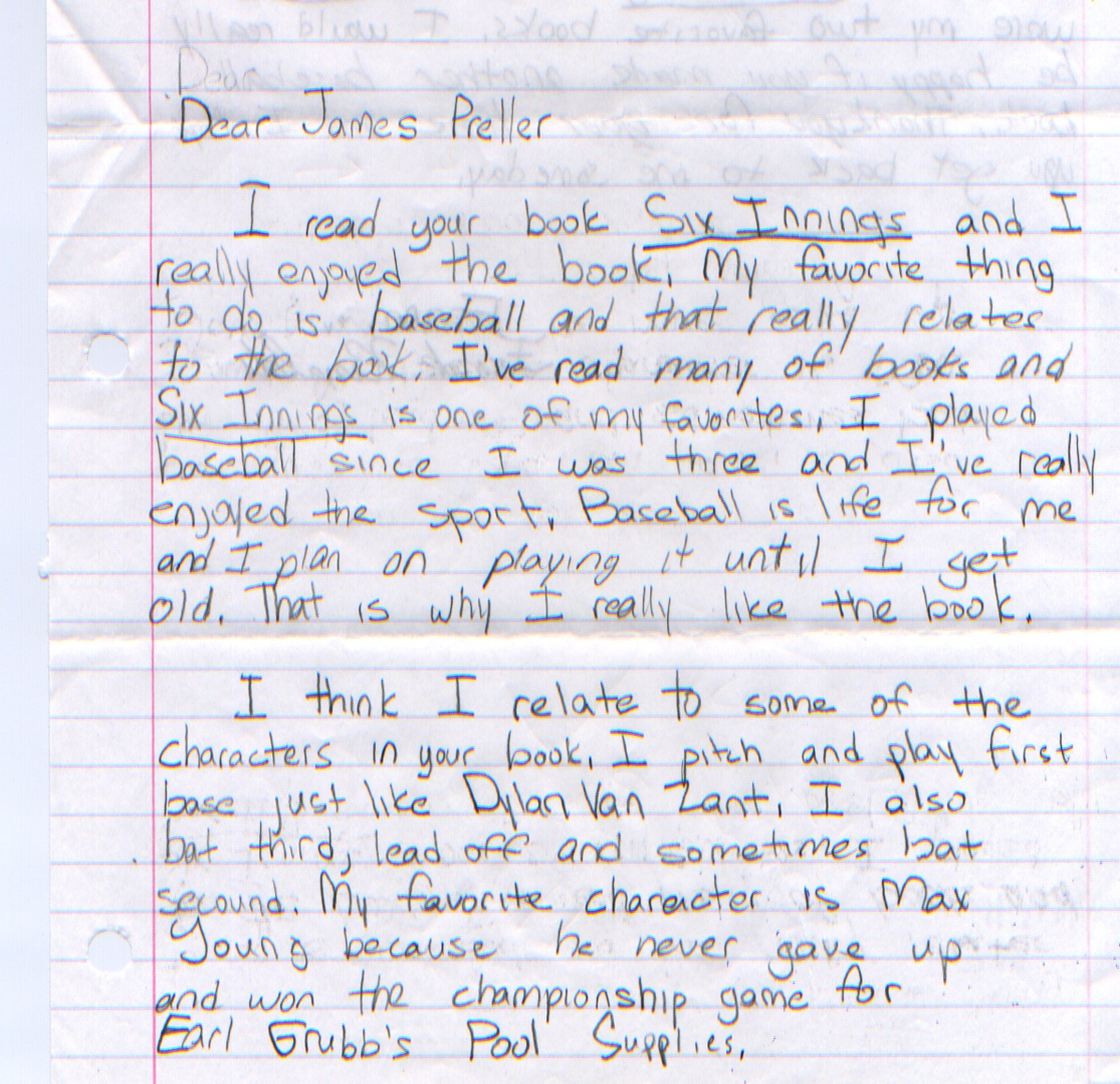
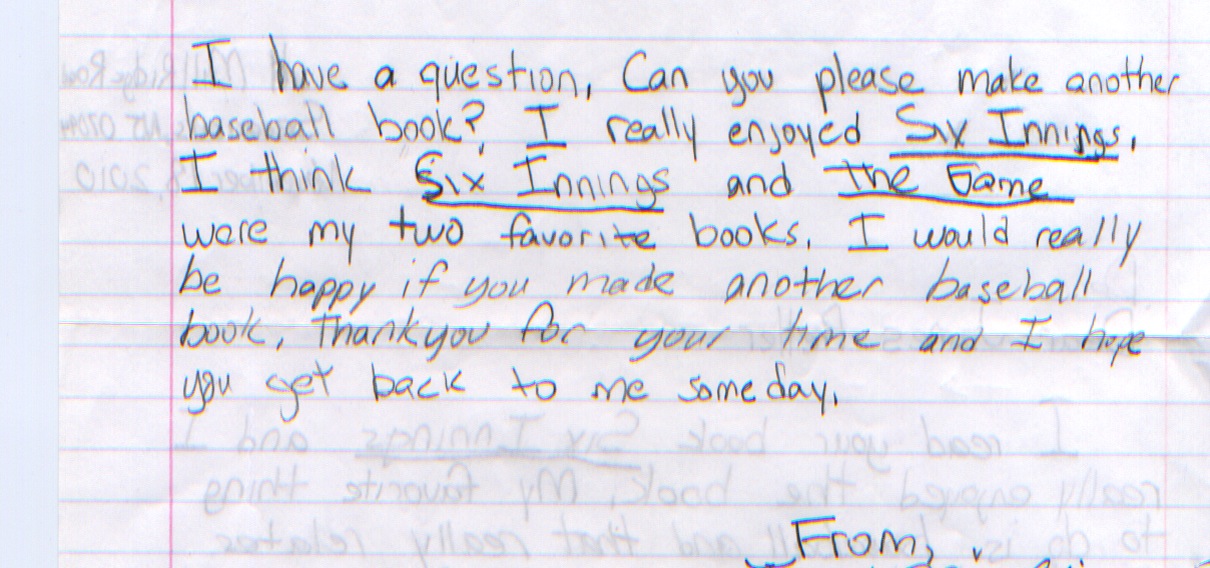
Here’s a letter from Frank in Secaucus, New Jersey!
Hold on while I warm up the scanner . . .
I replied:
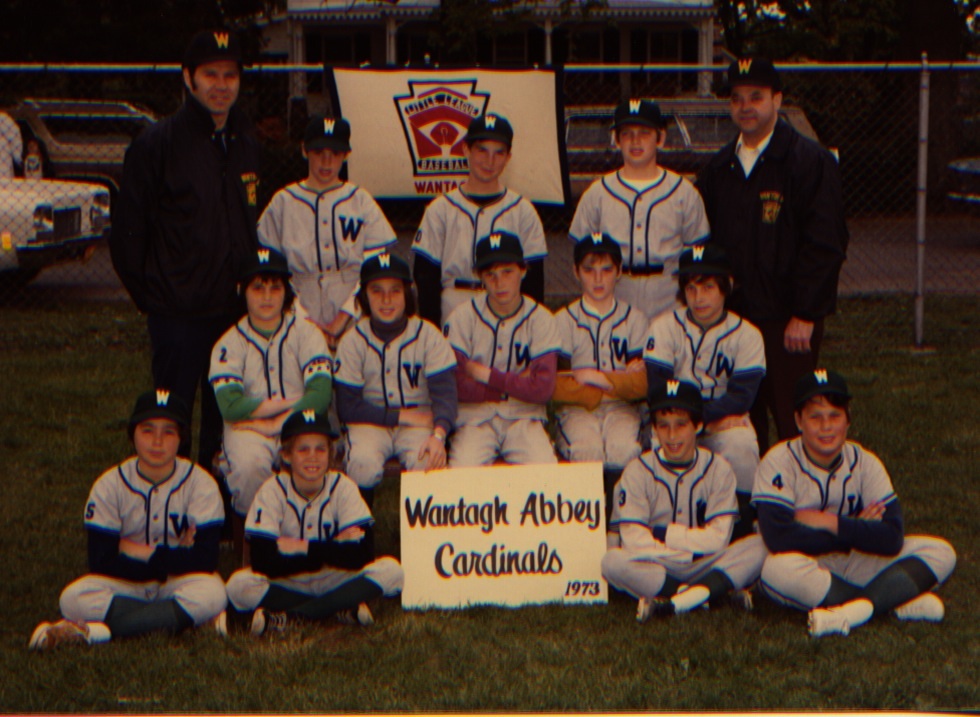
Hi, Frank. Thanks for the letter. It sounds like we’ve got a lot in common, since I’m also a huge baseball fan. Here’s a shot from back in 1973, when I was 12 and played Little League for the Cardinals in Wantagh, Long Island.
That’s me, top row, center.
I loved playing baseball so much that when I turned 38, I joined a Senior Men’s Hardball League. I started my own team, managed a group of men for eight seasons — doctors, engineers, state troopers, teachers, it didn’t matter so long as they could play! I had to stop a couple of years back, when coaching my son in Little League and All-Stars and Travel Baseball just got too overwhelming. I ultimately had to realize, this was his time, not mine. Even so, I hope to get back on the field again someday, because it’s just so much fun to go out there and play, compete to win, dive for a ball, steal a base, rip a double into the gap. My point: You don’t have to give up the game just because you’ve gotten older.
This is me about 30+ years later.
After Six Innings, I was a little bit worried about being typecast as “just” a sports writer. I wanted to write about many different things, so I avoided following up Six Innings with another baseball book. But I do have an idea for one, and I hope to get around to it within the next couple of years.






)

