Tag Archive for Six Innings Preller

JUSTIN FISHER: Recommended for the Read-Aloud Classroom

Though I published my first book in 1986, it wasn’t until recently that I experienced book reviews. Despite a crazy assortment of books, plus forty titles in the Jigsaw Jones series, the books were never, to my knowledge, reviewed.

That’s the paperback world. I began to think my name was James “Critically Ignored” Preller. The consoling factor was the books were being read by their intended audience, with titles like Hiccups for Elephant and Wake Me In Spring selling more than one million copies (thanks to the might of Scholastic Book Clubs). Beats a review any day. And yet, and yet. There’s something about the validation that comes from a positive, industry-sanctioned review. I think I longed for somebody to say, “Okay, he’s in the club!”

Things changed when I entered the hardcover world in 2008 with Six Innings. Suddenly my work was deemed review-worthy. The coach tapped me on the shoulder; I grabbed my helmet and raced in from the sidelines: I was a playa!  I’ll admit it: the world of reviews represents a confusing, seemingly arbitrary process. While I’m grateful to each reviewer who spends time with one of my books, I’m still afraid to read most of them. Some reviews are perfunctory at best, even when they say decent things about a book. Other reviews are canny and insightful. The whole process feels like a crapshoot. Who are these reviewers, anyway? These strangers who can fill my head with praise or cut me off at the knees (example: for the generally well-received Mighty Casey, a book-lover for Kirkus Reviews snarked: “As a writer of verse, Preller, author of Six Innings, makes an excellent prose novelist.”)

Freaking ouch. I’ll never rhyme again!

And then there are rare reviews that are just incredible, because of the source. That’s how I feel about this latest blog review by Franki Sibberson for Justin Fisher Declares War!

I first learned of Franki when I became a fan of her blog, A Year of Reading, which I discovered on the blogroll over at Literate Lives. I figured that Franki was just another fabulous Ohio-based teacher who loved books (they seem to grow like mushrooms out there). Later I noticed Franki’s name referenced in Ralph Fletcher’s most excellent book, Boy Writers: Reclaiming Their Voices.
I did a little research and soon learned that Franki was an accomplished author herself, co-authoring Beyond Leveled Books (with Karen Szymusiak and Lisa Koch), Still Learning to Read (Karen Szymusiak), Day-to-Day Assessment in the Reading Workshop (again with Karen Szymusiak), and more.

Clearly, Franki knows and cares about teaching reading in the elementary school. She’s invested and dedicated. As a former school teacher told me over lunch earlier this week, “teaching is an act of hope.” My guess is that Franki would nod her head at that comment.

So I’m honored by Franki’s review of Justin Fisher Declares War! A book that has not gotten much attention to date.

Click here to read the review in full — and then be sure to bookmark Franki’s site, because it’s an inspiration and an education. Here’s an excerpt from the review (I confess that it amounts to more than half of Franki’s review, because I didn’t have the heart to cut any good parts):

I am a huge James Preller fan but this may be my favorite from his list. Most of my teaching life has been in grades 3, 4, and 5. I feel very at home in 4th and 5th grade classrooms. I love the age and James Preller must also love this age. He really understands them and the struggles they deal with. Over the years, I have learned what a huge transition this age is for kids. They go from being little kids, to being big kids and it is sometimes a little confusing.

In this book, we learn that since 3rd grade, Justin Fisher has been the class clown. He is always up to something. He has good friends but in 5th grade, that seems to be changing. His friends and classmates have had enough and are starting to keep their distance. For me, this book is about figuring things out. Things that are cute and funny when you are 8, are no longer cute and funny when you are 11. This is a hard lesson for kids and finding their place in the world gets trickier. But Justin finds his way, thanks to an amazing young teacher (one that clearly deserves a spot on 100 Cool Teachers in Children’s Lit!).

If I were in the classroom this year, this would probably be my first read aloud. The first read aloud has always been key and the choice is always a hard one but there are so man reasons that JUSTIN FISHER DECLARES WAR would make a great first read aloud.

<< snip >>

—–
Franki recently listed some recent raves for middle grade fiction — and I know I’ll be checking them out soon (if not reading every one, at least buying a few for my fourth-grade daughter, Maggie):

Out of My Mind by Susan Draper

Touch Blue by Cynthia Lord

Keeper by Kathi Appelt

Mockingbird by Kathryn Erskine (already on my night table)

As Simple as It Seems by Sarah Weeks

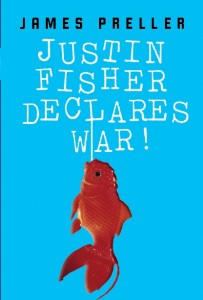
Obviously, Franki really likes books with blue covers (goldfish and water optional).

And you know what else? She’s a huge James Preller fan!

Absent Parents in Children’s Literature

A friend of mine, author David Klein — whose debut novel, Stash, is due out later this month — alerted me to a recent interweb discussion about absentee parents in children’s literature.

Literary agent Nathan Bransford summarized the debate here, while making some solid, sensible points. Here’s one quick snip:

Another major factor in YA and MG literature is allowing the characters to fight their own battles. It’s a very common theme in YA for parents to be absent, abusive, oblivious, or otherwise useless. There’s actually a reason for this, other than the obvious ready-made angst factor. You see, for a story to truly be centered around an underage MC, they have to do everything themselves. Parents, guardians, and other adults can’t do it for them.

Of course, this is an old narrative device, wildly popularized (and trivially conventionalized) by the folks at Disney (Bambi, Simba, I’m looking at you). Seriously, the list of dead or missing parents in Disney films is long and almost comical in its predictability.

Note: This screen shot was filed under the caption,

“Awesome Moms,” so of course she had to go.

The role of parents is often a thorny issue in children’s books, for some of the reasons explained above. But as a devoted parent, I have mixed feelings. I understand the narrative expediency of eliminating parents, or making them appear incompetent, but at the same time I kind of hate it in books when every adult is a complete, useless waste of oxygen. I guess I’m much more offended by one-dimensional characters than the idea of absentee parents.

Personally, I tend to write sympathetically about parents in my books. The trick is to keep the story child-centered. Because, likewise, I also loathe it when a perfect adult prances into the story and solves the problem for the child.

In Bystander, my recent book about middle school bullying, I created an absent father and it served as an important fact in my main character’s life. A source of vulnerability, the limp in his walk. At the same time, Eric’s mother is outstanding. She does a lot of things right as a parent of a child who is bullied. For example, even though her role in the book is limited, Ms. Hayes has thoughtful family policies about computer and cell phone use, she advocates aggressively for her child with the school once she perceives a problem, she makes an effort to spent alone time with him and, basically, she tunes in. I like her and wanted to model how a good, caring mother might act under those circumstances, since I think that’s the most likely scenario. The adults in the school are also shown in a positive light.

Even so, the conflict and the drama remain with the boy, Eric Hayes, in his own world (mostly) away from home. Mom isn’t the answer, but she does provide a foundation of support.

In Six Innings, I’m pretty sure all the adults portrayed are sympathetic and realistic, though Mike Tyree’s parents are distracted by his sister’s athletic success. They don’t quite give Mike the attention he needs. When I started the book, a few people asked me, essentially, “Are you going to write about how the Little League parents and coaches are so awful and over-the-top?”

My answer, “No, not this time.”

In my experience, the coaches — while flawed and sometimes too focused on their own child — are good, decent parents who volunteer an incredible amount of time and energy to the benefit of many children in the community. These aren’t horrible people. And overwhelmingly, the parents in the stands are good folks, too. Hopelessly biased, a little irrational at times, emotionally invested, caring. What I respect most is they are . . . there. They show up, and if you ask me, that’s 95% of parenting: showing up, day after day.

Quantity time, not quality time.

Art: rough cover sketch by R.W. Alley,

where Jigsaw literally finds a skeleton

in the closet.

Lastly, since I’m on this topic, I’ve written almost 40 Jigsaw Jones mystery books. His parents are amazing, loving, funny, intelligent, present in every way. It’s a great family. Mila Yeh has a stepmother — and guess what? She loves Mila just as much as a birth mother. Part of that was inspired as a reaction against the negative cliches that are prevalent about stepmothers, but also by my own wife, Lisa, who is an incredible mother and stepmother.

Still: The stories are about Jigsaw, his adventures and struggles in his boyhood world, and that’s where the conflict takes place. So from my point of view, I think you can represent strong, capable, caring parents in children’s literature and still keep the story kid-centered and child-resolved.

Coach Preller . . . and a Deleted Scene from “Six Innings”

Baseball has been central to my life for as long as I can remember. These days, it’s primarily as a coach, since I’ve become too busy to play on my men’s hardball team.

Let me give you a quick update:

* On Saturday, my Little League team, RC Dairy, lost a devastating semi-final playoff game by the score of 9-7. We had ended the season in 1st place, with a 12-4 record, but in baseball anything can happen in a single-elimination format — and anything did.

I was very disappointed; it took me a day and a half to get over it. Seriously. I couldn’t get that loss out of my head. I loved that team and wanted them to play in a Championship Game, to feel that excitement, have that lifetime memory. I also understood that most kids never get that opportunity. Eight years ago I coached my oldest son’s team, Blue Sky Music, to a championship victory. It would have been nice to do it again, on the same field, with a different child. Maybe I’m still not completely over it.

* The next day, Sunday, Father’s Day, my Travel Team played a doubleheader about fifteen minutes north of Saratoga Springs, an hour’s drive. This team plays on Sundays only, and again it was the end of our regular season. We won both, 11-4 and, in extra innings, 12-11. Gavin had a great day, a couple of big hits, a beautiful sacrifice bunt, pitched three solid innings, and scored the winning run in game two. A close play at the plate, safe, game over! Awesome. A great way to spend Father’s Day.

* Meanwhile, today is the first day of practice for our District 13, ten-year-old All-Stars. That will go hot and heavy until July 13th — unless we come out on top, in which case we’ll move on to Regionals. (I can imagine a dozen parents, thinking of camps and vacation plans, crossing their fingers and hoping . . . not.)

As you likely know, I wrote the book Six Innings about the boys who play in a championship Little League game. It was a book I was highly qualified to write. I know the game, and I know those players (an aside: at this level it is extremely rare to see a girl on the field; softball has swallowed them up).

In revising Six Innings, I cut about 10,000 words. Most of it was back story, character sketches, small moments off the field. We decided that my initial format was too confusing for the reader, bouncing back and forth from game action to character pieces tended to undercut the drama of the game itself. So I cut it to the bone. Painful but necessary. I’ve blogged about this before, and previously shared four deleted scenes: here, and here, and here, and here.

Below, here’s a fifth deleted scene, this time with the focus entirely on two fathers. That’s another lesson learned; there’s not a kid in sight, generally a no-no for children’s books. In short, I needed to write the scene, I needed to know it, but it didn’t have to go into the book. That’s the iceberg theory of writing. Nevertheless, don’t get me wrong: I like this scene a lot, there’s truth in it, and it was something I wanted to explore, how the game helped keep a fractured family connected. Here goes:

CASPER LIONNI

Brrriiiiing!

Jeff Reid groaned, hit the mute button. “Hello,” he spoke into the phone.

“Is this Jeff?”

“Speaking.”

“Jeff, hello. This is Casper Lionni,” he paused, “Alex’s father.”

“Yes, Casper,” Jeff replied. “How can I help you?”

“I understand that you’ve got Alex on your Little League team this coming season,” Mr. Lionni said.

“Yes, I do. We’re eager to get started.”

There was a brief pause on the phone. Casper Lionni continued haltingly. “I was wondering if, perhaps, you could use an assistant,” he began. “However, I confess that I don’t know much about baseball.”

“Neither do I!” Jeff joked. “I appreciate the offer, Casper, really. But I’ve been coaching with Andy Van Zant for the past couple of years, so we’re pretty set in that department.”

“I understand.”

Jeff could hear the disappointment in Casper’s voice.

“You see, er,” Casper continued, “as you may know, my wife, Lauren, and I, have recently separated –”

“Yes, I heard that,” Jeff admitted. “Small town.”

“I only see Alex on Wednesday nights and alternate weekends,” Casper said.

Jeff nodded, said nothing. Before giving it more thought, he blurted, “Do you know how to keep a scorebook?”

“A scorebook?” Casper repeated. “I’m sure I don’t even know what that is.”

“You can learn,” Jeff answered. “It’s pretty straightforward. You could come to the games and help out that way. Would that suit you?”

“What? Are you saying that — ?”

“We’d love to have you,” Jeff replied.

“Thank you,” Casper said. “This means a lot to me. You have no idea.”

The two men spoke for a few more minutes. The conversation confirmed three things in Jeff’s mind. Casper Lionni was a good guy, he really didn’t know anything about baseball, and he missed his son, terribly.

Jeff Reid hung up the phone, turned the sound back on for the spring training ballgame. The Red Sox just scored a run, a lefty was warming in the Yankee bullpen. He thought, Oh boy, here comes another season.

Summer Reading List

Over at the Semicolon blog, Sherry offers up a diverse and deep list for Summer Reading. In her words, “52 Picks for the Hols.”

As Sherry explains:

I used to love to read the British slang in books by C.S. Lewis, E. Nesbit, P.G. Wodehouse, and others. It took me a long time to figure out that those kids weren’t carrying actual torches in their pockets (how?), but rather normal old flashlights. And “hols” were holidays, any break from school.

Typical, Standard Englishman.

As for the point above, I believe that English charm was an aspect — just a small part overall, of course — of the appeal of Harry Potter to American readers. The unfamiliar words and expressions helped give the books an otherness that fit seamlessly with the content. I recall that when it came time for Scholastic to publish the American edition, there was some brief conversation about those nettlesome English words and phrases, concern that they might slow down (and thus, turn off) American children. The decision, correctly, was to keep the manuscript as it was on the page. I may have that wrong, and it could well be that Ms. Rowling would have insisted upon it, but there was a least a passing thought about Americanizing the manuscript, which often happens when books are taken across the pond.

It is hard to recall today, but there was a brief flickering moment when Harry Potter and the Sorcerer’s Stone was simply a good book, not a publishing sensation. I remember Barbara Marcus confessing to me, “We originally hoped we could sell 20,000 in the library market.”

Anyway, Sherry selects books from these categories: Picture Books, Younger Readers, Middle Grade Readers, Young Adult, Young Adult, and Adult Fiction and Nonfiction.

I was glad to see Six Innings make the list, along with these books in the Middle Grade Readers category:

The Penderwicks: A Summer Tale of Four Sisters, Two Rabbits, and A Very Interesting Boy by Jeanne Birdsall

Six Innings by James Preller

Leepike Ridge by N.D. Wilson

The Girl Who Threw Butterflies by Mich Cochrane

The Voyage of the Dawn Treader by C.S. Lewis

Henry Reed, Inc. by Keith Robertson

Umbrella Summer by Lisa Graff

Spiderweb for Two: A Melendy Maze by Elizabeth Enright

Galveston’s Summer of the Storm by Julie Lake

It is always a happy surprise and a great tribute to be included in these recommended lists, along with such respected company. I’ll have to go wash up, put on something nice. Maybe a sweater vest or something. Thank you, Sherry, whoever you are!

Fan Mail Wednesday #85

When it comes to fan mail, I’ve been a bad, bad boy. So let’s get to work!

Hello,
My name is Bobbie P. and I am a fifth grade student. I read your book Six Innings and thought it was a good book. How did you come up with the idea for
Six Innings? How did you come up with the characters? What inspired you to write this book? Please answer me back so I can finish my PowerPoint on your book. Thanks for your help.

I replied:

Bobbie,

Hey, lighten up on the praise, you’re giving me a swelled head!

Thanks for reading Six Innings. Gosh, I don’t think I’ve ever before been the subject of a PowerPoint.  I wonder: Is it like acupuncture? I mean: Will it be very, very painful? I don’t like needles or pointy things.

Brrrrinnng, brrrinnnng. Hold on: I’ve got to take this call from my wife.

(JP: “What’s that my little love muffin? PowerPoint? It’s on a computer? Really?! It’s not pointy at all? No sharp needles! Oh, thanks for the info. It’s so hard to keep up with technology these days.”)

So, um, Bobbie: nevermind!

To answer your questions:

I had to write a book about baseball; it was inevitable. Baseball has touched my life in every way that it can be touched, it’s an invisible thread that connects all the corners of my life. Most vividly in my childhood memories, most profoundly with my mother –- watching ballgames, having catch, connecting through the game. As a father, I’ve spent a lot of time around Little League fields. I’ve coached and managed many teams. I’ve watched those kids, tried to help the best I could, and always came away convinced that I learned more than they did. It’s a world I know. But more than that, it’s a world where many boys live –- passionately. We remember those games, those times, forever. For the book, I wanted to use baseball as a way to explore character. The friendships, the struggles, the inner lives as they are revealed in thought and action during a six-inning baseball game.

I started writing the book by filling a notebook with different ideas for characters. I’d write about them, think about their lives, who they were. Once I had a fairly large cast of characters that seemed alive to me, I put them into a baseball game. It’s one of the tricks of writing: You take characters and put them in stressful situations to see how they might react.

Good luck on the PowerPoint thingy!

By the way, for more on this book, this post gives you more background on the character, Sam Reiser, and how he was inspired by real life experiences.

My best,

JP