Tag Archive for Jean Feiwel

Mighty Casey: Editorial Letter Excerpts

I’ve been doing a lot of school visits, book signings, and book fairs over the past two months. It’s been a lot of fun, distracting, joyful, happy, hard, and humbly rewarding. One of the highlights of my act — between juggling chain saws and wrestling live bears — has been reading Mighty Casey, illustrated by Matthew Cordell, to audiences up to 200 (squirming, wriggling) children. The book really goes over well (if I don’t say so myself), especially when I stop and go into great uproarious detail about Ronald the Runt, who has to pee, “and decided left field would do.” Kids love that part, and it’s absolutely true to my coaching experience. Happens every year. Some of those little boys just want to play and play until the lastpossiblesecond, not missing a thing, and they don’t always make it all the way to the bathroom.
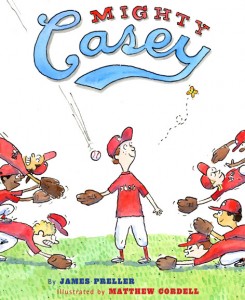
When Ernest Thayer wrote the original “Casey at the Bat,” published in a San Francisco newspaper in 1880, he considered it a mere doggeral. He even used a pen name, to disassociate himself from the poem that would later (ironically) define his career.

I never really thought of Mighty Casey as a poem, per say. It rhymes and bounces along well enough, but it’s not, to me, poetry. Like most published books, it went through various drafts and revisions. And it was definitely made better through the help of my editor at Feiwel and Friends, Liz Szabla. As a rule, anybody with two z’s in their name has to be awesome. Name your child Buzzy and you are guaranteed a terrific kid. Anyway, here I am digressing once again, suggesting names for your children, which, let’s face it, is probably a personal decision and none of my business. But: Buzzy. Think about it.

I just came across an editorial letter from Liz, with comments and suggestions in response to the first draft of Casey (that is, the first  draft that Liz saw; not the first draft I wrote). The way this works for Liz is like this: We’ll talk on the phone, go through things in a general manner, and she’ll follow that up with a more detailed “formal” letter. Most editors seem to work this way. Below you’ll find the bulk of that letter, with only a few passages removed to save the author from further embarrassment. I should also note, for those interested in the publishing process, that I didn’t see that first draft as a finished piece. It needed work and I knew that. But I had reached the point where I needed another eye, another point-of-view. I needed, that is, HELP! And Liz was there to catch me.

MIGHTY CASEY is mighty charming and we’ve enjoyed the time we’ve spent with it. I’m delighted now to be sending you our thoughts as well as a line-edited manuscript. You and I haven’t worked together before – please know that all my suggestions are open to further discussion if anything doesn’t feel quite right.

First and foremost, the Delmar Dogs are hilarious! Casey, as the unlikely hero, is wonderful. And the echoes of “Casey at the Bat” make Casey’s final triumph all the more satisfying, of course.

Let me break in here to comment that all editorial letters begin with a compliment. It’s a trick they teach you early on in Editorial School. The editor opens your ears by saying something positive. I tell this to kids who do peer writing in school: Always begin by saying something nice. Find a part in the story that you like and praise it. That way, you increase the chances of the writer hearing any critical suggestions you might later make. I’m saying: Liz didn’t fool me; I knew there was a big “but” in there somewhere.

You’ll see that I’ve make some suggestions and tweaks on the manuscript to fine-tune the rhythm or syntax in places. I won’t detail those suggestions here, but do let me know if I’ve fouled anywhere (heh, heh). Now onto a few issues to keep in mind as you consider the line-edit….

Note: the “line-edit” is the marked up manuscript, with more detailed comments and suggested changes in the dreaded red pencil. The general editorial letter comes along with a marked-up manuscript, which can be a cold thing, almost painful. Thus, the editorial letter serves as fabric softener to the line-edit’s starch. (Oh dear me, a laundry metaphor? Move on, people, there’s nothing to see here, nothing at all . . . .)

4th stanza
Although the “enjoyed…destroyed” rhyme is marvelous and unexpected, I can’t help but wonder if, in the fourth stanza, the parents’ feelings about the game are at odds with the Dogs’ pride at trying their best. To say that the adults don’t “enjoy” the games is a bit of a disconnect with the spirit of the Dogs. Still, I certainly see how it might be tough for the parents to see their kids trounced, and if this is what you intend, then let’s leave it. But if you want to work on another layer of subtlety – that is, the kids’ pride being stoked by their parents’ empathy, then I believe it’s worth exploring.

This is an example of an editor forcing the writer to think. I had to go back and look at what I was attempting to achieve in that stanza. I suspect Liz’s motherly instinct was to keep the parents cheerful and positive, whereas I wanted the recognition of how tough it can be to sit in those stands sometimes. In the end, I pretty much kept this stanza as is, but Liz made me to think about it and justify those words in my mind.

13th stanza
I’m a bit confused about why so few spectators notice or cheer when Jinn Lee bloops a double and later scores a run. Here’s where I see the Dogs and the parents on their feet, pumping their arms in the air!

Liz was right — and she was right in many places — so I changed it. The revision now reads: “When Jinn Lee clubbed a homer/The crowd stood and cheered.”

18th stanza
As Casey steps up to bat, there are a few things readers should know: How many outs are there? That is, is he the team’s last hope? If he strikes out, do they lose? If the situation is clarified, then you’ll really ratchet up the suspense in this last section.

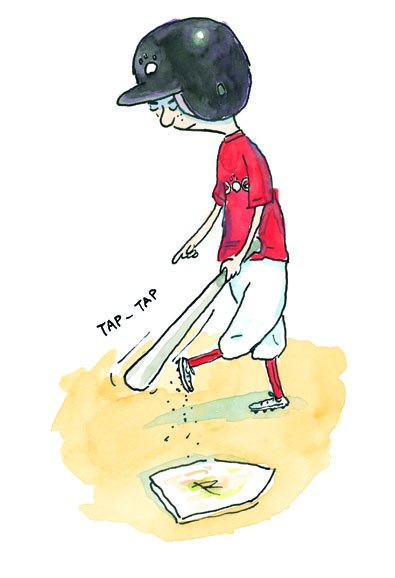
Again, just some essential details that I completely neglected to add. Or perhaps assumed. The facts were there, but I didn’t make them clear, clear, clear. This is a common kind of editorial suggestion — to “pause a beat” — forcing the writer to slow down, to really set the scene for the reader. Sometimes we’re in such a rush to get to the next thing, we don’t always properly build up to that Big Moment. It’s a Hitchcock trick. Once you’ve built up suspense, it’s time to slow things down. Think of those movie shots when we see close-ups of the killer climbing the steps, footfall by footfall. The doorknob slowly, slowly turns . . . or Casey taps his cleats.
The finale
I suspect the ending could have more zing to it…. The mother crying and the father’s heart bursting with pride seem stereotypical amid all the other fresh action and description. The fact that they’re stereotypical does fit the tone and conclusion of “Casey at the Bat,” but I believe descriptions that are as fresh as the rest of the story will complement the tone and mood you’ve established and make for a stronger ending. Also, the “bursts with pride” description echoes the language of the 3rd stanza (“bursting pride”). Would you consider echoing some of the language in the ending for “Casey at the Bat” instead? “[H]earts are light…men are laughing…little children shout…”?

The very last line is also in need of some zing. “Three cheers” feels predictable and “our side” seems too general and not exciting or punchy enough for a conclusion. Perhaps you can work “Delmar Dogs” into the final line, so that it appears in the opening and conclusion, just as “Mudville” does in “Casey at the Bat.” What do you think?

Hey, I knew the ending wasn’t right (to put it kindly). I probably even said so when I handed in that first draft to Liz. I was struggling with it. I remember interviewing James Marshall, tape recorder rolling, back in the early 90’s. He said something that always stuck in my head, simple and profound: “It’s always the ending that gives me the most trouble. The ending is what people remember. If the book fizzles in the end, they remember the whole thing as a fizzled book. It’s important to have a very satisfying ending for the reader. They’ve entered a world and now they are leaving it. So it’s a puzzle that has to be solved. I remember with one of the Miss Nelson books, it took us [the author Harry Allard and I] two years to come up with an ending we liked.”

Liz concluded her letter:

This is already so much fun – I believe that with some fine-tuning, it will be an even more dramatic and satisfying experience. Jean and I look forward to seeing what you come up with, Jimmy.

Please call or email me if you have any questions, or want to discuss any of these issues further.

Aren’t I fortunate to have such a warm, insightful, supportive editor? Liz made me think. She offered ideas and suggestions, but always made it clear that it was my book, my decisions. She got me to get back to work, keep hauling those rocks — but without feeling bad about myself, or my book. Instead I was energized, enthusiastic, ready to roll up my sleeves. Now you can see why so many authors dedicate books to their editors. We know we couldn’t have done it quite so well without a lot of help from the unseen hand of a talented editor.

Every time I read Mighty Casey out loud to a group of kids — when they laugh in the right parts, when they lean in to learn what happens next, when they burst into applause at the end — I always think of Liz and my publisher Jean Feiwel, and wish that they could be with me to share in the moment. The applause is also for them.

. . . and Friends?

I got a fat package in the mail yesterday, sent by my editor at Feiwel & Friends, Liz Szabla. It contained their Fall 2009 catalog, along with ARCs for eight upcoming novels:

Everything for a Dog by Ann M. Martin

In the Path of Falling Objects by Andrew Smith

Spellbinder by Helen Stringer

The Sweetheart of Prosper County by Jill S. Alexander

Buck Fever by Cynthia Chapman Willis

The Eyeball Collector by F.E. Higgins

Bystander by . . . that would be me (and for the record, I can’t wait to talk about this book, and the topic of bullying in general)

One of Jean Feiwel’s stated missions for her new publishing venture, after something like 20 years at Scholastic, was to Keep It Small. And so far, she’s stuck to that goal, despite the temptations to grow, and Grow, and GROW. But still: Feiwel AND Friends. If you are like me (read: hopelessly cynical), then you probably think, “AND Friends,” yeah, right.

But I do feel a difference. Part of that is based on my association with the merry crew that makes things happen at F & F. It’s a small staff and I think I’ve met them all, even the person who gives Liz and Jean their weekly pedicures, and I’ve even Facebooked a few. (Yes, it’s a verb now.) But there’s also, for me, a sense of community with the other authors and illustrators. We’re all on the same team, so to speak, and like a fan in the stands, suds in hand, I’m rooting for them.

Will I read all these galleys? Nope. I mostly read adult books. But I’m eyeballing that new Andrew Smith book, curious about what he’s done with it. And Julie Halpern is a fresh, original voice — so uncool that somehow she’s totally the coolest one of all. Then there’s Spellbinder, a debut novel, which on the surface seems familiar and yet strange at the same time. Who is Helen Stringer, anyway?

A confession: I’ve never had much interest in cultivating friendships with other authors. I know a few on Facebook and whenever I read their status updates on new galleys or their writer’s block or revision process or whatever — well, it just turns me away. I’m just not interested (as I sit here, blogging, semi-ironically, at this Shrine to Myself). The idea of going on, say, an “artistic retreat” with a bunch of other writers makes my skin crawl. I’m not sure why that is, exactly, but it’s real for me. Maybe I like regular people better. Or maybe I’m too competitive, or too insecure. Maybe it’s like ordering a Bud in a can when there’s some snazzy cherry-flavored micro brew available. I don’t know.

But this crowd at Feiwel and Friends? It’s hard to explain. Just a sense I guess, a feeling that’s kind of sloppy and formless, like a first wet kiss. A little creepy, but kind of nice, too. A little like . . . friendship. With benefits. Like free ARCs!

And by the way: I’m back from vacation. Hear me roar.

Check Out My Interview

Over at Feiwel and Friends, they are celebrating the publication of Mighty Casey like it’s 1999. They are even blogging about it. Please click the link because Matthew Cordell just interviewed . . . me! Their blog is pretty great even without us (imagine that!) because other F & F  authors and illustrators contribute often, most recently John Coy and Maria von Lieshout.

Here’s two brief excerpts from that longer piece.

—–

MC: I can assume that many writers, like many illustrators, are particular about how they work and where they work. Where do you like to do your writing? And what are your tools? The pen, the old-timey typewriter, word processor, or personal computer?

JP: Matt! Let me begin by saying — and since this is your first interview, no one would expect you to know this, but — you don’t actually have to sit on my lap during an interview. It’s not like a Santa thing.

MC: Whoops!

—–

MC: What do you see are the major differences in crafting picture books vs. novels? With the novel format, you generally have the space to open up and write more at length. Less confined, I’d imagine, than picture books, where you really have to choose words wisely. Do you prefer writing one over another?

JP: Well, there are two things at play here: picture books are dependent upon illustrations, so the writer is already in a strange position. With novels, you have more control over the finished product. Secondly, novels probably better suit my sensibilities. I find that I can’t force a picture book, which tends to be concept-driven and needs to perfectly distill an experience to its essence. With a novel, you have more opportunity to wander in and out of different rooms, and I think that better reflects how my mind natively operates.

James Preller Interviews . . . Author Karen Roosa

A while back, I stopped by Julie Fortenberry’s most excellent blog and noticed the cover of her new book, Pippa at the Parade. The author’s name was Karen Roosa.

And I thought, I wonder if that’s my Karen Roosa? My Karen was an old stall buddy from Scholastic, back in the mid-to-late 1980s. We were copywriters together, working on book clubs and catalogs. Neighbors, we shared a cubicle wall, but had lost touch twenty years ago. So I contacted Julie, who kindly passed along Karen’s email, and here we are: She’s a big-shot famous author and I knew her when!

– – – – –

Karen, it’s so nice to catch up with you. You must be excited about your new picture book, Pippa at the Parade. It takes a long time, doesn’t it?

It is great catching up with you too, Jimmy.   It really does take a long time to see a picture book published. I had sent a different manuscript to Boyds Mills Press in late 2006, and got a call from the editor saying that story wasn’t quite right for them, but to send others.  They were looking for stories that would appeal to very young children.

Actually, I’ve heard that picture books are trending younger these days; publishers seem to be looking for titles that will appeal to the preschool crowd. We’re seeing less of the text-heavy, William Steig-type picture book.

Yes, I think that’s true — picture books for the very young child. So I sent a collection of summer poems and the Pippa manuscript, and he replied about a month later in early 2007 that they’d like to publish Pippa at the Parade. My part was essentially done right then, but an illustrator needed to be chosen, the artwork completed, and the book printed. Two years, or even longer, is fairly common.

Tell us a little bit about the inspiration for the book.

I was trying to write a “musical” story, something rhythmical and fun to read aloud, but nothing seemed to work. Once I started thinking about feeling the rhythm through the sound of the instruments, the idea of a little girl at a parade came to me.

I get the sense that your first love is poetry.

I do love poetry, reading and writing it. Trying to pare language down to its essence.

Did you have any input into the illustrations? How did that relationship with artist Julie Fortenberry work? And be careful, Julie might be reading this.

I didn’t have any input, which is not unusual. My editor fortunately chose Julie Fortenberry, a fine artist and illustrator.  I saw her work online and really liked her style.  Then I just had to wait to see the finished illustrations.

What was it like when you finally saw the illustrations? It’s an exciting but also a frightening moment.

It was very exciting. The art director at Boyds Mills sent me a PDF last summer to check the text one last time.  It was then that I could see the illustrations for the first time and I really loved them, very whimsical and playful.  They fit the story perfectly. It was a thrill to receive the finished book in the mail.

I see you already got a great review from Kirkus Reviews. And I quote in part:

“The marching band booms by and the onomatopoeic text enlivens the rhythm, “Clapping hands! / Clappity-clap. / Band is coming! / Tippity-tap.” As each section of the parade passes by Pippa is enchanted by the many instruments, which include trumpets, trombones and drums. First the gymnasts flip past, then the ten-foot-tall man on stilts . . . Fortenberry’s rippling illustrations, at once serenely indistinct and lovingly detailed, combine misty, milky hues with thick, robust pastels, presenting a celebration of excitement and indulgence that can only be fully appreciated in childhood.”

Pretty nice, Karen — you too, Julia, and thanks for the use of your illustrations. Personally, I’m frightened by reviews.

It is a little scary. But I have to look. And by the way, congratulations on Six Innings being named an ALA Notable Book — very exciting.

Thanks. I’m sorry that I missed your first book when it came out, Beach Day, illustrated by Maggie Smith. You must have been thrilled when it was named a Bank Street College of Education Best Children’s Book of the Year. Now it looks like you are on a roll. What’s next?

I have a couple of picture book manuscripts that I’m sending out, and I’ve always liked the idea of trying a longer story for older children.  Plus maybe poetry, short stories . . .

Well, obviously, the big bucks are in poetry.

Yes, of course!

We shared a cubicle wall for at least a few years back in the way back, the late 80’s, when we both worked as copywriters for Scholastic Book Clubs. Was I good neighbor? I tried to keep the music down when I had large parties. You never called the cops.

Those were good days at Scholastic. The 80s!

Let’s pause here for a salute to the decade . . . and yes, I wore a black Members Only jacket. Their tagline: “When you put it on, something happens.”

A  touching tribute, Jimmy. That job at Scholastic was one of the best ever.  It was great being cubicle neighbors with you. I actually do remember a lot of parties on our floor.

As one of the few heterosexual males in the department, I used to joke with Craig Walker that I felt personally responsible for all the sexual tension in the building. It was pretty much up to me, Greg Holch, and the mail room guys. The pressure on us was enormous. I’d come home from work exhausted.

That’s funny, Jimmy, but you might be exaggerating a little.

Never! Eva Moore was the editor of Lucky Book Club back in those days. Each month, we had to read and describe more than 30 books for both teachers and young readers. It was quite an education, wasn’t it?

You’d get your box of books from Craig Walker for Seesaw Book Club, I’d get mine for Lucky Book Club, and I remember quite a few conversations about Curious George and Clifford the Big Red Dog.

I remember getting advice from Ed Monagle, the Chief Financial Officer for Scholastic at the time. Ed was a money guy, not necessarily a book guy. So one day he tells me, in his avuncular way, “Jimmy, you should really make up one of these popular characters. Look at Clifford the Big Red Dog. He’s a dog. He’s big. And he’s red. How hard can that be?”

I remember Ed and can hear him saying that. If only it were that easy!

Yeah, I told him I’d get right on it.

It was great working with Eva, and reading all of those books really was a terrific education in children’s literature.

Not to mention posters of cute kittens.

I recall many cute kitten posters in my box . . . and also glow-in-the-dark Halloween stickers.

Do you have any favorite memories from those days? I remember writing the first hardcover catalog, when Jean Feiwel launched the line back in 1986 or so. It had four books, total. Harry Mazur, Norma Fox Mazur, Julian Thompson, and I forget the other book, I think it was some kind of “stay away from strangers” type book. Anyway, we came up with an awful catalog cover that Jean absolutely (and correctly) hated. A simpler time.

I remember meeting Joanna Cole because the Magic School Bus was really big at that time, Ann M. Martin when she came in for the Babysitters Club, and a lunch with Norman Bridwell.  I still have the big red plush Clifford from our table that day.  It was a lot of fun just being immersed in children’s books all day with others who had the same interests.  And the camaraderie was great.

There’s a long gap from after you left children’s publishing to when you published Beach Day. It’s like the missing seventeen-and-a-half minutes of the Watergate Tapes – except it’s like seventeen years. What have you been up to –- and why or how did you decide to get back into it?

I left the city in the early 90’s and moved to Pennsylvania.  My children were very young and I wanted to try freelance writing. I’d send out manuscripts, but had no luck for a long time.

Many others have been defeated when faced with the same situation. What kept you going? Any advice?

I think it’s important to not give up. You never know when your story might match an editor’s tastes and needs for their list at that particular moment. I still have a huge stack of rejection letters. Occasionally a publisher would jot, “Send us more,” so I kept at it. One day I received a letter from an editor asking if I’d be willing to make a few changes in a manuscript that I’d sent; after tweaking the text a bit back and forth, Beach Day was published.

Did you celebrate?

I jumped up and down on the kitchen floor.

Okay, Lightning Round. Favorite children’s books?

Charlotte’s Web by E.B. White, From the Mixed-Up Files of Mrs. Basil E. Frankweiler by E.L. Konigsburg, A Wrinkle in Time by Madeleine L’Engle, and the books of Kevin Henkes, Kate DiCamillo, and Mo Willems.

Kevin Henkes is just spectacular. I really admire his work. Such a talent, almost in an Old School tradition. Mo Willems is great, too. I met Kate a couple of times, I liked her a lot, very down-to-earth. She has a wonderful essay on her website, titled “On Writing.” You have to read it. Go on, I’ll wait.

Okay, I just finished. That is fantastic. It is all about really seeing, then doing the work of writing. Sitting down to write. Rewriting. And then somehow mysteriously having those ordinary moments undergo a magical transformation on the page.

What about favorite adult books?

Atonement by Ian McEwan, The Collected Stories of Amy Hempel, Savage Beauty by Nancy Milford, The Secret History by Donna Tartt, the poetry of Mary Oliver, Basho, and William Carlos Williams.

I’m a huge fan all three poets, though moreso Basho and Williams. My favorite Basho line is, “The journey itself is home.”

Last question: Favorite movies?

The Crying Game, Pan’s Labyrinth, Once, The Graduate, The Ice Storm.

Thanks, Karen. I’m really glad to reconnect with you after all these years. I wish you all the success in the world, you deserve it. And as a parting gift, I was going to give you a plush version of Clifford the Big Red Dog, but you already have it. So I guess I just saved eight bucks. Sweet!

As a consolation prize, please enjoy this video of Mr. T’s fashion tips — “Hey, everybody got to wear clothes!” — and be glad we survived the 80’s with (most of) our dignity intact. (The link works, but it might take a double click.)

You need to a flashplayer enabled browser to view this YouTube video

2009 Notable Children’s Books: The Official List

The official list is out — and I’m still on it!

Whew.

There are a lot of people to thank, and many of them signed this ball. Jean, Liz, Rich, Elizabeth F., Dave, Christine, Elizabeth U., Nicole, and Jessica: Thanks. Jean Feiwel came along and believed in me at a time when I needed exactly, precisely that. A cliche, but absolutely a dream come true: “Here’s a contract, now go write the best book you can.” Forever in her debt for that opportunity.