Tag Archive for Jean Feiwel

When That First Copy Arrives in the Mail: Shiver Me Timbers!

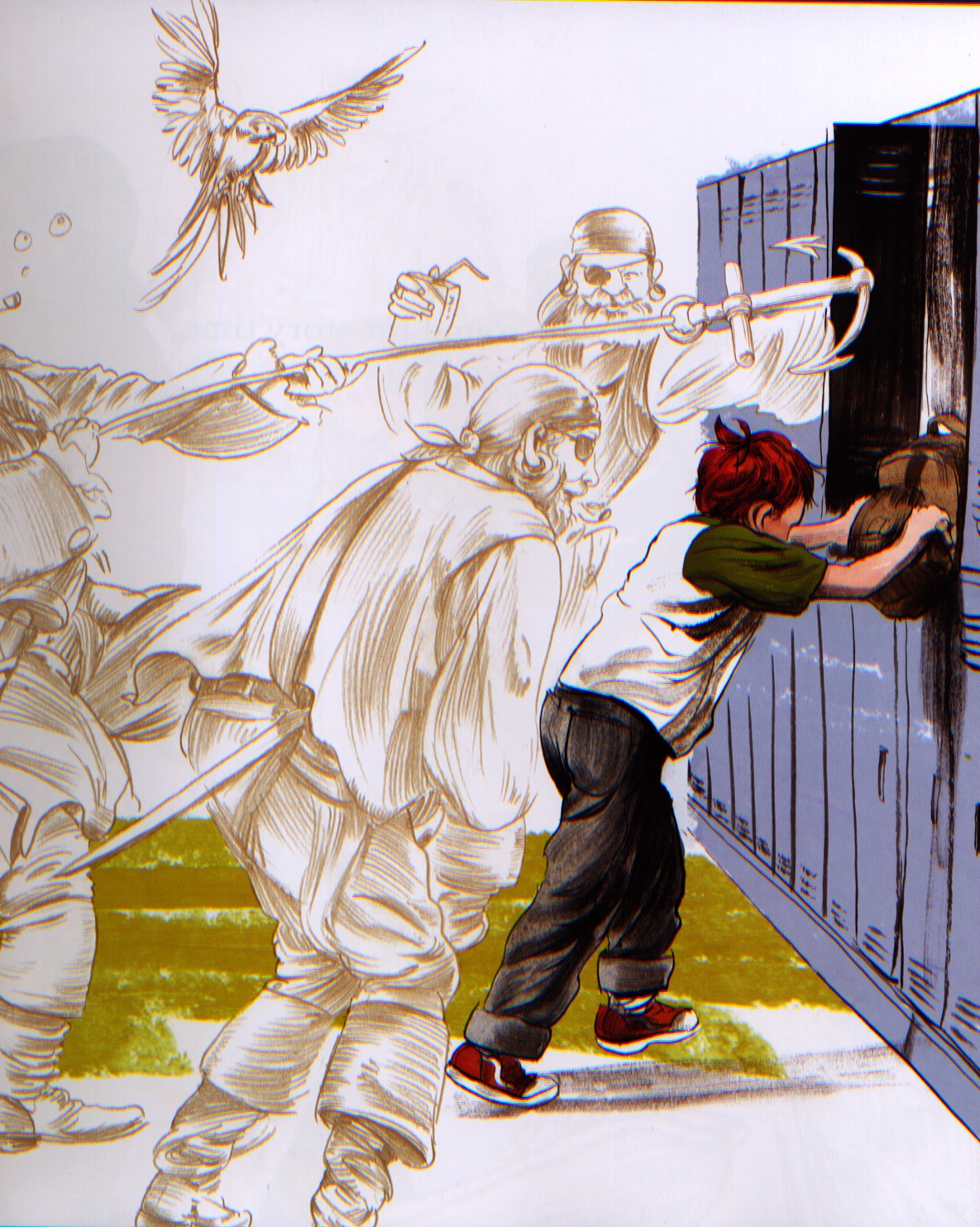
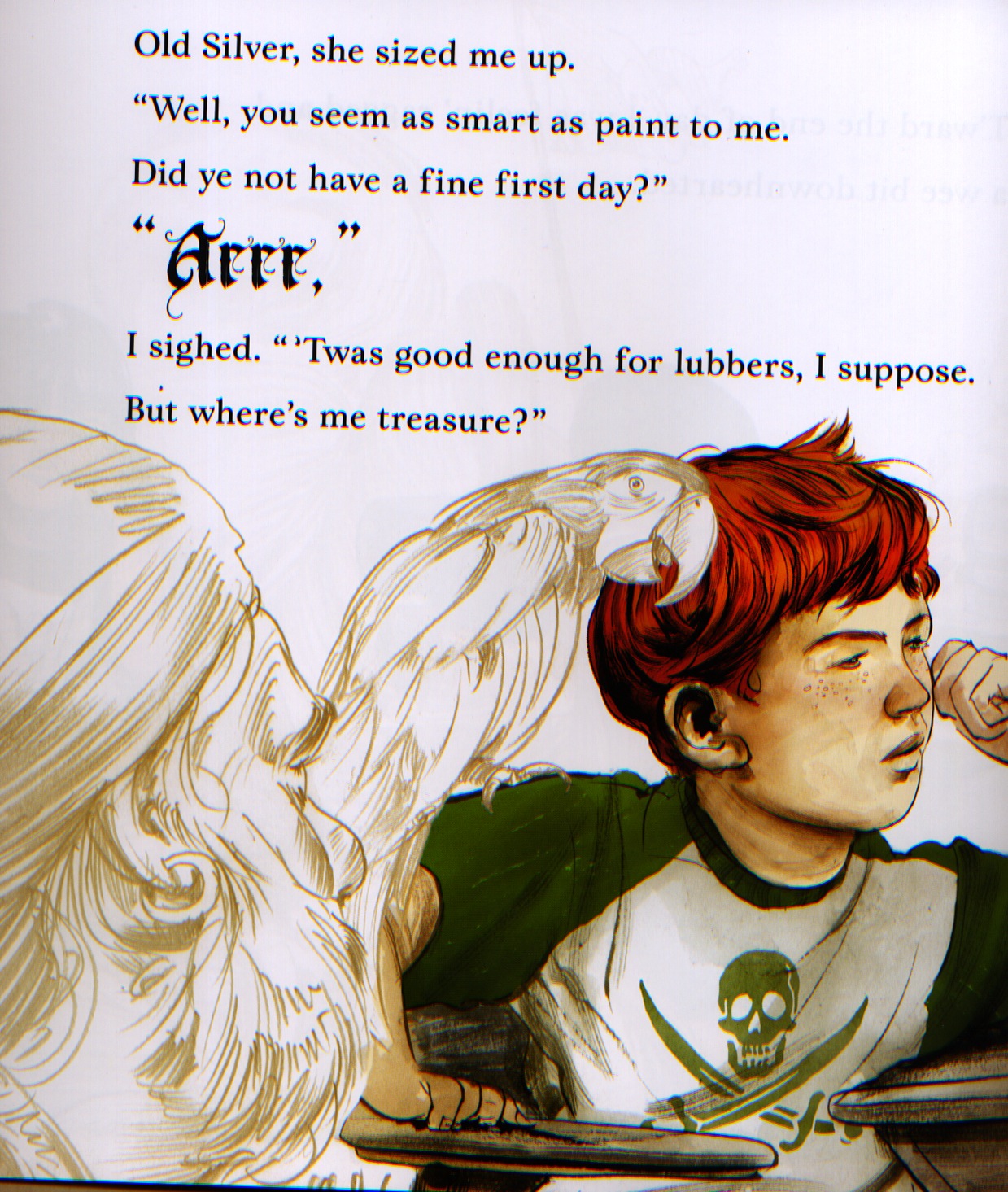
I don’t do happy dances. I’m not a fist-pumper, chest-thumper, or rump-bumper. It’s just an inward satisfaction, and pure pleasure; the culmination of something that’s been brewing for years. In the case of this book, A Pirate’s Guide to First Grade, illustrated by Greg Ruth, my pleasure is tripled by the gratefulness I feel to be so well published.

What does that mean, exactly? Well, for the most part, after you sell a manuscript your editor and publisher will make a hundred small decisions about the book. And each decision boils down to one thing: How much care are they going to put into it? Sometimes it’s money; mostly it’s attention to detail. For example, almost all picture books are 32 pages. But for this book, Feiwel & Friends gave illustrator Greg Ruth the freedom to stretch out the artwork across 48 pages. In doing so, they showed a commitment to story.

As an author, you can see it in the book, in the conversations you have about it, in all the myriad details of how it and you are treated. At times in my twisting, inglorious career I’ve been disappointed and disheartened. So clearly a B-lister.

That’s the most important thing, I think, with my editor Liz Szabla at Feiwel & Friends, the art director Rich Deas, publisher Jean Feiwel, and many others who work so hard there: Dave Barrett, Nicole “May I Buy a Vowel” Moulaison, and the entire “Fifth Ave” sales force (for talking like a pirate on all sales calls). What’s more, they all now bring parrots on all bookstore visits. That’s commitment, folks.

Collectively, they seem to care deeply about every book they publish. And for that I am enormously grateful and, yes, indebted.

The book hits the market for real on July 20, 2010 — just in time for the coming school year.


Fan Mail Wednesday #82-83

I’m running a day late again, and falling behind on everything. So let’s hop to it!

Letter #82:

I replied:

JonJon,

Thanks for the letter and the book report. I’m glad you connected with Six Innings. I’m a big reader of baseball books myself; I’ve actually built up a pretty good collection over the years. It means a lot to me that I now have a book to place on the same shelf alongside some of my all-time favorites.

Where I live, in upstate New York, we’ve finally broken winter’s back. I’m now coaching two baseball teams. One is regular Little League, boys 10-11, and the other is a 10-Under Travel Team. By the time All-Stars is finished in July, I expect I’ll spend about 70-80 days running practices and filling out lineups for games. I love it — and have always, always loved it, for as long as I can remember — so it was natural for me to finally get around to writing a baseball book. It’s a world and a game I know inside out and from a variety of perspectives.

Whenever I think of that book, I’m grateful to Jean Feiwel and Liz Szabla, my editors in New York City, for giving me the opportunity to write it. (By the way, Jean is going to be very angry when she sees that you misspelled her name — it’s the kind of thing that freaks her out completely; my advice, find a safe house somewhere, stay out of the city for a while, lay low.) You know, it  means everything in the world when there’s someone behind you, believing in you, setting you up to succeed. That’s my coaching philosophy in a nutshell: I try to be the guy on the side clapping my hands, saying, Come on, you can do it.

Isn’t that what everybody needs?

Oh yeah, thanks a lot for the self-addressed, return envelope. Very thoughtful and much appreciated.

JP

* * * * *

Letter #83:

I wanted to tell you that my son (6 years old) and I have greatly enjoyed your Jigsaw Jones series.  I picked your series because they were chapter books, but mainly because they were upbeat and friendly.  I was a bit dismayed by the dark  themes that some of the other series contained and was happy to find yours.  Many thanks for all the writing you have done!

As an aside, in one of the books I read “FLY 92” and my curiosity was suddenly piqued!  I was tickled when I realized you are currently in the Capital District.  I grew up in Greenville, NY which is southwest of Delmar.

Blessings to you and your family.  We look forward to reading more of your books (not just Jigsaw!) in the future!

– Rachel

I replied:

Rachel,

I am always so grateful when I receive notes like yours. It means a lot that you, a parent, took the time to say those kind words. I’m touched. And yes, sure, I’m glad somebody noticed! I’ve kept Jigsaw squeaky clean because I’m writing for very young readers. It’s easy to lose track of how little these kids are. I just have a clear sense of where I will and won’t go with that series. I don’t see the need for words like “fat” or “stupid” or mean-spirited behavior, much less what we commonly hear in popular children’s movies today. In fact, I feel a strong need to avoid that language.

Quick story: Yesterday we had a hard moment with my daughter Maggie, who’s in 3rd grade, when someone called her fat (she isn’t, but that’s beside the point). At the same time, I’ve been reading Queen Bees and Wannabes, constantly reminded of the importance of language and the labels we use to hurt or limit others. There she was, crying. And it wasn’t the crying that worried me, but the self-image issues that can make being a girl so difficult in today’s world. Maggie’s mother is 6’1″ — strong and powerful and gorgeous. For Maggie there’s no hope that she’ll be the idealized petite blond in skinny jeans.

I guess we’re growing up.

In fact, I blogged about this same issue — in a totally different context — earlier this week. Words have a power over us.

Thanks for writing. When you are ready to take the next step beyond Jigsaw, you might like Along Came Spider, which is just right for 3rd grade and up. Mighty Casey is a baseball-themed picture book your son might enjoy. Sorry, didn’t want to sound like a commercial there at the end.

Greenville forever!

JP

Fan Mail Wednesday #70

It’s snowing in upstate, New York! Time to break out the snow plow, because we’re still looking at a 9:40 dentist appointment for Gavin. Bummer. Let’s reach into the big barrel and see what we come up with today . . .

Dear James Preller,

I have almost read all your books but I am stuck on one book its #2 which is The Case of the Christmas Snowman. I asked my teacher if she can buy that book but she can’t find the book.

Before I go any farther I’ll tell you about myself I am turning ten, my name is Jobert, my grade is 4th and I enjoy your books.

I’ve only read The Case of the Missing Hamster and The Case of the Buried Treasure (Jigsaw Jones Super Special #1). In that book I like it how they find the time capsule and Jigsaw Jones dad put an action figure in the time capsule.

And on book #1 when they tried to find the hamster they thought Wingnut’s brother’s boa constrictor ate the hamster but actually Hermie was in the closet with her babies.

Mr. James Preller my questions for you are:

#1 What inspired you to write Jigsaw Jones?

#2 When you were a kid did you want to be a detective?

#3 When you were a kid did you want to be an author?

#4 What is your favorite book out of the books you wrote? Well that’s all my questions.

Now I’ll tell you more about myself I have black hair, my skin color is brown, I like your books and I am a shoe head.

When you write back can you please tell me about your self? Oh and I go to elementary school. Please write back soon Mr. James Preller.

Sincerely, a big fan,

Jobert

I replied:

Dear Jobert,

Thanks for your letter. I’m glad that you’ve enjoyed so many of my books, especially The Case of the Buried Treasure, which is one of my favorites.

I see you asked some questions and –- hey, wait a minute — did you say you were . . . a shoe-head?

Yup, there it is. You snuck it in toward the end of the letter, as if I wouldn’t notice. I quote: “I have black hair, my skin color is brown, I like your books and I am a shoe head.”

Maybe I’m out of touch, because I don’t know if that’s a Good Thing or a Bad Thing. But, okay, hey, I’m cool with that. Some of my biggest fans — and newest friends — are shoe-heads. According to the Urban Dictionary, it means you’re in love with shoes. As Jigsaw might say, “Go figure.” I’m in love with chocolate and the sound of the electric guitar.

Okay, here comes the part of the letter when I answer your questions. Are you sitting down, all buckled up?

1. Writing a mystery series was almost an accident. I started out just writing scenes about a boy character with a vivid imagination. He pretended to be a cowboy, a scientist, an astronaut, a detective. An editor, Jean Feiwel, encouraged me to focus on the mystery element. We never expected that it would turn into 40 books.

2. I liked to spy on my brothers and sisters (I had six, total), but that was the extent of my detective work. And, oh yes, I loved to sneak around to find Christmas presents hidden in closets or under beds. By the time Christmas came, I knew about 90% of what I was going to get. I don’t think that made me a detective, exactly, more like just a nosy kid who usually found Christmas to be a little anti-climactic. That is: a letdown.

3. As a southpaw from Long Island, I wanted to pitch for the New York Mets. Too bad my fastball couldn’t break a window. I was definitely more of a “get outside” type kid than a “sit inside and read” one. I didn’t become crazy about reading until my teenage years, I guess. The writing came along at that time, too, when I started to buy journals and notebooks, writing to help sort through my teenage feelings. Actually, come to think of it, when I was very young I used to FILL notebooks with imaginary baseball games that I invented using a pair of dice.

I played hundreds of those games alone in my room, thousands maybe, kept statistics, box scores, the whole works. I know that kids today, in this age of Xbox and PlayStation, can’t relate to spending hours throwing dice and scribbling figures in a notebook, but that’s what I did. Not exactly writing, but nevertheless I had a pen and paper and I kept my mind engaged, and myself happy. Maybe those days were the early roots of my life as a writer, just that it became a comfortable place for me, alone with a pen and a piece of paper.

4. Besides the Jigsaw Jones books, I’m most proud of Six Innings. And Bystander, too (click here for a sample chapter). I have a new one coming out late this summer, Justin Fisher Declares War! (Scholastic, August, 2010), and I like it because it’s upbeat and funny — it doesn’t mean anything, just a fun bumpy ride in the amusement park. Sometimes it’s nice to keep things light.

Be well, Jobert, and have a great holiday.

P.S.: By the way, Scholastic offers a number where customers can call to request specific titles that might not be offered on recent book clubs. Your teacher you can contact Scholastic Book Clubs at 1-800-724-6527, or go to this website for more information. I hear they are receptive to customer’s requests, and will try to do everything possible to be helpful. Thanks for reading my books — and good luck with the footwear, Mr. Shoe Head!

What Is a Smile If Not a Baring of Teeth?

The end of summer? Oh, let’s call it the beginning of autumn.

I’m excited to embrace the daily routine, my kids at school while I quietly hum along downstairs. We break out the sweaters, play soccer and baseball, rake leaves, build fires in the backyard, clean the gutters one last time, throw an extra blanket on the bed.

Blog-wise, I’m eager to get going on a lot of projects. I want to start talking about Bystander in earnest, background stories and such. That begins today, below. Honestly, I have notes for dozens of potential topics. I want to attempt a series of posts on “How to Plot a Mystery,” since so many teachers seem to work on that in the classroom. I’ve found some amazing videos to share, want to talk about books I’ve recently read (The Grapes of Wrath, In Fed We Trust, What the Heck Are You Up To, Mr. President?, Columbine, Swordfishtrombones, The Hunter, etc.), so many things to discuss!

Anyway, a cyberpage has turned. I’m energized and enthusiastic. I’m finishing a manuscript this week and starting another immediately.

Let’s talk about smiles . . .

I began my work on the book that would become Bystander by hanging out in the local library with a composition notebook. At the top of the first page of that notebook I see that I copied a line from Michael Connelly’s  Echo Park: “What is the bad guy up to?” I was excited. After writing 30-plus Jigsaw Jones mysteries for younger readers, I finally had a bad guy. It wasn’t going to be all benign misunderstandings and well-intentioned foul-ups; here, I had a character with potential for real darkness.

I see that I was reading Savage Spawn: Reflections on Violent Children, by Jonathan Kellerman. A powerful, disturbing book that looks at antisocial youth, from aggressive bullies to cold-hearted killers.

And right there on that first notebook page I started a list of potential “bully” characteristics. I wrote:

Smart, charismatic, charming, popular, superior, tortures animal?, trouble with police?, lights fires, COLD, raised by grandmother?, non-compliant, poor grades, not affected by discipline, causes fear, lucid, psychopathic?, free of angst, free of insecurities, (later, when caught, self-pity), preternaturally CALM.

I was in the first stages of character development — and for me, I’m at my best when character evolves into story, as opposed to plugging character into plot. That is: character first. With my focus exclusively on this “bad guy,” I even came up with a potential book title: Predator.

It became important to me that my main antagonist, Griffin Connelly, was divorced from the bully stereotypes we often see in books and movies. You know, the bully as gross coward, unlikeable lug, dim-witted brute, dirty, ugly, unpopular. It simply wasn’t realistic, and by turning bullies into  one-dimensional characters, we surrendered much of the complexity (and difficulty) of the topic (and story).

A quick plea: There’s a tendency to slot any topical book, such as this, into the bibliotherapy shelf. But Bystander is a story, a page-turner with thriller elements that a biased Jean Feiwel called, “Unputdownable.” It’s not a thesis paper. It’s a good, fast read. I hope boys find it.

Whew. I see that I’m letting this post get away from me, because I’m trying to talk about too much. So I’ll get specific:

I wanted Griffin Connelly to be  a great-looking kid, with charm and verbal dexterity and a great smile. He would be, in every sense of the word, attractive. All the surfaces would shine. The ugliness concealed.

His smile was one of the keys to his character. But what is  a smile if not a baring of teeth? The smile beams beatifically, but also represents a flashing of fangs. A threat. The wolfish grin. There’s menace under the surface.

Griffin Connelly was the kind of person who would smile at you while he stuck a knife in your back. And maybe, for pleasure, gave the blade a twist. The toothy smile was the mask he wore, this master of the mixed message.

Page 7, when Eric first meets Griffin:

The shaggy-haired boy in the lead pulled up right in the middle of the court, halfway between the foul line and the basket. He stayed on his bicycle seat, balanced on one leg, cool as a breeze. The boy looked at Eric. And Eric watched him look.

His hair fell around his eyes and below his ears, wavy and uncombed. He had soft features with thick lips and long eyelashes. The boy appeared to be around Eric’s age, maybe a year older, and looked, well, pretty. It was the word that leaped into Eric’s mind, and for no other reason than because it was true.

Some random examples now . . .

Page 11:

Words came easily to Griffin, his smile was bright and winning.

Page 18:

Griffin flashed a smile, that hundred-dollar smile he could turn on in an instant. He reached out his fist. “Are we cool, buddy

Page 50:

“Mrs. Chavez!” Griffin exclaimed, smiling cheerfully. “Please let me help you with that . . .”

Page 68:

There was no way Eric could tell Griffin Connelly that story. So he told bits and pieces and white lies. Eric wondered if Griffin sensed it, the whole truth, if somehow Griffin already knew, saw into Eric’s secret heart and smiled.

Page 78:

“You want to hang out, don’t you?” Griffin asked. He smiled, put an arm around Hallenback’s shoulder.

Page 130:

Griffin winked at Eric. Then gave that big Hollywood smile, and swept the hair from his eyes.

Page 130:

“What are you going to do? Punch me?” Griffin taunted, grinning.

Page 131:

“I’ll be seeing you around, Eric,” Griffin said. His smile was like a pure beam of distilled sunlight. His long lashes blinked, his cheeks pinkened. He wore a perfect mask of kindness and light.

Page 165:

Griffin smiled wide, folded his hands together, and said in a soft voice, “We’ll see about that.”

Page 186:

Griffin grinned through the insults.

——-

Presented in this way, it may seem a little much. But  in the context of the story, I suspect it’s unnoticed. The accumulated effect, I hope, is creepiness. Here’s a guy you can’t trust. Every threat comes with a smile. White teeth gleaming in the sunlight, fangs bared.

“My Grandma, what big teeth you’ve got?”

Don’t let that smile fool you.

Cover Art by Greg Ruth for “A Pirate’s Guide to First Grade”

One of the ruling ideas behind this blog is to document the working life of a writer. I try to skip the boring parts, of which there are many. But one thing that is never dull is when I first glimpse finished art for a book. About four years after I completed the manuscript for A Pirate’s Guide to First Grade (Feiwel & Friends, Fall, 2010), along comes the final cover art by the astonishingly talented, Greg Ruth. Obviously, art director Rich Deas hasn’t done his part of it yet, settling on a typeface and other design elements. So let me get this out of the way right now: Rich, my name should be bigger! I’m thinking GIANT TYPE, maybe orange neon, maybe with those sparkly bits they used on The Rainbow Fish. Definitely embossed. And, um, can there be fireworks included? Like instead of the letter “L,” there’d be actual bottle rockets? Which kids can light off. I’m just brainstorming here, typing out loud.

That said, take a gander at this:

I wrote the story right around the time Pirates were “hot,” and Jean Feiwel wasn’t sure if it could make it in the cluttered marketplace. She held onto it, and waited. I finally wrote to her and asked, “So . . . ?”

Jean decided to take it — after all, she liked it — and bide her time, determined to pair it with an illustrator who could do something fresh and original with it. She found Greg Ruth. And I was like, “Who?”

I looked up some of Greg’s work, here and here and, amazingly, here, and was blown away. Lucky me, lucky book. Impressively, Jean and Liz decided to let Greg stretch out his illustrations across 48 pages, rather than the traditional 32. Here’s another piece of finished art that will appear in our book, when — “Arrrr!” — the pirate-obsessed boy wakes up for the first day of school. Note: Be sure to click on the art to see it in full glorious detail.

——-

Shiver me timbers, what a slobberin’ moist mornin’!

Me great scurvy dog slurped me kisser

when I was tryin’ t’ get me winks!

To read an interview with Greg, click here. And don’t miss Greg’s new book, Our Enduring Spirit (HarperCollins, Fall, 2009), where he illustrates President Obama’s inaugural address.