In what I hope will be a recurring feature on an irregular schedule, I thought I’d try to convey some of the background to each of my Jigsaw Jones titles.
And in no particular order.
The Case of the Ghostwriter has a lot of cool little things in it that most readers might miss.
I dedicated this book to Frank Hodge, a near-celebrity local bookseller on Lark Street in Albany, who is known and beloved by many area teachers and librarians. He’s one of Albany’s living treasures. When I moved to the area from Brooklyn, in 1990, Frank’s store, Hodge-Podge Books, was right around the corner. Of course, I stopped in and we became friends. I actually put Frank in this story: a guy named Frank owns a store called Hedgehog Books. I even included his cat, Crisis. Jigsaw and Mila visit Frank’s store in the hopes of tracking down a mysterious author.
Chapter Eight begins:
Hedgehog Books was a cozy little store. Our parents had been taking Mila and me since we were little. My mom said that Frank’s favorite thing was to bring books and kids together.
In the story, there’s a series of popular books — The Creep Show series — loosely modeled on R.L. Stine’s “Goosebumps.” Mila has been eating them up, reading titles such as Green Wet Slime and Teenage Zombie from Mars. The author’s name on the cover, a pen name, is R.V. King. (Ho-ho.) There’s a rumor that he’s coming to visit room 201 for the “Author’s Tea.” Who can the Mystery Author be? I bet you can guess.
For me, the part I’m proudest of in this book is Chapter Seven, “My Middle Name,” a tribute to my oldest brother, Neal, who passed away in 1993, a few months after my first son, Nicholas, was born.
Ms. Gleason has the students reading family stories in class, Abuela by Arthur Dorros and The Keeping Quilt by Patricia Pollaco. The students, including Jigsaw and Mila, are asked to write their own family stories.
To research his family stories, Jigsaw interrupts his parents while they are playing chess. “Now’s not a good time,” his father replies. “I’m trying to destroy your dear mother.” (I always liked that line.)
At bed that night, Jigsaw and his father have a heart to heart. Mr. Jones tells Jigsaw about his middle name, Andrew, who was Jigsaw’s uncle. Now this part is totally true, because my son’s middle name is Neal, after his uncle.
“And he died,” I said.
“Yes,” he said. “Andrew died.” I heard the air leave my father’s lips. The sound of a deep sigh.
I put my head on his shoulder. “Why did you name me after him?”
They talk some more:
That’s when I noticed it. The water in his eyes. A single tear, then another, slid down his cheek. My father was crying. I’d never seen him cry before. It made me nervous.
“Don’t be sad, Dad.” I hugged him with both arms, tight.
He wiped the tears away with the back of his sleeve.
He sniffed hard and smiled.
“I’m not sad, Jigsaw,” he said. “It’s just that I remember little things that happened. Little things Andrew said or did. And I’ll always miss him.”
“Can you tell me?” I asked. “About the little things?”
My father checked his watch. “Not tonight, son. It’s late already. But I will tomorrow, promise.”
“Good night, Dad,” I said. “I’m sorry you’re sad.”
“Don’t be sorry,” he said. “That’s life, I guess. Sometimes we lose the good ones. Good night, Theodore Andrew Jones. Sleep tight.”
Then he shut the door.
I’d never attempt to read that chapter aloud to a group. I can never read it without remembering, without crying. I guess in that scene, I’m Jigsaw’s dad — and my son, Nicholas Neal Preller, stands in for Jigsaw, trying to learn about an uncle, my brother, whom he never had the chance to meet.
I always like to read a baseball book around this time of year. So I just ordered Ron Darling’s new one, The Complete Game: Reflections on Baseball, Pitching, and Life on the Mound. Here in upstate New York, we’re in the mud stage, where the fields are not quite ready, but hope is in the air. We can feel it coming, outside, playing that game we love.
To make any kind of all-time “Top Ten” list of books is ridiculous, because I keep coming across potentially great books that I haven’t read (yet!). Or read so long ago that my memory is unreliable. Ball Four? It’s been more than 30 years. It was funny, right? But why let that stop the fun? So those caveats aside, here’s a list of ten favorite baseball books, in no particular order.
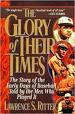
THE GLORY OF THEIR TIMES: THE STORY OF BASEBALL TOLD BY THE MEN WHO PLAYED IT
A no-brainer, my all-time favorite. No other book touches closer to the heart of the game. From an Amazon review: “An oral history of the game in the first two decades of the century, Glory sends out its impressive roster of players to tell their own stories, and what stories they tell–the story of their times as well as of their game; the scorecard includes Rube Marquard, Babe Herman, Stan Coveleski, Smoky Joe Wood, and Wahoo Sam Crawford. A delight from cover to cover, Glory is the next best thing to having been there in the days when the ball may have been dead, but the personalities were anything but.”
A DAY IN THE BLEACHERS
by Arnold Hano
A few years ago, I took a men’s team down to Texas for a hardball tournament for ages 38 and up. I was GM, manager, and player. One of the players gave me this book as a gift. Hano captures one glorious day, September 28, 1954, when he attended the first game of the 1954 World Series. At age 84, Hano recently recalled: “When I subwayed home six hours later in a state of delicious languor, I decided to write about my day. The book I wrote, A Day in the Bleachers, does not deal just with the game. Oh, it does that too — the famous catch by Willie Mays takes up nine pages — but mainly it is about my day. I banter with a Brooklyn Dodger fan nearby (she carried a flag proclaiming her allegiance). I mutter incantations of hope during the not-quite 10 innings of strife. I wince at Cleveland pitcher Bob Feller’s valiant attempt to get himself in shape by doing push-ups in centerfield during batting practice, his backside too high. I marvel as Alvin Dark of the Giants intercepts a ground ball with his bare hand in the eighth inning. And I recall one final picture that day, umpire Larry Napp running down the right field foul line, indicating that a ball struck by New York’s Dusty Rhodes was indeed a game-winning home run. Immediately, all I had seen began to percolate in my brain. I had a book to write.”
THE UNIVERSAL BASEBALL ASSOCIATION, INC.
by Robert Coover
I like this line from a July 7, 1968 review in The New York Times: “Conversely, not to read it because you don’t like baseball is like not reading Balzac because you don’t like boarding houses. Baseball provides as good a frame for dramatic encounter as any. The bat and ball are excuses.” Coover was an experimental writer, an innovator, and this is possibly the most creative, imaginative of all the baseball books I’ve read. In brief, with pen and paper and three dice, a man, Henry Waugh, creates his own world, peopled with vivid characters — in this case, the Universal Baseball Association, Inc. Genius. The book had added appeal to me, personally, because as a boy I filled notebooks with imaginary games I played by rolling dice — very much like Henry Waugh did in the novel.
A classic. I read this one as a teenager and it was one of the first books — of any kind — that blew me away. Even moreso, I suppose, because the Dodgers were my mother’s favorite team before they broke her heart and moved to Los Angeles. Kahn, too, rooted for the Brooklyn Dodgers as a child. He later covered them in the 1950s as a beat writer. According to a review in the blog, Curled Up with a Good Book, “In The Boys of Summer, Kahn reflects on the Dodgers and his own boyhood following the team. He visits with the Dodger greats to find out about their life after baseball and their own reflections on the team. What makes this arguably the seminal sports book, the book against which all other books in this genre should be judged, is Kahn’s ability to both paint a lyrical, moving account of his heroes and allow us to share intimate times on and off the field with icons such as Pee Wee Reese, Gil Hodges, and Duke Snyder . . . This is a book that belongs on every sports lover’s bookshelf. It is a literary masterpiece that masquerades as a sports memoir.”
Published in 1973, this satiric book involves another fictional baseball league, the Patriot League, and could be the funniest take on baseball. If you haven’t read it, you must. The set up for the story takes Roth about 40 pages before he gets on firm ground, and then the story rolls and the laughter ripples. From a review in The New York Times: “The ballplayers of Roth’s fable, though they bear the names of deities, are anything but images of perfection. The Mundys consist of 50-year-old veterans who have tottered out of retirement, a French-Canadian refugee from the Japanese League, adolescent boys, an alcoholic ex-con (“the Babe Ruth of the Big House” when he played for Sing Sing), a peg-legged catcher, a one-armed outfielder, a midget relief pitcher and so on. Named for their founder, the legendary Glorious Mundy, they are the sacrifices implicit in his credo (“baseball is this country’s religion”), and their season of shame, relieved only by an 11-game winning streak powered by a secret diet of synthetic Wheaties concocted by a teen-age genius, culminated in a 31-0 loss to the pennant- winning Tri-City Tycoons on the final day of the season.”
THE SOUL OF BASEBALL: A ROAD TRIP THROUGH BUCK O’NEIL’S AMERICA
Buck O’Neil, a former star from the Negro Leagues, teams up with the great Joe Posnanski — one of my favorite bloggers and sports writers working today — and together they tour the country for various public relations events and ballgames. While Posnanski documents the journey, recounting Buck’s baseball memories along the way, it is the spirit of Buck O’Neil that shines through: his hopefulness, his zest for life, his grace, his humility, his soul. I found this book poignant and uplifting. A joy. For a nice interview with Joe Posnanski, click here. Said Leigh Montville: “This book is flat-out terrific. If Gandhi had played baseball, he would have been Buck O’Neill.”
I haven’t read this book in a long time, my memory of it is vague, and it may not be a fashionable pick due to the Hollywoodization of the film adaptation. But I remember being struck by Kinsella’s magic realism, his richly imaginative take on the baseball novel — Kinsella, for me, took the typical baseball story and brought it to a whole new place; and in doing so, opened up my own thinking about baseball and books and the realm of what was possible. Of course, even non-readers know the movie, The Field of Dreams, the at-times smarmy film starring Kevin Costner. At his best, Kinsella is lyrical and deep, writing not only about baseball but also love and memory, fathers and sons, dreams and truth. Many writers tend to go a overboard when talking about baseball — the prose too purple, too much religion in it — and Kinsella shares those faults. But there are other times when he absolutely nails it. An important book for me, since it came out in 1982, right around the time in my life when I first dreamed of becoming a writer.
Absolutely the right book at the right time. Lewis is a great nonfiction writer. His research (thanks to incredible access to Oakland A’s GM, Billy Beane) is thorough, he organizes his information beautifully, and much like Malcolm Gladwell, Lewis has a knack for conveying complicated ideas in a clear, accessible, entertaining manner. That is, he’s a hell of a writer — but not in a way that you’d necessarily notice at first, since it’s not so much about style as it is about substance. Here’s what Tom Wolfe had to say: “What does it take to turn a subject like baseball statistics into a true-life thriller not even a baseball-loathing bibliophobe could put down? Answer: saturation reporting, conceptual thinking of a high order, a rich sense of humor, and talent to burn. In short, Michael Lewis. Moneyball is his grandest tour de force yet.” Word is that they are going to make a movie based on Moneyball, starring Brad Pitt. Really. Fun fact: Lewis is married to Tabitha Soren, former MTV reporter.
JOHN McGRAW
by Charles Alexander
McGraw is one of the game’s great originals, a mercurial character whose career spanned the early decades of baseball, as it grew from its rough-neck, pugnatious roots into the national pasttime. Here’s a review from Amazon, written by Jeff Silverman: “Alexander’s marvelous biography of McGraw does what McGraw’s own My Thirty Years in Baseball couldn’t: it lets the volcano that was the man erupt in all its raw glory. A true baseball original, McGraw, as Alexander describes, ‘ate gunpowder every morning and washed it down with raw blood.’ He loved to win, but he hated losing more, and as manager of both the old Baltimore Orioles and New York Giants, he’s the only skipper in the game’s history to win almost 1,000 games more than he lost. McGraw was so outsized, flamboyant, fiery, and, at times, sentimental, that it would be easy to caricature him; Alexander’s remarkable achievement here is that he doesn’t (nor does he succumb to hero worship or bubble bursting). His triumph is letting McGraw stand on his own two spikes; the man — and the legend — have no problem standing up for themselves.”
FIVE SEASONS
Roger Angell
Hands-down, my favorite baseball writer ever, but that claim places Mr. Angell in too small a box. Sentence for sentence, Roger Angell is one of the great American writers of the past 50 years, period. And I’ll punch anyone in the nose who doesn’t think so. I love the shape of his sentences, his language, insight, and humanity. But because his form is most often the essay, Angell really hasn’t written a great (great, great) full-length book. Don’t get me wrong, his collections are wonderful and I own them all. When I was writing Six Innings, it was all I could do to limit the amount that I stole from Angell, the master. I’ve written one fan letter in my life — and it went to Roger Angell. Still, I had to pick something from his work, so I went with Five Seasons, probably because it focuses on baseball in the middle 70’s — perhaps the last truly great era of the game. From The New York Times Book Review on Five Seasons: “A book for people who miss good writing, who miss clarity, lucidity, style and passion. It’s a book for all seasons.” Since 1956, Angell has worked as an editor for The New Yorker, where most of his eloquent writing has first appeared. His stepfather was E.B. White, not a bad writer himself.
—–
AND THE LIFETIME AWARD GOES TO . . .
Bill James
I’ve had a love/hate/love relationship with Bill James, but he may be the most influential baseball writer to ever put pencil to scorecard, purely in terms of changing the way we’ve come to know the game. His annual “Abstracts” — which often exposed the foggy thinking behind baseball’s most cherished “conventional wisdoms” — were must-buys for me throughout the 80’s. Over the years, James seemed to grow increasingly bitter and his writing got snarkier, more unpleasant. Despite his growing legion of fans, the baseball establishment appeared to reject and ignore his ideas. A rebel and provocateur, James loved the role of gadfly, of misunderstood outsider, yet at the same time seemed to pine for the game’s warm embrace. After years of writing in the wilderness, James finally gained full acceptance in 2003, when he was invited inside, hired into the progressive, sabermetrically-inclined front office of the Boston Red Sox. Smart club, those Sox. A wonderful baseball blogger named Rich Lederer did an outstanding series of articles called, “Abstracts from the Abstracts,” where he brilliantly details the importance of each book. Fantastic stuff. And for a quick sample of James, here’s a famous extract taken his 1988 Baseball Abstract. The brief piece is now widely known as “The Bill James Primer.”
———
AND FINALLY, A LITTLE BIT ABOUT . . .
SIX INNINGS
One of the early influences for the format for Six Innings was a landmark book, titled Nine Innings: The Anatomy of a Baseball Game by Daniel Okrent — a man largely credited with inventing Fantasy Baseball. The format is essentially one game, a nothing game, June 10, 1982, Brewers vs. Orioles, including everything that happens on the field and, more importantly, inside the head of Mr. Okrent. Some folks consider this to be one of the most significant baseball books ever, in part because of Okrent’s analytical, Jamesian approach. It used to be out of print, and I’m glad to see that it’s made a comeback, hopefully with more success than Oil Can Boyd. Many other baseball books have taken that “one game” structure, including For the Love of the Game by Michael Shaara , The Last Nine Innings by Charles Euchner, and as I mentioned above, A Day in the Bleachers by Arnold Hano. With all those books in mind, and more, I knew that I was very much writing Six Innings within that tradition, and for that tradition, and that knowledge gave me the confidence to proceed.
I was tempted to make a long list of Honorable Mentions . . . but figured maybe you’d like to help. So, come on, which books did I forget to mention?
On Facebook, it’s popular for people to make lists of the 25 albums that “affected them profoundly.” As a music lover, I figured such a list was for me, but found it an impossible and wholly unsatisfying task. Yet I couldn’t quite let go of the idea.
Eventually it struck that a mere list was part of the problem. I needed to talk about the music a little, why it meant something to me. You see, music has played a central role in my life for as long as I can remember. The youngest of seven children, I inherited a great, vast collection of 60’s/70’s music. Recalling these albums, I began to see my life unspooling, circling like a needle on vinyl, as my growing mind took on new shapes, colors, and sounds.
A friend of mine, a 7th grade English teacher, recently read my upcoming novel, Bystander (Feiwel and Friends, Fall ’09). One line that he mentioned to me — and it’s often surprising to hear what folks connect with, or what gets quoted in reviews — was this: “Music helps.” And I think it does, and certainly has for me, just as it helps that book’s central character, Eric Hayes.
So appropos of nothing, here goes . . . something.
1) Batman, Original TV Soundtrack Album
I got this as a kid and wore it out. Actually, I think I got bubble gum stuck on it. But nevermind! It was the first album I’d reach for, over and over again, wearing a towel as a cape, pretend-fighting the Penguin, the Joker, the Riddler, King Tut and more. And I always, always won.
2) Monkees – Greatest Hits
Another childhood favorite, watching that silly TV show and listening to my sister Jean’s Monkees albums. As I grew up, my tastes became more sophisticated, and it took me another couple of decades before I fully appreciated the pure pop structures and giant, tooth-decaying hooks of these Boyce and Hart tunes.
3) Beatles – White Album
The Beatles have to be on here and this is the one I’d pick, despite all the flaws and warts, or perhaps because of them. Everything’s already been said about this disk, and this band; I just keep coming back to it, and hearing new things, finding new favorites, and it’s been more than 40 years ago today. I remember my brothers coming home with this one, and that strange plain white cover, the gatefold, and the four glossy photos inside. That’s how I learned their names, quizzed by my elders: “This one is Ringo, that’s George, he’s John, and the other one is Paul.”
4) Led Zeppelin – s/t
With four older brothers and two older sisters, I inherited one of the great record collections of all-time. We had everything, it was when classic rock was NEW, and I listened to it all at a very young age. I remember when this disk came out and how I liked the cover of that blimp exploding. Probably my first “heavy” album. This video is a cheat, “Immigration Song,” from the (underrated) 3rd album — but definitely definitive with a monster riff.
5) Andrew Lloyd Webber – Jesus Christ Superstar
I have a very specific memory of when my oldest brother, Neal, brought this album home. We were a Catholic-school family, and the very idea of this disk kind of freaked my mother out. True story: All seven kids crowded into Neal’s room — this was 1970, so I must have been nine — and we listened to it all the way through, both disks. And Mom and Dad were not thrilled. It gave me the inkling that rock could be dangerous, driving a wedge between generations. How cool was that?! Also: a great lyric booklet to study and sing along with! “Prove to me that you’re no fool/Walk across my swimming pool!”
6) Yes – The Yes Album
Like so many vets, my brother Bill returned home from Vietnam with a most excellent stereo system –- including one of those (cheesy) light boxes, with flashing colored lights that responded to the music. I remember sitting in his room, a bunch of his friends gathered around, listing to this album and just staring in red-eyed stupification at that dumb light box. Music became . . . a head thing. Steve Howe was probably my first guitar hero.
7) Allman Brothers – Fillmore East
Maybe not the greatest collection of tunes ever assembled –- and I am absolutely a song craft geek who loves Burt Bacharach and the Brill Building-era songwriters -– but the performances on this live album are staggering. Duane Allman at the peak of his prowess, that slide guitar rising up from some deep backwoods place, Dicky Betts playing alongside him, the two drummers churning, moving it all forward, Greg Allman’s white-boy soul-stirring vocals. This is also a double disk and one that defined a certain time and place for me, one of the first “air guitar” albums where you just had to play along. A great guitar album that still makes me think of an old childhood friend, Jimmy A, a transplanted Georgia boy who loved his Allmans.
8) Jimi Hendrix – Electric Ladyland
This is the first disk where Hendrix really took control in the studio, and thusly spread his wings and waved his freak flag in the sky. I’m stunned by the variety, the skill, the confident cool of this double disk. And I still get a kick out of listening to “Still Raining, Still Dreaming” on my headphones, hearing that guitar whoosh through my brain, one ear to the other, like some kind of 60’s skull rinse.
9) Neil Young – After the Gold Rush
One of the ultimate singer/songwriter disks, filled with sad lonely tunes from a sensitive young Canadian. It was a revelation: Oh, a boy can have feelings -– and express them?! “Oh, oh, lonesome me . . . .” Everybody, it seems, has a sad summer that they spend listening to Neil Young, and this was the album I heard. “Only Love Can Break Your Heart,” indeed. But, hey: “Don’t Let It Bring You Down.” This is a disk that makes me remember certain people, specific times, and it’s all good.
10) Bob Dylan – Blonde on Blonde
If I had to pick one Dylan album –- and I have nearly all of them –- this has to be the one. Or maybe “Blood on the Tracks?” Or “Highway 61 Revisited?” Anyway: Ranging from the pure blues of “Leopard-Skin Pill-Box Hat” to the visionary, surreal writing of “Visions of Johanna,” this is Dylan’s magnum opus. Here’s Bob at the height of his powers. He is absolutely my favorite all-time musician/songwriter; I consider him the greatest American artist, any genre, of the 20th century –- and he’s still kicking. No one is in second place.
11) Rolling Stones – Exile on Main Street
The template for a style of rock and roll I still love today, sprawling, a little sloppy, a little dirty, raw and imperfect. It’s about the spirit, not the polish. This isn’t a great singles collection, but a unified whole, though “Tumbling Dice” was the cool kids’ tune for the summer of 1972, But still: “Rocks Off,” “Sweet Virginia,” “Loving Cup,” “Ventilator Blues,” “Shine a Light,” 18 songs that define rock and roll. Also, amazing piano on this one from the unheralded Nicky Hopkins.
12) Genesis – The Lamb Lies Down on Broadway
This is the album that made me pour over the liner notes and parse the lyrics, attempting to figure out what the hell they were writing about. The story puzzled and intrigued me. While most prog has not dated well, this disk still stands up for me –- even if I’m still not sure what’s going on in this concept album’s surreal tale. Vintage Peter Gabriel on voice, some understated solos and guitar effects by Steve Hackett, great drum fills by Phil Collins, production touches from the great Brian Eno, Tony Rutherford on bass, and maybe too much keyboard wankiness from Tony Banks; it created a world and swept me away. Clip: Excerpt from “Supper’s Ready,” from “Foxtrot,” a song inspired by the Book of Revelations.
13) Stiffs Live
My first true introduction to punk, this 1977 compilation kind of baffled and frightened me. Uneven and imperfect, it nonetheless featured a rowdy take on Nick Lowe’s “I Knew the Bride,” “Wake Up and Make Love with Me” by Ian Dury and the Blockheads, and Elvis Costello and gang doing the mock-anthemic, “Sex & Drugs & Rock & Roll & Chaos,” the way another generation might play, “Will the Circle Be Unbroken.” At a time when I was impressed by musical virtuosity, this disk helped me value the importance of attitude.
14) Talking Heads – More Songs About Buildings and Food
It was 1978 and I was still listening to prog bands like Yes and Genesis, though that was clearly dying, when my oldest brother visited from NYC and handed me this brand-new disk. It took a little while before I got it, and it sent me hurtling in a new musical direction. I went on to become a huge Talking Heads fan for much of the 80’s . . . until they ran out of steam.
15) David Bowie – Ziggy Stardust
Here’s the English dandy, the art rock, the glam side of things. When so many in my environment were listening to southern rock or heavy metal, I was seduced by this disk’s crazy artistic pretensions and writerly concerns. “Starman,” “Suffragette City,” “Rock ‘N’ Roll Suicide” –- and it’s not just me. This is one of the most influential albums ever made. Music aspiring to . . . art. Connecting to Marc Bolan and T. Rex, and Robert Fripp, Brian Eno, Talking Heads, U2, etc.
16) The Clash – London Calling
Is this list too obvious? Am I boring you? Well, what can I say except, um, too bad. Released at the dawn of the Reagan Era, the Clash collectively cemented themselves as the only band that mattered. To me, the perfection of snarling punk spirit, with great songwriting and energetic performances that embrace ska, punk, rock, and even a touch of Motown. Mick Jones and Joe Strummer forever. This came out my first year of college and when I hear it, that’s where I am again, every time.
17) Richard and Linda Thompson – Shoot Out the Lights
Thompson is one of my musical heroes, an inventor of folk-rock, master guitarist, brilliant songwriter. And Linda has the voice of an angel. These deep, penetrating, personal tunes combine to make one of the great records, ever. That Richard & Linda’s marriage was breaking up during the recording of this disk somehow makes it all the more harrowing: “Shoot Out the Lights.” The track below, “A Heart Needs a Home,” is a cheat; it originally appeared on the album, “Hokey Pokey,” but it’s such a nice moment I had to share it.
18) John Coltrane – A Love Supreme
This is the sound of the soul unfolding, pure and free, a master of his instrument searching, experimenting, going off. Absolutely wild, it represents the opening up of all possibility in music. Not at all the slick jazz I once listened too – you know, those albums for “refined tastes” – this was as insane and alive as anything ever put on vinyl. He was a giant and to listen to this was to stand in his footprints.
19) REM – Murmur
Here was another album that came along, around 1984 or so, and made me rethink music. Punk and New Wave had come and gone, bland Hair Bands were ruling the airwaves, and this raggedy collection of guys from Athens, Georgia –- of all places –- arrived with a new sound. And what was up with that singer? What was he mumbling about? The guitarist wasn’t that good, but he had a certain something. They struck me as fresh and original. These guys only got better for a nice long stretch . . . until they got worse. Hey, it happens.
20) The Band – Music from Big Pink
Great American roots rock -– from a bunch of Canadians. The songwriting, the musicianship, the blend of traditional (“Long Black Veil”) and the new (“Chest Fever”), with some classics thrown in: “The Weight,” “This Wheel’s On Fire,” “I Shall Be Released.” The arrangements are ragged and rough, no shiny veneer at all, blending country, rock, R & B, folk, and soul. A perfect document of a particular place and time –- and also, timeless.
21) Beach Boys – Pet Sounds
It took me a long while to come to this album, since I tended to dismiss the Beach Boys as dumb surf dudes who were writing superficial ditties. Somewhere along the line I discovered song craft, and melody, and harmony, and realized that Brian Wilson was a genius, and that this was his shining hour. “I Just Wasn’t Made for These Times,” “God Only Knows.” This clip kills me.
22) Marvin Gaye – What’s Going On
I love 70’s soul, all those great singles, but this is the album, the unified whole, that transcended the genre. The nine songs lead directly into each other in a fluid song cycle that addresses themes such as the Vietnam War, drug abuse, the environment, economics, justice –- and you could dance to it. A disk that amazes me. “Mercy Mercy Me (The Ecology),” “Inner City Blues (Make Me Wanna Holler),” “What’s Going On,” “Save the Children.” If you’ve never heard this as an album straight through, then you are in for a treat.
23) Bob Marley – Songs of Freedom Box
This is a cheat, of course, because it’s a box set and has nearly everything, but that’s only because for Marley it wasn’t about one disk or one song. He was the first World Music superstar, and he opened my ears to sounds outside the familiar comfort zone of my own Western culture. Beyond the easy riddums and sunny vibe, there’s this incredible man writing deep, meaningful tunes. “Redemption Song,” anyone?
24) Guided By Voices – Bee Thousand
This came out in 1994 and introduced me to the lo-fi, indie scene, with beguiling, hook-laden tunes recorded in a basement. From the opening fuzz of “Hardcore UFO’s,” here’s a 30-song buckshot of unfinished ideas, broken melodies, and hipster cool. Again, an album that just sort of changed my ideas of what an album could be. They were doing it themselves, without permission from the big record companies.
25) Elliott Smith – Either/Or
Styles change, but it always comes back to the songs for me, and the songwriter. Some guy at a piano, or idly strumming a guitar, picking out a melody. So I’ll end with this 1997 disk by Elliott Smith. Depression, drug addiction, suicide, and great songs: What more could you ask for? (Life, O life!) An indie darling with hushed vocals, as far from arena rock bombast as you could get, Smith connects Nick Drake with the Beatles, Ray Davies with Big Star, AC/DC with Modest Mouse. And of course he admired Dylan. Said Smith, “I love Dylan’s words, but even more than that, I love the fact that he loves words.” Elliott Smith died on October 21, 2003, and he is missed.
When I was working on Bystander (Fall, 2009), a book that centers on bullying, I kept running across different quotes by Martin Luther King, Jr. He would often express the same idea in subtle variations. In essence, Dr. King issued an indictment against the tyranny of silence, reminding us all of our responsibility to speak up. King believed in the common good. He had an abiding faith in his fellow man. If only we would all stand up and be heard, then justice and democracy and human kindness would surely prevail over cruelty and prejudice.
That’s partly why I named the book, Bystander. Not bully. Not victim. I wanted the focus to be on the overwhelming majority of us who stand by as mute witness; and how we are, therefore, complicit in acts of cruelty, our silence a form of tacit agreement. For responsibility is nothing if not an “ability” to “respond.” That’s where we find hope for real change. In our voices.
Here’s a few relevant quotes from Dr. King:
“In the end, we will remember not the words of our enemies, but the silence of our friends.”
“The ultimate tragedy is not the oppression and cruelty by the bad people but the silence over that by the good people.”
“Our lives begin to end the day we become silent about things that matter.”
“Cowardice asks the question, ‘Is it safe?’ Expediency asks the question, ‘Is it politic?’ But conscience asks the question, ‘Is it right?’ And there comes a time when one must take a position that is neither safe, nor politic, nor popular but because conscience tells one it is right.”
This brief, one-minute clip is from Martin Luther King, Jr.’s last speech. He knew what was coming, he knew.
Last winter, we finally caved and bought a snowblower.
Up until that moment, I had only disdain for those mechanical menaces. They were for the weak, the pampered. No, I preferred the exercise of shoveling — the peace after a storm, the winter quiet interrupted only by the manly scrape of a shovel on concrete. Sure, it took longer. It required physical effort. But so what. I liked it, I told myself. It brought me closer to nature, closer to the elemental Viking Quality of life in the Great Northeast.
According to experts in the field of psychology, this is what is called a massive rationalization. In other words, complete bear scat.
Because I’m telling you I love my new Sears snowblower more than I love most of my own children. No cords to pull, it has an electric starter. Plug it in, push a button, starts right up. Vroom! The concussive cacophony of hearing that heavy-duty, four-cycle monster roar to life, rattling the window panes, echoing off the walls of my garage like store-bought thunder . . . it stirs the soul and sends testosterone roiling through the veins.
I am transformed! I am like a demi-god risen from Norse mythology, guardian of Midgard, son of Odin. Brandishing my new snowplow as if it were the very hammer of Thor, I will clear a mighty pathway down the driveway!
Okay, sure, I’m not happy about my friend, Paul. He one-upped me by purchasing a blower with heated handles and a headlight. Who the hell plows in the middle of the night?! Heated handles! A perk for the coddled. For softies. This is exactly what Tom Brokaw has been talking about. We aren’t the greatest generation. Not even close. Why? Because of people like Paul with their chubby little fingers like pink sausages who need electric, heated handles.
Sigh. I wish I’d thought of it. Sometimes my digits do get numb.
Truthfully, I want a snowplow that makes hot chocolate. Not the boutique kind you get in Starbucks, where it takes twelve hours to get a cup. I want the hot chocolate you get in diners where they push a button and presto! out it comes. (And yeah, I want whipped cream with that. Why are you even asking?!) I want this hot chocolate maker built directly into my snowblower. Or at least as an optional attachment. That way, I can beat Paul and warm my fingers.
Mostly I’ve learned that owning a snowblower is about power. And noise. Making a blessed racket! Being a real man behind a loud machine, hurling that white stuff into the sky, screaming to all the world: I AM MAN . . . HEAR ME ROAR!
(When you write children’s books for a living, believe me, you need this.)
But darn, it is nippy out here. My toes are freezing. I’m sleepy and this wool scarf is scratching my neck. It hate that prickly feeling. I hope I don’t get a rash. I feel itchy already. Can’t I just go inside for some soup? This machine is kind of scary and dangerous. I could easily lop off a hand. How am I supposed to TiVo and eat pretzel nuggets with only one good hand?
I should have slept in and waited for the wife to do it.
Hey, you know . . . I wish I’d thought of that sooner. Lisa would actually enjoy the peace and the beauty, the winter quiet. I’d be doing her a favor. For Lisa, it would be like yoga. Bend, lift, throw could become her new mantra. A Zen exercise, a Way to mental health and wholeness. She wouldn’t be shoveling, she’d be . . . centering.
Think of the huge chunk of change I could have saved. Instead, I blew it on the blower.