I’d guess that all writers do it, but I can only speak for myself. During the course of brainstorming for a book, which for me usually involves a composition notebook and random observations, snatches of dialogue, character traits, ideas for scenes, etc., I’ll often write brief notes to myself. These notes that I’m referring to are general guidelines for the book I’m writing — about tone, intention, theme. They serve as signposts, clarifying my intent for that specific book. I’m not talking about notes to address specific scenes in the story, but more global thoughts about the book I’m hoping to write, what I’m trying to achieve.
Below, here’s a few notes taken from a larger notebook that I filled during the research phase for my middle grade novel, Bystander. This might come across as naval gazing, I suppose, but I hope the notes shed light on my writing process and in doing so help readers and writers with their own creative work.
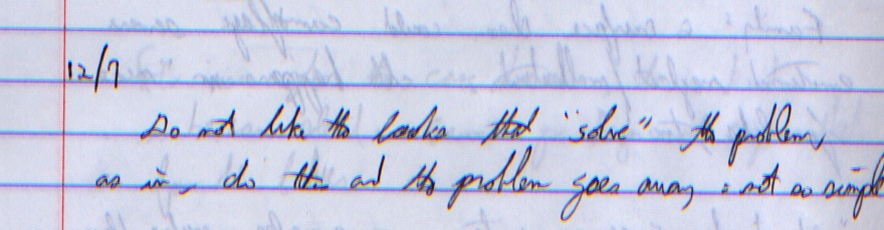
Don’t worry, I’ll translate these into English for those unfamiliar with the dialect of Southpaw Scrawl: “Do not like the books that ‘solve’ the problem, as in, do this and the problem goes away: not so simple.”
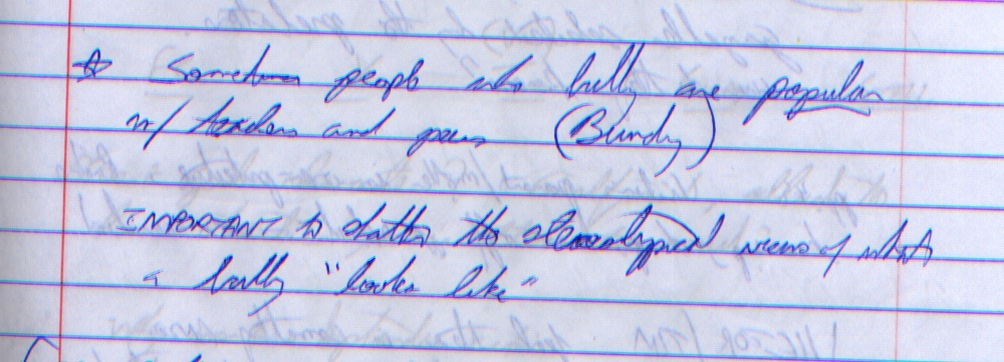
“Sometimes people who bully are popular w/ teachers and peers (Bundy)
Important to shatter the stereotypical views of what a bully ‘looks like.'”
“It becomes important to realize/understand what real friendship means.”
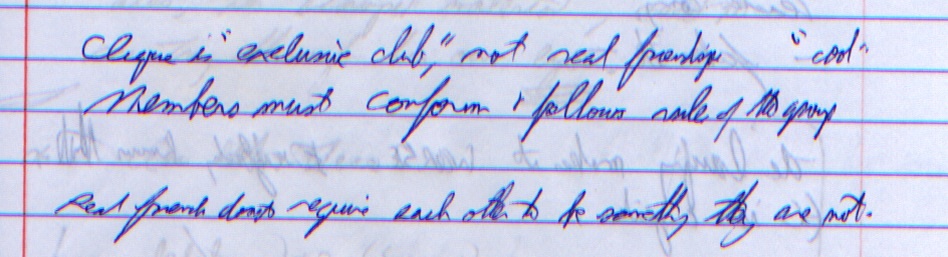
“Clique is ‘exclusive club’ not real friendship. ‘Cool’ members must conform & follow rules of group.
Real friends don’t require each other to be something they are not.”
“Children go to great lengths to hide the fact that they are victims of a bully.”
“Bully/victim is more dangerous, because acts out of anger, revenge.”
You are getting tired of my slipshod approach, the endless excuses about how busy I am.
But!
Yesterday I coached two baseball practices, for two different teams. Threw batting practice to twenty-two different boys who are at a point, ages 11 and 12, where it’s no longer okay to just blob it over. They need the ball with a little heat. So my wing is sore.
Today I’m driving off to Geneseo with my oldest, Nick, for a second look-see. He’s a high school senior and we’re getting down to decision time for college. On Wednesday, my good wife Lisa flies down to Atlanta, where she’s going to learn how to perform minor surgery on a cervix — and frankly I do not want to know any more details than that. She comes home Sunday, the day I coach a doubleheader and drive down to Long Island for a week’s worth of school visits.
And, oh, yeah. There’s the job thing, too. Writing stuff.
So the blog suffers.
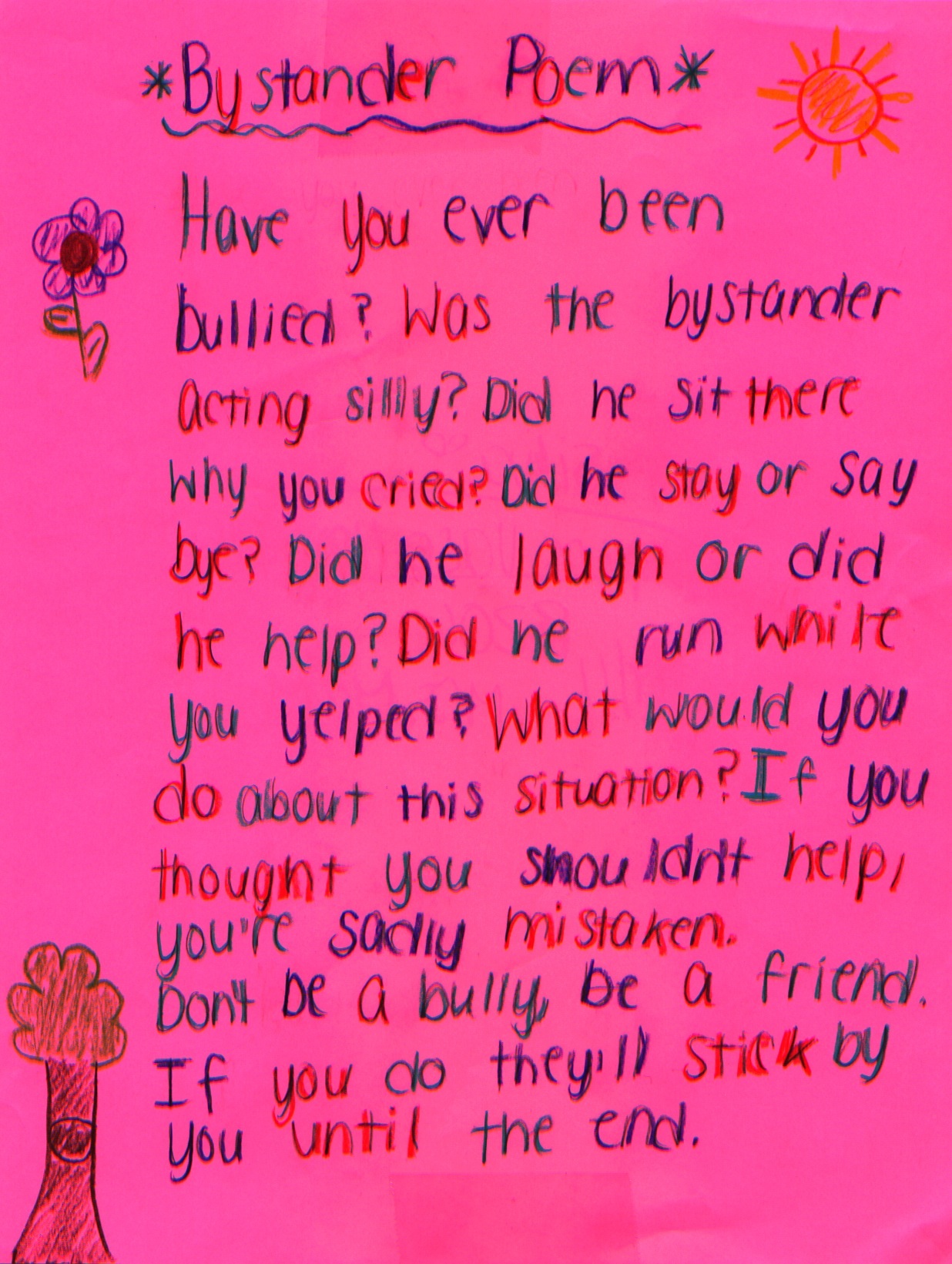
I wanted to share a few scans and photos. I recently visited a school down in Sicklerville, NJ, where the students filled the halls with creative responses to my book, Bystander.
There were posters and poems. Some students wrote journal entries from the perspective on a book character, and I thought those were particularly interesting and effective. Isn’t that the big lesson in To Kill a Mockingbird, when Scout stands on Boo Radley’s porch and sees the world from his perspective? When she stands in his shoes?
“You never really understand a person until you consider things from his point of view . . . until you climb into his skin and walk around in it.” — Harper Lee.
So after my presentations were done, and the books signed, we walked around the halls and filled a big box with incredible artwork, posters, etc. I can’t show it all to you, but here’s a few samples:
Most posters were too big to scan. I loved the tagline that one boy came up with . . .
Don’t you love the icon that I use for every Fan Mail Wednesday? A word of explanation for younger readers: It’s an illustration of something we used to call “a letter.” You see, long ago, we used to — and you’re not going to believe this — write words on actual paper (made from trees!) to our friends and relatives and business associates. Then we’d place the paper in a sealed envelope, called an ENVELOPE, and then . . .
–
Nevermind.
–
A girl sent this one via the interwebs. I removed her name for privacy:
–
Hi, I was at the school that you were at today at Vail Farm 3/30. I was wondering how you come up with titles because I’m a writer too. I’m writing a book that is about a girl who gets picked on a lot just like the book bystander. But just so you know I didn’t steal it from you. But any way I can’t come up with a title for it so that’s all I want to know.
Love,
X
–
I replied:
Hey, X. Thanks for writing. You must have been one of those students with your hand raised when we ran out of time. Sorry I didn’t call on you.
–
Titles are a tricky business. I can’t say that I’m an expert. With books like Six Innings and Bystander, I had those titles very early on. In fact, writers will often plug in a “working title” for a book in progress. It’s not the final title, or at least doesn’t seem to be, it’s just something handy to call the untitled book. For Six Innings, my working title was . . . Six Innings. That was always the concept for the book from the beginning, very clear in my mind. So when it came time to officially name the book, I used the working title.
–
With Bystander, my first title idea was Predator. That’s because I began by focusing my research and note-taking on the bully character, Griffin Connelly. But after a short while, I became convinced that the real story was with the bystanders. In life, there are a few bullies and some victims, and then there’s the rest of us, the overwhelming majority, the bystanders. We are often silent, yet hold all the real power. I knew it should be the focus of my book, and the title. Of course, there are all sorts of bystanders. The floaters and the enablers, the watchers and the cheerers and the ones who simply walk away — all with our own roles to play in the schoolyard drama. Few of us are purely innocent.
–
Speaking of bullies, have you ever noticed that they almost always need an audience? They don’t bully unless there’s somebody to watch it, to cheer them on, to laugh. Fights are the same way. It’s interesting when you think about it, isn’t it? What would happen if there was no audience? Do bullies need bystanders in order to exist? Are we their oxygen?
–
Back to titles: In many cases, writers don’t have a title until the book is finished. Editors have told me not to worry about the title, just write the story, worry about the title later on. It can be hard, because you do need a good title. I wanted my title for Justin Fisher Declares War to be Justin Fisher Declares War on Fifth Grade, but that was vetoed due to length. I never felt that we got that title right.
–
–
When I begin a book, I often purchase a composition notebook. My working title for Justin was Talent Show. Maybe I should have stuck with that.
–
–
Here’s the first page from that notebook. I wrote it in the Bethlehem Library in Delmar. I had this idea of Justin defacing a poster in school and it’s the first scene I wrote, event though it doesn’t happen until Chapter Four of the book.
–
Often writers will go back over a story and see if there’s a word or phrase in the text that somehow stands out. You’ll see that a lot when you read books, the book’s title buried somewhere deep in the pages of the book. I’d recommend that strategy for you. Reread your story. Does a character say something that could work as a title? Is there a symbol in the book that somehow represents a character or an idea?
–
With Jigsaw Jones, my publisher wanted a title from me before I even wrote the book or, in some cases, knew what it was about. It drove me crazy.
—
The other strategy is to ask for help. That’s what I do. I’ll have a reader — my editor, almost always — read the manuscript and we’ll talk about titles together. Sometimes it takes another person who has some distance from the story to see what it’s really about. And isn’t that nice, when someone can give you the title?
–
Lastly, brainstorm. I’ve created long lists of potential titles. Then you can review them, whittle them down, and maybe share them with other people. Maybe even people who haven’t read your story. Which titles appeal to them? Is there a title that gets them curious? Nowadays this is called “crowd-sourcing,” when you simply ask a bunch of random people for their opinions.
–
Anyway, sorry, long letter. Good luck with your story. It’s always nice to meet a young author.
I’ve been reading a lot about cyberbullying in preparation for Tuesday night’s panel discussion. Here’s a quick link dump of a sampling of the better articles.
It’s something that we care about not only as president and first lady, but also as parents,” Michelle Obama said. “It’s tough enough being a kid today, and our children deserve the chance to learn and grow without constantly being picked on, made fun of, or worse.”
But according to a new survey released Wednesday, the issue simply isn’t getting enough attention.
The report, released by the National Cyber Security Alliance in collaboration with Microsoft, claims that just 26 percent of K-12 teachers surveyed have taught kids how to handle cyberbullying, versus 15 percent who have spoken to students about hate speech online.
* Cyberbullying and Suicide: A summary from the Cyberbullying Research Center. As summarized by Sameer Hinduja, Ph.D. and Justin W. Patchin, Ph.D.:
One factor that has been linked to suicidal ideation is experience with bullying. That is, youth who are bullied, or who bully others, are at an elevated risk for suicidal thoughts, attempts, and completed suicides. The reality of these links has been strengthened through research showing how experience with peer harassment (most often as a target but also as a perpetrator) contributes to depression, decreased self-worth, hopelessness, and loneliness — all of which are precursors to suicidal thoughts and behavior.
It is unclear exactly how prevalent cyberbullying is. However, some statistics suggest that anywhere from 10 to 40 percent of youth in the United States encounter the phenomenon, although this figure varies depending on age. Since cyberbullying can be done by computers, cell phones and other devices, and since these devices are widely owned, the means to cyberbully are easily accessible.
The Australian study of more than 1000 parents found that 87 per cent of children aged between four and 16 own or have access to a mobile phone and 66 per cent take their mobile phones to school at least some of the time.
Van Vugt said this access to technology needed to be better managed.
“All children have the capacity to behave badly, especially if they don’t understand the impact of their behaviour,” she added.
* Tips to Fight Against Cyberbullies by Kenneth Butler, who consulted with Nancy Willard (Center for Safe and Responsible Internet Use), Parry Aftab, author of A Parent’s Guide to the Internet, and Anne Collier, executive director, NetFamilyNews.org.
For social networking and online etiquette, the popular saying “What goes around comes around” is as valuable as knowing when to use a frowning smiley or a winking one. When chatting, posting messages, or sending e-mails, it’s always a good idea for young web users to be “mindful of their digital footprint,” said Nancy Willard, director of the Center for Safe and Responsible Internet Use. In other words: “Don’t engage in unkind or hurtful actions online because the person you really hurt will be yourself.” That includes being the instigator of online spats as well as retaliating in them. Too much combative behavior could lead to a bad reputation online, and it could damage relationships with peers both in front of and away from the computer screen.
Before I make a post, I pledge to ask myself:
* Who will be able to see what I post?
* Will anyone be embarrassed or hurt by it?
* Am I proud of what I’m posting?
* How I would feel if someone posted it about me?
* What are the warning signs? What can parents do? What can educators do? Here’s a great resource: StopBullying.Gov.
There are many warning signs that could indicate that someone is involved in bullying, either by bullying others or by being bullied. However, these warning signs may indicate other issues or problems, as well. If you are a parent or educator, learn more about talking to someone about bullying.
Over the past few years, I’ve spoken to many educators, parents and kids who’ve had to learn this very difficult lesson: We cannot change the behavior of others. We can only choose how to respond to it, and how we respond to it reveals our character.
* Mahwah Police Chief James Batelli promotes new software which allows parents to monitor their children’s online activity.
“Call it whatever you want,” Batelli said in an interview in his office at police headquarters on Franklin Turnpike on Tuesday, March 1. “If it’s going to save my daughter or someone else’s daughter, then call it whatever you want.”
* More parents are getting involved in their kids’ online activity — by helping them lie about their age. (“Where Age Is What You Say It Is,” from The New York Times, by Matt Richtel and Miguel Helft.)
State senator Linda Chesterfield (D-Little Rock) is now pushing SB214.
“It was the news of so many children committing suicide who had been bullied via the internet so as a former educator it resonated with me that we’ve got to do something,” Chesterfield says.
The one page legislation would establish the crime of “cyber bullying” in Arkansas.
“This is an acknowledgement that in this day and time with technology the way it is, that people are able to use other means and sometimes hide their hands when they throw the rocks,” Chesterfield says.
The bill says someone commits cyber-bullying if they electronically communicate with someone with the purpose of harrassing or intimidating, whether by cell phone or on-line.
Now two Pennsylvania districts — Mt. Lebanon and Penn Hills — are piloting an enhancement to the program that includes a character education component aimed at turning students into good citizens and empathetic colleagues who will be less likely to engage in bullying behavior.
* Lastly, more and more schools are featuring this well-reviewed book for a “One Book, One School” program.
I’ve been invited to participate in a panel discussion on the topic of Cyberbullying: What Every Parent Should Know.
Essentially, from what I can gather, there’s going to be a bunch of experts . . . and me.
The panelists include:
* Lydia Kulbida, Moderator. WTEN-TV news anchor. Mother of two teens. * Lori Cullen: timesunion.com blogger. Mother of three teens. Founder of Millennial Youth, an independent, youth-run magazine housed at the Times Union
* Sandra Morley: Principal, Bethlehem Central Middle School
* Prof. Stephen Birchak: Educator, lecturer, author of “How to Build a Child’s Character – By Tapping Into Your Own” * Lt. Joseph Donohue: State Police Computer Crime Unit. Oversees the federal Justice Department’s Internet Crimes Against Children Task Force * James Preller: Author of more than 80 children’s books. His most recent novel, ‘Bystander,’ tells the story of bullying from multiple perspectives
FOR MORE DETAILS, AND TO REGISTER (DON’T WORRY, IT’S FREE!), CLICK HERE.







)

