Tag Archive for james preller writing process

RE-POST: Pretty Lights on the Tree, I’m Watching Them Shine

Sometimes you can hear a song a hundred times and on a random afternoon it will hit you in a new way. Whap, right upside the head. As a huge Bob Dylan fan, that happens to me frequently, where I’ll suddenly appreciate, say, Dylan’s piano technique on “Blind Willie McTell” — and need to hear that song every day for weeks.

That happened to me recently with “Christmas (Baby, Please Come Home),” written by Ellie Greenwich, Jeff Barry, and Phil Spector.

Specifically, these simple lines:

Pretty lights on the tree
I’m watching them shine
You should be here with me

Those lines have all the qualities of a successful haiku except for the syllable count — that attention to concrete detail, the lean clear prose (no purple or wasted words), and a darting movement from exterior, objective reality to an interior emotional state, where “outside” and “inside” become linked through juxtaposition.

I admire lines that can be as unadorned as, “Pretty lights on the tree/I’m watching them shine.” I love how that straight description conveys an inner depth (I’ve talked about that quality before, most recently here). I think it’s difficult to pull off, using simple words, yet evoking a depth of feeling that lies somewhere below language.

“You should be here with me.”

And, absolutely, it’s Darlene Love’s vocal performance that puts it over the top.

A lot of people have done this song, with mixed results: U2, Death Cab for Cutie, Mariah Carey, John Martyn, Hanson, Bruce Springsteen, etc. But nobody, but nobody, touches Darlene Love’s version, produced by Phil Spector on this 1963 LP: “A Christmas Gift for You from Phil Spector.”

On this essential disk, Spector lends his signature “Wall of Sound” treatment to a number of secular holiday tunes, enlisting the vocal talents of the Ronettes, the Crystals, Bob B. Soxx & the Blue Jeans, and Darlene Love. A few years back, Rolling Stone magazine ranked it #142 on its list of 500 greatest albums of all time — not bad for a holiday album.

Here’s Darlene Love on a 2012 visit to “Letterman” — just a stunning version, given the full arrangement it so richly deserves. Violins and cellos, nine backup singers, a horn section, random percussionists pounding on the kitchen sink, and . . . snow!

You need to a flashplayer enabled browser to view this YouTube video

The snow’s coming down
I’m watching it fall
Lots of people around
Baby please come home

The church bells in town
All singing in song
Full of happy sounds
Baby please come home

They’re singing “Deck The Halls”
But it’s not like Christmas at all
‘Cause I remember when you were here
And all the fun we had last year

Pretty lights on the tree
I’m watching them shine
You should be here with me
Baby please come home

They’re singing “Deck The Halls”
But it’s not like Christmas at all
‘Cause I remember when you were here
And all the fun we had last year

If there was a way
I’d hold back this tear
But it’s Christmas day
Baby please come home

Here’s Bono and the gang giving it a go:

You need to a flashplayer enabled browser to view this YouTube video

In this recent cover by Death Cab for Cutie, Ben Gibbard eliminates the celebratory element that has crept into recent versions, to capture the sadness and longing that is at the song’s (true, I think) core.

If there was a way
I’d hold back this tear
But it’s Christmas day
Baby please come home.
You need to a flashplayer enabled browser to view this YouTube video

Sloppy Copy, Ugly Beginnings & the Sense of Smell

I could never write a book about writing well — not smart enough, for starters — but I can give you a glimpse into how it sometimes works for me. I don’t speak from a pedestal; this missive comes from the trenches.

I was recently writing Book #3 for my new SCARY TALES series for grades 2-5 (read: solidlly 3-4).

Plot: There are three kids trapped in a school at night and strange creatures gather outside the building, shuffling closer. And, sure, maybe there’s already something frightening downstairs, too.

As I was working on the story, it hit me that there was a smell to it, a smell of evil that drifted into the building like smoke, lingering and circling and rubbing against your legs like a cat. So I jotted down a few words. They are an ugly mess. And I didn’t know at the time where in the story this could possibly occur, if at all.

Let me show you . . .

Yes, this is not a beautiful beginning, but precisely because it is a beginning, I am here to celebrate it. Anything that gets you started — that opens a door — is a good thing for a writer.

Worst handwriting ever. Plus, it looks like I left the paper in a puddle, or used it to soak up a spill. This is the moment in writing when you unexpectedly receive the kernel of an idea, the beginning of something, and you need to quickly get some words on the page — even if they are only 33% of the right words, and in entirely the wrong order. You know it isn’t right, not even close, but it’s not a real worry either. Those concerns come later on, like mosquitoes at dusk.

Since this will ultimately be a scary story for children, I want to be careful about how far to go with it. Where is the line I won’t cross? My intention is to push that line a little, but I don’t want to get too dark. Everyone is going to have a different opinion on what’s “too scary” and what’s not scary enough. In terms of how that plays out as a writer, I suspect it’s best to push the limits in a rough draft, since you can always pull back in revision — and again after the input of an objective editor.

Grumpy Answers to Great Questions: Wastepaper Prose (and Other Literary Woes)

I was recently invited to participate in Round 7 of “The Author Insight Series,” hosted by the outstanding Wastepaper Prose blog.

It was exciting to get an invitation anywhere, frankly, so I went out, bought a lightweight seersucker suit, and dithered over which holiday present to re-gift.

(Little known fact: I am 51 years old and have never owned a suit. Or a watch. Carry on!)

The Insight Series is actually quite impressive. In this case, Susan sent along a list of 16 questions to 23 authors. We all answer the same questions in our own way. My way was, naturally, the grumpy way; I feel like that’s my turf.

It’s strange to experience the compare-and-contrast effect of 23 writers answering the same question. I didn’t want to lose! Didn’t want to be the one lame author limping along in last place every time, feet blistered, clutching my side, gasping for air. Everything in life is a competition, as I tell preschoolers at every opportunity, and I was determined to avoid that kind of embarrassment.

Here are the answers to Question #1: “If someone had a behind-the-scenes pass to observe your writing process what would they see?”

My writing process in a picture. Do we really need

a thousand words?

In all seriousness, across four-plus years of blogging I’ve tried to write openly and honestly about my writing process . . . without sounding too precious about it. Click here if you care about that stuff.

I was glad for the opportunity to participate. Glad to be able to bring some sliver of attention to my upcoming YA novel, Before You Go. Authors come in all shapes, shades, and sizes — all with our own fingerprint — and it’s worthwhile, perhaps even inspiring, to celebrate that variety of voices. And guess what else? There was be PRIZES and GIVEAWAYS, signed books and such, at the end of the series. Go to Wastepaper Prose and knock yourself out. Hopefully you’ll discover some new writers in the process.

Sneak Peak 2: My New Series of Scary Tales

Last month I handed in the manuscript for the first book in a new series — my first since Jigsaw Jones. Though Jigsaw is still around, with many titles still available, I haven’t consistently written new books in that series for the past six years.

In the intervening time, I’ve published hardcover books, a first for me, in picture book format (Mighty Casey, A Pirate’s Guide for First Grade) and for older readers (Six Innings, Along Came Spider, Justin Fisher Declares War, Bystander, and Before You Go).

I haven’t written specifically for what was once my core readership, the grades 2-4 crowd. I needed to step away, explore different things. But now I’m back, writing 80-page chapter books for exactly that age group. And I have to tell you, I’m absolutely in my comfort zone with this new, evolving series — my “Twilight Zone” for younger readers.

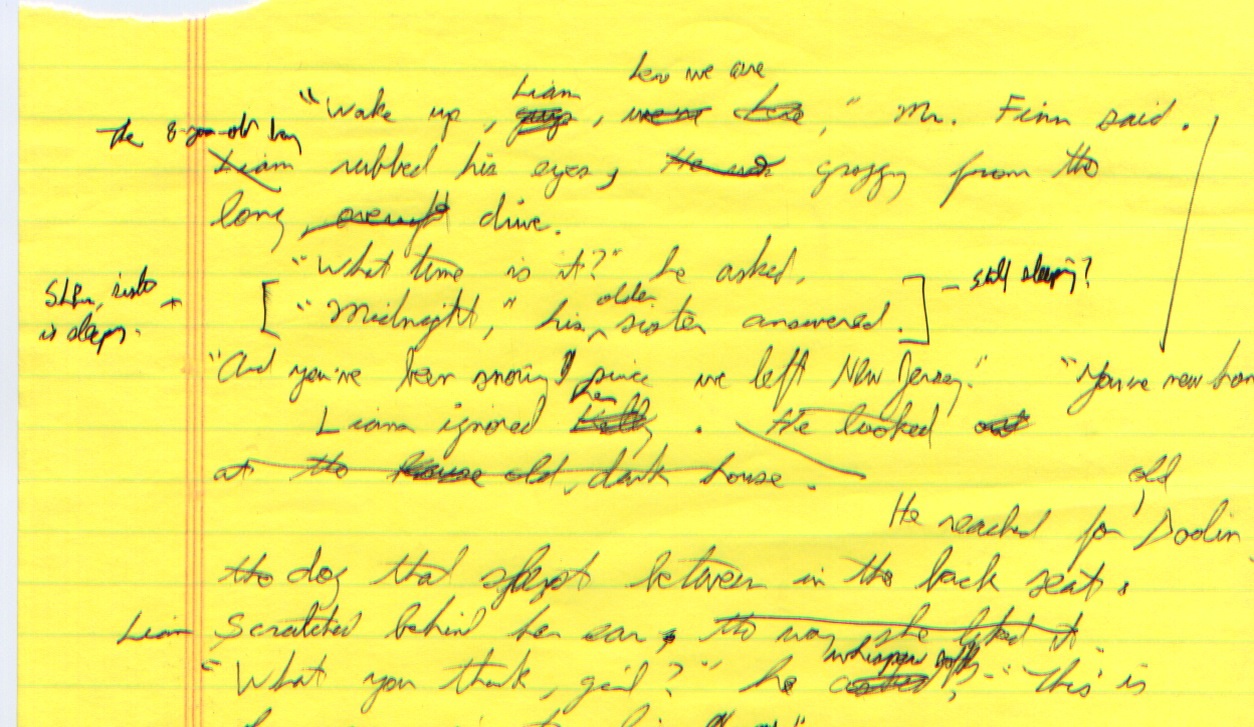
Here’s a sample page 1 from my first draft, scribbled out on a yellow legal pad (as if my usual practice):

Kind of messy, right? Not sure you can read this. Lots of interesting changes/revisions/improvements on the fly. I gave the sister an early line of dialogue, then to the side, later, asked myself: “still sleeping?” Brought “Our new home” up into the first paragraph, deleted words and phrases, etc.

Last week I received the copyedit in the mail, which I reviewed over the phone with my editor, Liz. So now that same section looks like this:

The ring, I learned as I wrote, figures large in the story. There is a power to it. So during revision I made sure to get it into that opening scene, underscoring Kelly’s relationship to it, giving it, in other words, its moment.

I was grateful to receive positive feedback from my publisher, since the first book in a new series can be tricky. You make many decisions that you’ll have to live with for the length of the series. Jean Feiwel sent me a note, “I love love love this book.” That was good day. I was not asked to make any big changes, just light revisions. In another month or so I’ve receive the galleys, with the corrected type set in a carefully-selected font, exactly as it will appear in final book form, and with it the opportunity for another round of tweaks, improvements. The artwork will come in within the next two weeks — and there will be a lot of it. That’s exciting. I can’t wait to see what the (super-talented, surprise) illustrator does with the story. All the while, I’m writing the second book of the series, which is due in another month.

The series, tentatively titled “Shivers,” will launch in the summer of 2013.

EDIT: Now called “SCARY TALES.”

Starting a new series presents many challenges, the thrill of creating something brand new. Hopefully this will be the beginning of something great. That’s always my dream going into a job, “Maybe this one will be great.” I don’t think I’ve gotten there yet, but I keep hoping.

We are not interested in creating a formulaic set of stories, stamped out by a factory. We want each book to stand alone, featuring different characters and different settings. Again, in this sense, I am inspired by Stephen King and “The Twilight Zone” (and yes, I own the complete series on DVD), which rather than one type of story, featured a comprehensive variety of sub-genre, including science fiction, horror, social satire, fantasy, ghost stories and countless variations. My hope is that across a number of books we’ll be able to accomplish something similar in terms of scope and content, while still maintaining a signature fingerprint. When a reader opens a “Shivers” book, he’ll know that he’s about to get strapped into the roller coaster, taken for a wild ride, and returned back safely again — hopefully screaming, “Again, again, again!”

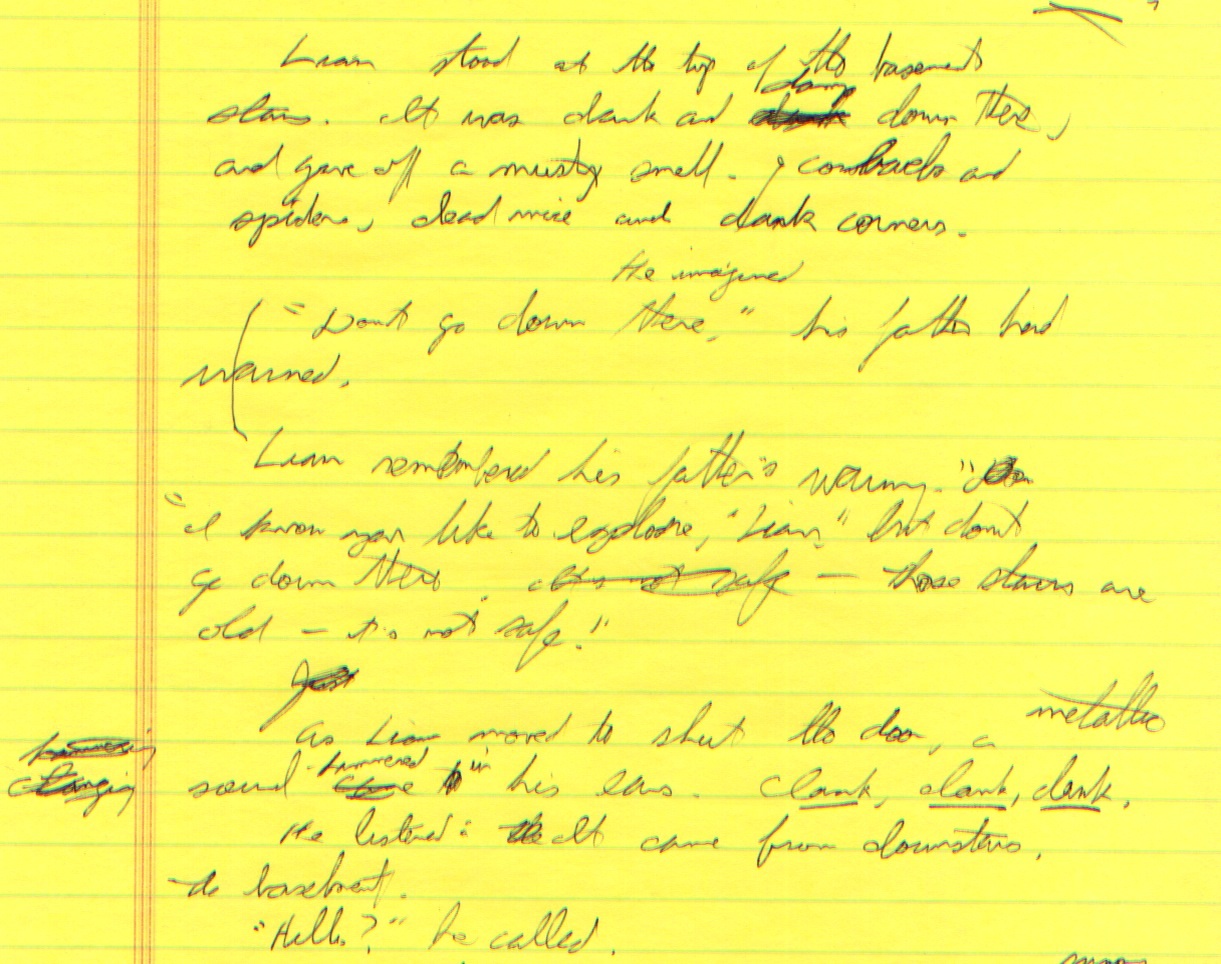
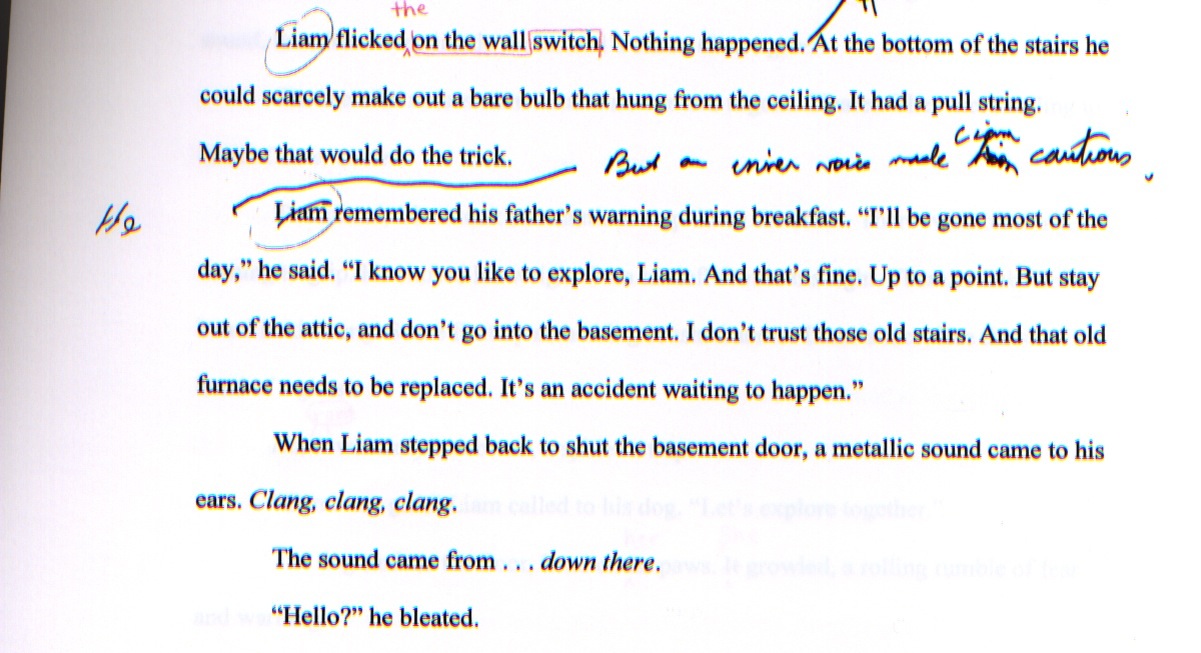
For fans of process, here’s another example of how the story moved from first draft to copyedit:

The copyedited version, which arrives after many revisions by me at home before it goes to the publisher, represents the first edited response from my publisher. Again, this sample shows a light touch by the folks at Feiwel & Friends, thank goodness. Note the circles around “Liam.” We commonly refer to this as an echo. Sometimes when we use a word too many times over a few sentences, or when, in this case, the paragraphs open in the same way. Doesn’t mean it must be changed, just that it should be looked at, considered, before it is changed or not. Alert readers will also note that I changed “‘Hello,’ he called” to “‘Hello,’ he bleated.”

A little lamb, lost in the wilderness.

Have a great Memorial Weekend, everybody. And please remember why we celebrate it. Be grateful to the uniformed men and women who have served our country over the years.

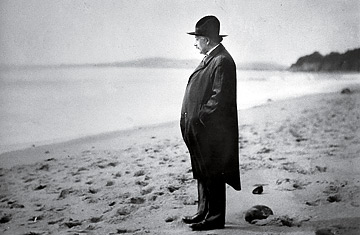
Einstein on the Beach: How a Quote Informed a Scene from BEFORE YOU GO

“The most beautiful thing we can experience is the mysterious.

It is the source of all true art and all science. He to whom this emotion

is a stranger, who can no longer pause to wonder and stand rapt in awe,

is as good as dead: his eyes are closed.”Albert Einstein.

It’s a simple quote, really, and I came across it when reading his biography, brilliantly written by Walter Isaacson.

And I kept returning it to my mind when I was writing the closing chapter to Before You Go. The scene takes place on the beach, Jones Beach specifically, a place I know well. It’s a feeling, too, not just a place. Because when you stand at the edge of the world like that, the ocean crashing before you, it’s impossible not to feel like a tiny part of something enormous and beautiful, the power and wonder and vastness of nature. The mystery of God or whatever you want to call it.

And I wanted the book’s endnote to convey some sliver of that. When I look at my notes on the final galleys, I see that I fussed with that passage to the last. Deleted a comma and the word “and,” cut a compound sentence into two short ones. I toyed with gilding the lily on the line, “There was another world across it,” but I suspect I got talked out of that by my editor, Liz. Or, hey, sometimes I have the sense to talk myself out of those things. Understatement, you know — it’s what all the kids are clamoring for.

Understatement and subtlety, that’s where the money is!

This brief passage doesn’t live up to the great Einstein quote. I know that. But the echo is there for me and, I hope, reaches readers in some serpentine way. Just the sense of that word, mystery. The ocean gives that to me, and to many other people I know. A sense of peace, and calm, and belonging to some greater thing.

So two teenagers walk on the beach, a broken-up couple heading to the shore:

Becka led the way through the dark, down the long West End beach toward the ocean. Jude smelled the briny air, tasted seaweed on his tongue before the ocean’s hum had even reached his ears. His vision limited to shades of gray and black, Jude sensed something in the distance that couldn’t be seen, something vast and mysterious called the Atlantic. There was another world across from it. He reached out for Becka’s hand. They walked barefoot and together to land’s end.

And again, a few pages later, with Jude alone, I reached for it again . . .

He didn’t know what would happen with Becka. Maybe that’s why he needed to be alone on the beach, to watch the sunrise, to be okay with himself, despite everything. Sometimes life seemed impossibly hard, full of car wrecks and souls that shined like stars in yellow dresses. So much heartbreak and undertow. Jude bent down, picked up a smooth white stone, measured its heft in his hand. And he reached back to cast that rock as far as he could.

Just to see the splash.