Tag Archive for james preller writing process

“My Life’s Sentences” by Jhumpa Lahiri (on the art and craft of writing — and reading!)

I have to share this brilliant piece from The New York Times Sunday Review, March 18, 2012, written by the Pulitzer Prize-winning author, Jhumpa Lahiri. I powerfully identified with it.

In it, she expresses her love of sentences. Everything about this piece confirms, echoes, and expands upon my own feelings as a writer and a reader. Though we’re told that Lahiri’s piece is part of a series about “the art and craft of writing,” it is just as much about reading. Perhaps more so. Teachers, librarians, editors, readers, please check out it.

Art by Jeffrey Fisher.

Here’s the opening . . .

In college, I used to underline sentences that struck me, that made me look up from the page. They were not necessarily the same sentences the professors pointed out, which would turn up for further explication on an exam. I noted them for their clarity, their rhythm, their beauty and their enchantment. For surely it is a magical thing for a handful of words, artfully arranged, to stop time. To conjure a place, a person, a situation, in all its specificity and dimensions. To affect us and alter us, as profoundly as real people and things do.

I remember reading a sentence by Joyce, in the short story “Araby.” It appears toward the beginning. “The cold air stung us and we played till our bodies glowed.” I have never forgotten it. This seems to me as perfect as a sentence can be.

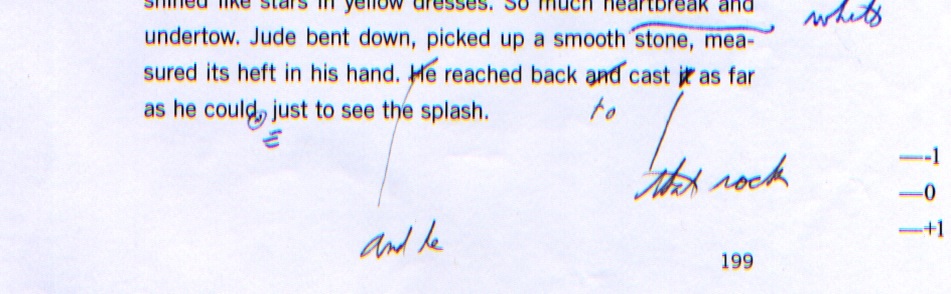
As I’ve said before on this blog, that’s how I read — pen in hand, underlining sentences, making marks, asterisks and exclamation points, my beloved marginalia. But the thought that really had me nodding in agreement was how the best sentences made me stop reading. I looked up from the page, thinking, feeling, dreaming. It’s counter-intuitive. We want readers to keep turning the pages, right? To devour the book, consume it. Well, maybe not. Maybe we want them to slow down, or stop altogether.

From my copy of Let the Great World Spin, by Colum McCann.

That’s why, I think, that I’m so often uncomfortable when I encounter the counters and the tickers, the well-meaning folks who inform us how they read exactly 214 books this year and so on. I don’t mean to insult anyone, but I’m so tired of the idea of quantity.

Pause and reflection, that’s reading too.

Of course, there are different kinds of reading. Librarians, for example, tend to read with an ultimate user in mind. So he burns through a Percy Jackson book (doesn’t that kill you when folks use that language, burning through a book), wanting to be familiar with it, but mostly thinking, “I can’t wait to give this book to about twelve boys I know.” That’s an altogether different reading experience — and probably a topic for another day.

Speaking of sentences, here’s a sturdy one:

The best sentences orient us, like stars in the sky, like landmarks on a trail.

And in the next paragraph:

They remain the test, whether or not to read something. The most compelling narrative, expressed in sentences with which I have no chemical reaction, or an adverse one, leaves me cold.

This is exactly why I could not continue reading Twilight, for example. For me, there was no spark in the sentences, no electric connection between writer and reader. I couldn’t even get past them to story.

Sentences are the bricks as well as the mortar, the motor as well as the fuel. They are the cells, the individual stitches. Their nature is at once solitary and social. Sentences establish tone, and set the pace. One in front of the other marks the way.

Another sentence to underline:

My work accrues sentence by sentence.

So true, could it be any other way? Bird by bird, sentence by sentence, brick by brick.

I hear sentences as I’m staring out the window, or chopping vegetables, or waiting on a subway platform alone. They are pieces of a jigsaw puzzle, handed to me in no particular order, with no discernible logic. I only sense that they are part of the thing.

I talk to students about this in a different way, more about ideas than sentences. Those times when you are thinking that you are not thinking. That’s often when the ideas come, when the sentences, unbidden, line up inside your skull. I know a book is going well when sentences come to me in the shower.

Last  thought — and please, go to the original piece, read it in full — I also connected with Ms. Lahiri’s concept of revision:

All the revision I do — and this process begins immediately, accompanying the gestation — occurs on a sentence level. It is by fussing with sentences that a character becomes clear to me, that a plot unfolds. To work on them so compulsively, perhaps prematurely, is to see the trees before the forest. And yet I am incapable of conceiving the forest any other way.

Students are taught the writing process in school, the five steps, brainstorming and so on, that it’s easy to imagine each as isolated, distinct from the other. In fact, many experts advise writers to “just write” in the beginning, get the words on the page, don’t worry about mistakes. And while I understand that point of view, that’s never been how I do it. Revision begins instantaneously, inextricably linked to the writing impulse. In this age of trumpeting daily word counts on status updates — “1,687 words today!” — it’s nice to read that maybe I haven’t been doing it completely wrong after all.

When something is in proofs I sit in solitary confinement with them. Each is confronted, inspected, turned inside out. Each is sentenced, literally, to be part of the text, or not. Such close scrutiny can lead to blindness. At times — and these times terrify — they cease to make sense. When a book is finally out of my hands I feel bereft. It is the absence of all those sentences that had circulated through me for a period of my life. A complex root system, extracted.

I have just been through this with my upcoming book, Before You Go (Macmillan, July 2012).
And though all my favorite writers are great sentence-makers, with this novel I came closest to that ideal. This book has my best sentences. Each confronted, inspected, turned inside out. Yes, the sentences are vehicles for ideas, feelings; they carry story on their shoulders. But story itself consists solely of sentences, sounds, rhythms, meanings. And  now that my book is at the printer — hey, before you go! — too late, too late! — I too feel a bit bereft.

The only way out of that hole is to write a new story. Sentence by sentence.

Go here to learn more about Jhumpa Lahiri.

Advice for Young Writers

“All the work necessary to learn how to write

boils down to reading and writing.” Scott Raab

I’ve been paying my bills with writing since the mid 80’s. I went freelance in 1990 and, at this point, have pretty much zero skills to bring to the job market. I’m unemployable — because, you see, I’m a writer. People buy my books, offer me contracts for work not yet written, and often schools pay for me to speak to their students. I actually get on planes, stay in hotels, so I can talk to students about my books and, more or less, my life as a writer. So it’s natural for folks to ask me, “What advice do you have for young writers?

And one of these days I might come up with an answer, instead of doing my usual stammering thing. I mean, I must know something. Right? So for me the problem is that temperamentally I don’t like acting like I’ve got all the answers, especially when most days I feel like this . . .

And it’s also because the answer is just sooo dull. The words come out of my mouth and thud to the floor. They don’t sound wise or insightful. There’s no penetrating insight, no secrets to reveal. I’ve got nothing. Nada. Or, at least, nothing that gets anybody sitting upright, shouting, “Eureka!”

The good news: I recently came across a short piece by Scott Raab titled “Writing” where he tackles the same question. And I loved the tone he set, his directness and utter lack of bull, the way he nailed it to the wall, a nice guy sincerely trying to tell it straight:

I get asked for advice by young writers and never know what to offer beyond a few things that sound absurdly simple. I don’t want to be discouraging. I don’t want to be overly encouraging, either. Print may or may not be dying, but writing isn’t. People still want to become writers, hope to make a career of it, think of it as something special — all that jazz.

I think the fundamental force behind writing is passion. The writers I know are insane. They don’t know how NOT to write about stuff. It’s like pro athletes often say about their sport: They’d play for free. Writers love to write — and not because it’s easy. Getting it right isn’t easy at all, and that challenge is a big part of why writers love to write. It’s a high, working on your game, a way of being in the world that feels absolutely honest and true.

Raab continues for a few paragraphs more, and you really ought to tap the link for it. Ultimately, Raab doesn’t offer shortcuts. I’d say he “refuses” to offer shortcuts, but that would be wrong. I’m sure he’d give you a shortcut if he knew a faster way to get out of the woods — but there is no shortcut, that’s the deal in a clam shell. And the dirty truth is, that’s exactly the opposite of what most people want to hear. “How did you get published? How did you become a writer?”

As if I could scribble a phone number on a slip of paper and whisper, “Ask for Lori, mention my name, she’ll take care of you.”

And by the way, you don’t become a writer. You are one, or you aren’t. You write, or you don’t. And that’s perfectly okay. Quick story: I’ve been reading a biography on Kurt Vonnegut, and old Kurt had a rough time of it for many years. It was hard to get published, a trial to make money. His books didn’t sell, quickly went out of print. There was zero acclaim. So sometimes, down in the dumps and ready to give up, he’d complain. And one time his fed-up agent (or editor) snapped back, “Nobody asked you to be a writer!”

The world didn’t owe him anything.

I quoted my favorite line from the Raab piece up at the top. You want to be a writer? You want advice?

Write, read, rinse and repeat.

The Hidden Lives of Middle Schoolers

I’ve been enjoying Linda Perlstein’s wonderful book, Not Much Just Chillin’: The Hidden Lives of Middle Schoolers, which you might recall from a previous post, here.

I’m not really interested in conjuring up a new review for it, since most of it has already been said. For example, from The Atlanta Journal-Constitution: “Perlstein’s interpretation of what’s going on inside [middle schoolers] hormone-charged world is information every educator and parent should have . . . . A fascinating and important book.”

But as a writer, as someone who finds this stuff useful — applicable, insightful, helpful, necessary — I just want to say: Thank you, Linda Perlstein, great job. Very impressive, not only the detailed, intimate research, but somehow organizing that mound of raw data, as it were, into such digestible (and entertaining) form.

I’ve been working on a book about middle schoolers, seventh-graders to be precise, and at the same time sharing a house with a seventh-grader of my own. This book feeds and informs that work. So as always, I’m reading it with pen in hand, underlining, starring, writing in the margins, endlessly fascinated, sympathetic, horrified, amused, saddened. Such an age of change and uncertainty.

I share the above as an example of my marginalia. I nodded during that passage, because it exactly echoed the central theme of my 2008 book, Along Came Spider.

Anyway, here’s another brief passage I loved. Perlstein is writing about Jackie Taylor, a seventh-grader, her inner thoughts and musings:

If there were a giant question box in the sky, to which you could submit any query without fear of embarrassment, Jackie would ask two things: How do you make out? and What happens after you die?

There it is in a nutshell, don’t you think?

Writing Process: Research to Feed Your Head

“Talent must be stimulated by facts and ideas.”

— Robert McKee, Story

For the most part, I don’t talk about writing in global terms. It’s an individual process, and it’s not like I think I’m a master. I mean, sure, I’ve been writing professionally since 1986, so I’ve learned some things along the way. As time goes on, even I have to admit that I probably know something. Even so, I try to limit that to sharing my own experiences, things that have worked for me, rather than pretending to know what works for everyone. I’m more student than teacher. Nonetheless, one guideline of this blog since inception has been to be open about my work as a writer, no matter how squirmy that might make me feel.

I mean to say: A huge, huge part of me lands in the A.J. Liebling camp, who wrote: “The only way to write is well and how you do it is your own damn business.”

That’s why I don’t type status updates about my work on, say, Facebook, or begin party conversation by expounding upon my work routine. My brother, Al, sells insurance and I sure don’t want to read on Facebook about how he does it behind the scenes — just make sure I’m covered when we bend a fender, bro. However, I submit that a writer’s blog is different: You came here, I didn’t hound you down, so it’s your own damn fault if I sometimes prattle on about me, me, me. There’s an assumed interest that, again I contend, just isn’t there in most of social situations.

Back to the topic at hand, research: It’s like that last line in the Jefferson Airplane song about Alice In Wonderland, “White Rabbit,” I agree with the dormouse: It’s vital to feed your head. Ideas don’t usually appear in a vacuum. My most enthusiastic writing is fueled by new knowledge, new information. My focus is largely on building character, revealing character through events. If I only write about what I know — a rant I’ll save for a later date — then all my characters will ultimately be limited by the contents of one (not necessarily fascinating) character, me.

Fortunately, it’s never been easier to learn new things — and it’s also fun.

Two examples:

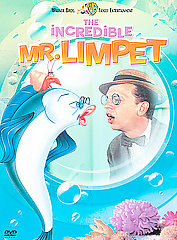
1) I’m writing something now and it struck me that a minor character might be really into tropical fish. He’s got a fish tank, reads books about fish, is just deeply into it. I have a personal connection to that, since when I was growing up my father had a fish tank and, for a while, my brother and I picked up the hobby (Billy even bred Siamese Fighting Fish — craziness, believe me!). But this was long ago. Let’s see . . . what else? As a kid, I loved the movie, The Incredible Mr. Limpet with Don Knotts. More recently, I’ve renewed contact with an old college friend who is . . . really, really into tropical fish. So he got me thinking about it again.

The reality is that I don’t know much about fish, but I want to create a character who does. So I’ll do research, see what comes up, try to write some scenes, go visit a fish store, and who knows. It might work for me, stimulate my imagination with facts and ideas, or not.

2) In Along Came Spider, I very much wanted to show that Trey, a positive, wonderful boy with autism, had his own unique talents and interests. For one, he loved animals and had a special affection for birds. He built his own bird houses and hung them in his back yard — and, in the book, one such house becomes a meaningful gift for the school librarian, Mrs. Lobel. However, I had a problem: I personally can’t build a piece of toast, much less a bird house. Time for some internet research to stimulate my brain with facts and ideas.

Here’s part of the scene that resulted, excerpted from Chapter 13, “Ava Bright.” In a meeting arranged by Trey’s oldest friend, Spider, Ava Bright visits Trey in his backyard:

They found green-haired Trey sprawled on his back patio. He was on his knees, hunched over scraps of wood and various tools — measuring tape, saw, hammer, drill, chisel, screwdrivers.

Ava’s eyes widened as she took in the entire backyard, the stand of breathtaking oaks, maples, and pines, the field of wild grass beyond. She arched her back and gazed up at the great old trees. “This is really, really nice,” she murmured.

Trey scrambled to his feet. “Oh, hi. I didn’t hear you guys.”

“What are you building?” Ava asked.

“A gift,” Trey answered. “It’s a nest box.”

“A nest box?”

“Most people call them birdhouses,” Trey said, “but most people are wrong.”

Spider grinned. He had heard Trey recite facts about birds and nest boxes many times. It was amazing and, at the same time, So Totally Out There. Trey could sit for hours in perfect silence, but when he got going on one of his favorite topics — like birds or rocks or ice cream — he would talk nonstop. And it didn’t matter if you paid attention or not. It was as if Trey had so many facts crammed into his head, he couldn’t keep them locked inside. Spider imagined a volcano spewing hot lava: Mount Trey.

“Can I help?” Ava asked. “I mean, I don’t know anything about nest boxes, but I’m pretty good with a hammer.”

Trey nodded, sure she could help. He looked at Spider with a question in his eyes.

“Sounds good to me,” Spider said.

Trey showed them what to do. And while he did, he explained things to Ava, who was either astonishingly polite or very interested — or both. “About one hundred different species of birds nest in natural cavities,” Trey said. “You know, like holes in trees, the eaves of houses, things like that.”

Ava nodded, listening as she made measurements on a length of pine board.

“But lots of trees are cut down every year,” Trey said. “That’s bad for birds. Their natural habitat is shrinking. Plus, other animals — like squirrels, which I do not like — he said with surprising hostility — “all compete for the nesting places. Lots of songbirds like nest boxes. Bluebirds, titmice, chickadees, wrens –“

“It’s nice that you build them,” Ava said. “I’m sure the birds appreciate it.”

“Well, we have to take care of them, don’t we?” Trey said matter-of-factly. “I mean, they can’t build these by themselves. And it’s so easy for us.”

Even though Spider had heard Trey say things like that many times before, this time the words struck him in a different way. We have to take care of them, don’t we? It was a simple thing to say. A clear, true thought. We have to take care of them, Spider repeated to himself. It’s so easy for us.

The clouds parted and a warm yellow sun shone down. Ava, Trey, and Spider worked together for the next couple of hours, laughing and talking. Ava asked a lot of questions — she had a curious, interested sort of mind — and Trey had all the answers. He explained how the nest box roof needed at least three inches of overhang to protect the birds from hard rain. He showed Ava how to spread a coat of petroleum jelly along the inside of the roof to keep away wasps and bees. And with a chisel, Trey patiently grooved the interior walls of the house. “It helps the baby birds climb to the opening,” he explained.

Ava was impressed. She looked around, suddenly puzzled. “But I only count two nest boxes in your yard,” she said. “I thought you built lots of them?”

“I give them away,” Trey answered. “Birds are territorial. They don’t like it if you put the boxes too close together. They don’t like crowds, and I totally agree with them,” he said. Trey finished screwing the last galvanized screw into the nest box. “There,” he said proudly, holding  up the final creation.

“You’re very talented, Trey,” Ava said with admiration. “And smart. Isn’t he, Spider?”

“He’s one of a kind,” Spider replied, grinning.

<< snip >>

The scene continues at a leisurely pace, the three kids hanging out together, building a friendship over hammers and wood. Nothing amazing ever happens in this book, frankly, a minor crisis or three, but my point in sharing this scene is to show how it grew organically out of my research for this character. He was interested in something I didn’t know anything about. As a writer, I felt in no way  limited to write about only what I knew — what I knew was that I needed to feed my imagination with facts and ideas! I wanted to learn and grow as a person, as a writer. Once I got to a point where I knew something (new), I was able to write, k/newly inspired.

That scene, and some core metaphors for the book, grew out of that research.

You need to a flashplayer enabled browser to view this YouTube video

When logic and proportion
Have fallen sloppy dead
And the White Knight is talking backwards
And the Red Queen’s “off with her head!”
Remember what the dormouse said:
“Feed your head
Feed your head
Feed your head”