I confess: I sometimes have misgivings about the kidlitosphere. At times it feels like just another clique, and one dominated by women. I recognize that one woman’s ceiling is another woman’s floor; a “clique” could easily be described as a “community” — a source of strength and positivity.
There’s nothing wrong with women, of course. It’s just that I’m a guy. I have a male point of view. For example, the writers I most love tend to be men. Actually, that’s not true: They are men. I’m just like that second grade boy who won’t pick up a Junie B. Jones book (I know, I have two sons, and I’ve tried to press those books in their hands). If it seems like girl stuff, I’m not all that interested. Or at least, there are hurdles, dispositions, to overcome. Sorry. I have a gender bias. That’s not news, right?
The nature of this clique, or community, has always been at the center of the children’s book world, back from my earliest days as a junior copywriter at Scholastic in the late 80’s. Women, women everywhere. They were the editors, the librarians, the teachers, the reviewers — and now, the bloggers.
Just to make myself crazy, I did a quick look at the 101 names listed as judges of the Cybils. By my estimation, which involved a little guesswork, 86 of them are women. That’s a lot, right? I’m not complaining, exactly, and I certainly don’t blame anybody. If more men were around, then . . . more men would be around. It’s our fault: guys need to step up or shut up, I suppose.
I don’t know if I have a thesis point. I’m mostly just typing out loud. Other than to say that as a man in a woman-dominated kidlitosphere, I feel like an outsider. And I wonder if there might be some connection to boys and reading. If they feel as disconnected as I sometimes do.
Yet through this blog I’ve made some meaningful connections. A few friendships here and there. Last year I was invited to Dublin, Ohio, by Bill and Karen from Literate Lives. I still go back to their blog from time to time, because they inspire me with their enthusiasm, their dedication, their sense of purpose. Clicking on today, I saw that Bystander was the recent topic of discussion on a Tuesday night, as part of Bill’s annual “Grand Discussion” series. Check it out, here.
Bill even sent me this photo:
I was supposed to be a part of it, through an iChat link-up. But I couldn’t figure out the technology in time, to my great disappointment. If there was a lake next to my computer, you would have heard a groan of frustration followed by a splash. It’s one more hurdle I’m going to have to figure out, because it seems like a great way to connect with readers.
Thank you, Bill, for the friendship and the support.
——-
In other news, Musings of a Book Addict recently reviewed Bystander and had some nice things to say. But that’s assumed, isn’t it? I mean, if she didn’t have nice things to say, I wouldn’t link to it. I’m superficial that way.
For the full review, click here. For those short on time, here’s the money quote:
I see the problem of bullying in my school everyday. Sometimes it takes the form of a kid saying something mean to another. Sometimes it is a child saying something nasty about the other kid’s parents. All of it is a form of bullying. However, most kids don’t realize that just standing around saying nothing, doing nothing, when they witness bullying is just as bad. This was an awesome book and one I look forward to placing on my shelves at school.
Eric Hayes, the main character in Bystander, plays guitar. He’s also missing an absent father, who occasionally sends CDs in the mail. Here’s a brief excerpt from Chapter 4, the first time that subplot is explored. To set up the scene: Eric’s father calls the family at their new home, five hundred miles away. The conversation does not go well; 13-year-old Eric is uncommunicative. The phone call ends.
Click, and he was gone, again. Call over.
Eric looked at the phone in his hand, shot daggers at his mom, snapped it shut. He went into the kitchen, looked for something to eat. A bowl of Rice Krispies, some pretzels, anything.
His mother barked something about dinner being almost ready, and not to spoil his appetite. Rag, rag, rag. So he grabbed his iPod instead, slid open the back door, and parked himself in a lawn chair. Eric turned the music up, let it pour into him, fill him up. He had downloaded the songs from his dad’s CDs. Eric did not curse, or cry, or seem to feel much of anything. It was all just a swirling mass, a crazy mess inside his numb skull. He closed his eyes and heard Led Zeppelin guitarist Jimmy Page pick out the first notes of “Communication Breakdown,” rapid-fire like a machine gun on the open E string, before hitting three big chords, D-A-D. Then singer Robert Plant’s siren wail: “Hey, girl, stop what you’re doin’!”
It had rained and some worms crawled from their holes out onto the brick patio. Eric grabbed a stick and idly poked at one, turning it over. That’s how he felt, he decided. Just like that worm. Pushed around, prodded by a stick. After a while he’d crawl back into his hole. And then, in a few days, off to school. A new hole with red bricks and homework.
It would be a fresh start. A new beginning. Isn’t that what his mom said? New and improved. Guaranteed or your money back.
I hit on that particular song, “Communication Breakdown,” for maybe too obvious of reasons. But ignoring the song’s title for a minute, it’s on the first Led Zeppelin LP. I remember listening to that album as a young kid, staring at that cover — which depicted, I later learned, the 1937 burning of the Hindenburg airship. This was probably around 1971 or so, when as the youngest of seven I reveled in my siblings’ record collections. It wasn’t classic rock back then; it was brand spanking new.
Though I’m not a musician, my character, Eric, played guitar — so I knew he’d hear it differently than I did. Eric would understand the notes, what Jimmy Page was doing. I figured I’d have to look up the tabs, maybe describe it through Eric’s ears, the way a musician might hear it.
That’s when I learned that part about the open E string. Then those three fat chords: D-A-D.
Dad.
Perfect, right? It could have been G-F-G, or whatever, and that’s what I would have typed. I’m glad it worked out way better. A happy accident.
Note: If you want to rock, stick around for the solo, at 0:49. Can’t wait for my Gavin, age 10, to learn how to play this all the way through, and believe me, it’s gonna happen. The kid’s got talent.
By the way, came across this review today. I’m always glad when they spell my name correctly:
“Preller displays a keen awareness of the complicated and often-conflicting instincts to fit in, find friends, and do the right thing. Although there are no pat answers, the message (that a bystander is hardly better than an instigator) is clear, and Preller’s well-shaped characters, strong writing, and realistic treatment of middle-school life deliver it cleanly.” — Booklist.
I received a curious package in the mail today, a padded envelope from the Junior Library Guild. It included a congratulatory letter from Jeanette Rivard, stating in part:
In keeping with our goal of providing extraordinary reading experiences for children, Bystander has been awarded the designation, “A Junior Library Guild Selection” for Fall 2009.
The Junior Library Guild Selection designation is unique in that it is typically awarded so early — often in advance of publication. With its distinction as one of the first awards given, it is often viewed as a bellwether of future success.
That’s some word, bellwether. It means: a male sheep, usually castrated, with a bell hung from its neck, that is followed by a flock of sheep. Well, my goodness, thank you very much, I think (as I slowly cross my legs).
The package also included a nifty JLG lapel pin, pinned now to my t-shirt, and a handsome certificate “suitable for framing.”
What? No bell?
Hey, pretty cool. Casting aside thoughts of castrated sheep, I thank you very much! Now if only we can get the rest of those pesky awards to fall in line. Baaa.
Today, I got asked this question three times before ten o’clock: “So how’s the new book going?”
It’s a well-intentioned question, and it comes from friends. I don’t know how to answer, in part because I don’t know the answer. It’s not like I get daily phone calls from my publisher, “We just sold seven in Maine!”
I guess I could say, “Um, no word from The Today Show or Oprah just yet — though my publisher did send an ARC to a blogger in Boise, Books I Feel Like Blogging About . . . And Other Stuff! So we’re hoping!”
Though I first published at age 25, in 1986, I don’t have a lot of experience in the hardcover world. My first hardcover, Cardinal and Sunflower, went to HarperCollins and sank like a stone. “Temporarily Out of Stock” on Amazon for the past nine years. It did not earn back the modest advance, was never picked up in paperback. I don’t think that’s an atypical story. How’d that book go? Um, it went, but thanks for asking.
For ten years, I wrote Jigsaw Jones books — and there was never any professional reaction, other than the letters I’d get from kids (fabulous!) or random comments I’d receive from teachers and parents. But hey, let’s not forget the ultimate measure: royalty checks. All that creative work gets reduced to simple mathematics. If it’s a big number, the book went well; if it’s a small number, disappointing, worrying. Those Jigsaw Jones books were never reviewed. Series paperbacks, you know. The kids seem to like ’em, but. If one was better or worse than another, nobody said so. After a while (read: after the first book), the publishing folks at Scholastic didn’t much read them either, other than those young editors who did so as part of their job description.
The furnace beckons. If sales go well, my publisher asks for more. If sales go down, the furnace grows cold. They try burning something else. It’s almost entirely outside of any concept of quality. (Perhaps that sentence was too generous, I’m not sure.) The numbers don’t lie. And again, this is a business. I get it. Chug, chug, chug. The train has got to keep moving down that track.
I want to be clear about this: This doesn’t make anybody a bad guy. It’s reality. I don’t curse the sky when it rains. But I’m not going to pretend the sun is shining, either. Books are products, after all; they must move. For most of us — who don’t land on the New York Times Bestseller List, or who don’t somehow cut through the clutter, as they say — it’s just how things go. Don’t cry for authors, Argentina.
Now, of course, writers today can get another helpful number over at Goodreads — if they dare. At the present moment, four people read Bystander, two reviewed it, and the score is 2.67. Or something close to that. I’m guessing that somebody didn’t care for it much. I have a nervous disposition; I generally don’t read reviews.
So how’s the new book going?
No parades yet. One official review, which was brief and mildly positive (read: bums me out they didn’t love it), and that’s about it. I think, in truth, that’s the way things go for the overwhelming majority of authors. It’s not like the world changes. Or even stands up to take notice. With Six Innings, I was lucky. Some good things happened. A blog review here, another there. A starred review, then another! It took time for the book to find an audience, and it was astonishing to me when a year later it hadn’t fallen off a cliff. Miracle of miracles, it was named an ALA Notable Book. I mean to say: It kicked Cardinal & Sunflower’s butt up and down the block.
With Bystander, who knows. I wrote the book, it’s out there, it’s out of my hands — like a little craft I built of balsa, cork, Krazy Glue, and dowels. A boat I pushed out into the water. I don’t control the journey. It floats, it sinks, it gets caught up in a current and travels hundreds of miles. I’m that kid staring helplessly at the edge of the pond. Swim, boat, swim. Go find readers.
I also get useful advice, like that same boy, now at home plate, after he swings through a fastball. “Elbow up, head in, lay off the high ones.” In this case: Hire a publicist, get an agent, promote yourself, go on Twitter, make a Facebook page, film a book video and put it on Youtube, etc.
Do you blog? Oh boy, do I ever!
Anyway: Please check out this short, satiric piece in The New Yorker, “Subject: Our Marketing Plan,” by Ellis Weiner. Every author should read it. A tip of the hat to Deborah Kovacs for bringing it to my attention. The one-page article begins:
Hi, Ellis—
Let me introduce myself. My name is Gineen Klein, and I’ve been brought on as an intern to replace the promotion department here at Propensity Books. First, let me say that I absolutely love “Clancy the Doofus Beagle: A Love Story” and have some excellent ideas for promotion.
To start: Do you blog? If not, get in touch with Kris and Christopher from our online department, although at this point I think only Christopher is left. I’ll be out of the office from tomorrow until Monday, but when I get back I’ll ask him if he spoke to you. We use CopyBuoy via Hoster Broaster, because it streams really easily into a Plaxo/LinkedIn yak-fest meld. When you register, click “Endless,” and under “Contacts” just list everyone you’ve ever met. It would be great if you could post at least six hundred words every day until further notice.
If you already have a blog, make sure you spray-feed your URL in niblets open-face to the skein. We like Reddit bites (they’re better than Delicious), because they max out the wiki snarls of RSS feeds, which means less jamming at the Google scaffold . . .
Well, it’s been a wonderful week and I’ve really enjoyed having Lewis Buzbee as my co-host, trailing after me like a lost puppy . . .
Believe me, if I had any idea he’d act like this, I never would have asked Lewis to stay for an entire week. But Don Rickles canceled, Sammy was busy, and Barbra never returns my calls.
Seriously: I don’t hang with authors much. I don’t get invited to conventions or even blog tours or — come to think of it — neighborhood block parties, so it’s not like I get the chance to meet many high-flying literary types. I tend to spend my time with my wife, my kids, and other people here on earth. But when I read The Yellow-Lighted Bookshop, I felt an immediate connection to Lewis. I had to talk with this guy. I wanted to push his doorbell, spend the weekend. Separated by 3,000 miles, I did the next best thing: Asked him for an interview.
I hope you’ve enjoyed this series of interviews half as much as I did. I feel like I’ve not only discovered a terrific writer — someone whose career I will follow, whose books I will read — but also, something more lasting, more meaningful: I’ve found my 163rd Facebook friend.
If you missed the fun, click here to catch up on Part One or Part Two.
And we’re off . . .
Is John Steinbeck still your favorite author?
Least favorite question.
Oh, man. Sorry. Now I feel like Geraldo.
He’s my first writer, for sure. And reading him again and again as an adult, I learn more from him every time. But there’s a million others out there who are my favorite writers. I go with E.M. Forster on this. I don’t see writers in any competition, I see them all working together in the big round reading room of the British Library. Isn’t it a miracle we have so many great writers to read?
So, yes, he has to be my favorite.
What have you learned from him?
I hope what he wrote to a young Peter Benchley, who was in boarding school at the time. He was friends with Peter’s father. Steinbeck wrote, “Only a fool is willfully obscure.”
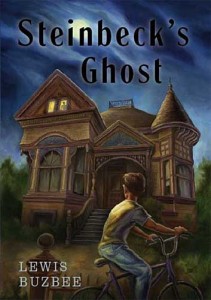
Yes, excellent. You put that in Steinbeck’s Ghost.
In other words: the exact opposite of what they taught us in college! To me, so much of my adult writing life has been about unlearning those lessons, the obtuse writers that we were supposed to admire and love. I mean, yes, some are great. But there’s definitely an Emperor’s New Clothes thing going on: I don’t understand it, I can’t comprehend it, so golly it must be good! More and more, I respect writing that has clarity, directness, and restraint. An absence of flash. I’m striving to write sentences like, “He put the glass on the table.”
Many of my students — I teach part-time in the MFA program at University of San Francisco — are under the impression that subtlety is the goal. And by that they mean murkiness. One of them recently told me, “I love stories that leave you completely confused about what’s happening.” Okay, fine.
Flannery O’Connor wrote that in a time when there is too much noise in the air, and everyone is heard of hearing, the writer needs to practically shout, use primary colors, be bold. Yep.
Talking about Steinbeck, I’m reminded of how I read many of his books as a young teenager. He and guys like Ray Bradbury and Kurt Vonnegut, Jr. (probably my favorite at that age) were the young adult literature of my youth. There was no such thing as “YA.”
I think that that’s my ultimate goal as a writer, to crack open the brain, and unleash the words, of a fourteen-year-old. To meet the big ideas about the world that are just forming in their enormous brains. As a bookseller, who should pay attention to categories, I was never one for categories. Good is good. That’s that. Bradbury, Vonnegut, Steinbeck — that’s a good desert island stack.
You recently wrote your first children’s book, Steinbeck’s Ghost. How did that happen?
Like I said, I wasn’t a voracious reader as a kid, so I missed a lot of great kids’ lit. But the very first bookstore I worked in was run by three wonderful women, who were all passionate experts about kids’ books. And they made certain that I read as much as I could, and that I understand, not only the importance of kids’ books, but the variety and expertise of kids’ books, their sophistication. So my whole adult life, I’ve been a reader of kids’ books. And I’ve always wanted to write my own.
I’m glad you did, just don’t eat up too much of the market share. Oh, wait. We”re not supposed to be in competition. Can’t I just quietly hate you?
You became a father relatively late in life. How do you think that’s affected you as a writer? As a reader?
Lord, what a question. It changed everything.
When my daughter was born, I was halfway through the second draft of a six hundred page novel that was all very clever and erudite and luminous. But I threw myself, gladly, into being a dad, changing diapers and staying up nights for feedings, strollers, all the rest. It was a blast. By the time I got back to that novel, I was disenchanted with it — it seemed so unessential, so small. And I immediately began writing a whole new crop of stories about what I felt were bigger things. That became After the Gold Rush, my first book of stories.
My daughter “restored me to life,” as Dickens said, reminded me what was essential. And since then, I’ve written so many books, with such urgency. She not only reminded me what to write about, but showed me, perhaps for the first time, why I was writing. Dude, seriously, it’s life and death stuff — that’s how it makes me feel.
Katherine Paterson has a wonderful line about that, reflecting on being a parent and a writer: “I can see that the very persons who have taken away my time and space are those who have given me something to say.” There it is, I couldn’t possibly say it better. Like we were talking about before — she said it for us, articulated that chaos of the heart, and I’m grateful to her for that.
God, what a great line. I wish I’d said that. Can we pretend? That’s the wonderful thing about being a parent, and I think a lot of people miss this part — especially the “workaholics”: my pleasures here are purely selfish; she gives me so much.
And then, of course, there was reading to her. She’s eleven now, and we still read together every night. But the first day she was home from the hospital, I read to her — Beatrix Potter, Maurice Sendak. And it’s been such a journey to follow her through that development, through all the picture books, then the chapter books, then the middle grade novels. Yes, that had a huge influence on my desire to get into the kids’ section.
What’s your daughter’s name? I’m guessing it’s Flannery, Harper, or Willa.
Maddy. Yes, Madeleine. Actually named after a character in the Bill Forsythe movie, “Comfort and Joy,” who is a kleptomaniac, and her boyfriend follows her around department stores watching her steal, and he’s always saying, in his Scottish accent, “Ach, Maddy; ach, Maddy.”
Ach, Maddy — that’s funny. What’s next for you?
My second middle-grade reader, The Haunting of Charles Dickens, will come out in September 2010, and I’ve just finished Mark Twain and the Mysterious Stranger, September 2011.
Quick idea here, Lewis, if the series is successful: Marcel Proust and the Madeleine Tea Cake. Kids are always clamoring for more Proust — plush toys, bed sheets, lunch boxes, 8-track tapes. Or how about, Ernest Hemingway and the Disappearing Absinthe. Maybe you could package it with “Death in the Afternoon by Chocolate” brownies or something. Hey, it’s your series — do with it what you’d like. I’m just typing out loud here.
I was thinking more like Kafka Goes Krazy. I think Kafka is the perfect karacter for kids to relate to. I mean, you know you did something wrong, and have to stand trial for it, but you just don’t know what it is you did. Plus, it’s got movie written all over it.
Actually, I think Kafka’s “Metamorphosis” is the most borrowed idea in children’s picture books. Imogene’s Antlers, anyone? A Bad Case of Stripes? There are many variations. And I love that idea today, waking up in a transformed body. It’s probably a great story starter in the classroom.
I’m just starting a new adult nonfiction book, along the lines of Yellow-Lighted Bookshop. It’ll be called Blackboard: The Life of the Classroom, and will concern itself with classrooms and what happens in them. It’ll include history, too, but also the memoirs of a student, and of a teacher.
Wow, huge topic, sounds interesting — I’ll look forward to reading it. Now strap in, Lewis, here comes The Lightning Round. Five favorite TV shows, all-time?
Simpsons, South Park, Cheers, M*A*S*H, iCarly (my new favorite).
Five best concerts you’ve ever seen?
Tom Waits on New Year’s Eve; Elvis Costello’s Spinning Wheel Tour; Bob Dylan’s Slow Train Coming Tour; Talking Heads’ Stop Making Sense Tour; Bruce Springsteen in San Jose, 1978.
I love Tom Waits, and he is a genius. But frankly, a lot of the more recent stuff is just too, well, obscure. I’m not a musical genius. I like songs. I have all his albums up through the early nineties. Then it stops. But I’d love to have lunch with him someday.
Five favorite bookstores?
City Lights; Green Apple Books; Booksmith; Books, Inc.; all in San Francisco. Shakespeare and Co., Paris, because it’s in Paris.
You are outside somewhere, peaceful under the night stars. There’s a song playing and a drink in your hand. What’s the song? What’s the drink?
Van Morrison’s “PIper at the Gates of Dawn,” with a Martini, Sapphire, shaken, very very cold, and only the faintest touch of Vermouth (one should only whisper the history of Vermouth to the martini).
Last five books you’ve read?
Listen, I was told there would be pie. Is there pie? No pie? Oh, okay.
I just met Rebecca Stead, ever so briefly. Got a signed copy of When You Reach Me for my kids. I don’t think she realized how fabulous I was, or else she would have been more excited. Don’t you think? A lot of talk about that book. How’d you like it?
It’s a great voice she has, and a real great, what I call “kid brain.” I also like that she and her publisher were willing to go back to the 70’s. Near history, not movie history. I dug it, completely. Like Konigsburg, she knows how intense every moment of childhood is, and she knows that kids are intensely involved with the lives of adults, too.
Wouldn’t now (cough, cough) be a good time to talk about my books? I mean, dude, throw me a bone here. It’s how we met, isn’t it?
I didn’t know you wrote. Oh, you’re that James Preller! Hmmm. It’s true. I recently read Bystander, and wrote you a somewhat unabashed fan letter. Because, like Stead and Konigsburg and L’Engle and Cormier, you get what the best kids’ writers get and what makes me want to keep doing this: kids are way, way smarter than we think they are, and their lives are as worthy of serious literature as adults. Perhaps more. Then I read Six Innings, which I loved, and I thought, crap, this guy is too good.
Yeah, baby!
But seriously, where’s my pie, Mr. Preller?
I lied about the pie. Listen, bro, thank you so much for hanging around, putting in all this time. I can only hope my Nation of Readers goes out and buys all your books. You should expect a huge spike in sales. Please except this new Kindle 2 as a parting gift. It’s lightweight, 20 percent faster than the original Kindle, and lasts four to five days without needing to be plugged in or whatever. Let’s see a book compete with that! Plus, you can use it as a doorstop.
Can you hand me the chainsaw, please? The chicken is getting antsy.
Last thought, as the credits roll . . .
. . . the nicest thing I can say about Lewis Buzbee is that after you talk to him, you want to go out and buy a book. You want to catch up on all those treasures you’ve missed. You want to walk into a good bookstore, run your fingers down those beautiful spines, bring the weather with you. We all feel it, everybody here. We’re readers. We love books; it’s at the core of everything we do. Thank you, Lewis Buzbee, for reminding us of that love.Now get outta here, ya big lug, before I hit you with a pie.
——-
FOR MORE INTERVIEWS . . .
If you enjoyed this interview with Lewis Buzbee, you might like interviews with other author/illustrator types:




)