Archive for Readings

Blackboard: A Personal History of the Classroom

I am proud of my friend, Lewis Buzbee, who has written this much-acclaimed book — and it just came out this week. He is a great writer and friend and I can’t wait to read this new one. A book for anyone who has gone to school, or cares about education.

A classic back-to-school book.


10524370_10204440422270168_5446714264040880078_n

“Buzbee’s affectionate account [is] a subtle, sharply etched critique of contemporary public education. . . . Deeply affectionate toward teachers, harshly critical of budget cuts, the book offers an eloquent, important reminder (which in a perfect world would inform policy) about the nature of school.”—Publishers Weekly, starred review

“A bracing rejoinder to the didactic, data-driven books from policy gurus and social scientists. . . . From the layout of schools to the distinction between ‘middle school’ and ‘junior high school,’ Buzbee spreads engaging prose across the pages, providing both a reminiscence of better days and a considered examination of the assumptions we all make about what does—and does not—constitute a quality education. . . . A welcome book on the importance of education for all.”—Kirkus Book Vault Reviews

A Children’s Book That Left a Lasting Impression

I was recently contacted by a journalist for a national newspaper who wanted me to name a book I read as a child that left a lasting impression.

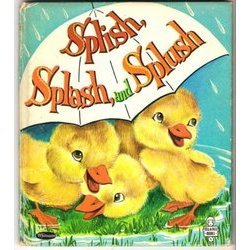
That’s a tough question for me, because I sense that my answer is never exactly what the questioner is seeking. I don’t have a poignant story about Charlotte’s Web or Harriet the Spy, that glorious day when I suddenly knew that reading was for me, and forever. I can’t describe in loving detail the book I encountered as a fresh-faced welp. (Though I do recall loving Splish, Splash, and Splush.)

Nonetheless I did somehow grow up to become an author, and therefore my answer is, I guess, legitimate. It’s the only story I’ve got.

Here’s how I replied, limited to 150 words:

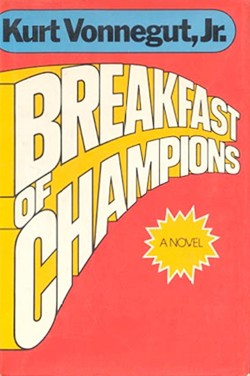
Born in 1961, I have no memory of my parents reading to me. That’s not a complaint, by the way. I grew up surrounded by six older siblings and they were (mostly) all readers. I guess I got the message by sheer proximity. As a baseball-mad boy in a world without ESPN, I devoured the sports pages in the daily newspaper. Those were the first writers I desperately needed. By age 13, I encountered Kurt Vonnegut’s “Breakfast of Champions.” It was funny and easy to read. There was no YA back then, my generation naturally graduated to Steinbeck, Bradbury, Brautigan, Vonnegut, Plath, whomever. “Breakfast” blew me away. Here was something as devilish as the kid in the back row, irreverent, rebellious, hilarious, wild. In a word, subversive. In those pages I first recognized the possibility that a book could be supremely cool. Thanks, Kurt.

A Perfect Passage from THE ROUND HOUSE by Louise Erdrich

No offense to any librarians out there, but I prefer to own books, not borrow them. I realize there’s a financial downside to my predilection, but what can I say? It feels good to support the industry, the book stores, the publishers, the authors themselves. If I can manage it, I don’t mind spending the money on books.

For starters, I like having them around, living in my rooms. Books make great furniture and, in a way, furnaces: they warm homes.

Secondly, I usually read with a pen in my hand. I underline passages, write comments, exclamation points, stars, notes and complaints. It is the dying art of marginalia, a direct reader-response. I can’t do that with library books, and Post-It Notes simply do not satisfy.

I’ve been on nice reading streak lately — have picked out some good ones. I just finished THE MARTIAN by Andy Weir. Fabulously entertaining, and a celebration of science and the intelligence of man. A geek-hero who survives through his attitude, his determination, and his brilliant mind.

Before that, I read THE ROUND HOUSE by Louise Erdrich. I loved it, every word. What a great writer. Seamless sentences, never a crack showing, and such human insight. A writer with soul. But I’ve got a problem and you can probably guess it: I borrowed the book from my local library and it’s past due.

I’ve been reluctant to return it, to drop it into the slot and hear the dull thunk as it hits the bin. Gone, gone, gone. My book no more.

One first-world problem is that I’ve been rereading, almost daily, the book’s perfect last paragraph. Over and over I return to it, stunned and speechless. That penultimate sentence, especially. What a beautiful evocation of lost innocence, the crossing over into something harder, more brutal and cold, adulthood and loss, “when we all realized we were old.”

I really didn’t want to let the book go, and maybe I’ll buy a copy for myself one day. In the meantime, I’ll type out that last paragraph here, so I’ll have it safely tucked away in the white, high-ceilinged halls of cyberspace. I don’t think there’s any spoilers revealed, it’s not that kind of book. A 13-year-old boy and his parents return home after a long drive.

Quick aside: I don’t play a musical instrument, but I love music. One of the things I’ve always envied about musicians is that they can play all these great songs, have those enduring melodies and fat riffs run through the fingers as they channel greatness.

That’s how I feel typing this passage from Louise Erdrich. Like I’m playing the guitar part from “And Your Bird Can Sing.”

How I wish that I could write as simply, as beautifully.

– – – – –

IN ALL THOSE miles, in all those hours, in all that air rushing by and sky coming at us, blending into the next horizon, then the one after that, in all that time there was nothing to be said. I cannot remember speaking and I cannot remember my mother or my father speaking. I knew that they knew everything. The sentence was to endure. Nobody shed tears and there was no anger. My mother or my father drove, gripping the wheel with neutral concentration. I don’t remember that they even looked at me or I at them after the shock of that first moment when we all realized we were old. I do remember, though, the familiar side of the roadside cafe just before we would cross the reservation line. On every one of my childhood trips that place was always a stop for ice cream, coffee and a newspaper, pie. It was always what my father called the last leg of the journey. But we did not stop this time. We passed over in a sweep of sorrow that would persist into our small forever. We just kept going.

Donalyn Miller’s “The Book Whisperer” Reaches Cultural Icon Status

I met Donalyn Miller at a Literacy Conference in Ohio. She was the keynote speaker and I came away impressed, inspired, and determined to read her book, THE BOOK WHISPERER: Awakening the Inner Reader in Every Child.

I started reading it yesterday, frustrated over my own 9th-grade son’s brutal, book-hating experience in advanced, 9th-grade English.

I underlined this passage from Donalyn’s book, page 18:

Reading changes your life. Reading unlocks worlds unknown or forgotten, taking travelers around the world and through time. Reading helps you escape the confines of school and pursue your own education. Through characters — the saints and sinners, real or imagined — reading shows you how to be a better human being.

The book is filled with passages that make you want to stand up and cheer.

Anyway, this morning Donalyn Miller shared her enthusiasm over this fun bit of pop culture stardom:

Good for Donalyn Miller, good for Jeopardy.

It’s funny, isn’t it? That’s a real touchstone in America today. An undeniable sign that you’ve arrived and made your mark. You become a clue on Jeopardy!

Donalyn is also a founding member of the Nerdy Book Club, which you should definitely follow. Seriously, I insist.

Writing Advice from a Master: “There’s Only One Question and One Answer.”

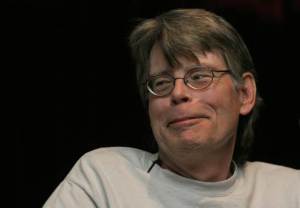
I have an uncomplicated relationship with the books of Stephen King.

For the longest time, I ignored ’em.

The problem was two-fold:

1) for whatever reason, I didn’t get around to them in high school, which was too bad, because of what happened next;

2) next, I went to college and got educated.

College can mess you up. I was a Lit major, trying my hardest to be a good student and a sublime writer, and for the most part that meant dealing with IMPORTANT BOOKS and LITERARY WRITERS and DIFFICULT TEXTS. I don’t regret any of that — it’s where I learned to love books, and I enjoyed many great teachers —  but I wish somebody said, “You know, don’t underestimate the value of a good story.”

It sound ridiculous, of course, since “a good story” is only everything.

But it took me a long time to grasp that plain fact. My head was in the clouds; my nose was in the air.

In college, I learned a lot, and later in life I had to unlearn a lot.

So I’ve come to Stephen King late in life. And now that I’m here I am filled with great respect for the man and the writer. I previously wrote about his excellent book on writing, titled — wait for it — On Writing. I’m not an expert on these things, but I found it to be the best, most relatable, no-nonsense book on THE JOB (& CRAFT) of writing as anything I’ve come across before or since.

I’m currently reading 11/22/63, King’s great novel about time travel and a man who seeks to change history by thwarting the Kennedy assassination.

Here’s a few lines from p. 150, which struck me as great advice and, for a writer with my flaws and proclivities, an essential reminder. Maybe it will help you, too?

“In both fiction and nonfiction, there’s only one question and one answer. What happened? the reader asks. This is what happened, the writer responds. This . . . and this . . . and this, too. Keep it simple. It’s the only sure way home.”

I posted this long ago, but thought I’d hurl it into the maw of the internet once more just in case you didn’t catch it the first time around:

Here’s a quick recap of Stephen King’s 12 guidelines:

1. Be talented

2. Be neat

3. Be self-critical

4. Remove every extraneous word

5. Never look at a reference book while doing a first draft

6. Know the markets

7. Write to entertain

8. Ask yourself frequently, “Am I having fun?”

9. How to evaluate criticism

10. Observe all rules for proper submission

11. An agent? Forget it. For now

12. If it’s bad, kill it