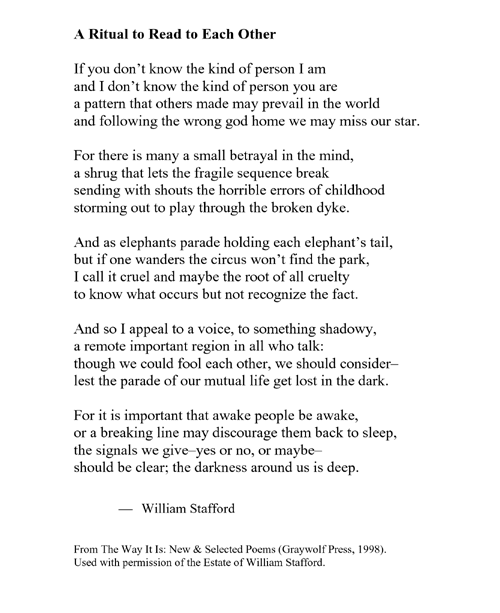
Before I rubbed the sand from my eyes, before I drank a cup of coffee, before I got dressed, I read this poem by William Stafford. Then I read it again, out loud, to my wife, before she rose from bed. Then I went downstairs, saw that the day was sunny and crisp, and that a dusting of snow covered the lawn.
I promised myself to be awake to the day.
Isn’t that something?
“the signals we give — yes or no, or maybe —
should be clear: the darkness around us is deep.”
Later I found this reading of the poem by a guy named Dale Biron. Not exactly how I hear it, but a pleasure nonetheless, because it’s always best when the words are heard, familiar units of speech floating on meaningful sound. Have a great day, people. Recognize the fact!
I suppose I should get to work, stop wasting time, eh? But here’s Stafford himself, 46 seconds long, reading “Scars.” Ah, poetry.
Sent to me by a friend . . . I wrote this book 19 years ago.
Some days are hard. Some days I don’t feel at all like a success. And other days I just want to give thanks, be grateful, and try not to be such an idiot. Happy Thanksgiving, folks.
It’s that time of year when our local, weekly farmers’ market moves indoors and, obviously, the product changes. These markets really are a summertime thing. I’ll be sad to see the empty parking lot on Saturdays outside the middle school where the market used to be.
My wife, Lisa, who is often a few years ahead of me in all things Cool & Progressive, was an early adopter. She valued local foods, loved our farmers’ market, and loathed to miss it. And I was like, “Okay, sure, I’ll tag along.” All cynical and whatever. But I learned over time that I enjoyed being there, running into folks, seeing my neighbors, goofing around, buying things . . . or not.
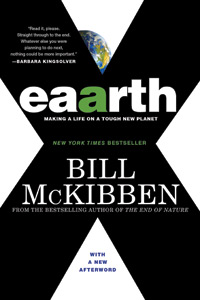
In a passage from his devastating, essential, must-read book, Eaarth: Making a Life on a Tough New Planet, Bill McKibben helped clarify for me what it was that I was experiencing at these markets, and maybe why I liked going so much:
Often a farmers’ market is the catalyst — not just because people find that they like local produce, but because they actually meet each other again. This is not sentiment talking; this is data. A team of sociologists recently followed shoppers around supermarkets and then farmers’ markets. You know the drill at the Stop’n’Shop: you come in the automatic door, fall into a light fluorescent trance, visit the stations of the cross around the perimeter of the store, exit after a discussion of credit or debit, paper or plastic. But that’s not what happens at farmers’ markets. On average, the sociologists found, people were having ten times as many conversations per visit. They were starting to rebuild the withered network that we call a community. So it shouldn’t surprise us that farmers’ markets are the fastest-growing part of our food economy; they are simply the way that humans have always shopped, acquiring gossip and good cheer along with calories.
Of course, McKibben has bigger things on his mind, and rightfully so. He recognizes this local, strengthening network as a catalyst, a foundation for political expression & action, for coordinated effort, and, yes, justice. In short, when people get together, it’s a good thing. So I want to thank all those folks who have worked so hard to bring the market to my little ‘burb in Delmar, NY, and the thousands like them around the country. You done good.
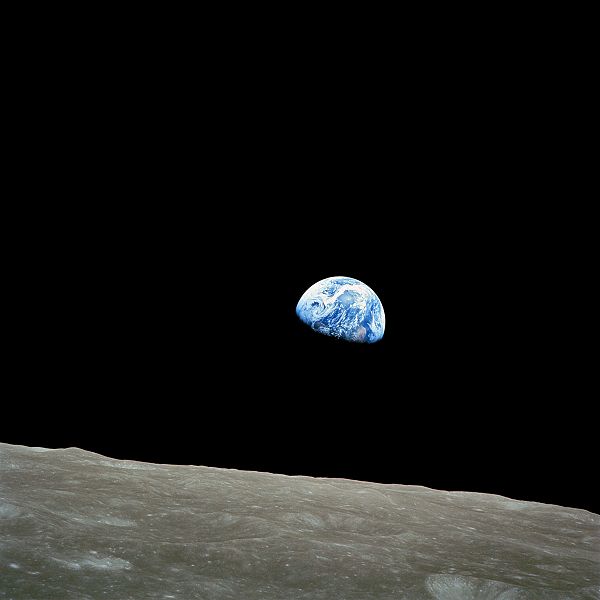
This photograph, known as “Earthrise,” was taken by astronaut William Anders during the Apollo 8 mission while in orbit around the moon.
I’ve been reading Bill McKibben’s book, Eaarth — that’s not a typo, by the way — and he has a nice passage about the taking of that photograph, and it’s “heart-catching” perspective on our fragile planet.
I’ll type it out for you:
In December 1968 we got the first real view of that stable, secure place. Apollo 8 was orbiting the moon, the astronauts busy photographing possible landing zones for the missions that would follow. On the fourth orbit, Commander Frank Borman decided to roll the craft away from the moon and tilt its windows toward the horizon — he needed a navigational fix. What he got, instead, was a sudden view of the earth, rising. “Oh my God,” he said. “Here’s the earth coming up.” Crew member Bill Anders grabbed a camera and took the photograph that become the iconic image perhaps of all time. “Earthrise,” as it was eventually known, that picture of a blue-and-white marble floating amid the vast backdrop of space, set against the barren edge of the lifeless moon. Borman said later that it was “the most beautiful, heart-catching sight of my life, one that sent a torrent of nostalgia, of sheer homesickness, surging through me. It was the only thing in space that had any color to it. Everything else was simple black or white. But not the earth.” The third member of the crew, Jim Lovell, put it more simply: the earth, he said, suddenly appeared as “a grand oasis.”
But we no longer live on that planet. In the four decades since, that earth has changed in profound ways, ways that have already taken us out of the sweet spot where humans so long thrived. We’re every day less the oasis and more the desert. The world hasn’t ended, but the world as we know it has — even if we don’t quite know it yet.
I basically took the summer off from blogging, so feel a little wobbly about it, my palms sweating on the handlebars, not sure I remember how to do this. I don’t know what happened, exactly, just somehow tired of the “James Preller” corporate thing. Ha. Mostly, I wanted to concentrate on other writings, as I’ve been deep in a new series that I’m writing for Feiwel & Friends. It won’t launch until The Fabled Summer of ’13, but I’ve nearly finished the third book in the series.
NOTE: I just reread this and had a chuckle about that “nearly finished” line. It only signifies that I’m an old pro when it comes to deadlines and editors: a manuscript that has not yet been handed in is always “nearly finished.” Any writer who says otherwise is a fool and a boob.
As for my new series, it feels like I’m that kid behind the snow fort, busily stacking up a supply of snowballs. Can’t wait to fire ’em out there. More on that topic another time.
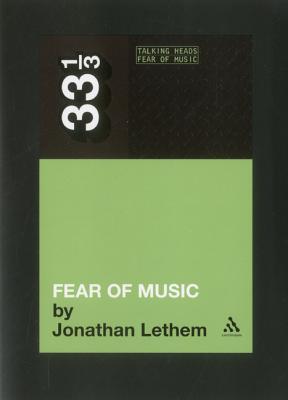
I’m usually a one-book-at-a-time guy, but I’m now reading three very different but equally remarkable books concurrently: Freedom by Jonathan Franzen, Fear of Music by Jonathan Lethem, and Good Poems, selected by Garrison Keillor.
Normally I don’t do that to myself, the three-books-at-once bafflement, but the mixture of long novel, short nonfiction, and poetry seem to complement each other nicely.
I have a long and sordid relationship with poetry, and I’m especially happy to find this sweet collection by Keillor, based on poems featured on “The Writer’s Almanac.”
Writes Keillor in the introduction:
Oblivion is the writer’s greatest fear, and as with the fear of death, one finds evidence to support it. You fear that your work, that work of your lifetime, on which you labored so unspeakably hard and for which you stood on so many rocky shores and thought, My life has been wasted utterly — your work will have its brief shining moment, the band plays, some confetti is tossed, you are photographed with your family, drinks are served, people squeeze your hand and say that you seem to have lost weight, and then the work languishes in the bookstore and dies and is remaindered and finally entombed on a shelf — nobody ever looks at it again! Nobody! This happens often, actually. Life is intense and the printed page is so faint.
Keillor, as curator, has a point of view. He likes poems that tell a story, poems that are direct and clear, that don’t sound too “written.” Poems that communicate. He quotes Charles Bukowski, “There is nothing wrong with poetry that is entertaining and easy to understand. Genius could be the ability to say a profound thing in a simple way.”
And I put a big star in the margin when Keillor described his former English major self — a tender self I identified with, all those lessons that have taken me so long to unlearn, the bad habits of academic thought, “back when I was busy writing poems that were lacerating, opaque, complexly layered, unreadable.”
I have a file drawer jammed full with opaque and unreadable poems.
Now I see that as my writer’s quest, this effort to write clearly (and yet, even so, to write interestingly, to achieve moments of “lift off”), to overcome my own big stupid fumbling ego, those temptations to craft “look at me!” sentences that dazzle and bore readers. Perhaps that’s the great gift of writing for children of all ages. They don’t go for the bullshit. You can deliver any kind of content — really, there’s nothing you can’t say in a children’s book — but please don’t overcook it.
One last phrase from Keillor, in praise of Maxine Kumin and Anne Sexton and, for that matter, all Good Poems:
“They surprise us with clear pictures of the familiar.”
So that’s how I’ve vowed to begin my days, by reading a few poems each morning. To sit in the chair, coffee at hand, and try on the silence. My favorite from today was Charles Simic’s “Summer Morning.”
You might enjoy it, too.
As a final treat, here’s Tom Waits reading “The Laughing Heart,” a poem by Charles Bukowski. Full text below.
your life is your life
don’t let it be clubbed into dank submission.
be on the watch.
there are ways out.
there is a light somewhere.
it may not be much light but
it beats the darkness.
be on the watch.
the gods will offer you chances.
know them.
take them.
you can’t beat death but
you can beat death in life, sometimes.
and the more often you learn to do it,
the more light there will be.
your life is your life.
know it while you have it.
you are marvelous
the gods wait to delight
in you.