Archive for Greatest Hits

Books for Boys: A Tribute to “William’s Doll”

“William wanted a doll.”

And so begins Charlotte Zolotow’s classic picture book, William’s Doll, illustrated by William Pene Du Bois. Published 38 years ago, and dedicated to Billy and Nancy, it is still relevant today — and very possibly moreso.

This title has been on my mind a lot lately, and comes to mind whenever the discussion turns to “books for boys.” Somehow the collective thinking about boys and reading has become muddled, to the point where “boys” has become a code word for “reluctant readers.”

I’ve talked about this before, here and here and here and elsewhere, and I don’t wish to repeat myself endlessly. Except to paraphrase Walt Whitman: Boys are large and contain multitudes. I find it unsettling, even disturbing, when I come across lists of “books for boys” that offer all the usual standbys: bodily humor, nonstop action, cars and trucks, sports, violence, and so on. You know, the kinds of stuff all boys like.

Imagine such a list for girls. Would it offend you?

And now imagine all the great books, and important thoughts, that would be missing from such a list. Because the nature of such lists is reductionist and simplistic and full of stereotypes, a narrowing of what children are and what children can become. Girls and boys.

Yes, for sure, I am strongly on the side of a teacher or parent who longs to turn a reluctant reader onto books. I can understand the desire for something sure-fire, a book that will turn the trick, unlock the door, open up the world of reading. But once that door has been pushed open, let’s not forget that boys can be sensitive, thoughtful, dreamy, mild, frightened, lonely, tender, loving, sad, and a thousand more things. It’s not just farts and firetrucks.

When my oldest son, Nick, was sick with leukemia, we struggled as parents. It was tempting to give him things, do things for him, make the experience easier and more enjoyable. In short: spoil him. After a spinal tap, how do you not buy that kid a lollipop? And a DVD of whatever he wants. So we did. But not always. My wife Lisa once said one of the most profound things about parenting I ever heard. Talking about this subject, she reminded me: “We’re not only trying to take care of a sick boy — we’re trying to raise a healthy adult.”

I think that applies to boys and reading.

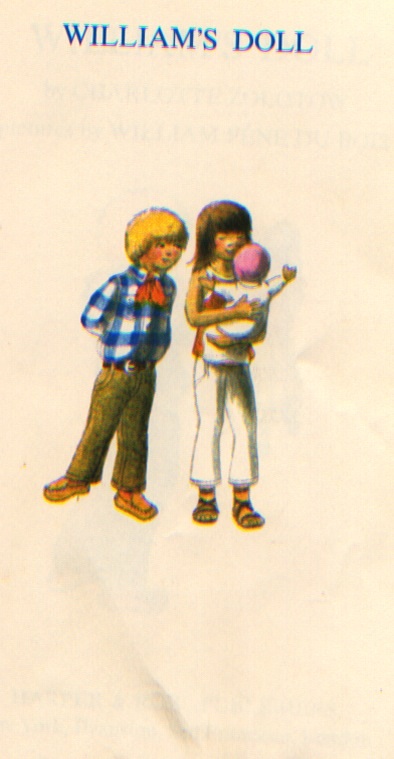
So let’s look at this book, William’s Doll. To me, the best illustration is on the first page, before even the title page. You know, the page we hurry past on our way to the story. It’s a picture, we will learn, of William and Nancy from next door. Nancy is holding a doll. But if you glance quickly at that illustration, look at it from a distance, it is a portrait of every young family in the world. Father, mother, and child.
“He wanted to hug it

and cradle it in his arms

and give it a bottle

and take it to the park

and push it in the swing

and bring it back home

and undress it

and put it to bed . . .”

His brother and the boy next door did not approve.
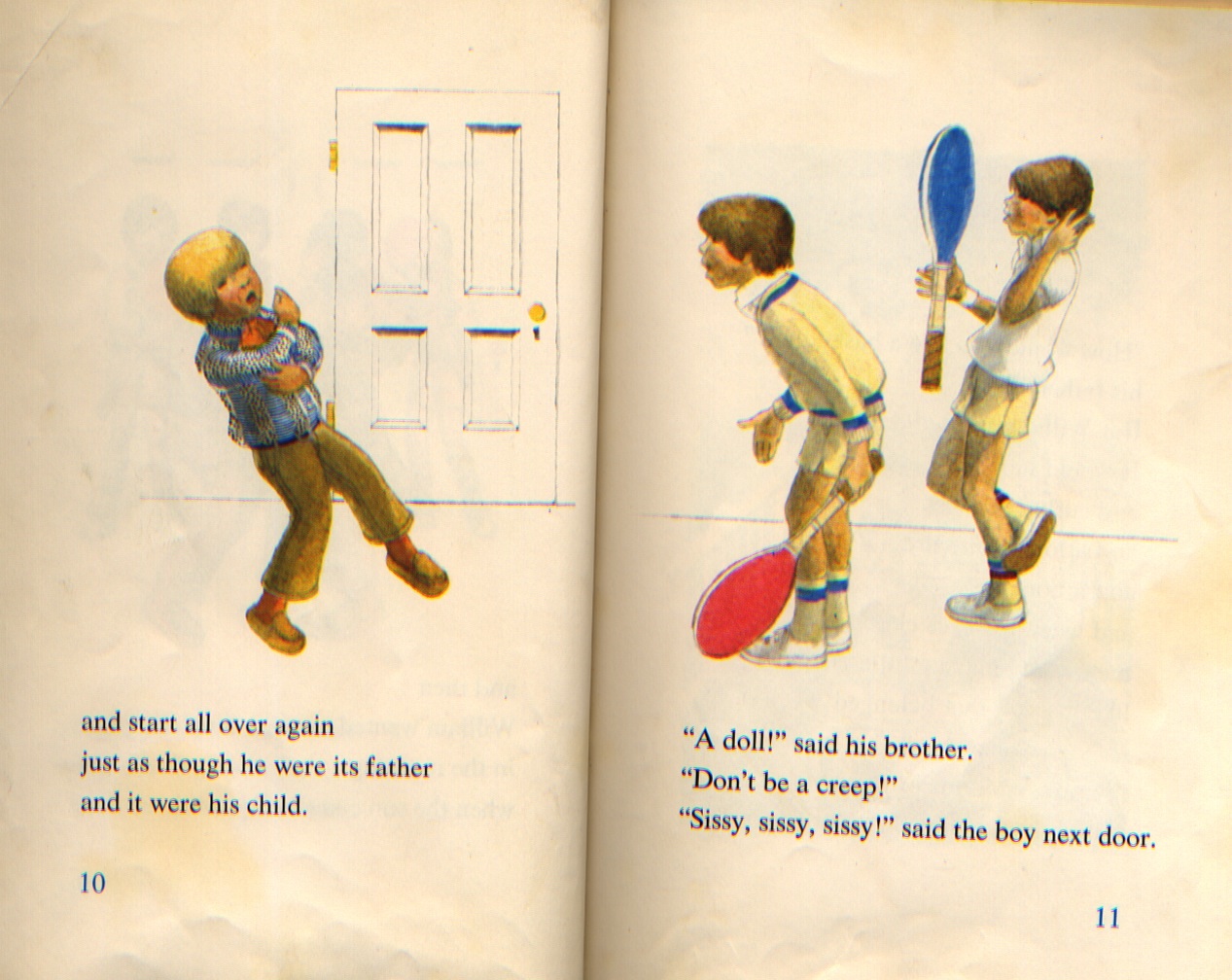
William’s father brought home a basketball instead.

He practiced a lot

and got good at it

but it had nothing to do

with a doll.

William still wanted one.

So his father brought home an electric train. With similar results.

One day his grandmother visited. William proudly showed her the basketball and his new train. He also expressed his desire for a doll, explaining, “My brother says it will make me a creep and the boy next door says I’m a sissy and my father brings me other things instead.”

His grandmother listened attentively.

“Nonsense,” she said.

She bought him a doll. I love the detail in this description, the clicking of the eyes. It reminds me of my mother’s Shirley Temple doll (not that I ever played with it!).

The doll had blue eyes

and when they closed

they made a clicking sound

and William loved it

right away.
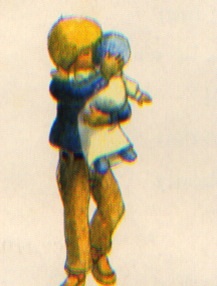
William’s father was upset. “He’s a boy!” he said.

And so the grandmother must patiently explain to her son:

“He needs it,” she said,

“to hug

and to cradle

and to take to the park

so that

when he’s a father

like you,

he’ll know how to

take care of his baby

and feed him

and love him

and bring him

the things he wants,

like a doll

so that he can

practice being

a father.”

I highly doubt you’ll find this book on a list of “books for boys.” It’s probably too sissyish. No, instead we’ll give them books about trains and basketball.

ENDNOTE: A song based on the story, with lyrics by Mary Rodgers and music by Sheldon Harnick, was included in the bestselling album, “Free to Be . . . You and Me.” In 1974, it was turned into a television special. According to producer Marlo Thomas, ABC fought to have the song dropped from the show. She recalled: “They wanted William’s Doll cut, because it would turn every boy into a homosexual.”

True to her ideals, and (importantly) armed with enough marketable power to win this battle, Ms. Thomas refused to comply, and the song remained. Somehow civilization was not destroyed — by this show, at least.

Click here for more on the sources of Charlotte Zolotow’s inspiration for this story, which was based on personal experience as a mother and wife. Commented Zolotow: “I wrote it out of direct emotional sorrow.”

Entenmann’s & Dad: Part 1, from memory to realistic fiction

Though sudden, it didn’t feel traumatic when my father died a few years back. He was in his 80’s and, well, it seemed about right. He went the way he wanted to go, puttering around in the yard. Then gone. I had the honor of giving the eulogy.

I find that I miss him more than I expected. Or, no, that’s not quite it. I find that I miss him more, now, and that’s not what I expected. I figured that the pain, or loss, would lesson over time. I’d get used to it. Dad’s gone. Okay.

And it is okay — but I keep thinking about him, remembering things, expressions he used, his odd habits. The memories have gotten sharper, more frequent. I do what I can to keep them coming. And I cling to them.

Growing up, my mother did not drive. Unusual, yes, but I simply saw her as a rare lady who did not drive a car. The roads were safer, I was sure. So my father always did the grocery shopping. And he did it with flair; he had a sweet tooth and made poor nutritional choices, week after week, year after year. Soda, peanut butter cups, sugary cereals!

Because of that, I can’t wheel past a supermarket display of Entenmann’s breakfast cakes without thinking of him. Dad was a sucker for Entenmann’s. I guess I inherited my father’s sweet tooth.

I submit to you: the raspberry danish . . .

. . . as constructed by the friendly folks at Entenmann’s.

These days, my wife Lisa is all about local produce, organic this, free range that, healthy choices, blah blah blah. I get it. She’s smart, she’s good to us, she’s doing the right thing.

Infrequently, I do the shopping. The way these things work, of course, is that I’ve become my father. I’m dad pushing the cart. I eye that Entenmann’s display and ask myself, WWDD? What Would Dad Do? So I toss that raspberry danish into the cart and roll on, pleased, full of good cheer. It drives Lisa a little crazy, how I undermine her best efforts. The kids don’t seem to mind. Mostly, it’s just a dance we do. When dad goes shopping, everybody knows he’s going to come home with a couple of things mom would never buy. It’s not really about Lisa, or me, or even the kids. It’s about my father, and keeping some things — even the silly stuff that seems to have no meaning at all — alive in our hearts and our kitchens and even our books.

And honestly, the danish is delicious.

CLICK HERE FOR PART 2, WHEN I SHARE HOW I USED THESE MEMORIES IN JIGSAW JONES #28: THE CASE OF THE FOOD FIGHT.

51 Great Bob Dylan Covers: A Chronological Guide

I’m a sucker for cover tunes. I’m always curious to hear a fresh new take on a song, almost any song. It’s like a conversation between two artists, a nod, a wink, a genuflection. Sometimes it’s pure fun; other times, disastrous and ill-advised. Since Bob Dylan is my favorite songwriter, I’ve made a small hobby out of listening to cover versions of his songs. Below are some of my favorites.

Note: I’m taking this chronologically, according to the dates in which the original songs were written (not the dates of the cover versions). In some instances I might be wrong, since the origin of some tunes is open to debate. Also, I’m not saying these are the only great versions of Dylan songs; I decided not to make myself too crazy over this, or to make this list go on forever.

One last thing before I lose you to the scroll: If you are interested in Dylan covers, you need to check out this extraordinary data base of songs featured at Dylancover.com.

Tomorrow Is a Long Time, Elvis Presley Honorable mention: Nick Drake, Nickel Creek.

You need to a flashplayer enabled browser to view this YouTube video

Blowin’ in the Wind,” Stevie Wonder

Girl from the North Country,” The Lions Honorable Mention: Roseanne Cash, The Eels.

A Hard Rain’s A-Gonna Fall,” Mavis Staples (from Bonus Disk, “No Direction Home” DVD)

The Times They Are A-Changing,” Keb Mo  Honorable Mention: Mason Jennings

When the Ship Comes In,” Arlo Guthrie Honorable Mention: Marcus Carl Franklin.

You need to a flashplayer enabled browser to view this YouTube video

Percy’s Song,” Fairport Convention

“Spanish Harlem Incident,” James Mercer (The Shins)

“To Ramona,” The Flying Burrito Brothers

It Ain’t Me Babe,” White Antelope (The Fleet Foxes) Honorable Mention: The Turtles.

You need to a flashplayer enabled browser to view this YouTube video

It’s All Over Now, Baby Blue,” Dave’s True Story

Can’t Leave Her Behind,” Stephen Malkmus & Lee Ranaldo

Like a Rolling Stone,” Drive-By Truckers Honorable Mention: The Creation.

Just Like Tom Thumb’s Blues,Nina Simone

You need to a flashplayer enabled browser to view this YouTube video

Positively Fourth Street,” Bryan Ferry

You need to a flashplayer enabled browser to view this YouTube video

Pledging My Time, Luther Johnson

Stuck Inside of Mobile with the Memphis Blues Again,” Cat Power

You need to a flashplayer enabled browser to view this YouTube video

Absolutely Sweet Marie,” Flamin’ Groovies

I’ll Keep It with Mine,” Marianne Faithful

As I Went Out One Morning,” Mira Billote

All Along the Watchtower,” Jimi Hendrix

Wicked Messenger,” The Black Keys Honorable Mention: The Faces.

I’ll Be Your Baby Tonight,” Norah Jones

To Be Alone with You,” Maria Muldaur

Lay Lady Lay,” Magnet & Gemma Hayes

Tonight I’ll Be Staying Here with You,Ann Peebles

If Not for You,” George Harrison

You need to a flashplayer enabled browser to view this YouTube video

Sign on the Window, Jennifer Warnes

When I Paint My Masterpiece,” The Band Honorable Mention: Emmylou Harris

You need to a flashplayer enabled browser to view this YouTube video

Goin’ to Acapulco,” Jim James

“You Ain’t Goin’ Nowhere,” The Byrds

You need to a flashplayer enabled browser to view this YouTube video

I”m Not There,” Sonic Youth

Billy,” Los Lobos Honorable Mention: Gillian Welch

Knockin’ on Heaven’s Door,” Antony and the Johnsons

You need to a flashplayer enabled browser to view this YouTube video

On a Night Like This,” Buckwheat Zydeco Honorable Mention: Los Lobos

Forever Young (A Capella), Audra Mae & Forest Rangers Honorable Mention: Pretenders

You Angel You,” New Riders of the Purple Sage

Tangled Up in Blue,” Jerry Garcia Band Honorable Mention: Vitamin String Band

A Simple Twist of Fate,” Mary Lee’s Corvette

You’re a Big Girl Now,Lloyd Cole Honorable Mention: The Go-Betweens

You’re Gonna Make Me Lonesome When You Go,” Madeleine Peyroux

You need to a flashplayer enabled browser to view this YouTube video

Buckets of Rain,” Neko Case

O Sister,” Andrew Bird

You need to a flashplayer enabled browser to view this YouTube video

Changing of the Guards,” Patti Smith

You need to a flashplayer enabled browser to view this YouTube video

Senor (Tales of Yankee Power),Willie Nelson with Calexico

“New Pony,” The Dead Weather

I Believe In You,” Sinead O’Connor Honorable Mention: Cat Power

You need to a flashplayer enabled browser to view this YouTube video

Pressing On,” John Doe

Every Grain of Sand,Emmylou Harris

Dark Eyes,” Iron & Wine with Calexico

Everything Is Broken, R. L. Burnside

Make You Feel My Love,Adele

You need to a flashplayer enabled browser to view this YouTube video

Dear Teacher: An Author’s Take on School Visits

I have been enjoying school visits for the past 15 years. I’ve played a role in great successes and I’ve had visits that have felt flat and, for me at least, unrealized.

Same guy. What was the difference?

Which is another way of asking, “What makes a successful author visit?”

Here’s a clue: I don’t think it’s the author. I’ve given talks when teachers have walked into the room enthusiastic and eager — curious to meet me, to hear my talk — and I’ve seen teachers arrive late, who appear put-upon and vaguely annoyed. They flip through papers, check their watches, see it all as an inconvenience rather than something germane to their mission as teachers. Students feed directly off those attitudes; it’s what they are taught. I’ve seen kids enter a room bubbling with excitement. I’ve seen it in their eyes. They were going to meet a real, live author. Someone whose books they’ve talked about and read. Other times, other groups: it’s more like, “Why are we here again?” They may not even be sure.

Here’s what I’ve concluded: A school visit isn’t something that happens to a school. It is something that a school does.

Let me put that another way:

Authors don’t “do” school visits.

Schools “do” author visits.

It’s an important distinction. An author visit is not passive for the school. It’s active. And it requires a lot of work, with a lot of different people pulling on the same oar. Schools make these visits happen — and by “schools” I mean the principal, librarian, teachers, service workers, and PTA/PTO. The author showing up? That’s after most of the real work’s been done.

At least 85% of what transpires for a visit is up the school, not the author. In fact, it’s not that much about “the event” itself, which happens in a flash and is soon over. A small part of a given day. The author comes and goes. Then it’s P.E. and lunch and recess and the math quiz. What endures is what happens in the school before and after the visit.

For an author visit to make sense, it has to be part of some greater context, a school’s emphasis on literacy, it’s fundamental belief in the value of reading and writing. The author is part of something much larger. Or else, seriously, don’t bother. Save the money.

Schools should think of a visiting author as a distant uncle they’ve invited over for Thanksgiving dinner. They’ve been preparing, shopping, cleaning, and cooking long before Uncle Jimmy ever shows up. Sure, he’s funny and nice and will add to the festivities, might even help make it a wonderful afternoon. But without all your work — if there’s no turkey! — then it’s not going to be much of a visit. And guess what? Uncle Jimmy isn’t going to hang around to do dishes. He won’t be eating the leftovers either.

What you get out of an author visit is in direct proportion to what you put into it — just like everything else in life.

There’s a wealth of practical “how to” information out there addressing every aspect of the successful visit. For some easy tips, try starting at these sites:

* How To Have Great Author Visits — from Pamela Curtis Swallow and Deborah Heiligman

* Planning, Fundraising, & Tips — from Scholastic

* Terri’s Tips for Terrific Author/Illustrator Visits — from Theresa Finch, Librarian

* Visiting Authors Dot Com — lots of good stuff here, start digging.

Overheard: Endlessly

It was one of those mornings when I clung to my cup of coffee, newspaper on my lap, and waited for consciousness to take hold.

(Like that kitty above, but not as cute.)

So, naturally, Gavin and Maggie were especially chatty.

Maggie announced: “I’m really, really good at fake laughing.”

For the next fifteen minutes she demonstrated her fake laugh.

“You’re not that good,” I told her.

You need to a flashplayer enabled browser to view this YouTube video

Then it was Gavin’s turn to take a drill to my skull. He delighted in telling me about his exploits playing Madden 10 on the XBox. The level of detail was excruciating. He explained to me the draft, the trades he made, the trades he almost made, the players on the opposing team, his overall record, the score at halftime, his precarious field position with 50 seconds left, play by play by play, endlessly.

I have often felt that all boys contain elements of Asperger’s; they are the collectors, the ones who go on at length about dinosaurs and trains; who can talk and talk without much interaction. They never seem to ask, “Am I boring you?”

I was patient with Gavin, stupified into submission, and nodded and grunted and asked for clarification accordingly. Is there anything more painstakingly tedious than a kid describing his video game adventures? Even if it’s a kid you kind of like? The answer is yes, an adult telling you about his Fantasy Baseball Team. But it’s close; they’re first cousins.

So finally it was time to drive to school. Gavin kept talking — this is the boy stuff in his very good brain, the material overflowing, the things he puzzles over, that excite him, that he thinks about at night: Madden 10.

I don’t think he recounts these stories for his mother; no, he saves up this stuff for Dad. This is our special conversation, and it would be wrong for me to shut down that tap.

As we drove, from the back seat Maggie practiced her fake laugh in its many shades and varieties: a titter here, a booming guffaw there, snickers, whoops, howls and giggles. Sometimes I’d interrupt Gavin, use the rear view mirror to lock eyes with Maggie to say, “That was a good one, Mags. Very authentic.”

But mostly I was counting the seconds till I could pull over and say, “Bye-bye!”

——-

More fake laughter, this time without smiling (because it’s a mixed-up crazy world and you can find ANYTHING on Youtube):

You need to a flashplayer enabled browser to view this YouTube video