Archive for November 12, 2010

Revision Week: Part 4 (A Few Great Quotes)

“In a minute there is time for decisions and revisions which a minute will reverse.” — T.S. Eliot

For the end of “Revision Week,” I thought I’d quickly throw up some quotes that I’ve come across recently, or recently remembered and found again.

“What I had to face, the very bitter lesson that everyone who wants to write has got to learn, was that a thing may in itself be the finest piece of writing one has ever done, and yet have absolutely no place in the manuscript one hopes to publish.” — Thomas Wolfe

“I’m a rewriter. That’s the part I like best…once I have a pile of paper to work with, it’s like having the pieces of a puzzle. I just have to put the pieces together to make a picture.” — Judy Blume.

“If a teacher told me to revise, I thought that meant my writing was a broken-down car that needed to go to the repair shop. I felt insulted. I didn’t realize the teacher was saying, “Make it shine. It’s worth it.” Now I see revision as a beautiful word of hope. It’s a new vision of something. It means you don’t have to be perfect the first time. What a relief!” — Naomi Shihab Nye

Comment: I love this one, and I think it goes directly to the heart of both revision and the spirit of the first draft. I have not read Nye’s work. I’ve learned she’s a poet who has published some picture books and YAs. This one got a starred review from Booklist:

“Sit down, and put down everything that comes into your head and then you’re a writer. But an author is one who can judge his own stuff’s worth, without pity, and destroy most of it.” — Colette

“If it sounds like writing, I rewrite it.”— Elmore Leonard.

“The difference between the right word and the almost right word is the difference between lightning and the lightning bug.” — Mark Twain

Revision Week: Part 3 (“Kill Your Darlings”)

For Revision Week here at jamespreller.com, I’ve found myself going through old manuscripts, seeking salient examples of my revision process. And while there are many, what’s even more pressing to me is that I’m revising a manuscript right now.

So I’ll stick with what’s immediately in front of me as an example.

Perhaps the most enervating aspect of revision is what I’ll call, The “I Stink” Syndrome. (And I’m watching my language here.) Where as writers we look at what we’ve written and realize that it’s not very good. Maybe even awful. And by extension, that we aren’t very good either. Conclusion: I stink.

You can’t write without confidence and this is a treacherous moment. So you have to fight those thoughts, even as you recognize that maybe what you wrote isn’t entirely a success. You have to let yourself off the hook. It stinks . . . but maybe I don’t.

As William Faulker once said of revision, it’s now time to “kill all your darlings.”

I just  overhauled a section of the book in which I repeatedly made a schoolboy mistake, an error that I should never make, not at this stage in my career. Yet there it was, clear as mud: I failed to “Show, Don’t Tell.” These writing lessons have to be learned over, and over, and over again.

As a visiting author, I go into schools and talk about the importance of showing. I’ll speak with large groups of kids and we’ll have lively, uproarious discussions about it. I’ll say, “I just took a train to New York. My editor asked about my trip. I told her it was terrible, absolutely horrible, the worst train trip ever.”

Then I’ll ask if anyone can tell me about my train trip. Of course, they can’t. There’s no detail. Zero visuals. So I propose that we try it again, with their help, by adding details. Think, everybody: What could happen on the worst train ride ever?

Once they catch on, the hands shoot up, the ideas get more hysterical (and sometimes disgusting), and laughter fills the room. The lesson is conveyed. Show, Don’t Tell.

So that’s a lot of what I’m doing this past week. Taking parts where I’ve told something about a character and writing new, brief scenes where we see that character in action. Really, it’s so basic that it’s almost embarrassing to admit.

In the previous manuscript, halfway through the book in Chapter 14, I wrote:

Jude considered himself a different kind of runner entirely. First of all, his father jogged; Jude ran. To Jude’s way of thinking, it was a big difference. His father was one of those old guys who stopped after his run, winded and panting, two fingers on his neck trying to find a pulse while his eyes stared at the watch on his wrist, counting the beats. Goofy, if you asked Jude. A lot of times, Jude headed out in just a pair of shorts. No shirt, no shoes, a barefoot runner in the ‘burbs. Nobody could say nothing, because Jude was faster than them all. He sometimes imagined himself as an old Indian messenger amongst the mesas, running till he found the next tribe somewhere over the rise. It was never about numbers for Jude. Not the distance traveled, nor the time it required. He ran for the love of it, like a colt in the grass.

Okay, I suppose that’s fine, and there’s a few nice phrases in there, some darlings I’ve come to like. Maybe there’s an image or two in there I’ll keep. But in thinking about the book as a whole, I needed to bring out that distinction sooner, allow the father to be present and alive. Show, don’t tell.

So I wrote a new scene and brought it all the way up to Chapter 5. Jude is back from his first day of work at Jones Beach. And we see the father. Note: My editor hasn’t seen a word of this, and it’s very likely to change significantly before I officially hand it in, so it’s possible this revision might not fly either. But here you go, folks, writing in the raw.

Jude stank of hamburger. He could barely stand it, the reek of cooked cow that clung to his clothes the whole bus ride home. He couldn’t wait to shower, rejoin the human race.

He saw his father out by the street in a cling-tight pair of black running shorts, stretching his Achilles tendon with one foot against the curb. Way more of dad’s butt than anybody needed to see.

“Hey, Jude,” his father greeted him. “I was just going out for a run. Want to join me?”

He always asked. Jude and his father hadn’t run together in years, but he always asked. And each time when Jude declined there was a lingering look of disappointment in his father’s eyes, a sag to his shoulders.

Jude pulled at the front of his sweat-stained shirt. Shook his head, “I’m too gross, can’t.”

Mr. Fox nodded as if he understood, and checked his sports watch. It was his new toy, a runner’s watch with all the latest features, heart rate monitor, pace alerts, session distance, GPS capability, the works. Jude’s father loved data, and as far as Jude was concerned, he did everything possible to suck the last ounce of joy out of jogging. Mr. Fox turned something as simple as going for a run into advanced mathematics, a middle-aged man still chasing his PBT (Personal Best Time). Even so, Jude had to admit it: the guy was in great shape.

“Mom inside?” Jude asked.

“Yes, um, she’s upstairs, resting,” Mr. Fox answered. “The heat, and –-“

“No worries,” Jude answered. “I ate at work.”

“Oh, hey, right. You worked today! How’d it go?”

“Pretty much okay. They gave me a paper hat.”

Jude kept the details to the bare minimum. He saw that his father only half-listened anyway. Mr. Fox brought two fingers to the carotid artery in his neck, lips moving slightly as he counted the pulse.

“Have a good run,” Jude said.

“I’m doing Bender Hill today. Five times up, five times down,” Mr. Fox announced. “Should be back in roughly sixty-five minutes.”

Yeah, roughly. Jude was halfway up the walk and gave no reply.

Fan Mail Wednesday #97

Let’s take a quick break from Revision Week to answer the mail.

But first, don’t you just love high-speed photography of water balloons? Doesn’t everybody?

To see more photos, and to read about how photographer Edward Horsford does it — alone, in his garden, at night — click here.

Now to the mail!

Dear Mr. Preller,
My students, Bianca and Thomas, really like your Jigsaw Jones books.  We decided to research you on the internet and found your blog.  We read several things you wrote, but the thing we found most interesting was the possibility of getting a signed bookplate so that we could put them inside our Jigsaw Jones books.
We know we need to send you a self addressed, stamped envelope; however, we cannot find your address on your blog.  Would you be able to e-mail us your address?  Thank you!
We look forward to hearing from you.
Sincerely,
Ann
I replied with my address:
12 Brookside Drive
Delmar, NY 12054
Then I thought about it a little more, and quickly wrote back:
Ann,
I must have been in a hurry this morning. Because I realized that I sent you a quick, informal response . . . and totally neglected to say anything to Bianca and Thomas.

I’m sorry about that.

So . . . Bianca, Thomas:

Thanks so much for reading my books, and caring enough to actually want my autograph. I’m afraid it will disappoint you, since penmanship is not my strong suit. I have a sloppy lefty scrawl that’s pretty awful.

Keep on reading books, any books, even mine. Books have brought such happiness to my life — I’ve learned so much, felt so much — that it makes me smile to think of you reading something that I wrote. And who knows, maybe somewhere down the line I’ll read something of yours.

My best,

JP

Revision Week: Part II

Here’s a copy of one paragraph from the edited manuscript for Before You Go (Spring, 2012), my first young adult novel — a book that just so happens to contain many, many paragraphs. I selected this one because it displays a heavier editorial hand than Liz usually employs. There are many pages that she’s left untouched, since her focus tends to be structural, more macro than micro, more about, say, the arc of a character than the stylistic tendencies of the author. But in this paragraph, something is tripping her up.

Now as the writer, it’s for me decide how to deal with those suggested cuts. Right now, at this moment, I don’t have to decide — and haven’t. I appreciate cutting, eliminating, paring down. I get that part of it. But at the same time, you have to be conscious of what you might lose along the way. You have to ask:

* What am I saying?

* What am I trying to say?

* And is it worth saying after all?

That’s the end point, isn’t it. Do we need this? Does it serve the story? So a lot goes into the trash. I do agree with Liz, fully, in dumping those last two sentences. I added them somewhere along the line and even as I wrote them I had my doubts. But early on I think it’s better to have too much than too little; it’s easier to ditch it down the line. I especially believe that’s true for humor, jokes. I’ll try to be funny somewhere, throw in a few lines without really knowing if it’s working or not. Later on, it’s pretty easy to take out the humor that falls flat. When you are early in the writing, though, it just not the time to question. You are slopping paint on the canvas, not stepping back to gaze upon it with furrowed brow.

For the other edits, I believe I’ll try to address the idea without necessarily sticking with the specific suggestions. There’s a thought in there that perhaps I didn’t convey well, so it might be a matter of taking another shot at it. Or two, or three. We’ll see.

There’s a short piece written by Stephen King floating around cyberspace, titled “Everything You Need to Know About Writing Successfully: In Ten Minutes.”

It’s quick and pithy and contains no fluff. I’ve come to respect King more and more over the years, and as an aside, I recommend his book, On Writing: A Memoir of the Craft. I admire King’s clear, direct, plain spoken, lunchpail approach to WORK. He doesn’t turn the business of writing into Fruit Loops & the mists of Avalon.

In the essay, King enumerates 12 basic guidelines. For number 4, he advises: “Remove every extraneous word.”

You want to get up on a soapbox and preach? Fine. Get one and try your local park. You want to write for money? Get to the point. And if you remove all the excess garbage and discover you can’t find the point, tear up what you wrote and start all over again . . . or try something new.

Of course, he’s absolutely right. But at the same time, it’s easy to say, harder to do. I find that it’s an honest struggle to separate what’s extraneous, and what’s poorly stated, from what’s important. I suspect the paragraph above will give me all sorts of trouble before I’m done. What am I trying to express about Jude’s father? And about Jude’s perception of his father? Is it that he runs, or that he runs to escape from something, or that somehow all that running has never offered him the solace he sought?

What happens if I honor the edits, delete as suggested, but insert something between “it all, yet always.” Such as, top of my head:

He ran to get away from it all, yet despite all the hours spent and miles logged, he always returned to the same place; the road never rose to lift him to some new, shimmering elsewhere.

Oh dear Lord. You can lose half a day this way. Which is why they say that novels are never finished, they are abandoned.

And finally . . .

Here’s a quick recap of King’s 12 guidelines:

1. Be talented

2. Be neat

3. Be self-critical

4. Remove every extraneous word

5. Never look at a reference book while doing a first draft

6. Know the markets

7. Write to entertain

8. Ask yourself frequently, “Am I having fun?”

9. How to evaluate criticism

10. Observe all rules for proper submission

11. An agent? Forget it. For now

12. If it’s bad, kill it

It’s Revision Week at Jamespreller.com!

This week we’re all about the revision process here at Jamespreller.com. I’d say that we’re celebrating revision . . . but let’s not get carried away. It’s not really a party.

I’ve found that one of the keys to revision involves a mental trick: I try to never allow myself to think I’m done. So I reserve some energy, some well of enthusiasm, for every writing project, no matter how close we get to publication. Because once I let down my guard to relax, that makes revision almost impossible and truly heart-breaking.

Last week I needed room to spread out, so took over the kitchen table upstairs. Even though the book, Before You Go, feels thisclose to finished — this stage marks the third time through the entire “finished” manuscript (not including dozens of edits I’ve made along the way) — I still needed to take one last macro look at the entire thing.

Often revision is confused with little tweaks and fussy details, but at it’s core revision is exactly that:

Re + Vision. To see again. It’s like a painter stepping back from the canvas.

On the table, on the lower left there’s a marked-up manuscript that was returned by my editor, Liz Szabla. I love Liz, and I’m grateful every day that she’s in my life. But if there’s ever a moment of strain in our friendship — a silence over the phone, a clipped response — it’s during the revision process. Because I want to hear only how wonderful I am, and that my book is perfect. Liz has a different agenda, and we have to work things out. Really listen, really hear, and in my case, most of all, to trust.

That’s why it’s so vital to still have a reserve of energy in the tank. This is the 18th mile of the marathon, the dreaded wall, and it’s tempting to give up.

I grabbed a stack of index cards and wrote out the basic events of each chapter. This, again, is what I think of as Big Picture Revision or Macro Revision. I’m looking at Chapter 8, for example, and thinking about sliding it up to Chapter 4, actually grafting it on to the first few pages of Chapter 4, while eliminating large pieces of old Chapter 4. This, naturally, will effect the content of chapters 5, 6, 7 and I’ll need to really examine those, too. For example, in the book Jude meets Becka outside on a bench at Jones Beach. This has been their first conversation since the first draft of the book. I probably wrote that scene ten months ago. And while the dialogue has evolved over time, the basic meeting has been unchanged from the beginning. But now at the 11th hour I’ve decided to blow things up, flip it around, to turn their second conversation into their first meeting. It feels more dramatic, and more true (more accidental, less intentional).

I didn’t ask Liz for permission for this — that’s not how she edits — but I did bounce it off her over the phone for a reaction. As always, while Liz will react to concepts, she reserves the right to see how it works on paper.

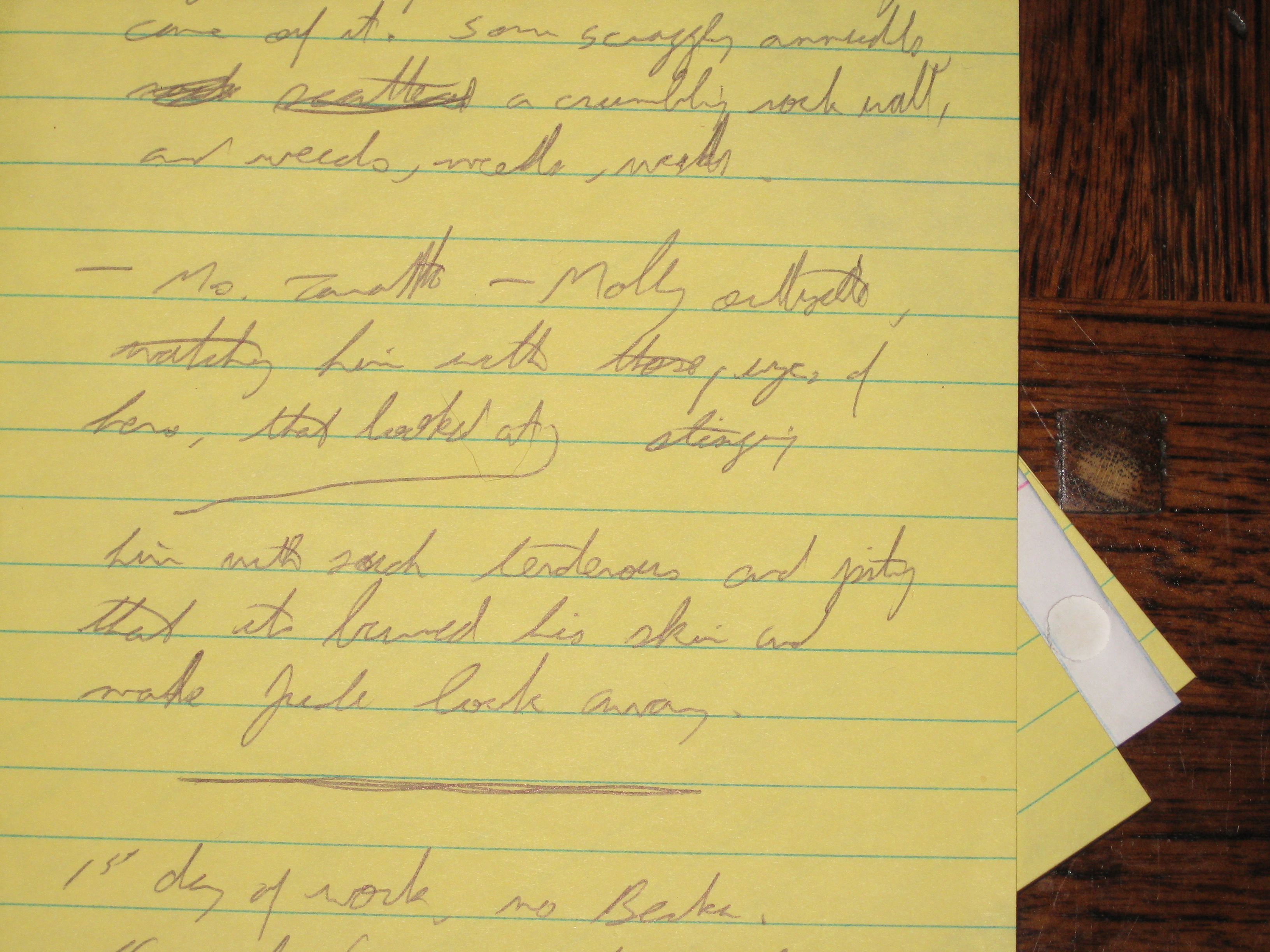
Back to the photo: The yellow lined pages come from various notes I’ve made over the past months, isolated ideas that have come to me, often while I’m in supposed to be asleep in bed. Very sloppy, in a kind of shorthand. Again, revision: These pages represent new ideas, new scenes or paragraphs or moments, that I may insert into the story.

I was thinking about a failed memorial garden in Jude’s backyard. To translate my lefty scrawl:

came of it. Some scraggly annuals,

a crumbling rock wall,

and weeds, weeds, weeds.

The second and third text blocks represent Jude’s awareness of a neighbor’s watchful eyes, and it’s a new layer I’ve added to the story. Extremely minor, but it needs to be there . . . it tells us something important about Jude, I think. It still remains to be seen how it works on the page, in the context of the entire book.

It reads:

— Mrs. Taranto — Molly, outside,

watching him with those eyes of

hers,  that looked at

[edit: the next word is stinging, to be inserted before eyes]

him with such tenderness and pity

that it burned his skin and

made Jude look away.

More, later. As always, thanks so much for stopping by.