I recently did an interview — honestly forget where, but it was with a middle-school reader — who asked the following question about Bystander:
Q. What was the reason you added some questionable or inappropriate words?
I replied:
I don’t understand the question. I think the word “ass” is in the book a couple of times. Was there anything else? Given what’s on television, and in PG movies, and in middle school buses and playgrounds, I’m sure the language in my book is extremely restrained and tame. When someone smashes his thumb with a hammer, the typical reaction is stronger than, “Oh, gee, golly darn,” and as a writer you have to decide whether to be true or false to that moment. Often it’s a matter of degree. In Bystander, again, there are no curse words — and I contend that it’s far tamer than most middle school playgrounds.
I don’t know that my answer is all that great. I find myself unable to give pithy answers to deep questions, since as a thinker I tend to circle and circle back, over and again, nuancing the damn thing to death. I faced this issue far more seriously with my debut YA novel, Before You Go (Spring, 2012), where there were no rules governing what could be included in the book. I was free to color outside the lines, because there were no lines. “Anything goes,” my editor, Liz Szabla, told me. Ultimately, I had to decide what I needed for this particular book, and what I personally wanted to put out into the world. And, yes, certainly: I had to at least consider the gatekeepers, whether certain choices might keep my book out of classrooms and school libraries. This included issues not only of language, but drug use, sex, jokes, interior thoughts, etc. It becomes a balancing act of “how true,” and “how much,” and “why.” I ended up following the basic principle of, a little bit goes a long way. But I respect writers who take it as far as they need to go to get it right, to be true, or real, or relatable.
Tricky stuff involving censorship, self-censorship, and our responsibility (the ethics) of being an adult working in the broad, vast, ever-expanding field of “children’s literature,” whatever that is. I don’t have the answers. But I am learning the questions.
Last week I posted about doing a couple of Skype visits, complete with follow-up comments from a teacher-librarian. Because Skyping is a relatively new (and powerful, and affordable) educational tool, I thought I’d recap my experiences in more detail. To that end, I decided to share a couple of different comments that came out of one post-visit debriefing. As background, Skyping is new to me as an author; this year I’ve been dipping my toe into the water, testing the temperature.
For the visit under discussion, I met with a combined classroom of two 6th-grade classes from the region of my parents’ old stomping grounds, Queens, NY. The students had all read my book, Bystander, and came prepared to ask questions — essential ingredients for a successful visit.
After the event, I received a note from the teacher, Adam, who was most instrumental in making the visit happen. He wrote:
James,
Today was fantastic — hands down one of my career highlights. I am proud of the work that the students have done on this topic and I am so impressed with how today’s Skype conference went. You certainly were able to capture and hold the attention of everyone who was in the Media Center today. Their insightful questions about specific characters along with your humor and honesty made the experience something that I will look back on for a long time to come as a moment in their lives that actually came alive. It was a perfect moment in the school day that makes it all worth everything that we do.
In a separate exchange, I heard from another event organizer, a parent. Liza wrote:
Great presentation today. I was sitting off to the side and could tell the kids really loved it. So much energy in the room! Great topic and technology.
I replied with a confession:
Skyping is a little weird, there’s a strange disconnect to it, so I find it hard to read the audience (whereas I think, live, that’s one of my strengths — I can tell when they are bored, when it’s time to stir them up or settle them down).
Liza responded with this observation:
Regarding Skype, the funny thing is that although you were experiencing “a disconnect,” the opposite was happening in the classroom. With your enlarged face on the whiteboard, it created the illusion that you were speaking/connecting with the audience and the energy level was palpable. I might even go so far as to say that the “gee-whiz factor” related to use of this technology make the experience more exciting to the kids than if you’d actually been in the room. From the audience’s standpoint, Skype/whiteboard is a wonderful and surprisingly intimate experience.
The origin of Skype, from The Wizard of Oz. Who knew?
Conclusion: Well, I think Liza said it, and I can only trust her opinion — a Skype visit can be an exciting, oddly intimate experience. As an author, and a 50-year-old guy dealing with (scary) new technology, it takes some getting used to. I appreciate the magic of it, the pure thrill of seeing those faces — from Kentucky or Queens, California or Maine — and answering their questions directly. Admittedly, I still feel a little removed, still feel like I’m alone in my office, voice echoing, the cats looking at me weird, but amazingly that doesn’t seem to be what happens on the other end.
I think it works well for an interactive, book-specific, Q & A session not more than 30 minutes in length. I know that it doesn’t replace the impact of a live author visit. That’s as far as I’ll go right now. Feel free to contact me if you are interested in exploring this new technology together. My fee for next year will be what appears as the industry standard, $150.
I’d guess that all writers do it, but I can only speak for myself. During the course of brainstorming for a book, which for me usually involves a composition notebook and random observations, snatches of dialogue, character traits, ideas for scenes, etc., I’ll often write brief notes to myself. These notes that I’m referring to are general guidelines for the book I’m writing — about tone, intention, theme. They serve as signposts, clarifying my intent for that specific book. I’m not talking about notes to address specific scenes in the story, but more global thoughts about the book I’m hoping to write, what I’m trying to achieve.
Below, here’s a few notes taken from a larger notebook that I filled during the research phase for my middle grade novel, Bystander. This might come across as naval gazing, I suppose, but I hope the notes shed light on my writing process and in doing so help readers and writers with their own creative work.
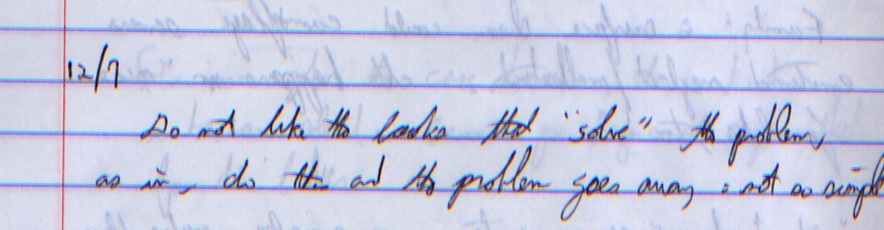
Don’t worry, I’ll translate these into English for those unfamiliar with the dialect of Southpaw Scrawl: “Do not like the books that ‘solve’ the problem, as in, do this and the problem goes away: not so simple.”
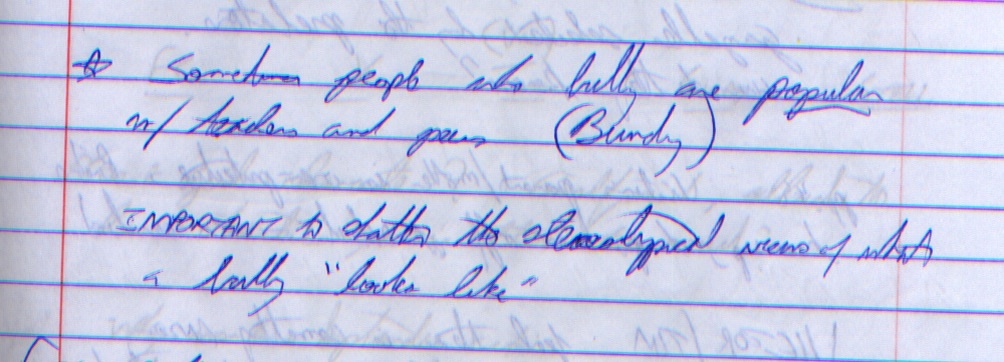
“Sometimes people who bully are popular w/ teachers and peers (Bundy)
Important to shatter the stereotypical views of what a bully ‘looks like.'”
“It becomes important to realize/understand what real friendship means.”
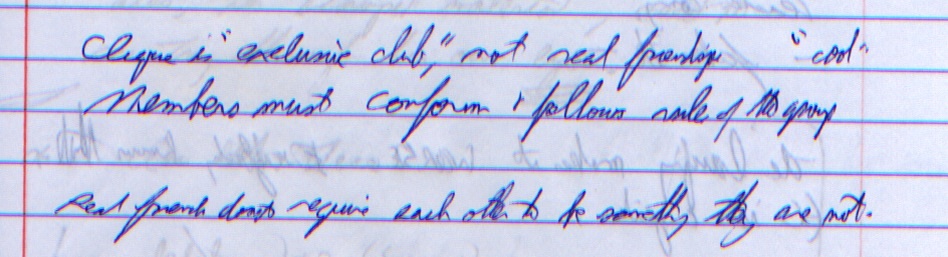
“Clique is ‘exclusive club’ not real friendship. ‘Cool’ members must conform & follow rules of group.
Real friends don’t require each other to be something they are not.”
“Children go to great lengths to hide the fact that they are victims of a bully.”
“Bully/victim is more dangerous, because acts out of anger, revenge.”
This is amazing good news. Great news, in fact. I’m happy and proud to say that my book, Bystander, is included on the ballot for the 2012 New York State Reading Association Charlotte Award.
The voting is broken down into four categories and includes forty books. Bystander is in the “Grades 6-8/Middle School” category. Really, it’s staggering. There are ten books in this category out of literally an infinity of titles published each year. You do the math, people.
For more background stories on Bystander — that cool “insider info” you can only find on the interwebs! — please click here (bully memory) and here (my brother John) and here (Nixon’s dog, Checkers) and here (the tyranny of silence).
Below please find all the books on the ballot — congratulations, authors & illustrators! I’m honored to be in your company.
–
GRADES pre K-2/PRIMARY
Bubble Trouble . . . Margaret Mahy/Polly Dunbar
City Dog, Country Frog . . . Mo Willems/Jon J Muth
Clever Jack Takes the Cake . . . Candace Fleming/G. Brian Karas
I’ve been reading a lot about cyberbullying in preparation for Tuesday night’s panel discussion. Here’s a quick link dump of a sampling of the better articles.
It’s something that we care about not only as president and first lady, but also as parents,” Michelle Obama said. “It’s tough enough being a kid today, and our children deserve the chance to learn and grow without constantly being picked on, made fun of, or worse.”
But according to a new survey released Wednesday, the issue simply isn’t getting enough attention.
The report, released by the National Cyber Security Alliance in collaboration with Microsoft, claims that just 26 percent of K-12 teachers surveyed have taught kids how to handle cyberbullying, versus 15 percent who have spoken to students about hate speech online.
* Cyberbullying and Suicide: A summary from the Cyberbullying Research Center. As summarized by Sameer Hinduja, Ph.D. and Justin W. Patchin, Ph.D.:
One factor that has been linked to suicidal ideation is experience with bullying. That is, youth who are bullied, or who bully others, are at an elevated risk for suicidal thoughts, attempts, and completed suicides. The reality of these links has been strengthened through research showing how experience with peer harassment (most often as a target but also as a perpetrator) contributes to depression, decreased self-worth, hopelessness, and loneliness — all of which are precursors to suicidal thoughts and behavior.
It is unclear exactly how prevalent cyberbullying is. However, some statistics suggest that anywhere from 10 to 40 percent of youth in the United States encounter the phenomenon, although this figure varies depending on age. Since cyberbullying can be done by computers, cell phones and other devices, and since these devices are widely owned, the means to cyberbully are easily accessible.
The Australian study of more than 1000 parents found that 87 per cent of children aged between four and 16 own or have access to a mobile phone and 66 per cent take their mobile phones to school at least some of the time.
Van Vugt said this access to technology needed to be better managed.
“All children have the capacity to behave badly, especially if they don’t understand the impact of their behaviour,” she added.
* Tips to Fight Against Cyberbullies by Kenneth Butler, who consulted with Nancy Willard (Center for Safe and Responsible Internet Use), Parry Aftab, author of A Parent’s Guide to the Internet, and Anne Collier, executive director, NetFamilyNews.org.
For social networking and online etiquette, the popular saying “What goes around comes around” is as valuable as knowing when to use a frowning smiley or a winking one. When chatting, posting messages, or sending e-mails, it’s always a good idea for young web users to be “mindful of their digital footprint,” said Nancy Willard, director of the Center for Safe and Responsible Internet Use. In other words: “Don’t engage in unkind or hurtful actions online because the person you really hurt will be yourself.” That includes being the instigator of online spats as well as retaliating in them. Too much combative behavior could lead to a bad reputation online, and it could damage relationships with peers both in front of and away from the computer screen.
Before I make a post, I pledge to ask myself:
* Who will be able to see what I post?
* Will anyone be embarrassed or hurt by it?
* Am I proud of what I’m posting?
* How I would feel if someone posted it about me?
* What are the warning signs? What can parents do? What can educators do? Here’s a great resource: StopBullying.Gov.
There are many warning signs that could indicate that someone is involved in bullying, either by bullying others or by being bullied. However, these warning signs may indicate other issues or problems, as well. If you are a parent or educator, learn more about talking to someone about bullying.
Over the past few years, I’ve spoken to many educators, parents and kids who’ve had to learn this very difficult lesson: We cannot change the behavior of others. We can only choose how to respond to it, and how we respond to it reveals our character.
* Mahwah Police Chief James Batelli promotes new software which allows parents to monitor their children’s online activity.
“Call it whatever you want,” Batelli said in an interview in his office at police headquarters on Franklin Turnpike on Tuesday, March 1. “If it’s going to save my daughter or someone else’s daughter, then call it whatever you want.”
* More parents are getting involved in their kids’ online activity — by helping them lie about their age. (“Where Age Is What You Say It Is,” from The New York Times, by Matt Richtel and Miguel Helft.)
State senator Linda Chesterfield (D-Little Rock) is now pushing SB214.
“It was the news of so many children committing suicide who had been bullied via the internet so as a former educator it resonated with me that we’ve got to do something,” Chesterfield says.
The one page legislation would establish the crime of “cyber bullying” in Arkansas.
“This is an acknowledgement that in this day and time with technology the way it is, that people are able to use other means and sometimes hide their hands when they throw the rocks,” Chesterfield says.
The bill says someone commits cyber-bullying if they electronically communicate with someone with the purpose of harrassing or intimidating, whether by cell phone or on-line.
Now two Pennsylvania districts — Mt. Lebanon and Penn Hills — are piloting an enhancement to the program that includes a character education component aimed at turning students into good citizens and empathetic colleagues who will be less likely to engage in bullying behavior.
* Lastly, more and more schools are featuring this well-reviewed book for a “One Book, One School” program.