Tag Archive for Meet the Authors and Illustrators

Celebrating 40 Years As a Published Author, Pt. 3: Standing on the Shoulders of Giants

My education in children’s books began, oddly enough, in my adulthood. The youngest of seven children, I have little memory of reading books as a child — some P.D. Eastman, for sure — and no memory of either of my parents reading to me. That’s not a complaint; they had their hands full. In 1985, I was hired as a junior copywriter for Scholastic at a cool $11,500 a year. I was one year out of college, a mere welp. My primary assignment was to write the SeeSaw K-1 Book Club. You remember those, right? The following year, I was asked to help launch Firefly Book Club. And, later, as a freelancer in Albany, NY, I started the Carnival Book Club out of my home at the behest of Barbara Marcus. You could say I got my Master’s Degree in Children’s Literature at 730 Broadway in New York, working for Scholastic.


That’s when, in other words, my head exploded just a little bit. 

I was given a cubicle, a typewriter, a lifetime’s supply of Wite-Out Correction Sheets, and a bottle of Liquid Paper. Less than a year later, that typewriter was swapped out for a Gateway computer that arrived in a distinctive, black-and-white, cow-patterned box. I dumped my Wite-Out for a lifetime’s supply of floppy disks and added “booting up” to my vocabulary.

My education really stepped up when I was asked to co-author a book with Deborah Kovacs, titled Meet the Authors and Illustrators: 60 Creators of Favorite Children’s Books Talk About Their Work. Deborah and split the assignment: I took the picture book authors and illustrators, she handled the middle-grade writers. We talked and supported each other and mostly stayed in our lanes.

Two years later, we wrote a sequel, Volume Two. And sometime after that, Scholastic collected my sections of the first two books, we added another 15 new profiles, and put out The Big Book of Picture-Book Authors & Illustrators. It contained 75 profiles in all.


Not only did I research each creator, but I got the opportunity to interview most of them. At one time, I had a shoebox of cassettes containing hour-long conversations with James Marshall, Barbara Park, Faith Ringgold, Mem Fox, Vera B. Williams, Pat Hutchins, Bill Martin Jr., Barbara Cooney, Peter Spier, Bernard Waber, Jack Prelutsky, Tomie dePaola, Kevin Henkes, Karla Kuskin, Joanna Cole, Donald Crews, Tedd Arnold, Patricia Polacco, Charlotte Zolotow, Shonto Begay, Bruce Degen, Gail Gibbons, and more — real treasures — which I ended up throwing away. Because sometimes I’m just a big dope.

But what an education! Not only the wisdom they imparted about their artistic process, but their demeanor and professionalism, the kindness they showed me. The goodness of their intentions. The quality of their work. It’s a little sad to realize how many of those folks we’ve lost over the years, gone but not forgotten.

“You want to write from the heart, that’s the important thing.” — Bernard Waber.

“The most enjoyable part of creating a book is doing the initial sketches, putting the book together, the thinking part.” — Peter Sis.

“My work has allowed me to dream.” — Jerry Pinkney.

“Don’t worry about what other people are doing. Don’t try to emulate. Work from what is inside you, crying out — however softly, however timidly — for expression.” — Emily Arnold McCully.

“If I don’t have a good character, then I don’t have a book.” — James Marshall.

“Writing is very difficult and gives me a great deal of pleasure, partly because it is so difficult.” — Maurice Sendak.

“I get a lot of personal gratification thinking of those people who don’t get any attention in the world and making them really valuable in my fiction — making them absolutely shine with their beauty.” — Cynthia Rylant.

These books came out at a time when Whole Language instruction was on the rise, when many teachers employed “real books” as a crucial part of the daily curriculum. They hungered for books and eagerly scooped up information about their favorite artists. At that time, many teachers considered it part of their job to be well-versed in children’s literature. These days, for a variety of reasons, I feel that’s no longer the case. Or certainly much less so. Now we have the demands of standardized testing, drastic cuts to librarian positions, and teachers who feel aggrieved, abused, overworked and under-appreciated. They just don’t have the time or the incentive to keep up with the tsunami of books published these days. 

When I started this blog in 2008, I continued to put a spotlight on creators I admired. I still try to do that today, though I don’t think many people read my blog here in the year of two thousand and twenty-six. Whatever. It’s not much different than writing a book. You make the thing and hope folks find it, or not. 

By using the search bar here, you should be able to locate long interviews with the following:

Aaron Becker * James Bird * Elizabeth Bird * Judy Bradbury * Lewis Buzbee * Nancy Castaldo * Carmen Deedy * Lesa Cline-Ransome * Matthew Cordell * Bruce Coville * Cynthia DeFelice * Liza Donnelly * Matt Faulkner * Ralph Fletcher * Alex Giardino * Mary GrandPre * Charise Harper * Susan Hood * Travis Jonker * Alan Katz * Deborah Kovacs * London Ladd * Jeff Mack * Vikram Madan * Daniel Mahoney * Matthew McElligott * Wendell Minor * Florence Minor * Susan Verde * Hazel Mitchell * Jeff Newman * Jessica Olien * Matt Phelan * Deb Pilluti * Lizzy Rockwell * Kurtis Scaletta * Chris Sheban * Jordan Sonnenblick * Hudson Talbott * Liza Gardner Walsh * Audrey Glassman Vernick.

In addition, I’ve featured contributions from the following writers and illustrators:

Tony Abbott * Paul Acampora * Heather Alexander * R.W. Alley * Jennifer Arena * Nora Raleigh Baskin * S.A. Bodeen * Nick Bruel * Laurie Calkhoven * Jay Cooper * Barbara Dee * Erin Dionne * Julie Fortenberry * Donna Gephart * Nikki Grimes * Keely Hutton * Laurie Keller * David Kelly * Jo Knowles * Mikki Knudson * Kevin Lewis * Lois Lowry * Elaine Magliano * Greg Neri * Jerdine Nolen * Barbara O’Connor * Aimee-Joan Paquette * Parker Peevyhouse * Yvonne Printz * Aimee Reid * Jen Sattler * Liz Garton Scanlon * Steve Sheinkin * Alan Silberberg * Charles Smith * Tonya Lee Stone * Todd Strasser * Don Tate * Matt Tavares * Chris Tebbetts * Rachel Vail * Eric Velasquez * Charles Waters * Eugene Yelchin * Suzanne Bloom * Joe Bruchac * Mem Fox * Patricia Reilly Giff * Cheryl Harness * Karen Hesse * Simon James * Eric Luper * Ellen Miles * Linda Sue Park * Karen Roosa * Jerry & Eileen Spinelli * Kyra Teis * Raul the Third * Nina Crews * Hannah Barnaby * Robin Pulver * Elizabeth Zunon.

I’m sure I’ve missed a couple dozen names along the way. Gratefully, I’ve learned something from each and every one of them. That’s the essential thing: the education never ends. There’s so much great work out there. So many good books. It’s an honor to be in this fine company, to stand on their shoulders, and perhaps to see just a little farther than I would have without them.

And if I haven’t said it yet, thank you, thank you all. 

James Preller Interviews . . . Deborah Kovacs, Part One

Back during the Archaean eon, the earth received a heavy bombardment of meteorites.

That’s about when Deborah Kovacs and I first met to discuss co-authoring a book for Scholastic Professional Books, eventually titled: Meet the Authors and Illustrators.

Wait, no, it wasn’t that long ago. Existence back then was not possible for current life forms due to the lack of oxygen, the absence of an ozone layer, and shortages of good, strong coffee. So let’s place this publishing event in 1991. A couple of years later, Deborah and I followed up with Meet the Authors and Illustrators: Volume Two. After that, we became more like Kiss during the solo album stage.

My sections from the previous two books, which concentrated on picture book authors and illustrators, was revised, updated, and recollected along with 15 new profiles for The Big Book of Picture-Book Authors & Illustrators (2001). Deborah went solo and wrote Meet the Authors, concentrating on writers of upper elementary and middle school books (there’s a bunch of sample pages here).

You can find the above titles where used books are sold. And you’d be fortunate, because those books are small treasures, filled with insights from the best artists and writers in children’s literature. For Deborah and I, working on those books was both an inspiration and a perspiration. It’s been a long time since Deborah and I chatted. But watch out, folks, here she comes strolling up my front walk! And guess what? These days she prefers to be called DJ (she’s like Sean Combs Puff Daddy P. Diddy that way — keeping it real).

Deborah Kovacs, er, I mean, DJ! So great to see you again. You know, we did a couple of books together, our roles neatly divided, and now I feel forever linked to you. It’s sort of like we went to the 8th grade dance together only to stand at opposite ends of the same gymnasium.

I was the envy of all the girls in my class . . .

Not really us, but should have been.

I think of those interviews all the time. I took the picture book folks, while you profiled authors of longer works, including such luminaries as Jean Craighead George, Katherine Paterson, Madeleine L’Engle, Lloyd Alexander, and many more.  Who were some of your favorites?

I think of those interviews all the time too. I did 80 interviews in all — really all the greats of that time (early 1990’s). Along with those you mentioned, I often think of the conversations I had with Joan Aiken, Lynn Reid Banks, Virginia Hamilton, Elizabeth George Speare, really everyone involved. They were all so friendly, accessible, interested in the project, and above all generous. Every one of them a hero(ine) of mine, then and now.

I agree. I only intensely disliked one very famous author. Considering the ratio, that’s pretty good.

My ratio was the same. But I still enjoy that author’s work, and realize that it’s not an author’s responsibility to be personable.

It was such a privilege to talk to those people. I keep remembering snatches of advice, different comments that authors or illustrators made. That must happen for you, too. Can you think of any examples?

I was just thinking this morning about Jerry Spinelli telling me he wrote his first novels during his lunch hour at his job at Rodale, shutting his office door for one hour every day.

I remember Kevin Henkes almost sheepishly explaining that he could never get his young children down for a nap. So he’d drive them around in the car until they dozed off. Then he’d park, pull out a notebook, and write. When there’s a will, there’s a way.

I remember Elaine Konigsburg telling me that “the difference between being a writer and being a person of talent is the discipline it takes to apply the seat of your pants to the seat of your chair and finish.”

Very true. Sooner or later, the butt has to find the chair.

I remember William Armstrong explaining that central to his method of cogitation was the fact that he wrote in pencil and kept his pencil sharpener at the farthest possible place in his house from his workroom, so he would be forced to get up and walk around when he was thinking of an idea.

Oh, I like that. Charlotte Zolotow once gave me a phrase that I think of all the time. She was trying to answer that impossible question, where ideas come from. She talked about how they came to her when she was walking around, doing the dishes or any manual task, and said almost as an aside: “When you’re thinking that you’re not thinking.”

Even though I’m not an illustrator, I sometimes brainstorm by drawing pictures. There’s also a huge rock out in the field next to my house that has helped spark more than one good idea (you sit on it and do nothing at all, and usually, “something” comes).

Man, I’ve got to get one of those idea rocks. The truth is, I’ve never been good at sitting and thinking. It always seems to flow better when I’m involved in something physical — when I’m doing other stuff. You know what’s funny? I often think of a reference that author Phoebe Gilman said on this topic. She compared it to that classic Sesame Street skit, featuring Don Music. He bangs his head on the piano in despair, “Oh, I’ll never get it right!”

You need to a flashplayer enabled browser to view this YouTube video

This could start a whole other flood of conversation, but did you know that I started my career at Sesame Street, in the days when Don Music (and his gang) were in full force?

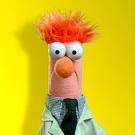
Was that you? I thought it was Beaker.

Beaker was on the Muppet Show, silly. Though he had some close relations on Sesame Street, specifically the Martians and the Two-Headed Monster. I was lucky enough to work at Sesame Street in the early days when all the original Muppet folks were around. Jim Henson has been a lifelong inspiration to me — really to everyone who ever worked with him, I bet.

That must have been a fantastic experience for you. I once worked at a Beefsteak Charlies, so I can relate. I mean, all the beer, wine, and sangria you can drink — that’s a certain kind of genius and the kids loved it, too. Anyway, I’ve always wondered, was Oscar really such a grouch? Any truth to the rumor that Don Music was forced to retire due to post-concussion syndrome? And is it also true that Bert and Ernie couldn’t stand each other off-set?

Those are all nasty, scurrilous rumors. I believe the folks who put this show together were (and are) among the world’s greatest creative and positive forces for the good of children. There are a couple of generations of people walking around the planet who had the benefit of this influence at a very early age. Of course, one could argue that with this great early influence, the world should be in better shape than it is.

Hey, I blame this whole Twilight thing on The Count. The resemblance is uncanny. Same nose, same eyes.

Anything else from those wonderful interviews you’d like to share?

I remember Madeleine L’Engle’s impressive presence, her height, resonant voice and sympathy. I remember Virginia Hamilton talking about how tortuously difficult it was to start writing a new book after M.C. Higgins the Great won the Newbery. Most of all, I will never forget Katherine Paterson describing her anguish at knowing she had to write the scene in Bridge to Terabithia when Leslie was going to die. She put off writing the scene as long as she could, and it broke her heart to have to finally put it in writing, because the story was based on an event in her son David’s childhood.

Also, it’s such a dramatic moment, pulling on those heartstrings, it had to be handled in exactly the right way. And she nailed it.

Many years later, when working at Walden Media (where I still work today)  I got to know Katherine and David and the rest of their family pretty well as we made the film of “Bridge to Terabithia” (on which David was a screenwriter and producer). My colleagues and I were so proud to support the family’s perspective as the film went through the inevitable grind of screenplay development.

I saw that movie! What a daunting task, to take a truly beloved, revered book and turn it into a film. You really don’t want to screw it up.

You just can’t.

Gosh, I wish some publisher would come along and ask us to write one of those books again. There’s been a whole new crop of talented folks.

Word.

——-

Sorry, faithful reader, but this concludes Part One of our interview with Deborah Kovacs. Scroll through to find Part Two when DJ talks about her own writing, bizarre ocean creatures, Charles Dickens, Sarah Palin, ALA Midwinter, her work at Walden Media, Ingrid Law (Savvy), and much more — including a list of some of her favorite books from 2009.

Okay lazybones, if you prefer, click here to leapfrog over to Part Two.