Tag Archive for James Preller

. . . and Friends?

I got a fat package in the mail yesterday, sent by my editor at Feiwel & Friends, Liz Szabla. It contained their Fall 2009 catalog, along with ARCs for eight upcoming novels:

Everything for a Dog by Ann M. Martin

In the Path of Falling Objects by Andrew Smith

Spellbinder by Helen Stringer

The Sweetheart of Prosper County by Jill S. Alexander

Buck Fever by Cynthia Chapman Willis

The Eyeball Collector by F.E. Higgins

Bystander by . . . that would be me (and for the record, I can’t wait to talk about this book, and the topic of bullying in general)

One of Jean Feiwel’s stated missions for her new publishing venture, after something like 20 years at Scholastic, was to Keep It Small. And so far, she’s stuck to that goal, despite the temptations to grow, and Grow, and GROW. But still: Feiwel AND Friends. If you are like me (read: hopelessly cynical), then you probably think, “AND Friends,” yeah, right.

But I do feel a difference. Part of that is based on my association with the merry crew that makes things happen at F & F. It’s a small staff and I think I’ve met them all, even the person who gives Liz and Jean their weekly pedicures, and I’ve even Facebooked a few. (Yes, it’s a verb now.) But there’s also, for me, a sense of community with the other authors and illustrators. We’re all on the same team, so to speak, and like a fan in the stands, suds in hand, I’m rooting for them.

Will I read all these galleys? Nope. I mostly read adult books. But I’m eyeballing that new Andrew Smith book, curious about what he’s done with it. And Julie Halpern is a fresh, original voice — so uncool that somehow she’s totally the coolest one of all. Then there’s Spellbinder, a debut novel, which on the surface seems familiar and yet strange at the same time. Who is Helen Stringer, anyway?

A confession: I’ve never had much interest in cultivating friendships with other authors. I know a few on Facebook and whenever I read their status updates on new galleys or their writer’s block or revision process or whatever — well, it just turns me away. I’m just not interested (as I sit here, blogging, semi-ironically, at this Shrine to Myself). The idea of going on, say, an “artistic retreat” with a bunch of other writers makes my skin crawl. I’m not sure why that is, exactly, but it’s real for me. Maybe I like regular people better. Or maybe I’m too competitive, or too insecure. Maybe it’s like ordering a Bud in a can when there’s some snazzy cherry-flavored micro brew available. I don’t know.

But this crowd at Feiwel and Friends? It’s hard to explain. Just a sense I guess, a feeling that’s kind of sloppy and formless, like a first wet kiss. A little creepy, but kind of nice, too. A little like . . . friendship. With benefits. Like free ARCs!

And by the way: I’m back from vacation. Hear me roar.

My Ten All-Time Favorite Baseball Books

I always like to read a baseball book around this time of year. So I just ordered Ron Darling’s new one, The Complete Game: Reflections on Baseball, Pitching, and Life on the Mound. Here in upstate New York, we’re in the mud stage, where the fields are not quite ready, but hope is in the air. We can feel it coming, outside, playing that game we love.

To make any kind of all-time “Top Ten” list of books is ridiculous, because I keep coming across potentially great books that I haven’t read (yet!). Or read so long ago that my memory is unreliable. Ball Four? It’s been more than 30 years. It was funny, right? But why let that stop the fun? So those caveats aside, here’s a list of ten favorite baseball books, in no particular order.

THE GLORY OF THEIR TIMES: THE STORY OF BASEBALL TOLD BY THE MEN WHO PLAYED IT
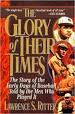
by Lawrence S. Ritter

A no-brainer, my all-time favorite. No other book touches closer to the heart of the game. From an Amazon review: “An oral history of the game in the first two decades of the century, Glory sends out its impressive roster of players to tell their own stories, and what stories they tell–the story of their times as well as of their game; the scorecard includes Rube Marquard, Babe Herman, Stan Coveleski, Smoky Joe Wood, and Wahoo Sam Crawford. A delight from cover to cover, Glory is the next best thing to having been there in the days when the ball may have been dead, but the personalities were anything but.”

A DAY IN THE BLEACHERS

by Arnold Hano

A few years ago, I took a men’s team down to Texas for a hardball tournament for ages 38 and up. I was GM, manager, and player. One of the players gave me this book as a gift. Hano captures one glorious day, September 28, 1954, when he attended the first game of the 1954 World Series. At age 84, Hano recently recalled: “When I subwayed home six hours later in a state of delicious languor, I decided to write about my day. The book I wrote, A Day in the Bleachers, does not deal just with the game. Oh, it does that too — the famous catch by Willie Mays takes up nine pages — but mainly it is about my day. I banter with a Brooklyn Dodger fan nearby (she carried a flag proclaiming her allegiance). I mutter incantations of hope during the not-quite 10 innings of strife. I wince at Cleveland pitcher Bob Feller’s valiant attempt to get himself in shape by doing push-ups in centerfield during batting practice, his backside too high. I marvel as Alvin Dark of the Giants intercepts a ground ball with his bare hand in the eighth inning. And I recall one final picture that day, umpire Larry Napp running down the right field foul line, indicating that a ball struck by New York’s Dusty Rhodes was indeed a game-winning home run. Immediately, all I had seen began to percolate in my brain. I had a book to write.”

THE UNIVERSAL BASEBALL ASSOCIATION, INC.

by Robert Coover

I like this line from a July 7, 1968 review in The New York Times: “Conversely, not to read it because you don’t like baseball is like not reading Balzac because you don’t like boarding houses. Baseball provides as good a frame for dramatic encounter as any. The bat and ball are excuses.” Coover was an experimental writer, an innovator, and this is possibly the most creative, imaginative of all the baseball books I’ve read. In brief, with pen and paper and three dice, a man, Henry Waugh, creates his own world, peopled with vivid characters — in this case, the Universal Baseball Association, Inc. Genius. The book had added appeal to me, personally, because as a boy I filled notebooks with imaginary games I played by rolling dice — very much like Henry Waugh did in the novel.

THE BOYS OF SUMMER

by Roger Kahn

A classic. I read this one as a teenager and it was one of the first books — of any kind — that blew me away. Even moreso, I suppose, because the Dodgers were my mother’s favorite team before they broke her heart and moved to Los Angeles. Kahn, too, rooted for the Brooklyn Dodgers as a child. He later covered them in the 1950s as a beat writer. According to a review in the blog, Curled Up with a Good Book, “In The Boys of Summer, Kahn reflects on the Dodgers and his own boyhood following the team. He visits with the Dodger greats to find out about their life after baseball and their own reflections on the team. What makes this arguably the seminal sports book, the book against which all other books in this genre should be judged, is Kahn’s ability to both paint a lyrical, moving account of his heroes and allow us to share intimate times on and off the field with icons such as Pee Wee Reese, Gil Hodges, and Duke Snyder . . . This is a book that belongs on every sports lover’s bookshelf. It is a literary masterpiece that masquerades as a sports memoir.”

THE GREAT AMERICAN NOVEL

by Phillip Roth

Published in 1973, this satiric book involves another fictional baseball league, the Patriot League, and could be the funniest take on baseball. If you haven’t read it, you must. The set up for the story takes Roth about 40 pages before he gets on firm ground, and then the story rolls and the laughter ripples. From a review in The New York Times: “The ballplayers of Roth’s fable, though they bear the names of deities, are anything but images of perfection. The Mundys consist of 50-year-old veterans who have tottered out of retirement, a French-Canadian refugee from the Japanese League, adolescent boys, an alcoholic ex-con (“the Babe Ruth of the Big House” when he played for Sing Sing), a peg-legged catcher, a one-armed outfielder, a midget relief pitcher and so on. Named for their founder, the legendary Glorious Mundy, they are the sacrifices implicit in his credo (“baseball is this country’s religion”), and their season of shame, relieved only by an 11-game winning streak powered by a secret diet of synthetic Wheaties concocted by a teen-age genius, culminated in a 31-0 loss to the pennant- winning Tri-City Tycoons on the final day of the season.”

THE SOUL OF BASEBALL: A ROAD TRIP THROUGH BUCK O’NEIL’S AMERICA

by Joe Posnanski

Buck O’Neil, a former star from the Negro Leagues, teams up with the great Joe Posnanski — one of my favorite bloggers and sports writers working today — and together they tour the country for various public relations events and ballgames. While Posnanski documents the journey, recounting Buck’s baseball memories along the way, it is the spirit of Buck O’Neil that shines through: his hopefulness, his zest for life, his grace, his humility, his soul. I found this book poignant and uplifting. A joy. For a nice interview with Joe Posnanski, click here. Said Leigh Montville: “This book is flat-out terrific. If Gandhi had played baseball, he would have been Buck O’Neill.”

SHOELESS JOE

by W.P. Kinsella

I haven’t read this book in a long time, my memory of it is vague, and it may not be a fashionable pick due to the Hollywoodization of the film adaptation. But I remember being struck by Kinsella’s magic realism, his richly imaginative take on the baseball novel — Kinsella, for me, took the typical baseball story and brought it to a whole new place; and in doing so, opened up my own thinking about baseball and books and the realm of what was possible. Of course, even non-readers know the movie, The Field of Dreams, the at-times smarmy film starring Kevin Costner. At his best, Kinsella is lyrical and deep, writing not only about baseball but also love and memory, fathers and sons, dreams and truth. Many writers tend to go a overboard when talking about baseball  — the prose too purple, too much religion in it — and Kinsella shares those faults. But there are other times when he absolutely nails it. An important book for me, since it came out in 1982, right around the time in my life when I first dreamed of becoming a writer.

MONEYBALL

by Michael Lewis

Absolutely the right book at the right time. Lewis is a great nonfiction writer. His research (thanks to incredible access to Oakland A’s GM, Billy Beane) is thorough, he organizes his information beautifully, and much like Malcolm Gladwell, Lewis has a knack for conveying complicated ideas in a clear, accessible, entertaining manner. That is, he’s a hell of a writer — but not in a way that you’d necessarily notice at first, since it’s not so much about style as it is about substance. Here’s what Tom Wolfe had to say: “What does it take to turn a subject like baseball statistics into a true-life thriller not even a baseball-loathing bibliophobe could put down? Answer: saturation reporting, conceptual thinking of a high order, a rich sense of humor, and talent to burn. In short, Michael Lewis. Moneyball is his grandest tour de force yet.” Word is that they are going to make a movie based on Moneyball, starring Brad Pitt. Really. Fun fact: Lewis is married to Tabitha Soren, former MTV reporter.

JOHN McGRAW

by Charles Alexander

McGraw is one of the game’s great originals, a mercurial character whose career spanned the early decades of baseball, as it grew from its rough-neck, pugnatious roots into the national pasttime. Here’s a review from Amazon, written by Jeff Silverman: “Alexander’s marvelous biography of McGraw does what McGraw’s own My Thirty Years in Baseball couldn’t: it lets the volcano that was the man erupt in all its raw glory. A true baseball original, McGraw, as Alexander describes, ‘ate gunpowder every morning and washed it down with raw blood.’ He loved to win, but he hated losing more, and as manager of both the old Baltimore Orioles and New York Giants, he’s the only skipper in the game’s history to win almost 1,000 games more than he lost. McGraw was so outsized, flamboyant, fiery, and, at times, sentimental, that it would be easy to caricature him; Alexander’s remarkable achievement here is that he doesn’t (nor does he succumb to hero worship or bubble bursting). His triumph is letting McGraw stand on his own two spikes; the man — and the legend — have no problem standing up for themselves.”

FIVE SEASONS

Roger Angell

Hands-down, my favorite baseball writer ever, but that claim places Mr. Angell in too small a box. Sentence for sentence, Roger Angell is one of the great American writers of the past 50 years, period. And I’ll punch anyone in the nose who doesn’t think so. I love the shape of his sentences, his language, insight, and humanity. But because his form is most often the essay, Angell really hasn’t written a great (great, great) full-length book. Don’t get me wrong, his collections are wonderful and I own them all. When I was writing Six Innings, it was all I could do to limit the amount that I stole from Angell, the master. I’ve written one fan letter in my life — and it went to Roger Angell. Still, I had to pick something from his work, so I went with Five Seasons, probably because it focuses on baseball in the middle 70’s — perhaps the last truly great era of the game. From The New York Times Book Review on Five Seasons: “A book for people who miss good writing, who miss clarity, lucidity, style and passion. It’s a book for all seasons.” Since 1956, Angell has worked as an editor for The New Yorker, where most of his eloquent writing has first appeared. His stepfather was E.B. White, not a bad writer himself.

—–

AND THE LIFETIME AWARD GOES TO . . .

Bill James

I’ve had a love/hate/love relationship with Bill James, but he may be the most influential baseball writer to ever put pencil to scorecard, purely in terms of changing the way we’ve come to know the game. His annual “Abstracts” — which often exposed the foggy thinking behind baseball’s most cherished “conventional wisdoms” — were must-buys for me throughout the 80’s. Over the years, James seemed to grow increasingly bitter and his writing got snarkier, more unpleasant. Despite his growing legion of fans, the baseball establishment appeared to reject and ignore his ideas. A rebel and provocateur, James loved the role of gadfly, of misunderstood outsider, yet at the same time seemed to pine for the game’s warm embrace. After years of writing in the wilderness, James finally gained full acceptance in 2003, when he was invited inside, hired into the progressive, sabermetrically-inclined front office of the Boston Red Sox. Smart club, those Sox. A wonderful baseball blogger named Rich Lederer did an outstanding series of articles called, “Abstracts from the Abstracts,” where he brilliantly details the importance of each book. Fantastic stuff. And for a quick sample of James, here’s a famous extract taken his 1988 Baseball Abstract. The brief piece is now widely known as “The Bill James Primer.”

———

AND FINALLY, A LITTLE BIT ABOUT . . .

SIX INNINGS

One of the early influences for the format for Six Innings was a landmark book, titled Nine Innings: The Anatomy of a Baseball Game by Daniel Okrent — a man largely credited with inventing Fantasy Baseball. The format is essentially one game, a nothing game, June 10, 1982, Brewers vs. Orioles, including everything that happens on the field and, more importantly, inside the head of Mr. Okrent. Some folks consider this to be one of the most significant baseball books ever, in part because of Okrent’s analytical, Jamesian approach. It used to be out of print, and I’m glad to see that it’s made a comeback, hopefully with more success than Oil Can Boyd. Many other baseball books have taken that “one game” structure, including For the Love of the Game by Michael Shaara , The Last Nine Innings by Charles Euchner, and as I mentioned above, A Day in the Bleachers by Arnold Hano. With all those books in mind, and more, I knew that I was very much writing Six Innings within that tradition, and for that tradition, and that knowledge gave me the confidence to proceed.

I was tempted to make a long list of Honorable Mentions . . . but figured maybe you’d like to help. So, come on, which books did I forget to mention?

Check Out My Interview

Over at Feiwel and Friends, they are celebrating the publication of Mighty Casey like it’s 1999. They are even blogging about it. Please click the link because Matthew Cordell just interviewed . . . me! Their blog is pretty great even without us (imagine that!) because other F & F  authors and illustrators contribute often, most recently John Coy and Maria von Lieshout.

Here’s two brief excerpts from that longer piece.

—–

MC: I can assume that many writers, like many illustrators, are particular about how they work and where they work. Where do you like to do your writing? And what are your tools? The pen, the old-timey typewriter, word processor, or personal computer?

JP: Matt! Let me begin by saying — and since this is your first interview, no one would expect you to know this, but — you don’t actually have to sit on my lap during an interview. It’s not like a Santa thing.

MC: Whoops!

—–

MC: What do you see are the major differences in crafting picture books vs. novels? With the novel format, you generally have the space to open up and write more at length. Less confined, I’d imagine, than picture books, where you really have to choose words wisely. Do you prefer writing one over another?

JP: Well, there are two things at play here: picture books are dependent upon illustrations, so the writer is already in a strange position. With novels, you have more control over the finished product. Secondly, novels probably better suit my sensibilities. I find that I can’t force a picture book, which tends to be concept-driven and needs to perfectly distill an experience to its essence. With a novel, you have more opportunity to wander in and out of different rooms, and I think that better reflects how my mind natively operates.

James Preller Interviews . . . Daniel Mahoney

I’m with Daniel Mahoney, a local illustrator who I first heard about from Frank Hodge, the legendary bookseller from Hodge-Podge Books in Albany. I ran into Daniel at a Planet Fitness (in our line of work, aerobic fitness is essential), and later at a book signing. But we’ve never officially hung out.

Quick story: We have a local organization, the Children’s Literature Connection, comprised of area teachers, librarians, authors and illustrators. Every once in a while I receive a postcard inviting me to an “Author’s Tea,” where the group presumably gets together, visits an artist’s studio, drinks tea (I’m guessing!), and, um . . . sings bawdy sea shanties? It’s probably a wonderful afternoon. But historically, I’m not much of a joiner. So I grumble, “Author’s tea? Invite me to an Author’s Beer and maybe I’ll show.” No hard feelings.

I mentioned this to Daniel, and he sympathized. So now we have plans, along with Jeffrey Scherer and Matt McElligott, to begin a new local tradition, sans tea.

Good morning, Daniel. Uh, dude, could you stop working and look at me? What’s on your drawing table right now?

I’m putting the finishing touches on the cover for a book proposal I’m about to send out. It’s titled, Monstergarten.

Great title. What’s it about?

It’s about a monster’s first day of school, and he’s nervous about the whole thing. The last painting I made was an interior illustration that I will be sending out with the dummy. It’s the opening scene of the book where the monster attempts to scare someone in preparation for his big day.

So that’s what it takes to sell a book? You have to send in a manuscript, book dummy, cover, and a sample of interior art?

When I send it to my agent, yes. She is in NYC as we speak (or type), showing it around. That’s pretty much the standard submission these days.

You still work as an X-ray technologist. Does that mean, like, you can tell what I just ate for breakfast?

I actually work only part-time as an X-ray technologist, so I can only see your eggs and toast on a part-time basis.

It still sounds gross. At what point did you decide to make the shift to children’s books? Was there a specific moment?

Well, I had been pondering about how to express myself with my art and earn a living at the same time. After not having any success publishing a comic strip in the newspaper, it hit me one day while shopping for my niece in a bookstore. As I perused the children’s section, I was in awe of all the beautiful books that people were creating for kids. I thought, I could do that, and knew right there and then that’s what I wanted to do.

Were you an artist as a child?

I’ve been drawing since I was three and a half years old, when my mother used to say I was the good one out of the three of us boys. I would sit with my crayons and paper at the coffee table while my brothers were out tormenting cats or whatever.

But you didn’t go to art school?

I did not go to art school. I’ve always loved to draw; and that’s key. I’ve been given a gift, and I’ve merely tried to take that gift as far as I can — and I continue to hone that gift and use it to the best of my ability. You never reach your “best” with art. You can always get better with constant practice and diligence.

I don’t know if you saw that I recently referenced a comment by James Marshall. He basically said that he was glad he never went to art school, because he felt it might take away his originality. Mark Teague is another guy I think of who was “self-taught,” as they say. There are probably many, many others.

Yes, I did see that, and it made me feel better about never going to art school. He makes a good point, and I’ll remember it every time I get stuck on a painting and wish I went to art school.

Your books earned some really nice reviews. The Saturday Escape and The Perfect Clubhouse were listed as Bank Street Best Children’s Books of the Year. A Really Good Snowman was named in a 2006 Kansas State Reading Circle Recommendation. That must have been enormously vindicating.

When my first three books came out, I was very new to the business. To tell you the truth, I never paid a lot of attention to that stuff. Now I appreciate what those acknowledgments mean.

Can we talk about your style a little bit? It’s so distinctive. I’m stumbling for words, because I don’t have the language to describe it. You have almost a folk-art approach, an old-timey sort of flatness to the composition. Am I making any sense at all?

Yes, perfect sense. My style arose from my knowledge (or lack thereof) of how to paint. I basically went to the art store and bought a bunch of watercolors because that’s what I noticed other children’s book illustrators using. I started experimenting with the paints, and gradually my style emerged. No instructor was there to tell me I was doing something right or wrong, so I just let loose with the brush. After much time and a lot of mistakes I developed a style that publishers seem to like.

Well, the style suits your subject matter. There’s a genuine warmth and gentleness to your stories. I saw that you recently attended the Rochester Children’s Book Festival. That sounds pretty cool. I never get invited anywhere.

I actually didn’t get invited. I asked the director if I could attend, and she said sure. I bet you could do the same.

I guess I’m like that shy guy at the roller rink, hoping that some girl with sweaty hands will ask me to skate during “Lady’s Choice.” It’s sad, really. I’m going to have to work up the courage.

It’s the third year I’ve been to the festival, and it just gets bigger and bigger every year. Last year they sold 35,000 books! Usually 35-45 authors and illustrators attend every year, including James Howe, Michelle Knudsen, Vivian Van Velde, and Paul O. Zelinsky, a personal hero whose artwork is sheer genius. I actually ate Indian food right next to him the night before the festival. He and a bunch of other authors and illustrators were staying in my hotel, so we just arranged this nice little outing to get to know each other. You have got to attend, Jimmy. Tell them I said so.

Okay, Lightning Round. Favorite children’s books?

Bedtime for Francis, The Nutshell Library by Maurice Sendak, Awful Ogre’s Awful Day, everything by Dr Suess.

I don’t know Awful Ogre. What’s special about that book?

It’s an awfully good book of poems, written by Jack Prelutsky and illustrated by Paul O. Zelinsky. It’s a book about grossness and yucky stuff in general that my four-year-old and I just eat up. These two masters of good, sick fun have created the funniest, most brilliant book about a day in the life of an awful ogre in all his disgusting glory.

Favorite musicians?

Fleetwood Mac, James Taylor, Eminem, The Cranberries.

That’s some diverse collection. I’d love to see them eat brunch together. You know, James Taylor asking Eminem to please pass the huevos rancheros and in return getting, like, stabbed in the neck with a fork, then the girl from the Cranberries writing a really mournful song about it.

But I digest. Top Movies?

Goodfellas, Raging Bull, Cinderella Man, Boys Don’t Cry, Halloween, Monster, Saving Private Ryan, Gladiator, The Incredibles, Ratatouille.

Dessert?

Chocolate cake — by a long shot.

Okay, Daniel. I can see the guy with the cue cards is waving frantically, so I guess our time is up. Thanks a lot. Good luck with Monstergarten. I’ll see you around.

Yes, we should have tea sometime.


Fan Mail Wednesday #21

Time’s a-wasting, so away we go:

Dear Mr Preller,

I recently read The Case of the Best Pet Ever. The main character of the book is funny and likes finding out mysteries. I noticed that Rags looks a lot like Daisy. Rags sleeps, drools, barks at the door bell and never seems to get things where he means to put them. Is that just like Daisy?

Is Rain just like your daughter? I liked her because she was the owner of the pet store and I love pets. I really liked when the ferret helped the team discover the mystery of how they lost their stuff. I also liked the time when all the pets came together for the contest and it got really nutty. Our family has stuff like that happen. Does your family have that kind of fun also? I also really liked how the little piece of fur lead them to discover the mystery of who was taking their stuff. I think it will help me to try to notice little things each day.

My favorite chapter is Rags to Riches, because at the end it tells us who took all their stuff. At Fins and Feathers it was really neat to imagine how crazy it was. I also thought it was cool that Rain the girl character was so active. I really felt like I knew her and I liked her because she was a girl.

Continued Success,

Reece

I replied:

Hi Reece,

Thanks for your kind and well-written note. You are an observant reader. Like a good detective, you notice small details.

You are right about Rags — he does look like my current dog, Daisy. But it’s only a coincidence.

When I wrote that book, we had a basset hound named Seamus (the book is dedicated to him). Seamus ate socks, stole food off the table, drooled constantly, and smelled bad. And those were his best features! He inspired aspects of Rags. While doing research, I discovered a Doggie IQ Test. You place a towel over the dog’s head and observe its reaction. An alert dog quickly shakes off the towel. A medium dog might wait a few seconds before responding. And a dog like Seamus sits and wonders who turned out the lights. Or in Rags’ case, falls asleep!

Jigsaw gets pretty bummed about Rags — he wasn’t going to win any talent shows — until Jigsaw realizes Rags’ true talent. As Jigsaw notes late in the book:

The big fur ball loved me with all his heart. Every minute of every hour of every day.

And that’s no small trick.

My father patted me on the shoulder. “A wise man once said, ‘Try to be the person your dog thinks you are.'”

He smiled and headed back into the kitchen. “I have an important meeting with a cheesecake,” he explained.

What else? Oh, yeah, you mentioned Rain. I wanted her father to be a “crunchy granola” type, thus his daughter’s name. I liked Jigsaw’s line after his brother, Billy, tells Jigsaw that his new girlfriend’s name is Rain. Jigsaw asks, “Does she have a sister named Partly Cloudy?”

My best,

JP

P.S. This was a difficult book for me, because when I was writing it my oldest son, Nicholas, became sick with leukemia. Though I did my best to keep working, my concentration was not great. And writing is nothing if not concentration. I finally asked my publisher for help and Howie Dewin stepped in as co-author. While this book is mostly me, some parts are not. The whole experience was a blur. So I look at that book and feel like it could have been better. It sort of bothers me. After that I took a break, then came back strong with Jigsaw Jones #23: The Case of the Perfect Prank.

P.S.S. Nick is doing great, by the way!