Tag Archive for Before You Go Preller

The First Look of the Rough-Draft Book Cover, “BEFORE YOU GO”

And so it comes after all that waiting, the book cover. Via jpg these days, that’s how you get the first glimpse of it, clicking on a file attached to an email.

And it comes with caveats, apologies, explanations, assurances. The idea is not to get too literal (and they say this to writers, the most literal of all).

You wrote the book what seems a lifetime ago. Revised it, revised it again, and again, to the point where you’ve moved past it. You’ve gone from loving it to sick of it to almost forgetting what it’s about anyway. Curious, you might even read it again one day.

In the meantime, an art director, Rich Deas, reads the manuscript, searching for ideas, hoping images will come unbidden. It’s an opening-up process, where all possibilities are invited, explored, played with, ridiculed, winnowed down. Meetings are  taken, editors opine, directions are discussed and discarded. The sales folks has their say and everybody listens because, lest you forget, we’re all in the business of selling books. As the author, you’re out of the loop. A million miles away. It’s time for other people to do their jobs, time for their talents to shine.

You cross your fingers and hope.

All preamble: Today I received an electronic file for the cover of my first Young Adult novel, Before You Go, to be published in Spring, 2012. What you see here, please understand, is a rough version. My editor, (the fabulous) Liz Szabla, told me, more or less, ‘It’s too this, it’s too that, and possibly not enough of something else. The type isn’t final — we’re still thinking about the type — none of it is final — but don’t you love it? We all love it. Rich is still tweaking it. He wants to make changes, I’m not sure what. He’s tweaking right now. I can practically hear the tweaking going on across the hall. You know Rich. He sees it all in his head. Tell me what you think. Don’t you love it?”

Here it is, folks. The first glance at the art director’s first draft, the rough cover treatment for my new book.
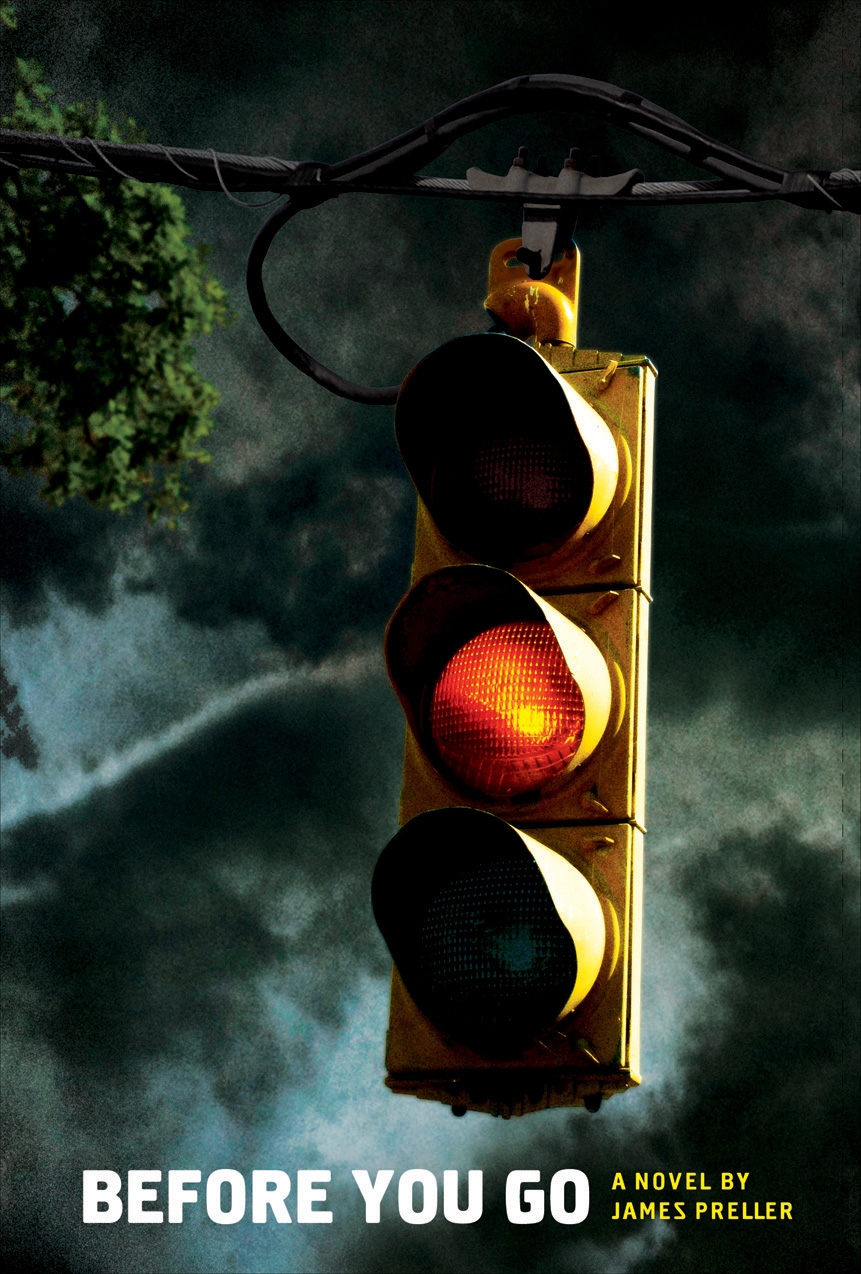
Some days it really is fun to be an author. Yes, Liz, I do love it.

I wonder what the final will look like.
Revision Week: Part II

Here’s a copy of one paragraph from the edited manuscript for Before You Go (Spring, 2012), my first young adult novel — a book that just so happens to contain many, many paragraphs. I selected this one because it displays a heavier editorial hand than Liz usually employs. There are many pages that she’s left untouched, since her focus tends to be structural, more macro than micro, more about, say, the arc of a character than the stylistic tendencies of the author. But in this paragraph, something is tripping her up.

Now as the writer, it’s for me decide how to deal with those suggested cuts. Right now, at this moment, I don’t have to decide — and haven’t. I appreciate cutting, eliminating, paring down. I get that part of it. But at the same time, you have to be conscious of what you might lose along the way. You have to ask:

* What am I saying?

* What am I trying to say?

* And is it worth saying after all?

That’s the end point, isn’t it. Do we need this? Does it serve the story? So a lot goes into the trash. I do agree with Liz, fully, in dumping those last two sentences. I added them somewhere along the line and even as I wrote them I had my doubts. But early on I think it’s better to have too much than too little; it’s easier to ditch it down the line. I especially believe that’s true for humor, jokes. I’ll try to be funny somewhere, throw in a few lines without really knowing if it’s working or not. Later on, it’s pretty easy to take out the humor that falls flat. When you are early in the writing, though, it just not the time to question. You are slopping paint on the canvas, not stepping back to gaze upon it with furrowed brow.

For the other edits, I believe I’ll try to address the idea without necessarily sticking with the specific suggestions. There’s a thought in there that perhaps I didn’t convey well, so it might be a matter of taking another shot at it. Or two, or three. We’ll see.

There’s a short piece written by Stephen King floating around cyberspace, titled “Everything You Need to Know About Writing Successfully: In Ten Minutes.”

It’s quick and pithy and contains no fluff. I’ve come to respect King more and more over the years, and as an aside, I recommend his book, On Writing: A Memoir of the Craft. I admire King’s clear, direct, plain spoken, lunchpail approach to WORK. He doesn’t turn the business of writing into Fruit Loops & the mists of Avalon.

In the essay, King enumerates 12 basic guidelines. For number 4, he advises: “Remove every extraneous word.

You want to get up on a soapbox and preach? Fine. Get one and try your local park. You want to write for money? Get to the point. And if you remove all the excess garbage and discover you can’t find the point, tear up what you wrote and start all over again . . . or try something new.

Of course, he’s absolutely right. But at the same time, it’s easy to say, harder to do. I find that it’s an honest struggle to separate what’s extraneous, and what’s poorly stated, from what’s important. I suspect the paragraph above will give me all sorts of trouble before I’m done. What am I trying to express about Jude’s father? And about Jude’s perception of his father? Is it that he runs, or that he runs to escape from something, or that somehow all that running has never offered him the solace he sought?

What happens if I honor the edits, delete as suggested, but insert something between “it all, yet always.” Such as, top of my head:

He ran to get away from it all, yet despite all the hours spent and miles logged, he always returned to the same place; the road never rose to lift him to some new, shimmering elsewhere.

Oh dear Lord. You can lose half a day this way. Which is why they say that novels are never finished, they are abandoned.

And finally . . .

Here’s a quick recap of King’s 12 guidelines:

1. Be talented

2. Be neat

3. Be self-critical

4. Remove every extraneous word

5. Never look at a reference book while doing a first draft

6. Know the markets

7. Write to entertain

8. Ask yourself frequently, “Am I having fun?”

9. How to evaluate criticism

10. Observe all rules for proper submission

11. An agent? Forget it. For now

12. If it’s bad, kill it

Revising on the Run: A Work In Progress

In our continued mission to pull back the curtain on the creative process — without, hopefully, going overboard on the me, Me, ME business — I submit the following:

Every writer works differently, and often individual writers might use different approaches for each book. There’s really no formula beyond: git ‘er dun.

While I recognize the value of blasting out that first draft — it’s time to turn on the faucet, not tinker with the plumbing — it’s not really how I work on a longer piece of fiction. I will take that approach for a scene, or for as long as the energy carries me (best, handwritten on a notepad). I’ll knowingly write sentences that are pure garbage and not fret in the least. Because it’s about riding that forward push of story while that fickle mistress, Momentum, has my hand.

Here’s a picture of what that’s like. You hang on and know that it will all come crashing down at any minute, so you try to enjoy the ride while it lasts.

But unlike some authors, I constantly circle back, fuss, reread, rest, and tinker — while I try to push the book closer to its conclusion. Maybe that’s not an advisable habit, I can’t say. (Cleaning as you cook, I guess, as opposed to my wife’s glorious mess in the kitchen.) In the best world, I tend to revise and write simultaneously. When it works — Six Innings, Bystander — the typical revision process is quick and painless. Other times, I’m just a mess all the way through and need to be saved by my editor, most recently in the case of Along Came Spider. Thank you, Shannon Penney.

Ultimately, I know this: No reader cares how you got there, the only thing that matters is the printed  page.

—–

I don’t sleep well. Insomnia. The engine revs, the car’s stuck in neutral. So two nights ago I groggily scribbled some words in the dark of night, ideas for improving little scenes that were previously written. Here’s that scrap of paper:

Can you read it? That, folks, is my lefty scrawl. From a prone position, middle of the night, sleepy. Not that wide awake is much better.

Again, this is a YA novel, with characters around age 16. I’ll quickly take you through it.

“Hey you,” that’s promising

NOTE: There’s a conversation between two boys, analyzing a text message from a girl. I had the idea of tagging “Hey you” in front of the message, and adding some conversation (hopefully humorous) about the potential meaning of “Hey you” as opposed to, say, “Hi” or “S’up.” Jude’s friend, Corey, sees “Hey you” as a very promising sign of great import.

Tree — butt-ugly — umbrella

nothing can keep out the rain

NOTE: There’s a large, old, ragged maple next to the main character’s house, keeping it in shade. It’s a minor detail. As I’ve gotten farther into the book, this tree has taken on unexpected metaphorical responsibilities, and I felt I needed to insert another reference to it earlier in the text (it gets chopped down in the end, to let in the light). These quick notes remind me to have Becka, the main girl in the story, comment on the tree’s ugliness; to have Jude, the boy, convey that his mother — worried about sunlight fading the rugs, among other things — thinks of it as an umbrella; and Becka to reply, matter-of-factly, “Nothing can keep out the rain.” Typing that just now, I wonder if I should change “rain” to “weather.” Mostly, I have to be careful with this, keep a light touch, and not turn this into Big Meaningful Tree.

— you have green eyes

NOTE: I simply decided that Becka has green eyes. Actually, last night on a separate scrap of paper at 3:00 AM I wrote this sentence:

And then the word came to him: turquoise.

Finally, there’s this:

— why are you so sad?

— downturn to your mouth, when you are thinking.

NOTE: I haven’t written this scene yet — it’s actually on today’s “to do” list. I want Becka to recognize the unspoken sadness in Jude, that buried darkness he carries around. Of course, it’s part of what attracts her to him, his sensitivity and depth. That she sees it in Jude, a detail that most others miss, indicates they might be right for each other. It also serves as a tool to pry open his secret.