Q: You wrote that you were inspired by Roald Dahl’s Danny the Champion of the World to focus on a father-son dynamic in The Courage Test. How would you describe the relationship between your character Will and his father?
A: Yes, I came late to the Dahl classic and was struck that here was a loving book about a boy’s relationship with his father — not the kind of thing I’ve seen in many middle-grade children’s books. I found it liberating, as if Dahl had given me a written note of permission.
In The Courage Test, William Meriwether Miller is a 12-year-old with recently divorced parents. His father has moved out and moved on. So there’s tension there, and awkwardness; William feels abandoned, and he also feels love, of course, because it’s natural for us to love our fathers.
I wrote about this at more length, here, back a couple of years ago. In the unlikely event you are really fascinated by my connection to the Dahl book . . .
I owe a debt of thanks to Donald Trump. His campaign rhetoric helped inspire parts of my new middle-grade novel, The Courage Test (Macmillan).
No book is written in isolation. There is always a personal and historic context, and it’s only natural for outside influences to leak into any manuscript. For this book, Donald Trump — as the emergent Republican frontrunner for the presidency of the United States — became the inescapable buzz and background to my thoughts.
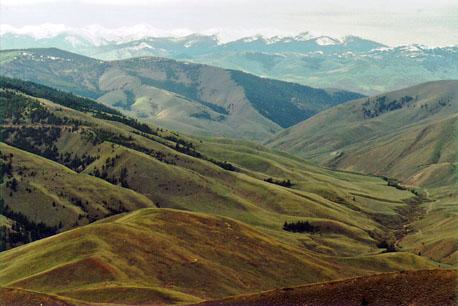
Back in early 2015, I set out to write the story of William Meriwether Miller, a 12-year-old boy who travels with his father along parts of the Lewis & Clark Trail. They drive, hike, backpack, and paddle through some of the most beautiful parts of America. Along their trip, they experience new places, new people, and (we hope!) gain new insights into themselves and each other.
Young Will’s experience parallels that of the original quest of Lewis & Clark and the “Corps of Discovery,” explorers who sought the Northwest Passage, the hoped-for water passageway from the Missouri River to the Pacific Ocean. The more I learned about that expedition, the more fascinated I became. I’d accidentally hit upon a rich pathway into the American soul. The scope of the book shifted under my feet. The Trail was no longer merely convenient metaphor; it became essential fact, a way into the messy heartland. So the book also became an expression of my awe at the exploration made by Lewis & Clark from 1804-06. Theirs was a military journey into uncharted territory — the old maps employed that great phrase, “Parts Unknown,” to label vast areas — the first epic and fateful push west that came to define the American pioneering impulse, for better and for worse. It was a story of discovery and nation-making, of personal bravery and perseverance, of ignorance and arrogance. Most profoundly, their exploration inevitably precipitated the cruel clash of cultures between the American government and the indigenous people who had lived on that land for centuries.
And so I set a father and son wandering along that same path to discover parts unknown. They learn something of themselves, but also this: that we are forever remaking our nation in a thousand different ways. How we respect the land, how we treat each other. Each day, we define ourselves anew. The idea of America is not fixed in time. It is a fluid, ever-changing thing.
Lewis & Clark are guiding spirits that haunt Will’s journey. The other specter that haunted my writing journey, if you will, was Donald Trump. I was hearing his words on a daily basis. And it struck me that what he represented seemed to strike against the spirit of this nation’s core. He boasts about building a great wall, he stokes fear and distrust of immigrants, he promises deportations. On the day of his campaign announcement, June 15, 2015, Trump said:
“When Mexico sends its people, they’re not sending their best. They’re sending people that have lots of problems. They’re bringing drugs. They’re bringing crime. They’re rapists.”
And Trump promised:
“I will build a great wall — and nobody builds walls better than me, believe me —and I’ll build them very inexpensively. I will build a great, great wall on our southern border, and I will make Mexico pay for that wall. Mark my words.”
He hasn’t stopped denigrating people since. Just yesterday calling the Somali immigrants of Minnesota a “disaster” for the state. It is one thing to lead a thoughtful discussion about immigration standards and practices; it is something altogether different, and more hateful and fear-mongering, to broadly disparage a culture and a community of immigrants living in our country. It’s also counter-productive.
In The Courage Test, I weave in details throughout the book that echo and mirror the explorers’ original experiences (an incident with a bear, adventures in the rapids, encounters with the Nez Perce tribe, etc). To cite one example: protagonists in both time periods meet up with a vulnerable, pregnant 15-year-old girl. For Lewis & Clark, her name was Sacagawea. She grew up with the Shoshones and was kidnapped by the Hidatsa tribe at roughly age ten. A few years later she was sold to a fur trapper named Toussaint Charbonneau, who made her his wife. Sacagawea famously joined Lewis & Clark on their journey to the sea. Correspondingly, in the main narrative, Will and his father meet Maria Rosa, also 15 and pregnant. It is strongly intimated that Maria came into the United States illegally from Mexico, a runaway seeking a new life.
Painting by Edgar Samuel Paxson.
To me, it became very important how Will and his father responded to this girl. Because it would not only reveal their character, but it would say something about America, at least a vision of America in which I still believe. In that sense the book became in part my response to Donald Trump. A story about morality, and compassion, and the courage to face the coming challenges with open, generous hearts.
—–
THE COURAGE TEST is a 2016 JUNIOR LIBRARY GUILD SELECTION.
“Preller traverses both domestic drama and adventure story with equally sure footing, delivering the thrills of a whitewater rafting accident and a mama bear encounter, and shifting effortlessly to the revelation of Mom’s illness and the now urgent rapprochement between Dad and Will. Whatever young explorers look for on their literary road trips, they’ll find it here. — The Bulletin of the Center for Children’s Books.
“Preller stirs doses of American history into a first-rate road trip that does traditional double-duty as plot device and coming-of-age metaphor. Will is initially baffled and furious at being abruptly forced to accompany his divorced father, a history professor, on a long journey retracing much of the trail of Lewis and Clark. The trip soon becomes an adventure, though, because as the wonders of the great outdoors work their old magic on Will’s disposition, his father and a Nez Perce friend (who turns out to be a Brooklyn banker) fill him in on the Corps of Discovery’s encounters with nature and native peoples. Also, along with helping a young runaway find a new home, Will survives a meeting with a bear and a spill into dangerous rapids — tests of courage that will help him weather the bad news that awaits him at home.”—Booklist, Starred Review
“A middle grade winner to hand to fans of history, adventure, and family drama..” — School Library Journal.
Let’s start by looking at this clip below. The illustrated video, created by Steve Cutts for Moby’s new song, “Are You Lost in the World Like Me?” is dark and disturbing. You can even watch it with the sound off, since my interest is almost entirely with the story told by the visuals.
Wow, right? A bleak look at cell phone addiction. Or maybe it’s just a slightly exaggerated look at our world?
Contemporary cell phone culture presents unique challenges to any children’s book writer. Not the phones themselves, of course, but the way in which so much of contemporary teen life is spent on those phones. A quick Google search reveals reports that claim young adults will take more than 25,000 selfies during their lifetimes. More than 93 million selfies are taken each day; and so on and so on. You get the picture.
In that regard, cell phones must be considered central to any telling of realistic fiction. It’s where so much of their lives are played out. But, confession: that’s not the version of life I’m personally interested in exploring. Maybe this reveals me for what I am — an old guy who grew up in a time before cell phones and personal computers. Their world is not my world. Maybe it’s beyond me. And yet I’m typing this on a laptop with an Apple phone at my side.
None of this was an issue for Mark Twain or Zora Neale Hurston.
How do writers of children’s literature deal with phones? How do we tell contemporary stories? One way, of course, would be to embrace the phone fully. Make it a central character — that’s where the drama plays out, so dive right in. That’s a legitimate approach, but feels gimmicky. I also suspect that technique would quickly become dated.
In my books, I’ve dealt with phones in a number of ways.
–
Here are a few:
* I recently wrote a new Jigsaw Jones, The Case from Outer Space. The characters are in second grade, so cell phones are not an issue. Nice!
* In my “Scary Tales” series, phones present a different sort of challenge. The phone makes the world less scary. I don’t want a kid who is trapped in a cave to be able to pick up her phone and call 911. And the inverse is especially true — any sense of isolation, of disconnectedness, raises their discomfort. In I Scream, You Scream, the phones are confiscated before a thrill ride (no photos). Other times, the Wi-Fi is mysteriously down (Good Night, Zombie). I’m often trying to get the phone out of the way.
* In The Fall, a book that deals, in part, with teenage cyber-bullying, there’s no way to pretend that phones don’t exist. My characters send and receive texts, and “cell life” is inherent in the story. Interestingly, while the phones enhance our ability to connect electronically, they can also limit our real-time connections. Here’s a moment in the story when Sam recounts his second meeting with Morgan. They are both walking their dogs off-leash behind the middle school. They talk a little bit, thanks to the dogs. And then, this:
I stared at my phone, scrolled.
Morgan pulled her cell out of a coat pocket.
We stood there in awkward proximity, alone on a field, playing games with our phones. Silence drifted over us like clouds.
I pocked the cell.
“Bye,” I said.
I don’t remember if she answered me, but Morgan called to Max, “See ya, boy!”
* For The Courage Test, a father and son go on a long camping trip together. It would have been perfectly valid for them to lose a signal at different points in the story (and they do). But I still had the problem — if you can call it that — of a kid with his phone. Rather than ignore it completely, I wrote a scene where they are driving along in Montana. William is playing a game on his phone, not, to his father’s mind, fully appreciative of the landscape. They argue about the phone. The argument escalates.
He holds out his hand, gesturing for the phone.
Now, this next part is funny.
Hilarious, almost.
And it’s also incredibly, fabulously stupid, because I can be such an idiot sometimes. My father has pushed me into a corner. We are in the middle of nowhere. Wi-Fi is spotty at best. Back home, at Puckett Field, there’s an All-Star practice tonight — a practice that I’m missing, for a team I can’t play on, because my ex-dad wants to haul me across the universe.
My right index finger pressed the button on the armrest. The window slides noiselessly down and I immediately feel it, the wind and whoosh of summer heat.
I turn and can’t resist, so with a flick of my wrist I pitch my phone out the window.
Problem solved.
* In Before You Go, possibly my only true YA, Jude has a phone and uses it. But at the same time, I mostly write around it — to a point that might present a picture that’s somewhat untrue to life as it is currently lived. Again, it’s hard to move a story along if people are constantly staring at Youtube videos and Snapchat. Or maybe you can? But yuck.
* Picture books, where characters can be talking pigs or pogo-sticking hyenas, offer another way for a writer to sidestep phone culture. Just create an alternative world and write for very young children. Though lately I’ve seen a few picture books where kids are dealing with parents who won’t stop looking at their phones.
* Write Historical Fiction. Set stories in a time before cell phones. The same is true for dystopian novels and science fiction. “Electricity’s out, folks, you’re going to have to talk among yourselves!” Maybe that’s why we see so much of it these days?
I share these musings not because I have the answers, but because I think it’s an issue which confronts contemporary writers. Phones are awfully tedious, and people staring at phones — while super realistic: just look around! — is even worse.
What do you think? Can you think of books that dealt with phones in an innovative or effective way? In our efforts to be realistic, do we need to incorporate more phone-drama in our books? Thoughts?
The idea of writing that Civil War story never looked so good.
I am grateful to share another positive review for The Courage Test, this one from the School Library Connection, a link which my glamorous editor Liz kindly passed along yesterday. The review will be featured in their print magazine supplement, as well as on the reVIEWS+ site.
The money quote:
“This book will find many fans.” — School Library Connection.
Let’s hope!
Review excerpts are limited to 50 words or less. Let’s see what I can pull without cheating too much . . .
“Many readers will identify with Will, who is forced to go on a road trip with his noncustodial dad, even though he really has other things that he would rather be doing. To make the trip worse, his Lewis and Clark obsessed history professor father has planned to follow most of Lewis and Clark’s route all the way across the country. The Corps of Discovery almost becomes another character in this coming-of-age story . . . . Recommended.” — School Library Connection.
NOTE: Father and son pick up the L & C Trail at Fort Mandan, ND, and travel west to Seaside, OR. Along the way they meet strangers, paddle a canoe, ride in whitewater rapids, camp, hike the Lolo Trail, encounter bears (metaphoric & literal), and more.
I’m extremely grateful to Jack Rightmyer for this generous review of my new book, The Courage Test, in a recent edition of the Albany Times Union newspaper.
An author sends a book out into the world. After that, there’s very little control over what happens next. Reviews, awards, invitations to speak at schools. Or sometimes, the cluttered, dusty world simply coughs and shrugs with indifference. Out of print, forgotten. Ultimately, I always hope for readers, it’s really all any author can ask. Articles like this one below do so much to help that hope become realized.
Most American authors get around to it eventually, the road novel, where two different characters set out on a journey to discover the country and more importantly to figure out who they are.
“We’re a car culture,” said local young adult and children’s author James Preller. “Americans love to be on the road. It’s awesome. This was my first attempt at writing the quest/journey book, and I loved the structure of it. My two characters were attempting to get to the West Coast. It’s a plot with built-in drama and the myth of the eternal return home.”
This is Preller’s fourth book for children ages 10 and up. Seven years ago he hit it big with “Bystander,” a book about bullying just when the topic was hitting a fever pitch around the country. Two years ago, he wrote “The Fall” about teenage suicide. His latest book, “The Courage Test” (Feiwel and Friends, 224 pages, $16.99), is a father-and-son journey along the Lewis and Clark Trail from Fort Mandan to the Pacific Ocean.
“I really wanted to write a father/son book,” said Preller, who lives in Delmar and is a parent to three teenagers. “I got the idea after reading Roald Dahl‘s book ‘Danny the Champion of the World.’ I loved the relationship of the father and son in that book, so I created two characters and set them out on the Lewis and Clark Trail.”
The story is told from 15-year-old Will’s point of view. He’s not too happy to stop playing on his summer baseball team to take a cross-country trip with his dad, who has recently left his mom and has a new girlfriend. Will’s dad is a professor and an expert on the legendary explorers Lewis and Clark. He thinks it would be good for his son to do something difficult like hike in the backcountry and go whitewater rafting.
“I want readers to like Will, even if he’s a bit of a jerk at times,” said Preller. “There’s a natural tension between a teenager and a parent, and I want the reader to sense that.”
Will and his dad don’t have much in common. “Will’s dad tends to lecture like he’s standing in front of a class, and he doesn’t care at all about baseball. My dad was like that. I learned my love of baseball and how to play the game from my mom. When my dad would throw a baseball to me, he was awkward and uncoordinated, and I’m sure I looked at him in a strange way. My kids look at me that way today when I sometimes butter my bread.”
Preller did an enormous amount of research on Lewis and Clark before writing the book. “I’d love to say I got in a car and traveled the route I wrote about, but no one was paying for me to take that trip,” said Preller. “What I did was read blogs, look at maps and photos of the Lewis and Clark Trail. There are so many resources on hand today. As I wrote the book, I felt like I was on the trip, and as a writer, I was able to use my imagination.”
Some of the plot takes place while the characters are whitewater rafting, and there is even an encounter with a bear. “I’ve gone rafting. I’ve seen bears. I’ve been to Montana, so I’ve experienced the essential feelings of what these characters were going through,” said Preller.
What readers begin to discover as they read this book is that Will’s father is bringing his son on this difficult trip to toughen him up for some hard times ahead. “Will’s dad is a bit of a geek, and he really does believe his son will be a stronger person by following in the footsteps of Lewis and Clark. That might be a bit idealistic,” said Preller, “but the essential experience is spending time alone with his son where they can face this hardship together.”
In researching this book Preller read numerous books about the Lewis and Clark adventure. “At first I thought they were only a metaphor for the plot of my book, but the more I read about them the more I was impressed about these explorers. They were amazing and flawed individuals, and I decided to include a lot of information about them throughout the book.”
He was impressed with how detailed their daily journals were as they explored the unknown territory of the West. “Lewis could hike 20 or 30 miles a day then journal and draw incredible pictures of the plants and animals he had encountered. He read the stars to figure out where they were on a map. There were many locations where they could have turned back, but they kept going right through dangerous Indian territory and up and down the Rocky Mountains.”
Preller has had a successful career as a writer for over 20 years. His Jigsaw Jones series for beginning readers has sold millions of copies, and new editions will soon be available. He has also recently completed a series of Scary Tales that are always popular around Halloween.
“One of the great joys of writing for young people is the opportunity to visit schools throughout the country and meet your readers,” said Preller. “I tell my young readers to write from your heart. Write something that means a lot to you, and read every day.”
——–
A NOTE OF CLARIFICATION: My children are Nick (23), Gavin (17), and Maggie (15). In addition to picture books and series titles for younger readers, these are my other middle-grade titles: Along Came Spider, Six Innings, Bystander, Justin Fisher Declares War, Before You Go (YA), and The Fall (now in paperback).