Tag Archive for Shaq and the Beanstalk

Celebrating 40 Years as a Published Author, Pt. 4: That Time I Was a Ghostwriter for Shaquille O’Neal

This year, my 40th as a published author, I am indulging in a series of reminiscences. Consider it a one-man celebration. Imagine a grown man, alone in a room, with one of those rollout party favors and a few deflated balloons, guzzling a gallon of root beer. It’s a party! These are the halcyon memories of a working writer, trying to pay the bills, seeking to survive and, hopefully, one day, thrive.
I was working in my 2nd floor office at 193 Hamilton Street in Albany, NY, when the phone rang. It was Jean Feiwel, editor-in-chief at Scholastic. I’d known Jean since 1985, but this was a rare thing: a phone call from on high.
A word about Jean Feiwel, who joined Scholastic in July of 1983, two years before I got there. Jean was, and remains, a formidable woman. She had a big job at Scholastic, and today she is justly credited for being one of the handful of prime movers — along with Barbara Marcus, Dick Krinsley, and Ed Monagle, in my estimation — who helped turn Scholastic into the publishing powerhouse it has become. 
The early 80s were transitional years for the company. Mistakes were made. It invested heavily in “family computing” and neglected its core business. Scholastic had no hardcover publishing program when Jean first arrived on the scene. The trade presence was non-existent. As a matter of fact, I was tasked with writing that first hardcover catalog under Jean, a little pamphlet that described four new books. Not 100% positive of this, but those first authors were Julian Thompson (A Band of Angels), Harry Mazer (When the Phone Rang), Norma Fox Mazer (Three Sisters), and Oralee Wachter (Close to Home). Things would quickly get better.
Jean did not suffer fools lightly. It was understandable. Jean had a ton of pressure and responsibility. Things to do. There would be no dilly-dallying during meetings, no socializing around the coffee machine. So when I entered her office, usually to get her to sign off on some promotional materials, I took care to not waste Jean’s time. We’d chat briefly and amiably and then Jean would get that look. Maybe pick up some papers on her desk, or glance at the phone, or nod at the anxious assistant hovering somewhere behind my left shoulder. Some subtle signal. I knew when to leave the room.
That day on the phone, Jean said, “I’ve been talking with the agent of Shaquille O’Neil. We’re going to do a book together.”
At this time, Mr. O’Neal was playing basketball for the Los Angeles Lakers. Likewise, I was busy, too, writing the Jigsaw Jones series, which was just getting off the ground.
Jean continued, “We have a title, Shaq and the Beanstalk and Other Very Tall Tales.”
“Nice,” I said.
“It’s actually going to be a series of fractured folktales, featuring Shaq. And we’re going to publish it in an extra-tall format.”
“Cool,” I said. “I didn’t realize Shaq had time to write a children’s book.”
“Well, he doesn’t,” Jean replied. “I was hoping you’d want to write it.”
I wondered how much I’d get paid to do that.
She gave me a number.
I said I’d do it anyway.
Still, this was kind of exciting. I didn’t normally hob knob with NBA superstars. “So will I get to meet Shaq?”
“No, he’s very busy right now.”
“What about a phone call? I’d love to get this thoughts, hear his vocal rhythms . . .”
“No, Shaq won’t be available for any of that,” Jean confessed.
And so that became my job. Having zero contact with Shaq, I was to write a series of fractured fairy tales in his voice. Not that weird. I’d already written a book in the voice of Bugs Bunny, so I’d dealt with legends before. Mr. O’Neal had agreed, I was told, to spend a total of two hours in the photography studio.
So that’s how the world works, I may have thought to myself.
I accepted the terms of the deal. Glad to get the work, grateful to get paid. Did this make me a hack writer? Um, hmmm, I guess so? But inside that world, I don’t think we, collectively, ever saw it that way. I was a carpenter tasked with building a set of bookshelves.
The book came out in 1999, illustrated by the very talented Shane Evans. In addition to “Shaq and the Beanstalk,” the stories included “Little Red Riding Shaq,” “Shaq’s New Clothes,” “Shaq and the Three Bears,” and “Shaq and the Three Billy Goats Gruff.” I’m sure you get the idea. 
The book turned out okay, I think. Shane’s work was terrific and the project was published with skill and care. I’ve seen it in libraries during school visits, and I’ll sometimes surprise folks with the comment, “You know, don’t tell anybody, but I wrote that book.”
My work, of course, went uncredited. The text copyright went to Shaquille O’Neal. A lot of time has passed, so I figure it’s okay to confess this tale. 
Right, Shaq?
You and me, we’re cool, right, big guy? 
I don’t want any trouble.
And though I’ve said it here before, and elsewhere, thank you again, Jean Feiwel, for everything. 

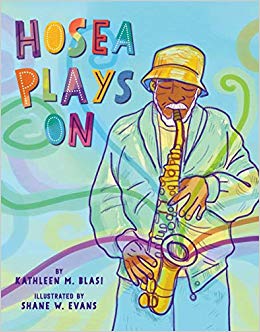
Author Interview: Celebrating Kathy Blasi’s Picture Book Debut, “HOSEA PLAYS ON”


“Fourteen years of writing,
revision, submission,
rejections, more revisions,
setting projects aside and starting new ones.
And boatloads of self-doubt.
But glimmers of hope, too.”

— Kathy Blasi


JP: Kathy, I am so happy to be holding your DEBUT PICTURE BOOK in my hands. You’ve traveled a long, hard road to reach this point. Now here we are: this beautiful book with your name on the cover. How does it feel?

KB: Ahh, to finally get an acceptance after years of stories not quite getting there, through getting close via an agent only to have that relationship end.
Now, with my new book, I have a sense of complete joy in seeing my words brought to life — through an astute editor, Ada Zhang, who championed the piece, a publishing house which embraced it, and through stunning illustration. I feel a sense of accomplishment and validation in not giving up over the course of years of ups and downs. I feel humbled and honored to bring to readers this particular story of a beautiful, everyday person, and I’m thrilled Sterling felt there was a place for it on bookshelves.


Before we get to the book itself, can you give us some background on your writing journey?

My first book, A Name of Honor, was released in 2006 through Mondo, an educational publisher. That was quickly followed by a nonfiction book about sports, also with Mondo. Not-so-fast forward to 2016, with the acceptance of Hosea Plays On, my third published book (though not the third I’ve written), due out in January 2020. Yes, that is 14 years. Fourteen years of writing, revision, submission, rejections, more revisions, setting projects aside and starting new ones. And boatloads of self-doubt. But glimmers of hope, too.


What in particular helped keep you hopeful?

Good rejections! It’s not easy for those outside of this business to grasp the concept of a “good rejection.” Early on, I received “Dear Author” responses to my work. Then, the “Dear Ms. Blasi” variety. Oh, and the ones with my name and pointed feedback. I knew I was getting somewhere. That if this is a continuum, I cannot give up. I could be embarrassed by that span of 14 years. But giving up would have been more embarrassing. I look at that span as a testament to always learning, to building bridges through respecting the business and the process, and above all, not giving up.


Do you participate in a writer’s group?

I have writing colleagues with whom I exchange manuscripts. We critique each other’s work online, via phone, and/or in person. They all make me a better writer. One writing friend, Elizabeth Falk, and I frequently meet at local libraries or at one of our houses. We spend the day plugging away and taking breaks to discuss about what we are working on. There’s something magical about working away and being able to look up and say, “When you have a second, I’d like to bounce something off of you.”


What helped you keep going, when at times it must have felt like you were running into a brick wall?

My writing peeps, absolutely. Brick walls have a way of propagating self-doubt. The external voice of rejection that suggests you’re just not good enough. But the voice of my discerning readers, holding the bar high, urging me on — is louder in the end. And for that, I’m so grateful. Another thing that keeps me going is after the sting of a rejection, over which one has no control, is to send it (or something else) again. The only person who is in control over sending out your work — is you.


What inspired you to write this particular story?

I credit my inspiration to insomnia and the magical hour of 3AM when in an effort to distract myself from the runaway thoughts in my head, I turned to reading the news. I read an article about Hosea Taylor’s passing, and his story tugged at my heartstrings. I had to learn more. I started with the reporter, Sarah Taddeo of the Democrat & Chronicle, who wrote the story, the beginning of a trail of breadcrumbs. When I learned of what Hosea did with the money folks placed in his saxophone case, I knew I had found the heart of a story I wanted to write for young readers.


You have a poet’s eye for detail and lyrical language, all told with directness and economy. “Fingers fluttered. Keys clicked. Smoky notes lifted through the air, treading along to waiting ears.” There’s a musicality to your language. Is that the result of endless revision?

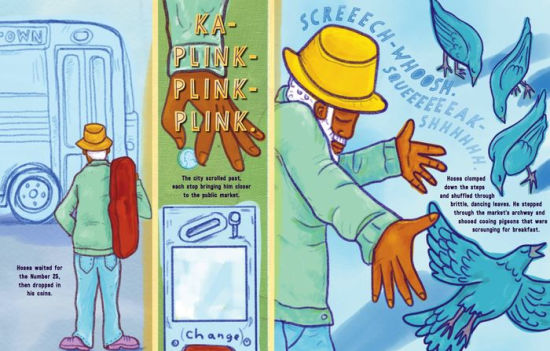
What a lovely thing to say! Once my early draft took shape, part of my revision process was to focus on word choice that could carry a tune, so to speak. To build a cadence for the read-aloud experience. Similarly, I incorporated sound wherever I could, such as coins dropping and the sound of a truck passing over a bridge.

Your illustrator, Shane Evans, did an amazing job bringing Hosea and his music to life. Do you have a favorite spread or moment in the book?

Shane did a beautiful job, indeed. I love the whimsical element he brought to the story. My favorite spread is that of Hosea playing his saxophone in the rain. When I wrote the story, I saw the three words “Hosea played on” standing alone, precipitated by the drum roll of the page turn. I wanted the reader to pause and take that in. With a leap of faith, the author must let the illustrator, editor, and art director do their jobs. Shane nailed it. 

Actually, Kathy, you and I have a funny connection with Shane. Back in the previous century, in 1999, I ghost wrote a book for Shaquille O’Neal, titled Shaq and the Beanstalk and Other Very Tall Tales. It’s actually a pretty entertaining story of six fractured folktales, all featuring Shaq (“Little Red Riding Shaq,” and so on). Shane illustrated the book and his name is included on the cover. My role went uncredited, of course — ghosts are invisible, that’s the agreement — and such is life when you ghost a book for a celebrity. I’ve been quietly rooting for Shane, whom I’ve never met, all these years. 

What an interesting connection! I like to believe that your quiet rooting led us all right here. Here’s another interesting connection. Shane lived in Rochester during his high school years and visited the market where the story takes place.

What’s the best writing advice you ever got?

Two things stand out. First (I will credit Elizabeth Gilbert and Jane Yolen): show up. Talking about writing and wanting to be a writer are not actually writing. Show up to the blank page, or the messy page, because the status of those pages will not change on their own. Work hard, so that eventually that and opportunity will intersect. This often, as is the case with me, requires balancing family life and another career.

Second: Once you are writing, focus on what’s in front of you (Kate Messner). You have no control over how long it takes editors and agents to read your work. You have no control over their decisions on your work. And you have no control over the schedules of others in the process, once you are under contract. Focus on the new piece. Or the one that needs revising. Have multiple projects going at once.


Do you have any advice for aspiring writers?

Begin by writing for you and the story you want to tell. That’s where the bones come from — from your excitement, interest, and passion for the story. That’s what will sustain you.

Surround yourself with those with similar interest and ambition. Join a writers and illustrators group. Join SCBWI and/or one of its regional chapters. There is a treasure trove of information and inspiration waiting for you. Learn all you can. Read all you can. Write. A lot!

Kathleen M. Blasi is active in the children’s literature community. She has long served as an organizer for the Rochester Children’s Book Festival. Readers may visit her online at kmblasi.com and on Twitter @kmblasi.